SK Inc Stock: Why Selling a Prized Wafer Maker Sparked a 19% Pop
On the evening of July 31, I sat with a calculator, trying to make sense of the strangest week SK Inc stock (KRX: 034730) has printed in years. SK Inc is the holding company at the top of Korea’s SK Group, and that day it agreed to sell its 70.61% stake in SK Siltron — the country’s only homegrown silicon wafer maker — to Doosan Corporation for ₩2.3 trillion, roughly $1.56 billion at the ₩1,470-per-dollar rate I use throughout this journal. Gross up that price and the whole company is being valued near $2.2 billion (₩3.3 trillion, my back-calculation). Korean press has long called Siltron a crown jewel that earns around ₩600 billion — about $410 million — a year. And yet the seller’s shares jumped 18.9% the day the deal was signed. Three sessions earlier, they had dropped 13% in a single day.
Sell the jewel, watch your own shares rip higher. That inversion is the puzzle I spent the last week of July working through, and this post is my attempt to write down the answer. My position: I own none of it, and I’m not buying yet — but for reasons that have less to do with the deal and more to do with three filings that haven’t landed.
The 30-second version
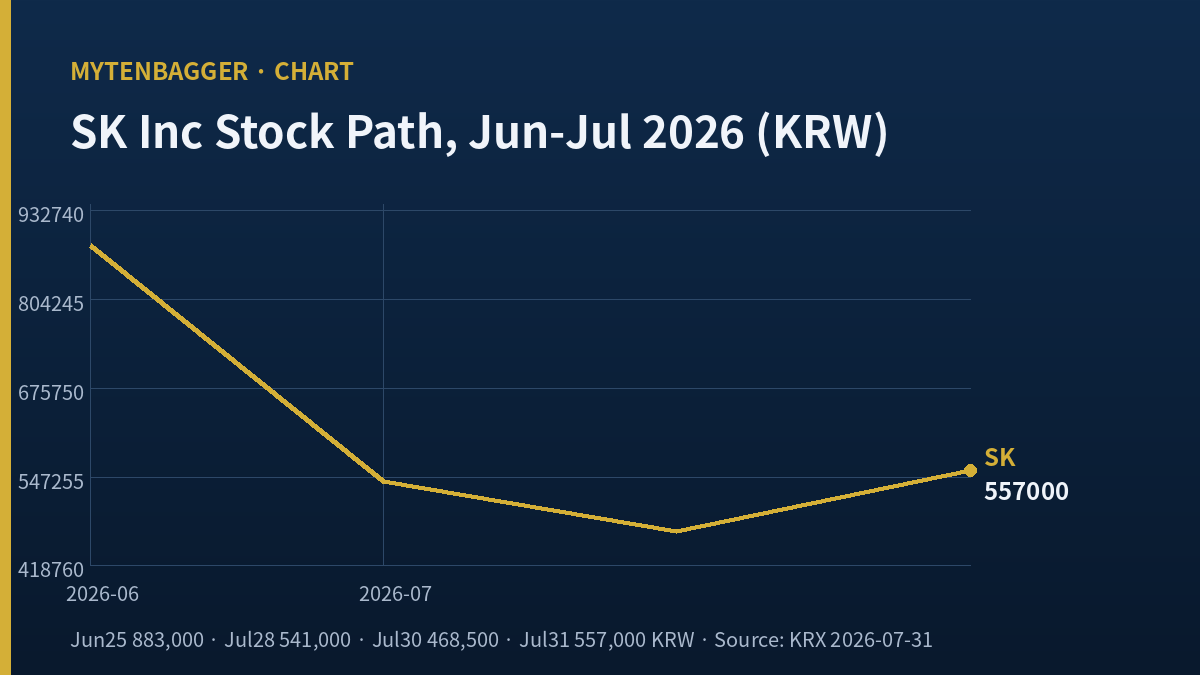
· From an intraday high of ₩883,000 (~$601) on June 25 to ₩468,500 (~$319) on July 30 — a 45.7% drawdown on closing prices (my math) — then +18.9% to ₩557,000 (~$379) on July 31, the day the Siltron sale was signed
· 70.61% of SK Siltron goes to Doosan for $1.56B; SK Inc paid roughly ₩620 billion for a 51% stake back in 2017, per Korean press at the time
· A cancellation of ~20% of all shares (≈$3.3B at the March announcement) is board-approved and pending, while Korea’s new rules now block most subsidiary re-listings
· I’m watching, not buying: consolidated operating margin of 0.9% and ROE of 6.4% (Kiwoom-compiled data) fail my earnings gate. My checkpoint isn’t a price — it’s three specific filings
Contents
SK Inc Stock 101 — The Holdco Atop Korea’s AI Trade
For readers coming from US markets: SK Inc is not SK Hynix, and it is not SK Telecom. It is the listed holding company that sits above the whole SK Group, Korea’s second-largest conglomerate. It trades on the KOSPI, the main board of the Korea Exchange, where single stocks move within a ±30% daily price band and marketwide circuit breakers halt trading in a crash — both of which mattered in July. Its market value at the July 31 close was about $27.5 billion (₩40.4 trillion — 557,000 won times 72.5 million shares, which I re-derived myself rather than trusting a screener), putting it around 18th on the KOSPI leaderboard.
What you actually own through SK Inc stock is a stack of stakes. Per a May 27 report from SK Securities analyst Choi Kwan-soon, the big three look like this:
| Key stake (SK Securities, May 27) | Ownership | Value |
|---|---|---|
| SK Square | 32.1% | ₩50.1T (~$34B) |
| SK Innovation | 52.1% | ₩10.7T (~$7.3B) |
| SK Telecom | 30.6% | ₩6.7T (~$4.6B) |
SK Square, in turn, is the vehicle that holds the group’s roughly 20% of SK Hynix — which is how a staid holding company became a levered play on the most crowded AI memory trade in Asia. When SK Hynix ran, SK Square swelled to the third-largest market cap in Korea (₩137 trillion as of July 31 rankings), and SK Inc stock tripled off its 52-week low of ₩176,900, up 164.6% over twelve months even after July’s damage.
July Put SK Inc Stock Through a Crash, a Verdict, and a Sale
The price path first, from Kiwoom-compiled daily data, because everything else hangs off it. June 25: intraday 52-week high of ₩883,000, close at ₩863,000. Through most of July the stock bled lower with the group’s AI complex. Then July 28: the KOSPI fell 10.84% in a single session — a genuine circuit-breaker day driven by a memory-sector shock — and SK Inc fell 13.0% from ₩622,000 to ₩541,000 (my calculation). July 29 printed an intraday low of ₩450,000. July 30 closed at ₩468,500, down 45.7% from the June 25 close. A holding company that rode Hynix up learned, in three sessions, that it falls harder than the index it rode.
Why harder? My mental model: a holdco trading at a deep NAV discount behaves like a levered claim on its own portfolio. In calm markets the discount is a sleepy constant; in a panic it widens at the exact moment the underlying stakes are falling, so the holder eats both moves at once. Nothing about July contradicted that model — the stock fell more than two percentage points beyond the index on the circuit-breaker day (−13.0% against −10.84%), and the bounce, when it came, needed a company-specific catalyst on top of the market’s recovery to reach 18.9%.
Two other things happened that same week, and I don’t think you can read the chart without them. On July 24, a Seoul appellate court, on remand, ordered group chairman Chey Tae-won to pay his ex-wife ₩944 billion — about $642 million — in the largest property division in Korean legal history, down from the ₩1.38 trillion an earlier ruling had set (Fortune and Seoul Economic Daily both covered it in English). And on July 31, the Siltron sale was signed and disclosed. The stock’s +18.9% close that day — ₩468,500 to ₩557,000, my math — landed on top of a broad market rebound, so I’m careful not to credit the deal alone. But the deal is what changed the company.
The Siltron Deal — $1.56 Billion for a Prized Wafer Maker
The mechanics, per the Korea Herald and Korea JoongAng Daily: SK Inc sells 47,322,350 shares of SK Siltron — 70.61%, combining its directly held 34.18 million shares with 13.14 million it will collect by exercising call options under a total return swap — to Doosan for ₩2.3 trillion, with boards on both sides approving on July 31. Doosan had been named preferred bidder back on December 17, per DigiTimes, so this was seven and a half months in the making. Seoul Economic Daily’s English edition called it Doosan’s first megadeal since Bobcat, the finishing piece of a chip chain that already includes test house Doosan Tesna. KED Global has reported Doosan ultimately wants 100% — which matters, because the 29.39% of Siltron not in this deal belongs personally to chairman Chey, and it’s the subject of separate talks.
Context for the price: SK bought control of this company — then LG Siltron, 51% — for about ₩620 billion in 2017, per Korean press at the time. Nine years later the same 51% slice, at deal terms, is worth nearly three times that (my conversion). Siltron is one of a handful of firms globally that can make leading-edge 300mm wafers at scale; the others — Shin-Etsu and SUMCO in Japan, GlobalWafers in Taiwan, Siltronic in Germany — are the whole club. I deliberately won’t quote peer multiples here because I haven’t verified them as of this writing; the qualitative point stands on its own. Wafer capacity is scarce, AI demand is pulling on it, and SK just sold its seat at that table.
One more layer US readers should register: the Korea JoongAng Daily headline called Siltron Korea’s sole wafer maker. This isn’t just a portfolio line item changing hands — it’s the only domestic supplier of the substrate under Samsung’s and SK Hynix’s entire chip complex moving from one conglomerate to another. That’s why the deal cleared boards on both sides as a strategic event, why Korean industrial dailies covered the negotiation for seven months straight, and why I treat the disclosed closing conditions — merger clearance included — as a real checkpoint rather than a formality.

The NAV Math Under SK Inc Stock — $65B of Stakes, a 50% Discount
Holding companies in Korea trade on net asset value and, more importantly, on the discount the market slaps on it. SK Securities’ Choi put SK Inc’s NAV at ₩95.9 trillion (~$65 billion) in late May, against a market cap that implied a 50.4% discount. Two named analysts have published constructive numbers since spring: Choi with a buy rating and an ₩800,000 price objective, and Heungkuk Securities’ Park Jong-ryeol, who on June 24 raised his objective from ₩760,000 to ₩1,000,000 and called 2026 the group’s “first real turnaround year,” penciling in ₩131.1 trillion of revenue (+7%) and ₩18.1 trillion of operating profit (+1,295% — not a typo) for the year. Both objectives sit far above the ₩557,000 close. I take neither at face value, because both stand on the same rubber band — an assumed narrowing of the NAV discount — and on two premises Park himself names: a semiconductor boom and inventory gains from higher oil.
The turnaround inputs are real but concentrated in the subsidiaries. SK Innovation swung to a ₩2.1 trillion first-quarter operating profit (Korean-language E2 News, my translation). SK Ecoplant — the construction arm rebuilt around AI infrastructure and the Essencore memory-module business — printed ₩931.4 billion of Q1 operating profit, up 1,262% year over year, per Korean-language Newsis. And on July 24 in San Francisco, the group announced a sweeping AI-infrastructure partnership with Nvidia at the Korea AI summit. The NAV numerator has been inflating all year. The question was always the discount — and that’s where the second half of this story lives.
A $3.3B Share Burn, New Listing Rules, and a $642M Verdict
Rewind to March 10. SK Inc’s board approved cancelling 14.69 million treasury shares — everything it holds except an employee-compensation reserve, about 20% of all shares outstanding, worth roughly ₩4.8 trillion (~$3.3B) at the announcement-day close. Korean tech outlet ZDNet Korea framed it as the largest cancellation ever by a Korean holding company, a direct response to Korea’s Commercial Act amendments pushing companies to retire treasury stock. The balance sheet made room for this: net borrowings fell from ₩10.5 trillion at end-2024 to ₩8.4 trillion by Q3 2025, per the same reporting. Heungkuk’s model has the cancellation completing by 2027 — board-approved, not yet burned.
The dividend tells the same story in smaller print. Regulatory-filing data compiled through DART, Korea’s disclosure system, shows the per-share payout climbing from ₩5,000 for fiscal 2023 to ₩7,000 for 2024 and ₩8,000 for 2025 — back-to-back raises, with a 14% bump in the latest step. At the July 31 close that’s about a 1.4% yield (my calculation), which won’t excite an income investor on its own; what interests me is the direction and the pairing. A rising dividend plus a pending 20% share burn is a very different capital-allocation signature than the one Korean holdcos are famous for, which is hoarding treasury shares as a control device and calling it policy.
Now add the regulatory turn. In early July, Korea’s Financial Services Commission and the exchange rolled out rules that block “duplicate listings” — parents floating subsidiaries — unless minority shareholders of the parent are protected. That’s aimed squarely at the playbook SK Inc itself used when it floated SK Biopharmaceuticals in 2020 and took listing-conditioned pre-IPO money into SK Pharmteco. In June, SK Ecoplant closed the book on its own IPO promise by buying back its pre-IPO investors’ convertible preferred and returning about ₩1.05 trillion in total (Korean-language Newspim, my translation). Put the three moves side by side — sell Siltron for cash, refund the IPO investors, burn a fifth of your own shares — and I see a holding company changing its operating system: from growing by listing subsidiaries to shrinking its own share count with asset sales. In my view that is the only credible path by which a 50% NAV discount actually narrows.
The verdict fits the same frame. The market’s long-standing fear was that Chey would have to dump SK Inc shares to fund his divorce bill. The bill just shrank from ₩1.38 trillion to ₩944 billion, and Chey’s personal 29.39% of Siltron — the stake Doosan is negotiating for separately — would be worth around ₩960 billion at this deal’s valuation (my back-calculation; the actual price is whatever the talks produce). Those two numbers nearly overlap. A path exists, on paper, to settle the largest divorce judgment in Korean history without touching a single SK Inc share. I think some of the +18.9% was the market doing exactly that arithmetic.
The Bear Case on SK Inc Stock — Selling Crown Jewels Into a Boom
Four arguments against, and I’ve tried to state them at full strength.
First, the timing critique. Korean dailies spent July asking why anyone would sell a wafer maker at the front edge of an AI supercycle — Kookmin Ilbo ran the negotiation as “Siltron’s price climbing on the semiconductor boom,” and Money Today reported in early June that the group had briefly slammed the brakes on the sale altogether. Gross the deal up and Doosan is paying something like five to six times Siltron’s reported annual earnings (my ratio, from the press-reported ₩600 billion figure). If that’s cheap, the discount went to Doosan’s shareholders, not SK’s.
Second, the cancellation cuts two ways. Retire 20% of the shares and the controlling family’s stake mechanically rises — Korean outlet Newsspace put the move from 25.43% toward the 33% range. Shareholder return and dynastic consolidation in a single board resolution. I don’t think that invalidates the signal, but it does discount it.
Third, the earnings floor is genuinely thin. On consolidated Kiwoom-compiled numbers as of July 31: operating margin 0.9%, ROE 6.4%, trailing P/E 25.5, and negative free cash flow. Holdco consolidation makes those figures noisy, but noisy is not the same as good. Even Ecoplant’s blowout quarter drew a Korean-press rebuttal that the parent alone, stripped of subsidiaries, ran at a net loss. The ₩18.1 trillion operating-profit year exists so far only in a spreadsheet in Yeouido.
Fourth, the discount has gravity. A 50% holdco discount is close to the resting state of this market — Japan’s trading houses needed a decade of governance reform and a famous foreign buyer before their discounts narrowed, and Korea’s version has survived every value-up campaign thrown at it so far, from index-inclusion carrots to disclosure sticks. Both analyst objectives assume the band narrows. If it doesn’t, the upside math quietly deflates — and the stock stays what it has been for years: a cheap thing that stays cheap.
Why I’m Watching SK Inc Stock, Not Buying — and What Flips Me
My process runs an earnings gate on anything inside Korea’s top 100 by market cap, and SK Inc fails it today — 0.9% operating margin and 6.4% ROE don’t clear the bar in any sector framing I use, and 25.5 times trailing earnings is not a forgiving multiple for a holdco. I also don’t step into names printing −13% and +19% sessions in the same week; that’s a volatility regime where my entry discipline has no edge. So I hold nothing and I add nothing, and everything below is observation, not action.
On the moat question I force myself to be specific: Siltron owned a real technology-and-cost moat in wafers, and SK just converted that moat into cash. What remains at SK Inc is a moat of control — stakes protected by holdco regulation — whose value swings daily with Hynix and oil. I don’t call that a durable advantage; I call it a levered index with a discount attached.
And yet I want to be honest about my interest, anchored to the filings rather than my feelings. A Korean holdco that sells assets to pay down debt and torch a fifth of its share count is rare enough that I refuse to look away. So instead of a price level — useless in a ±19% band — my checkpoint is three documents in the disclosure queue. One: deal closing. Merger clearance and final payment turn ₩2.3 trillion from a headline into balance-sheet cash, and I’ll read where it goes — against the ₩8.4 trillion of net borrowings, or into some new “future growth” line. Debt paydown keeps my thesis alive; a shiny acquisition kills my interest. Two: the burn itself. The 14.69 million shares are approved but still on the books; Heungkuk models 2027, and any acceleration is signal. Three: Ecoplant’s next sentence. If it refiles for listing under the new rules with real minority protections, fine; if the old carve-out playbook reappears, my whole reframing of this company is wrong and I’ll say so. SK Inc. now sits on the buying side of one of those deals itself: on July 1, 2026 it signed an investment agreement with KKR for a combined Korean renewable energy platform, KKR at 51 percent and SK Inc. at 49, and I wrote separately about the ₩23,700 per share KKR actually paid for control of SK Eternix.
Each filing that lands the way I’ve described erases one of my reasons for standing aside. If all three land, I still don’t buy on momentum — I go back and re-run the earnings gate on the consolidated second-quarter numbers, which typically arrive in August, and let that decide whether the turnaround is arithmetic or still aspiration. And there’s a branch that ends the whole watch: if the Siltron proceeds get routed into a new acquisition instead of the balance sheet, I close this notebook and move on, because at that point the capital-allocation turn I think I’m seeing would be a story I told myself.
Either way you’re wearing won-dollar risk on top of the equity, in both directions — and the ±30% daily band means position sizing has to respect single-day moves US large caps simply don’t make.
July compressed a crash, a record verdict, and a signature asset sale into five trading days — the densest week I’ve seen from a Korean holding company in years. I’m grading what happens next on filings, not on price. The first grade comes the day the Siltron closing hits the disclosure feed.
Sources: The Korea Herald — SK sells control of SK Siltron for ₩2.3tr · Korea JoongAng Daily — SK Inc to sell SK Siltron · Seoul Economic Daily — Doosan’s first megadeal since Bobcat · Seoul Economic Daily — ₩944B property division ruling · Fortune — Korea’s divorce of the century · The Korea Times — Siltron sale to benefit both sides · KED Global — Doosan aims for 100% of Siltron · DigiTimes — Doosan named preferred partner · Korean-language sources cited in the body — Asia Economy (deal structure), ZDNet Korea (share cancellation), Newspim (Ecoplant investor refund) — are my translations.
Related reading