CS Wind Stock: Accumulating the World’s #1 Into an OBBBA Cliff
- I’m accumulating CS Wind stock (112610 on the KOSPI, South Korea’s main exchange) in the low-₩40,000s, roughly $28. It’s the world’s #1 wind tower maker, down about 45% from its 52-week high, and Korean brokerages carry an average 12-month target near ₩73,000 (about $48) — more than 1.5x the recent price.
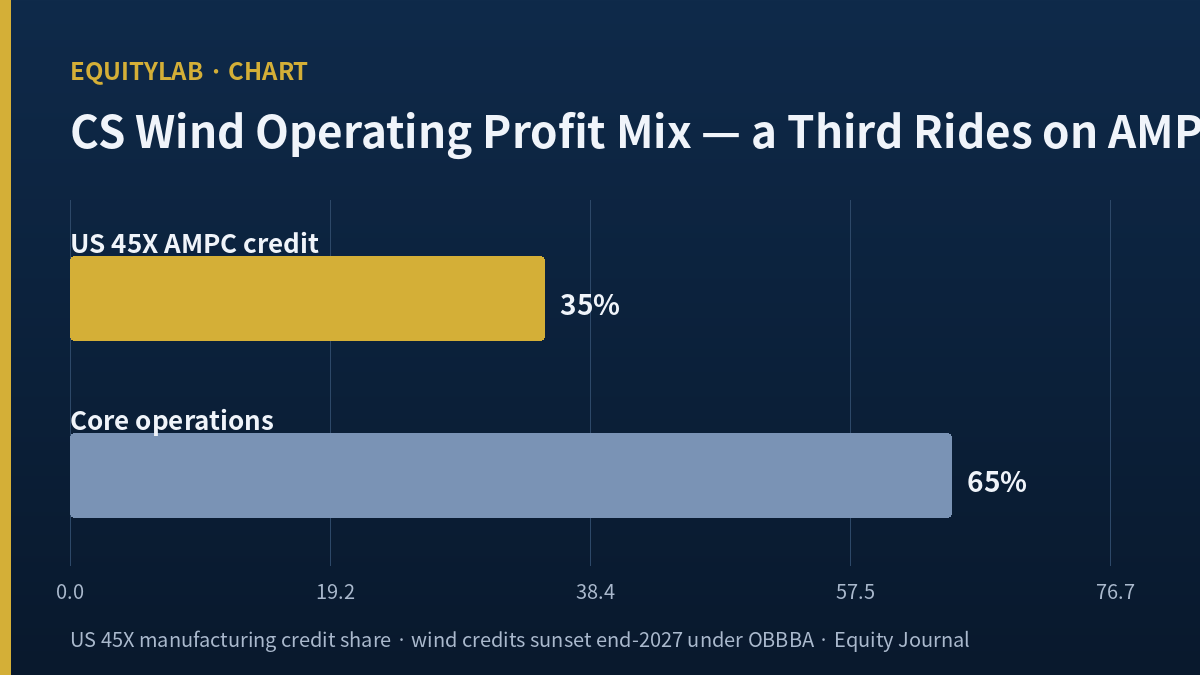
- The catch: roughly a third of this company’s operating profit comes from a US manufacturing tax credit (Section 45X, the “AMPC”). The One Big Beautiful Bill Act (OBBBA), enacted July 4, 2025, has already legislated that credit to disappear for wind components sold after 2027. Buying CS Wind stock is less a bet on wind than a bet on US policy direction.
- So I don’t buy it all at once — I accumulate. The staggered entry is my position-sizing answer to a cliff that is dated but certain. The checkpoints I watch: the July 4, 2026 demand-side deadline that just passed, the November US midterms, and the Q2 margin print.
I’ll be honest: CS Wind stock is a name my cursor hovered over more than once before I committed. The gap between “world number one” and a share price cut nearly in half is so wide that I kept flipping between “this is cheap” and “this is a trap.” Every time I ran the numbers, the answer landed somewhere between the two. In the end my answer wasn’t a direction — it was a method. When my conviction is split down the middle, I split the position too. This is the record of why I’m accumulating, and of exactly what would break the thesis.
One honest framing note before I start. If you follow Korean markets, you’ve heard about the government’s giant semiconductor-and-AI buildout. CS Wind has almost nothing to do with it. This company’s revenue comes from the United States and Europe, not from Korean policy. The real tailwind under wind is the global data-center power crunch — a worldwide story — not a domestic Korean one. I want that boundary clear from the first paragraph.
Contents
What CS Wind stock actually owns — the world’s #1, and where it’s built
It makes the tower, and increasingly the foundation under it
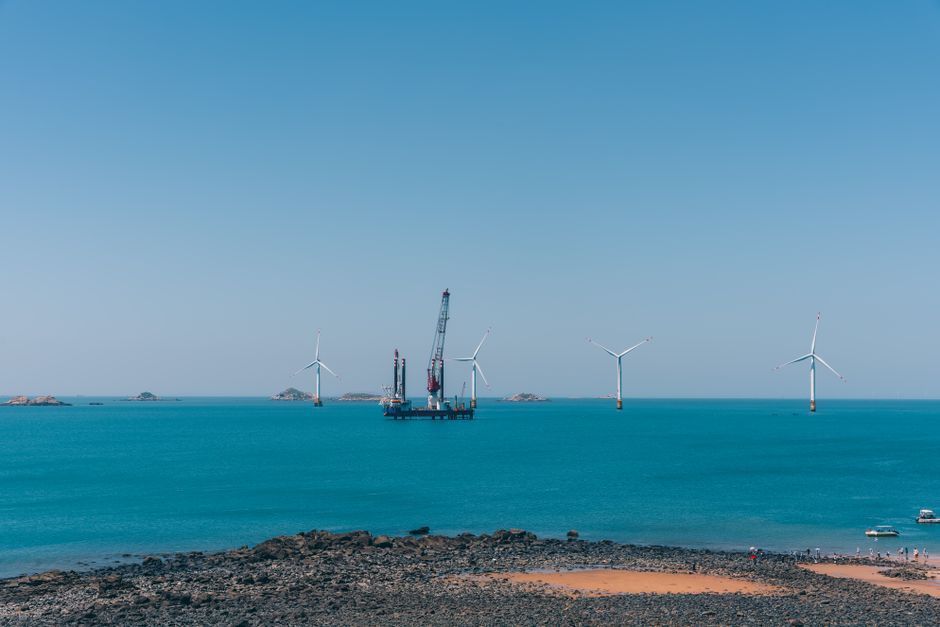
CS Wind was founded in 2006 and listed on the KOSPI in 2014. It is the world’s largest maker of wind turbine towers — the massive steel columns that hold turbines aloft — and it has expanded downward into offshore wind foundations (monopiles), handled by its Danish subsidiary Bladt and by CS Offshore.
The company’s real weapon is the location of its plants. In Pueblo, Colorado, CS Wind runs what it describes as the world’s largest wind tower factory, and it has a plant in the United Kingdom as well. Wind towers are several meters in diameter and weigh hundreds of tons, so freight is brutal; whoever owns a factory inside the demand region wins on logistics alone. By planting large facilities directly in the US and Europe, CS Wind turned that shipping barrier into a moat. But the moat comes with an expensive condition: a US factory is only a moat while the US wants wind — and right now, US policy is deciding whether to push wind or throttle it.
It helps to narrow the company’s position one more notch. CS Wind doesn’t sell turbines; it supplies the towers and foundations that every turbine needs, to the turbine makers and developers above it. Its customers include Vestas — the Danish company that is the largest wind turbine manufacturer in the world — and Ørsted, one of the biggest offshore wind developers. That matters because it means CS Wind is not a bet on any single turbine brand. Whether Vestas or America’s GE Vernova wins a given order, the tower underneath still has to be built by someone, and the world’s #1 tower maker takes a large slice of that bottleneck. I like owning the chokepoint rather than picking the winner. The only problem is that the “amount of wind getting built” is exactly what US politics is now squeezing.
CS Wind stock by the numbers — cheap, with a leash
| Item | Value | Note |
|---|---|---|
| Recent price (mid-June) | ~₩43,700 (~$28) | Down from ~₩65,000 in March; very volatile |
| Market cap | ~₩1.7T (~$1.1B) | 52-week ₩38,900–79,400; ~-45% off the high |
| Brokerage avg. target | ~₩73,000 (~$48) | 6 analysts, all Buy; ~1.6x recent price |
| Q1 2026 operating profit | ~₩74.3B (~$48M) | -40.7% YoY (tough base; met consensus) |
| Americas revenue share | 64% → 56% | 2024 → 2025 (policy-driven shrinkage) |
Sources: exchange quote (mid-June, Investing.com) and brokerage consensus; Q1 figures via Korean outlet Ferro Times; Americas share via Korean outlet Sisa Journal. USD conversions approximate at ~₩1,535/$. Drawdown is simple arithmetic off the 52-week high.
Read only the top three rows and CS Wind stock is plainly cheap. A world number-one supplier is down 45% from its high, the six brokerages that cover it are unanimously positive, and the average target sits about 1.6x the recent price. Yujin Investment & Securities has argued the stock is excessively undervalued relative to global peers. On valuation alone, there’s reason to be buying.
The trouble starts at row four. Q1 2026 operating profit fell about 41% year over year — a tough comparison against a quarter where tower results had been pulled forward, and it did meet market expectations, but it’s a decline. And the Americas share of revenue slid from 64% in 2024 to 56% in 2025 as the US wind market cooled under the new administration. The heart of the world’s #1 sits in America, and America is wobbling.
There’s a more encouraging balance buried in the recent results, though. Per Korean reporting, in Q4 2025 CS Wind’s consolidated operating profit rose roughly 106% year over year and beat consensus — but the driver wasn’t towers, it was offshore-wind foundations from its Danish arm, Bladt. In that same quarter the tower segment’s operating margin was a weak 2.1%, dragged by anti-dumping-related tax at the Malaysian unit and by lower credit recognition as US revenue slipped. In other words, while US towers were being squeezed by policy, European offshore foundations carried the quarter. That cross-segment offset matters to me: it’s evidence CS Wind isn’t a one-legged bet on America, but a company building a second leg in European offshore.
A balance sheet is also where I start on the other listed Korean wind name. Unison carries its debt differently from the European turbine makers it gets compared to, and I laid that comparison out in my entry on Unison carrying less leverage than Vestas or Nordex.
The real pressure point: a third of profit is a US tax credit
Here’s the whole thesis in one sentence: roughly a third of CS Wind’s operating profit comes from a credit written into the US tax code. The Colorado plant qualifies for the Advanced Manufacturing Production Credit (Section 45X, known in Korea as the “AMPC”), which pays a few cents per watt on domestically produced wind components. Korean outlet Business Post reported that CS Wind collected about ₩95.1 billion (~$62 million) in AMPC in 2024 — about 37% of that year’s operating profit — and roughly ₩40.6 billion in Q1 2025, about 32% of operating profit. This company’s income statement is, quite literally, a function of US tax law.
And that law has already changed. Under the One Big Beautiful Bill Act, enacted July 4, 2025, most 45X components keep their 2030 phase-down — but wind energy components are singled out, losing the credit for sales after 2027. On top of that, OBBBA’s “prohibited foreign entity” (FEOC) rules can strip eligibility earlier if a component uses too much material from Chinese and other flagged sources, with the material-assistance framework phasing in from 2026. So the wind AMPC that underpins a third of CS Wind’s profit already carries a legislated expiry: end of 2027. This is why I treat CS Wind stock as a policy bet wearing a wind costume.
Let me be fair about the discount. If I claimed the 45% haircut is pure market overreaction, I’d be lying to myself. When a third of your operating profit rests on a subsidy with a legislated 2027 sunset, a market that discounts you for it isn’t being lazy — it’s doing arithmetic. What I’m buying isn’t “the discount is too big” in the abstract; it’s the judgment that the discount is bigger than the actual hit. For the roughly 18 months until the sunset, CS Wind still collects the credit while running its US plants at full tilt, and the core value — the world’s #1 logistics moat plus European offshore — survives past 2027. Add the possibility that November’s midterms shift the politics enough to soften the timeline, and you have an asymmetry. That asymmetry is the case for accumulating.
The part US readers will feel in their bones: CS Wind sits on both OBBBA cliffs
This is where a US audience has an edge over most Korean retail investors, because OBBBA is your law. CS Wind stock is exposed to two OBBBA wind cliffs at once, and they work on different sides of the business.
The first is the supply side I just covered: the 45X manufacturing credit CS Wind’s Colorado plant collects, gone for wind after 2027. The second is the demand side. Under OBBBA, US wind (and solar) projects claiming the Section 45Y production credit or the Section 48E investment credit must either begin construction by July 4, 2026, or be placed in service by the end of 2027 to qualify. Those are the projects that order CS Wind’s towers. So the health of CS Wind’s US demand is chained to the same statute that governs its own credit.
And here’s the sharp, time-stamped part — I’m writing this in the first week of July 2026, days after that begin-construction deadline passed. Projects that established “beginning of construction” by July 4, 2026 are grandfathered out of the 2027 placed-in-service cliff; projects that didn’t now face that hard 2027 wall. That structure creates a textbook pull-forward: developers racing to start construction before the deadline to lock in eligibility, which should mean near-term order strength for tower makers like CS Wind — followed by a potential air pocket in US demand once the grandfathered pipeline is built out. To make the last mile messier, a federal court on June 6, 2026 vacated the IRS guidance (Notice 2025-42) that had narrowed how developers prove “beginning of construction,” restoring the older 5% safe harbor weeks before the deadline — adding a burst of last-minute uncertainty right at the finish line.
The takeaway I hold onto: the near-term US order book may actually look good because of the rush, and I shouldn’t mistake that strength for a durable trend. The durable question is what US wind demand looks like on the other side of the grandfathered wave, layered on top of CS Wind’s own credit ending in 2027. A comprehensive map of these overlapping deadlines — 45X, 45Y, 48E, and the FEOC material-assistance rules — is laid out in Novogradac’s compliance-timeline breakdown and in Sidley’s OBBBA energy overview, both worth reading if you want the statutory detail behind this stock.
How the market handles CS Wind stock — hot-and-cold, and a hesitating whale
Two observations I think are differentiated.
First, the market recently cheered a “policy risk gone” moment, and I don’t read it that way. When the administration dropped its appeal of a court ruling that had blocked its wind-permitting pause, CS Wind spiked to its daily limit. But as Korean outlet Sisa Journal framed it, dropping that appeal eased one specific piece of regulatory uncertainty without changing the administration’s underlying energy stance. In practice the government has kept squeezing offshore wind even after that — including paying developers to hand back leases. So the appeal withdrawal wasn’t an ending; it was one point on a hot-and-cold cycle. Anyone buying this stock is buying the oscillation, not relief from it.
Second, there’s a hesitation signal in the ownership data. According to Korean reporting, the National Pension Service — Korea’s largest institutional investor — raised its CS Wind stake from 8.96% to 10.47% in April 2026, then trimmed it back below 10% (to 9.92%) within a month as the stock fell some 35%. Even the biggest domestic whale bought and sold around this name rather than committing. I don’t read that only as a negative. A spot where the whale hesitates, where volatility runs high, is exactly the kind of entry zone that favors someone accumulating in pieces rather than betting all at once.
CS Wind stock scenarios — the three branches I weigh
US full-utilization plus European offshore lift profit (probability 45%)
The credit doesn’t vanish before 2027, and the US plant runs at full utilization through 2026. Korean outlet Ferro Times reported that Kiwoom Securities analyst Cho Jae-won expects North-America-led earnings improvement across 2026–2027; separately, brokerage tallies put Q4 2025 tower new orders at about $620 million, roughly double the prior quarter and about 60% US. Meritz has argued US-plant full utilization makes 2026 margin improvement clear through operating leverage, and Samsung Securities looks for double-digit tower revenue growth in 2026. On top of that, Ferro Times reported Kiwoom sees a good chance CS Wind lands a European offshore-wind foundation (TP) order within Q3 2026, with UK auction rounds (AR7/AR8) widening the opportunity from 2027. Even while US onshore wind is pinched by policy, a separate European offshore pipe keeps turning — which is why, in this branch, US risk can’t fully break the numbers. This is the path I weight most.
The discount unwinds toward the targets (probability 30%)
Policy uncertainty clears, and data-center power demand pulls US electricity needs — including some renewable buildout — higher. The same AI-driven power crunch I wrote about from the grid-and-transformer angle in my Hyosung Heavy Industries journal flows partly into new generation, and wind is part of that mix. The six-brokerage average target near ₩73,000 (~$48) sits more than 1.6x the recent price. If a world-number-one franchise with an intact logistics moat has been halved on policy fear alone, that gap can close quickly once the fear lifts. This is the upside reward for accumulating.
The credit expires and US demand freezes (probability 25%)
The downside is clean. The legislated end-2027 wind-45X sunset arrives, European and other diversification fails to fill the gap in time, and the administration’s anti-wind posture freezes new US orders after the grandfathered pipeline runs dry. If OBBBA’s FEOC supply-chain rules bite CS Wind’s sourcing, part of the credit could erode even before 2027. In that world the third of profit propped up by the credit disappears, and the Americas-share slide (64%→56%) deepens. Layer on the departure of Vice Chairman Hansen — a Vestas veteran who ran CS Wind’s global sales — who stepped back to an advisory role this year, and you get a policy cliff and weakening commercial muscle arriving together. This is the biggest threat to my accumulation thesis, and it’s precisely why I don’t buy it all in one shot.

CS Wind stock — the conditions that break my accumulation thesis
Three breakpoints, written in the order they’ll be answered. The first is whether CS Wind can harvest the credit at full US utilization right up to the end-2027 sunset while staying inside OBBBA’s FEOC material-assistance requirements — because if its supply chain trips those rules early and eligibility wobbles before 2027, then the valuation gap wasn’t cheap, it was a fair discount, and I stop adding and re-run the thesis from scratch. The second is the November US midterms: they’ll shape the direction of renewable policy and decide whether there’s any chance the 2027 timeline gets softened, and Samsung Securities has warned to expect elevated volatility into that vote — volatility that, for someone accumulating, is both risk and opportunity. The third is the Q2 print due in August: management and the brokerages have promised a margin recovery from Q2 as US production scales and productivity improves, and if that doesn’t show up in the actual numbers, I have to cut the 45% probability I’ve assigned to the rebound branch. If all three break the same way, my job is to move from accumulating to trimming.
So why do I buy it in pieces instead of all at once?
Here’s the whole thing. CS Wind is the world’s #1 wind tower maker, with a logistics moat and on-the-ground US and European plants, and it’s deeply cheap against the analyst targets. At the same time, a third of its operating profit rides on a US credit with a legislated 2027 sunset, and the policy runs hot and cold. Both of those are true. When conviction is split down the middle, the question stops being “buy or don’t” and becomes “how do I buy.” Rather than betting a time-stamped profit stream all at once, I chose to split it — accumulating across the harvest years and the core value that outlasts them. Accumulation isn’t an expression of certainty; it’s position-sizing against uncertainty. That’s the honest seat I found in this name. Whether the seat was right will be graded, in order, by the 45X harvest through 2027, the November vote, and the August print. A chance to buy the world’s number one near half price doesn’t come often — but I also know that a half price always has a reason behind it. I keep the scorecard in this journal, and I add to it as the answers come in.
Related reading