Hanmi Semiconductor: The 71% TC Bonder Monopoly Starts to Crack
My read, up front
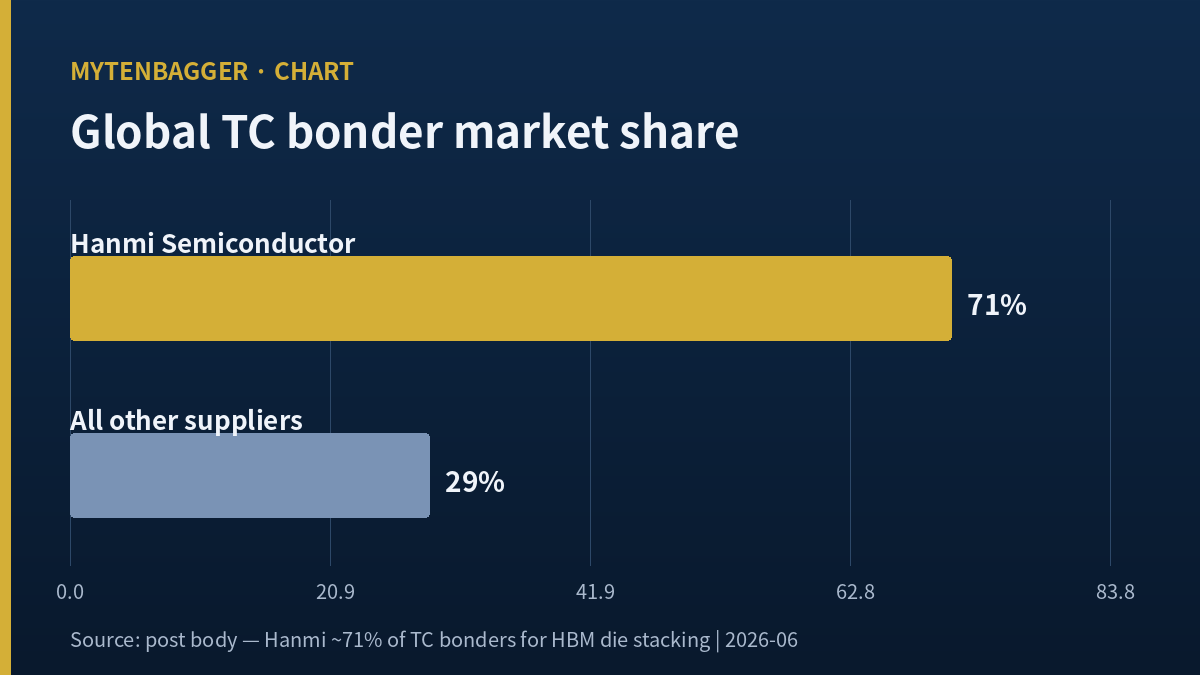
Hanmi Semiconductor (KOSPI: 042700) makes the thermal-compression (TC) bonder that stacks the DRAM dies inside high-bandwidth memory, and it holds roughly 71% of that market globally. Yet it just reported a Q1 2026 where revenue fell about 65% year over year. The headline reason is a temporary order gap during the HBM4 transition. What I keep coming back to is something else: SK Hynix has gone from buying TC bonders only from Hanmi to splitting orders across three suppliers, and the word “monopoly” is starting to fray at the edges. I have not bought this stock. I want to see the August 19 second-quarter print and how the next order wave gets divided before I decide whether to start a position.
Contents
How I walked down from SK Hynix to Hanmi Semiconductor
In an earlier journal entry I wrote about why I passed on SK Hynix even as it became Korea’s most valuable company. The reason was simple: not that the business was bad, but that the price was more than I wanted to pay. When I skip the headline name, my habit is to follow the money down the value chain. The capital flooding into the HBM super-cycle does not stop at the memory maker. It flows into the tools and materials that build the memory, and the very first stop on that road is the TC bonder. Say “TC bonder” in Korea and you are saying Hanmi Semiconductor.
I will be honest: when I first started reading on this name, I felt relaxed about it. A 71% share looks like a moat, and a moat is supposed to give you a margin of safety through the cycle. Then I put the Q1 numbers next to SK Hynix’s ordering pattern, and my comfort drained out. The word “monopoly” turned out to be softer than I assumed. This entry is the record of that shift.
One note for readers outside Korea: Hanmi trades on the KOSPI, the main board of the Korea Exchange, and there is no US listing or ADR. If you track the HBM packaging chain through ASMPT or BESI, or hold Korea through an ETF, this is the upstream name those flows touch. All won figures below are converted at roughly 1,540 won to the dollar, the late-June 2026 rate.
Why I keep Hanmi Semiconductor on my watchlist anyway
Before the bad news, let me say why I did not just delete this name after the earnings miss. A company I would throw away on one weak quarter is a company I would never have opened in the first place.
First, the TC bonder is the narrowest bottleneck in the HBM stack. HBM is built by stacking DRAM dies vertically, and the TC bonder presses those layers together with heat and pressure. As stacks climb from 12-high to 16-high, the placement precision the tool needs rises sharply. The narrower the bottleneck, the more pricing power the company that owns it has. Hanmi says in its own materials that it shipped the first HBM-grade TC bonder to a customer back in 2017 and effectively set the standard for the segment.
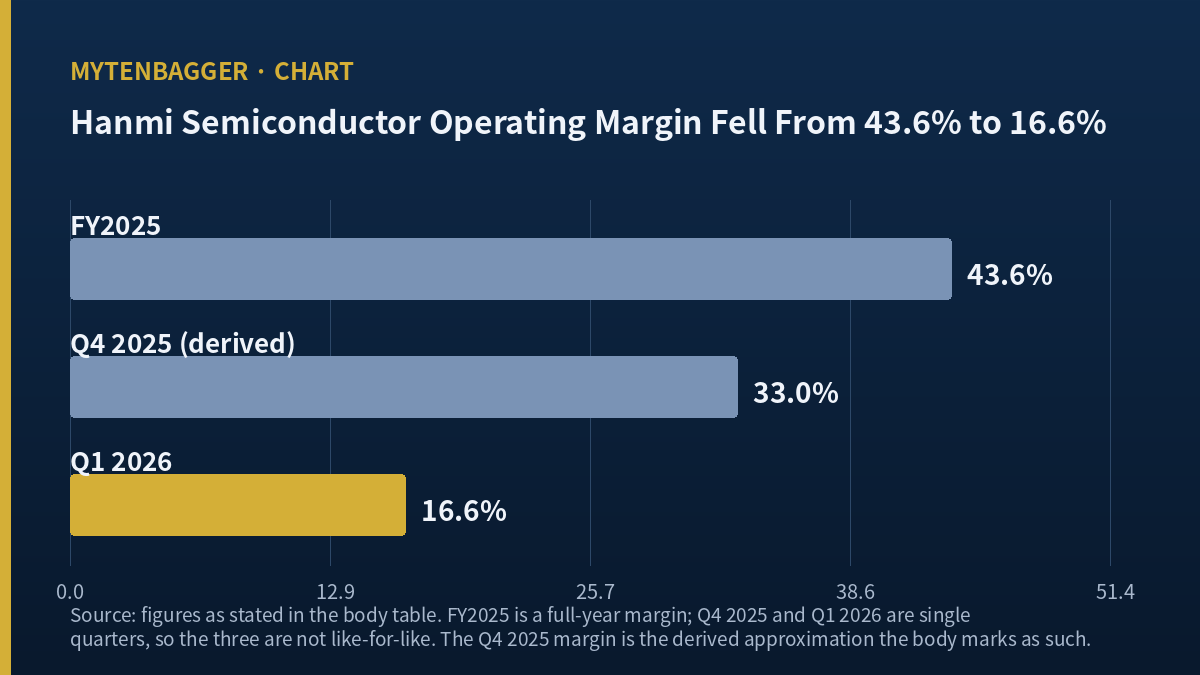
Second, the margins are not normal for an equipment maker. For full-year 2025 the company reported an operating margin of 43.6% on revenue of 576.7 billion won (about $375 million) and operating profit of 251.4 billion won (about $163 million). A 40%-plus margin on hardware is rare, and it comes from vertical in-house manufacturing and owned core technology. That margin structure is itself a barrier, because a latecomer cannot easily undercut it on price.
Third, the roadmap has a hedge built in. The company launched its HBM4-generation “TC Bonder 4” in 2025 and says it will release a “Wide TC Bonder” for HBM5 and HBM6 in the second half of 2026. The pitch is that while hybrid bonding, the technology the industry sees as the eventual successor, keeps slipping, the Wide TC bonder fills that gap. Demand backs the story up: Micron raised its 2026 capital-spending plan from $18 billion to $20 billion on its December 2025 earnings call, and it named Hanmi a Top Supplier in 2024.
I know it is a good company. That is exactly why the price and the share question matter more, not less.
Hanmi Semiconductor by the numbers: the earnings shock
With the bull points on the table, here is the actual damage. Every figure below is cross-checked against the company’s own disclosures and trade-press reporting.
| Period | Revenue | Operating profit | Op. margin |
|---|---|---|---|
| FY2025 | 576.7B KRW (+3.2%) | 251.4B KRW (-1.6%) | 43.6% |
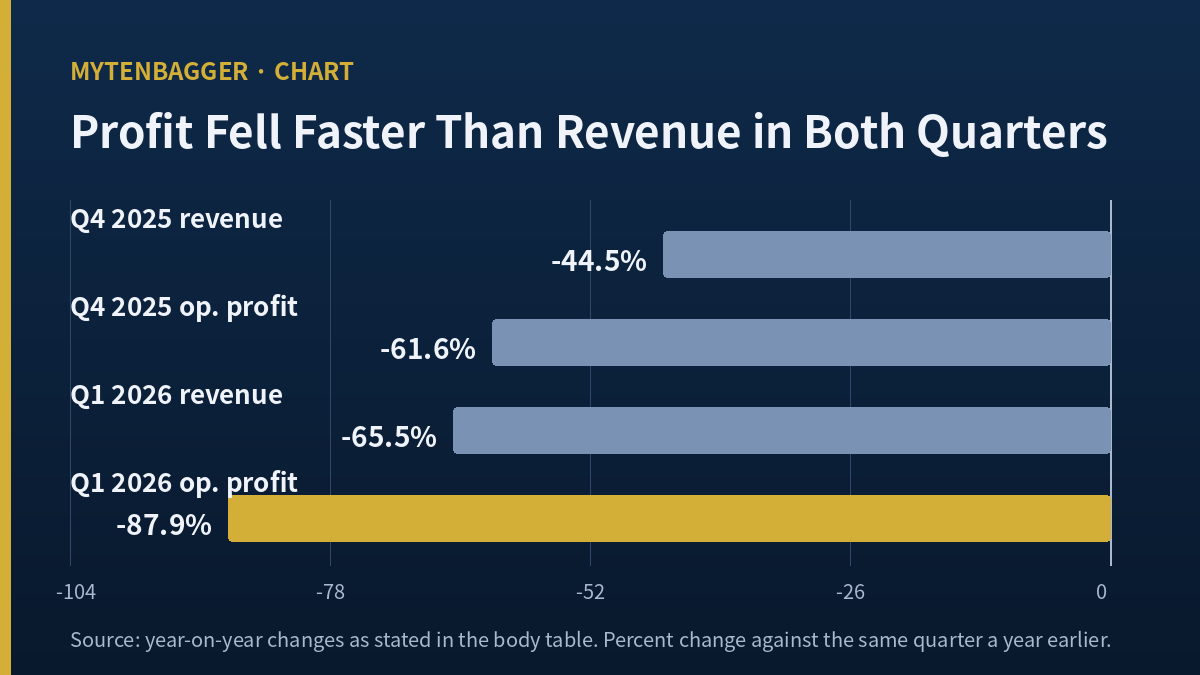
| Q4 2025 | 83.0B KRW (-44.5%) | 27.6B KRW (-61.6%) | ~33% (derived) |
| Q1 2026 | 50.9B KRW (-65.5%) | 8.5B KRW (-87.9%) | 16.6% |
Percentages in parentheses are year over year. The FY2025 figures, an operating margin of 43.6% on 576.7 billion won of revenue, come from the company’s annual results released in February 2026. Net income jumped more than 40% to 214.4 billion won (about $139 million), but that was driven by a one-off gain from selling a stake in HPSP, not by the core equipment business, so I treat the net-income surge as noise rather than strength.
The problem is the latest quarter. Q1 2026 preliminary results, disclosed May 15, were 50.9 billion won of revenue (about $33 million) and 8.5 billion won of operating profit (about $5.5 million), an operating margin of just 16.6%. Local brokerage consensus had been running near 190-200 billion won of revenue, so the print came in around a quarter of what the street expected, and operating profit at roughly a tenth. A margin that had held in the 40s for two years collapsed to the teens in a single quarter. Management frames it as a temporary gap: HBM4 mass production slipped to early this year, pushing tool orders out. The framing has some support across the sector, because peer equipment maker Jusung Engineering swung to an operating loss of about 7 billion won in the same quarter as Korean tool names broadly absorbed the customers’ production delays. Still, I notice the softness did not start in Q1; Q4 2025 revenue was already down 44.5% year over year, and TheElec described this as a third straight quarter of year-over-year decline, not a one-off air pocket, which is why I weigh the “temporary” label carefully rather than taking it at face value.
Since the trailing multiple is distorted, the forward view matters more. Brokerage 2026 estimates lean toward recovery: CGS International models Q2 revenue of 246.7 billion won and operating profit of 130.4 billion won (a 53% margin), and full-year revenue of 804 billion won with operating profit of 410.8 billion won; Sangsangin Securities sees full-year revenue of 785 billion won and operating profit of 369.4 billion won (both per TheBell, June 1, 2026). Even if that recovery lands, a 33-trillion-won market cap is roughly 90x on 2026 estimated earnings. What sits less comfortably with me is the target prices: LeadIng Investment at 240,000 won, Eugene at 230,000 won, and BofA Merrill Lynch at 300,000 won (February 2026). The mid-June price of around 350,000 won has already cleared the domestic targets and is brushing the most bullish one. A stock that has run past analyst targets even after pricing in the recovery is, to me, the core of the price problem.
Where the Hanmi Semiconductor monopoly actually cracks: SK Hynix goes three-way
This is the part I most wanted to write. “71% global market share” and “share inside the largest customer’s fab” are not the same sentence.
Hanmi used to be effectively the sole TC bonder supplier to SK Hynix. Then SK Hynix moved to diversify, and the picture changed. Hanwha Semitech (formerly Hanwha Precision Machinery) made its first TC bonder delivery to SK Hynix in March 2024, splitting the supply in two, and by late 2024 Singapore-based ASMPT had won dozens of TC bonder sets for SK Hynix’s HBM3E 12-high production, making it three. Sole supplier, to two, to three, inside about a year, as TheElec and TrendForce have reported.
The numbers make it sharper. According to that reporting (as of December 2025), SK Hynix was running roughly 50 TC bonder sets for HBM4 production, about half of them supplied by ASMPT, with Hanwha Semitech’s tools not yet in use. A company with 71% of the global market had handed about half of its single most important customer’s next-generation line to a rival. That is the gap between “monopoly” and “on-site share.”
ASMPT’s foothold is concrete, not a rumor. It won dozens of TC bonder sets for HBM3E 12-high back in October 2024, then a further seven HBM4 sets, each with two bonding heads and roughly $20 million in total, in late 2025, as TheElec reported. And HBM4 is not a side bet: it is slated to pair with Nvidia’s next-generation Rubin AI accelerators, so whoever holds bonder share inside SK Hynix’s HBM4 line holds share in the most important memory ramp of this cycle. Losing ground here is not losing a trailing-edge product; it is losing position in the part of the roadmap everyone is fighting over.
The friction shows up outside the numbers too. In April 2026 Hanmi pulled roughly 60 of its engineers who had been stationed at SK Hynix as support staff, a move widely read as a protest against the chipmaker’s decision to source equipment elsewhere, per DigiTimes and TrendForce. A core supplier openly signaling displeasure with its biggest customer is the kind of detail I sit with longer than the income statement.
You can see the same trend at the contract level. In May 2025 SK Hynix split a TC bonder order, about 42.8 billion won to Hanmi and 38.5 billion won to Hanwha, and in January 2026 it again divided roughly 20 billion won across the two. The “split-the-order” pattern that would never have appeared in the sole-supplier era is now a recurring quarterly event. Order by order, Hanmi still wins business; in trend terms, a three-way share structure is settling in.
In fairness, I have to write the other side too. On June 8, 2026 Hanmi disclosed a 44.2-billion-won order (about $29 million) from SK Hynix for an HBM4 “TC Bonder 4.5 Griffin,” its largest single contract, bound for the M15X back-end in Cheongju. That cuts against my hardening-split worry: it is a sign Hanmi is winning meaningful volume back. In fact LS Securities analyst Cha Yong-ho argues Hanmi’s share of SK Hynix’s TC bonder spend actually expanded, from 50% in 2025 toward 60% in 2026, the opposite of the 20-30% slide the channel check I cited feared. When two credible reads of the same company point in opposite directions on share, that disagreement is itself the central uncertainty here, and I have not resolved which is right.
The global peers: Hanmi vs ASMPT vs BESI
This three-way split is not a Korean turf war; it is a fight with global tool makers. ASMPT, headquartered in Singapore, is the world’s number-one back-end packaging equipment company, with 2025 revenue around 2.57 trillion won (roughly $1.7 billion) and TC bonder revenue up 146% year over year. One nuance matters: the roughly 30% TC bonder share ASMPT cited on its call is across the whole TC bonder market including logic, whereas Hanmi’s 71.2% is the HBM-only TC bonder market. Same word, different denominator. The other heavyweight is BESI of the Netherlands, widely seen as the front-runner in the next interconnect technology, hybrid bonding. For a valuation reference point, BofA Merrill Lynch pegged BESI’s 2026 estimated P/E at 41x and argued that against that benchmark Hanmi has further upside, the same data read as a bull case.
Here is what keeps nagging at me. One overseas channel-check note argued that as HBM4 tightens placement-accuracy requirements, Micron could move to BESI as its sole TC bonder vendor for HBM4, replacing both Hanmi and Shinkawa, while Hanmi’s share of SK Hynix’s own TC bonder business could slide toward 20-30% through 2026. The same note added that Micron is unlikely to adopt ASMPT on geopolitical grounds, given ASMPT’s Hong Kong roots and Micron’s role as a key supplier to Nvidia. I do not treat a channel check as fact, but the direction of travel, away from the Korean incumbent, lines up uncomfortably well with what SK Hynix’s own order split is already showing.
If that read is even half right, the Micron capex increase I listed earlier as a tailwind becomes double-edged for Hanmi: more spending does Hanmi no good if BESI captures the tools, because that volume never lands on Hanmi’s income statement. The company’s “Micron is a positive” story and the market’s “Micron could walk” worry are two faces of the same event, and that is precisely why I cannot put the whole position on at once.
Samsung sits outside this fight in a way worth noting. It leans on its in-house SEMES bonders with a non-conductive-film process for its current HBM and is widely expected to hold that approach until HBM5 and hybrid bonding before any major tool switch. So the TC bonder battle that actually moves Hanmi is the SK Hynix and Micron battle, which makes SK Hynix’s diversification and Micron’s vendor choice the two levers I care most about. The tool market itself keeps compounding underneath all of this; TechInsights projects the TC bonder market growing at roughly 13% a year from 2025 through 2030, so the fight is over share of a rising pie, not a shrinking one.
Two scenarios, written down on purpose
I cannot get to one-sided conviction here. When that happens, my method is to write the fork down both ways.
The recovery branch. If Q1 really was a transition-quarter air pocket, orders cluster from Q2 and the numbers snap back fast. There is a concrete reason for the delay: LS Securities attributed the HBM4 ramp slip to Nvidia raising its required per-pin speed from 8 Gbps to 10 Gbps, which pushed customers’ tool orders out. A spec-change delay is not demand disappearing. Chairman Kwak Dong-shin said on the May call that Q2 TC bonder orders were concentrating, and around the same time he bought about 5 billion won of company stock and announced a US entity, “Hanmi USA,” to open in San Jose, California by late 2026 to support customers like Micron on the ground. Brokerages model a sharp rebound, too: CGS International sees the Q2 operating margin recovering to 53%. The 44.2-billion-won June order is the first hard evidence of that turn. If that flow continues into further M15X orders and the Wide TC bonder carries into HBM5/6 demand, the multiple gets re-justified.
The fracture branch. The opposite is that the three-way split hardens. ASMPT holds its on-site share, Micron shifts HBM4 to BESI, and the patent fight with Hanwha drags on long enough to cost both Korean makers their window in hybrid bonding. On the legal front, Hanmi sued Hanwha Semitech in December 2024 over TC bonder patents (a two-module, four-head structure), and Hanwha countered, first with an invalidation petition in May 2025 and then in October 2025 with its own infringement suit, brought through the Kim & Chang firm, over flux-application and inspection methods. The industry worry is that a drawn-out fight makes both sides miss the moment to build a lead in hybrid bonding.
And the hybrid-bonding picture is not a clean win for Hanmi either. TrendForce reports SK Hynix decided to keep its existing MR-MUF process for HBM4 16-high for now, after evaluating fluxless bonding and judging it premature, helped by JEDEC relaxing the HBM module height limit from 720 to 775 micrometers, which extends the life of micro-bump bonding. For first mass-production hybrid-bonding equipment, SK Hynix ordered an inline system co-developed by Applied Materials and BESI, priced around $15 million, as TrendForce noted in April 2026. Hanmi is building a roughly 100-billion-won (about $65 million) hybrid bonder plant in Incheon set to start in the second half of 2026, with an HBM6-grade hybrid bonder targeted for late 2027. In other words, the first mass-production slot for next-gen bonding went to the BESI combination, and Hanmi is the one chasing.
Latecomer Hanwha Semitech is pressing too. It recently delivered a second-generation hybrid bonder prototype to SK Hynix and is awaiting performance validation, a step up from the first-generation tool the two co-developed in 2021. Hanmi, for its part, plans to ship its own second-generation hybrid bonder prototype within this year, so the two are starting the next round from nearly the same line. The consolation is that the pie itself is growing. The industry sees the hybrid bonder market reaching roughly $2 billion by 2028, with hybrid taking around half of bonding tools in the HBM4E generation, per TrendForce. As the pie grows, whether Hanmi’s slice stays near 71% or drops well below decides the next cycle’s earnings.
The line that decides whether I buy
My standing conclusion is “good company, not bought yet.” To keep that from sounding like a dodge, here is what I am watching to make up my mind.
The first gate is the Q2 2026 print scheduled for August 19. Whether management’s “Q2 orders are concentrating” line shows up in the numbers is the whole question. If revenue and margin climb clearly off the Q1 floor, the temporary-gap explanation gains weight. If they do not, I have to suspect structural share erosion.
The second gate is share allocation. The June 44.2-billion-won order confirms Hanmi pulled a big slice this time, but one contract does not set a trend. I want to see how the M15X and follow-on HBM4 lines divide among ASMPT, Hanmi, and Hanwha. Whether Hanmi’s SK Hynix share climbs toward the 60% LS Securities describes, or ASMPT holds half the floor and Hanmi slips again, is the split that matters.
The third gate is position in hybrid bonding. Which generation Hanmi lands a first mass-production slot in, relative to BESI and Hanwha Semitech, pre-sets its share for the next cycle. If it stays a chaser here, that 71% becomes a past-tense number.
If the Q2 print and the share allocation come in negative together, I trim this name out of active watch. If the two turn up together, I start scaling in from there. The more demanding a stock’s price, the less I am willing to put the whole position on in one move.
Where I stand right now
So here is the summary. Hanmi Semiconductor owns a narrow bottleneck in the TC bonder and runs an almost unreal margin; it is a good company, and one weak quarter does not change that. But “good company” and “fair price today” are separate judgments. A roughly 33-trillion-won market cap against 8.5 billion won of quarterly operating profit, plus the gap between a 71% global share and about half the volume inside its top customer, is something I have not digested yet.
So I have not bought it. I plan to watch the August numbers and the order split, and only at a point where the recovery signal is clear do I start a first, scaled-in position. For the first stop on a road I took specifically by passing on the headline name, this turned out to be a stock I have to watch longer than I expected. The next stop is the part of the chain that wins no matter who takes the bonder crown, and that is where I am looking next.
Related reading
- Samsung Electronics Lost the Crown the Day It Posted a Record Profit
- YC Stock Bottomed With Its Whole Sector and Did Not Come Back