DB Insurance Dividend and a Solvency Ratio That Fell 27.8 Points
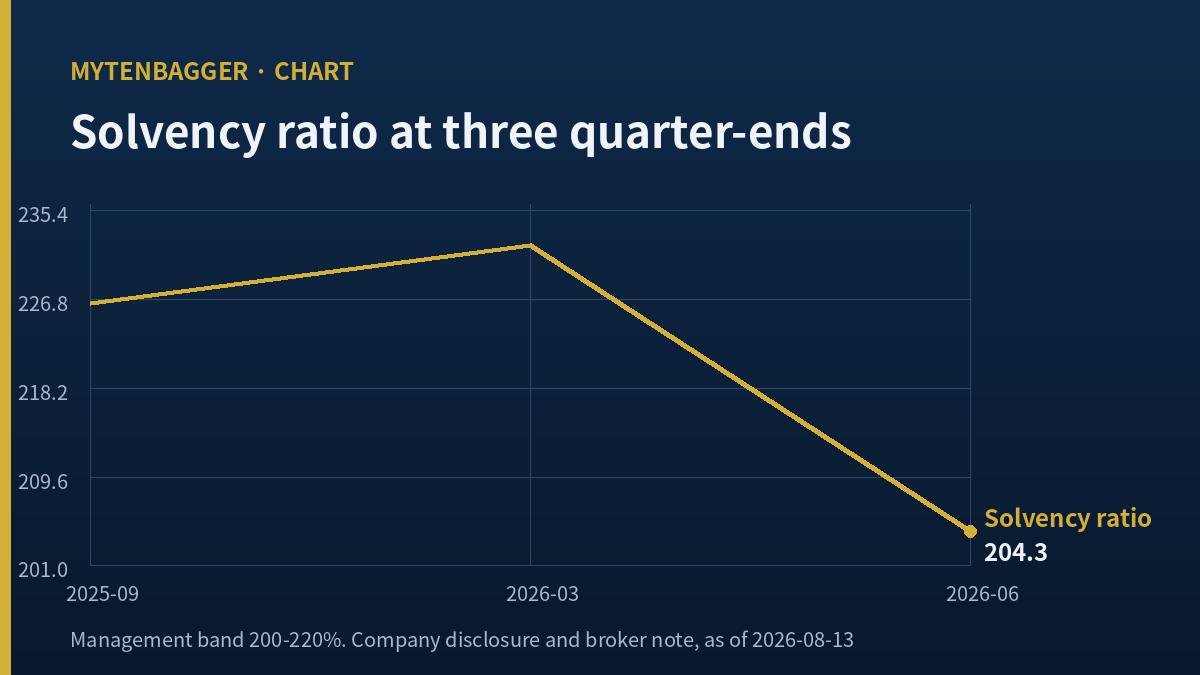
On August 13, 2026, two numbers about DB Insurance stock landed in the same release. Net profit of 711.1 billion won, roughly $501 million, the largest single quarter this company has ever booked. And a solvency ratio of 204.3 percent, down 27.8 points from 232.1 percent three months earlier. I spent the afternoon on the second one.
My reason is specific to the industry. For a property and casualty insurer, the earnings line tells me what happened in the quarter, while the regulatory capital ratio tells me how much of it the company is allowed to hand back. Buybacks and dividends at a Korean insurer are constrained by the supervisor’s solvency framework, so the size of the next return is decided upstream of the income statement. That is why the figure I copied into my notes first was 204.3 percent, and why laying it against the company’s own management target set the shape of this entry.
Four marks on one band, which is how I read this company
| Ratio | What it is | As of |
|---|---|---|
| 232.1% | Prior quarter, reported | March 31, 2026 |
| 220% | Top of the company’s own band | Cited in a February broker note |
| 204.3% | Current reading, lower half of the band | June 30, 2026 |
| 200% | Bottom of the company’s own band | 4.3 points of headroom |
I want to see which way those 4.3 points move in the third quarter before I treat the capital return story as funded.
Contents
What a Korean solvency ratio is, and why it is not RBC
Readers who follow US insurers will reach for the risk-based capital framework here. The Korean regime is a different animal. Since 2023 the country has run K-ICS, a market-consistent solvency regime built alongside IFRS 17, where both assets and insurance liabilities are marked at economic value and required capital is calibrated to a one-year 99.5 percent confidence level. The number that gets reported is available capital divided by required capital. The supervisory guideline floor sits at 150 percent. For a second reading of the same gauge at another Korean non-life name, Hyundai Marine & Fire reported a K-ICS ratio of 209.0% at the end of the second quarter of 2026, which I worked through in a separate piece on Hyundai Marine stock.
Two consequences matter for anyone pricing this insurer from abroad. First, the ratio moves with interest rates in a way a US RBC ratio does not, because a lower discount rate inflates the present value of insurance liabilities and eats available capital directly. Second, writing profitable new business consumes capital in the short run even while it builds future earnings, so a growing book can push the ratio down while the franchise improves.
The band is the company’s, not the regulator’s
At 204.3 percent this company sits well clear of that 150 percent guideline. What I am measuring against is tighter. Kiwoom Securities analyst Ahn Young-jun, in a February 23, 2026 note, put the company’s own management target at 200 to 220 percent and modeled a year-end reading of 217.9 percent. The actual came in below that model and did so two quarters early.
Treat 200 to 220 as a twenty-point corridor and 204.3 sits 21.5 percent of the way up from the floor. As long as management holds the corridor, incremental buybacks and dividend increases have to fit inside 4.3 points.
Why DB Insurance stock pays three times the yield of a US peer
The dividend is the reason most people look at this name. At the August 14, 2026 close of 176,800 won, about $124.66, the trailing yield is 4.30 percent on a declared 7,600 won per share. Dividing 7,600 by 176,800 returns 4.2986 percent, which matches the screen. The payout has risen for six consecutive years: 2,200 won in 2020, then 3,500, 4,600, 5,300, 6,800 and 7,600.
Set that beside a US property and casualty insurer of the same trading day. I used The Travelers Companies, which closed at $370.36 on August 14, 2026 at 4:00 PM Eastern.
| As of August 14, 2026 | DB Insurance | Travelers |
|---|---|---|
| Trailing price to earnings | 7.00x | 9.92x |
| Dividend yield | 4.30% | 1.35% |
| Price to sales | 0.70x | 1.58x |
| Net profit growth | 54.7% in Q2 | 58.3% trailing twelve months |
I capped the comparison at four rows deliberately. The two companies report under different accounting regimes, Travelers writes a book weighted toward auto and property while the Korean company’s engine is long-term protection business, and the loss-ratio definitions do not line up. So margins and combined ratios stay out of the table, and only the price-derived measures remain.
Even narrowed that far, the split is wide. The Korean name yields 3.18 times what the US name yields, and the US name carries 1.42 times the earnings multiple. Profit growth sits in the same neighborhood for both, though the Korean figure is a single quarter against the prior-year quarter and the US figure is a trailing twelve-month comparison. A company paying three times the income is trading at a thirty percent discount on earnings, and I read most of that gap as a discount the market applies to currency and venue, with underwriting a smaller component of it. Whether that discount is fair is beyond what I can settle here. The Travelers figures reproduce: 370.36 multiplied by 208.58 million shares gives $77.2497 billion against a displayed $77.25 billion, and the price divided by the multiple gives $37.33 against a displayed trailing EPS of $37.34.
The eight places I could be wrong about DB Insurance stock
Before going further I want the other side on the page. Any one of these holding strongly weakens the read above.
One. At 204.3 percent the company clears the supervisory guideline of 150 percent by 54.3 points. The band floor is a self-imposed target with no regulatory force, and management can move it, which would erase the 4.3-point arithmetic entirely.
Two. If the ratio fell because capital went to shareholders, that is evidence the policy is being executed. Asking a company that cancelled 973.2 billion won of its own shares in eight months to keep its capital ratio flat does not hold together.
Three. Q2 insurance profit of 561.8 billion won more than doubled from 267.6 billion won a year earlier. Dividing 561.8 by 267.6 gives 109.9402 percent growth against the prior-year base. Earnings power at that level rebuilds capital quickly.
Four. This ratio swings hard between quarters. It read 226.5 percent at the end of September 2025, rose to 232.1 percent by March 2026, then fell to 204.3 percent in June. Calling a trend off one print is a mistake I have made before.
Five. Management has said it will publish a new consolidated-basis value-up plan in the second half of 2026. That document could define capital headroom differently than I have here.
Six. At least six named Korean brokerages carry buy ratings, and I found no named house with a sell view. The absence of a bearish sell-side voice means my reading is the minority one. I log that as a coverage gap, and I do not take it as confirmation.
Seven. The contractual service margin stood at 12.79 trillion won at the end of June, larger than the 11.58 trillion won market capitalization. Dividing the second by the first puts the market value at 90.5144 percent of the stored margin. A pool of future profit bigger than the company’s price is on its own a reason to own this.
Eight. I did not open the 2026 half-year filing. Everything above comes from the company’s earnings release, Korean press reports of that release, and financial data vendor screens. The filing may read differently.
Splitting the quarter that DB Insurance stock is standing on
The August 13 release is on a separate-entity basis, which matters because Korean regulatory filings for the same periods are consolidated and the two series do not match. Net profit of 711.1 billion won was reported as 54.6 percent above the prior-year 459.8 billion won; dividing gives 54.6542 percent, which agrees. Operating profit rose 57.4 percent to 963.9 billion won. Revenue fell 3.7 percent to 5.3134 trillion won. Revenue down, profit sharply up.
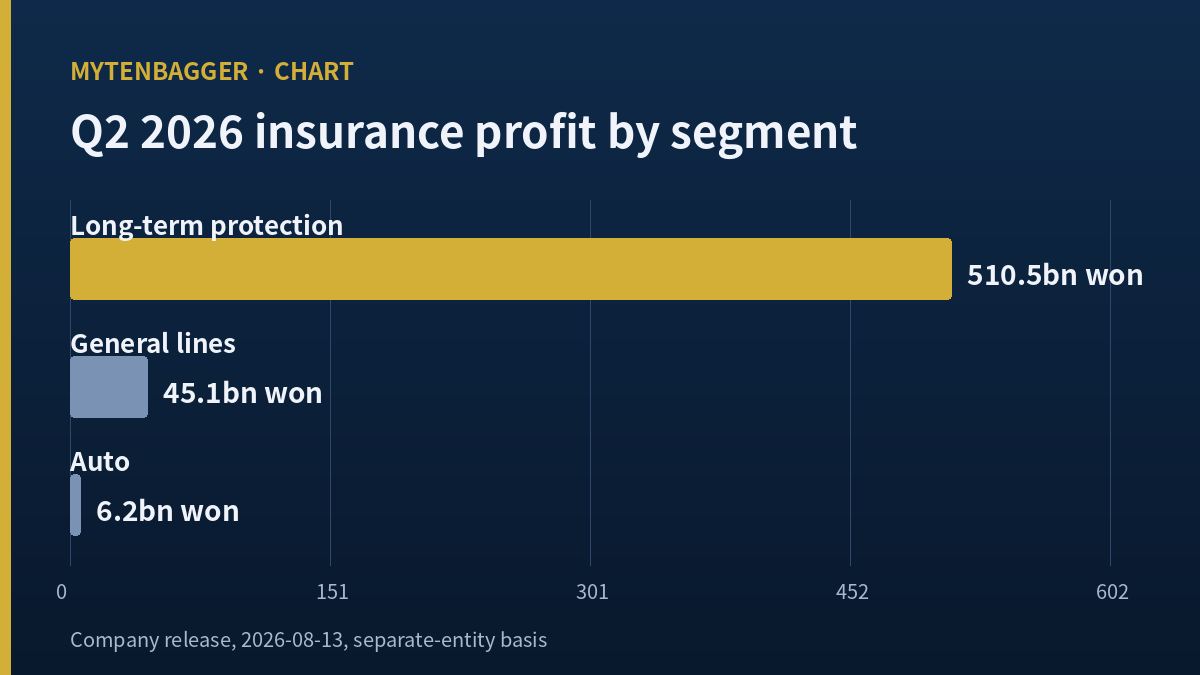
| Q2 2026, billion won | Result | Year earlier | Share of insurance profit |
|---|---|---|---|
| Long-term protection | 510.5 | about 257.0, derived | 90.87% |
| General lines | 45.1 | about negative 21.4, derived | 8.03% |
| Auto | 6.2 | about 32.0, derived | 1.10% |
| Insurance profit | 561.8 | 267.6, reported | 100.00% |
The three segments add to 561.8, matching the reported insurance profit to the last digit. Segment tables do not always reconcile with the line above them, so I added these first; here they closed. Investment profit of 402.1 billion won sits outside this table, and insurance plus investment gives the 963.9 billion won operating figure.
The year-earlier column is derived, not reported. The company published segment growth rates without the segment bases, so I divided 510.5 by the stated 98.6 percent increase to get roughly 257.0, and 6.2 by the stated 80.6 percent decrease to get roughly 32.0. Subtracting both from the reported prior-year insurance profit of 267.6 leaves general lines at roughly negative 21.4, which agrees in sign with the company describing that segment as returning to profit. Growth rates are published to one decimal place, so these derived figures carry error in the hundreds of millions of won and I kept them out of every calculation in the body.
What the company said made the long-term segment jump
Auto contributed 6.2 billion won, which is 1.1036 percent of insurance profit and effectively a rounding error. Korean press attributed the decline to a rising loss ratio. Auto cover is compulsory in Korea and pricing is closely watched by the supervisor, so an insurer facing higher claims there cannot reprice quickly.
The long-term segment is where I slowed down. The company gave two reasons for the improvement. One was a better long-term risk loss ratio versus the prior quarter. The other, in the company’s own words as relayed by Korean press, was a reversal of onerous-contract provisions arising from an assumption change. Under IFRS 17 an insurer that expects a group of contracts to be loss-making must recognize that loss immediately; revising the actuarial assumptions can release part of that recognized loss back through the income statement. It is real accounting profit and the company disclosed it openly. My reservation is about repetition. An assumption change is a step, and steps do not recur at the same size every quarter, so I did not use 711.1 billion won as the base for any forward estimate.
There is one more layer. The record quarter sits inside a half-year that grew 8.0 percent. First-half net profit of 979.6 billion won against 906.9 billion won a year earlier divides to 8.0163 percent, matching the release. Subtracting the second quarter from each gives the first: 268.5 billion won this year against 447.1 billion won last year. Dividing 268.5 by 447.1 gives a 39.9463 percent decline versus the prior-year first quarter. Both first-quarter figures are derived by subtraction. The record quarter follows a quarter that fell by nearly forty percent.
What the multiples on DB Insurance stock are actually dividing
Eight months in which the share count fell 7.4854 percent
Anyone applying a multiple here needs to know that the share count moved not long ago, and moved a lot.
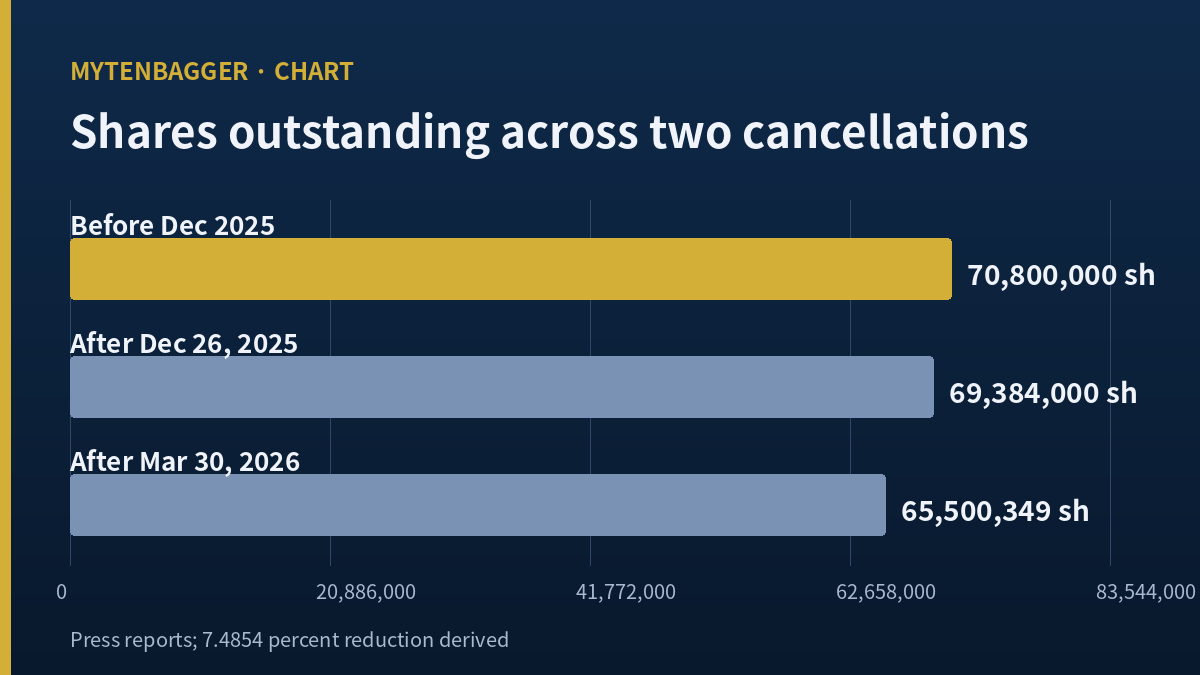
Korean financial press reported that the board approved the cancellation of 1,416,000 common shares on December 22, 2025, executed December 26, at a value of 175.159 billion won. Shares outstanding before that step were 70.8 million. The second cancellation was far larger: 3,883,651 shares retired at a value of 798.09 billion won, priced off the February 26 close of 205,500 won, with the retirement dated March 30, 2026.
The two outlets that covered the second step disagree on the board date. Bloter reported February 26 and Weekly Hankook reported February 27. I could not settle it against the original filing, so I carry both dates. Both reports give the same share count and the same value, and the share count is what my arithmetic uses.
The chain closes cleanly. From 70,800,000 subtract 1,416,000 to get 69,384,000, then subtract 3,883,651 to get 65,500,349. That figure matches the shares outstanding on the WiseReport screen exactly. The Kiwoom screen shows 65,500,566, a difference of 217 shares, and I used the number that reconciles with the cancellation arithmetic. Together the two steps removed 5,299,651 shares, which divided by 70,800,000 is a 7.4854 percent reduction, at a combined cost of 973.249 billion won.
Market capitalization closes as well. Multiplying 176,800 won by 65,500,349 gives 11.58046 trillion won against a displayed 11.5805 trillion won, or roughly $8.17 billion at the exchange rate footnoted below.
Three screens, three different book values for one company
Checking the multiples off the August 14 close produced a split. Both vendor screens agreed on a trailing price to earnings of 7.00 times; dividing 176,800 won by a precise EPS of 25,257.14 won returns exactly 7.0. Price to book was where they parted.
| Source | Book value per share, won | Price to book | How I checked it |
|---|---|---|---|
| Kiwoom screen | 158,606 | 1.11x | Internally consistent |
| WiseReport screen | 179,423 | 0.99x | Internally consistent |
| Filing, end 2025 | 156,821 | 1.13x | Pre-cancellation share count |
| Filing, Q1 2026 | 176,786 | 1.00x | Owners’ equity divided by share count |
The bottom row is the one I used. Equity attributable to owners of the parent in the Q1 2026 filing with Korea’s Financial Supervisory Service is 11.5795 trillion won; dividing by the post-cancellation 65,500,349 shares gives 176,786 won, and against the close that is 1.0001 times book. I did not pick between the screens on preference. I used the value that reproduces from the filing and left the others in the table so the spread is visible.
Return on equity splits for the same reason. The Kiwoom screen shows 17.7 percent. Dividing price to book by price to earnings gives 15.8571 percent. Taking 2025 profit attributable to owners over owners’ equity from the filing gives 16.43 percent. When I see this company’s return on equity quoted to one decimal, my first question is which of those three lineages produced it.
Where DB Insurance stock sits against the sell side
WiseReport’s August 14, 2026 aggregation counts 14 contributing houses with a consensus valuation of 220,714 won. Against the 176,800 won close that is 24.8382 percent of distance. Consensus EPS on the same screen is 24,788 won, which prices the shares at 7.1325 times.
Named houses: Kiwoom Securities opened at 250,000 won on February 23, 2026 with a buy rating; Hana Securities published 243,000 won on April 29; Daol Investment and Securities published 260,000 won on May 18 in a first-quarter review. Meritz Securities analyst Cho A-hae issued notes in May and again in August. Every figure here is what those houses published, and none of them is a number I have adopted.
One caution on the forward view. Kiwoom’s February note modeled full-year 2026 net profit of 1.5349 trillion won, a 13 percent decline. The first half alone came in at 979.6 billion won, so the company needs only 555.3 billion won across the back half to reach that model. The February estimate is stale. There is almost certainly a raised number circulating after the August print, but I did not read that note and so I am not quoting a figure for it.
What has to hold for a seventh straight dividend increase
Six consecutive increases is the strongest thing on this company’s tape and I do not dispute it. What I want written down is the arithmetic behind a seventh.
The fiscal 2025 payout ratio is 7,600 won over EPS of 25,263 won, or 30.09 percent. Management has said it intends to lift the payout toward 35 percent or more over the medium term, with Korean press citing a total shareholder return ratio reaching 35 percent by 2028. Moving from 30 to 35 percent lifts the dividend by 16.7 percent on identical earnings.
The catch is where that increase is drawn from. Cancellations took 973.2 billion won out over eight months, and the fiscal 2025 dividend takes roughly 497.8 billion won more at the post-cancellation share count. Together that is 1.4710 trillion won against Q1 2026 total equity of 11.6371 trillion won, or 12.6 percent. The 27.8-point fall in the solvency ratio points the same direction as that number.
So the durability of the dividend is not what I doubt. The pace is. I used the same test on NH Investment and Securities, where a mid-four-percent yield also failed to win me over: the size of the payout matters less to me than the slack in the capital that funds it.
Where DB Insurance stock trades, and the two bases it reports on
These shares trade on the KOSPI, the senior board of the Korea Exchange, under code 005830. The KOSPI is the large-capitalization market; the KOSDAQ is the separate venture-weighted board, and this company is not on it. Foreign ownership stands at 44.54 percent, which is high for a Korean financial and indicates the register is already open to overseas money.
One structural note. Korean insurers report on both separate-entity and consolidated bases and the market convention differs by document. The earnings release quoted throughout this entry is separate-entity, while the quarterly regulatory filing is consolidated. For the second quarter of 2025 the consolidated single-quarter net profit in the filing is 652.3 billion won, while the company’s separate-entity prior-year comparison is 459.8 billion won. The 192.5 billion won gap is a basis difference and not an error, which is why the two series never meet inside a single sentence here.
I covered the Korean comparables in earlier entries on Samsung Fire and Marine and Meritz Financial Group. One line from the first is worth carrying over with a caveat: I recorded Samsung Fire’s solvency ratio at 270.1 percent when I wrote that piece. Placed next to 204.3 percent that looks like a 65.8-point gap, but the two readings are as of different dates and I could not source a matched quarter. I am not comparing the two companies’ capital headroom. What my own notes do establish is that the low 200s is not the top of this industry’s range.
What I could not settle about DB Insurance stock
Recording the failures so I know what to fill in first when I reopen this.
I could not decompose the 27.8-point solvency decline into its drivers. My three candidates are the dividend paid out after the March annual meeting, required capital rising against a contractual service margin that grew 4.8 percent from year-end to 12.7941 trillion won, and a lower discount rate lifting the present value of insurance liabilities. The company has not published that attribution as far as I could find and I have not opened the half-year filing, so I put no weights on the page.
Half-year operating profit split between outlets: Insight Korea printed 1.4266 trillion won, Asia Today printed 1.4272 trillion won. The 600 million won difference is immaterial to the argument, but I could not establish which matches the company’s release, so neither figure enters any calculation here. Asia Today also printed a half-year revenue figure smaller than the single second quarter, which cannot be right, and I left it out.
Still open: the December 2025 solvency reading, the Q3 2026 results date, the remaining treasury share balance and its percentage, and the publication date of the consolidated value-up plan. The last of those is the unverified item closest to this thesis. If that document defines capital headroom differently, the 4.3-point calculation changes wholesale.
My position on DB Insurance stock and the condition that kills this entry
At 11.5805 trillion won of market value this is not a name that falls out on size, so the decision came from reading the indicators one at a time. The seven-metric checklist I run scores six of seven, or 86 points, and the single miss is price to book against the insurance-sector threshold of 1.0 times, where the vendor screen shows 1.11 times. As shown above, recomputing from the filing gives 1.0001 times. So this name did not fail a screen.
What I am waiting on is narrow. Does the September 30 solvency ratio come back above 204.3 percent, and does the recovery come from earnings. Both confirmed and I revisit my read, because a 4.30 percent yield at seven times earnings is already cheap enough on its face.
The condition that kills this entry: a Q3 2026 solvency ratio printing below 200 percent. Every calculation above rests on management holding the corridor it set, and a reading under the floor means that assumption was wrong, which makes the 4.3 points of headroom a meaningless quantity. At that point capital headroom has to be measured some other way and the arithmetic in this entry gets thrown out.
Laid out in order: 1,416,000 shares retired on December 26, 2025; another 3,883,651 retired on March 30, 2026; the ratio stood at 232.1 percent at the end of that month; the dividend went out and new business accumulated through the June quarter, leaving 204.3 percent; and on August 13 the largest quarterly profit in the company’s history was announced. The next item on that list is the September 30 reading. I open this entry again the day it prints.
Sources and reference dates
- Price, market capitalization, multiples and dividend data: Kiwoom and WiseReport screens, Friday, August 14, 2026 close. WiseReport company overview
- Q2 2026 results, company release of August 13, 2026, separate-entity basis, as relayed by Korean press: Insight Korea and Asia Today
- First share cancellation of 1,416,000 shares: Financial Today, December 23, 2025
- Second share cancellation of 3,883,651 shares: Bloter, February 27, 2026, and Weekly Hankook, February 28, 2026
- Broker view and the company’s stated management band: Korean coverage of the Kiwoom Securities note by analyst Ahn Young-jun, February 23, 2026
- Peer figures: The Travelers Companies, August 14, 2026 at 4:00 PM Eastern
- Consolidated quarterly financials: Korea Financial Supervisory Service electronic disclosure, Q1 2026 report (receipt number 20260515002382) and the 2025 annual report