Samsung Life Stock: I’m Buying a Discounted Samsung Proxy
- Samsung Life stock is down roughly 39% from its high and about 25% in the last month, back to the ~$207 (₩315,000) zone. I’ve been adding in tranches. I don’t own it as an insurer — I own it as a capital-backed, discounted wrapper on Samsung Electronics.
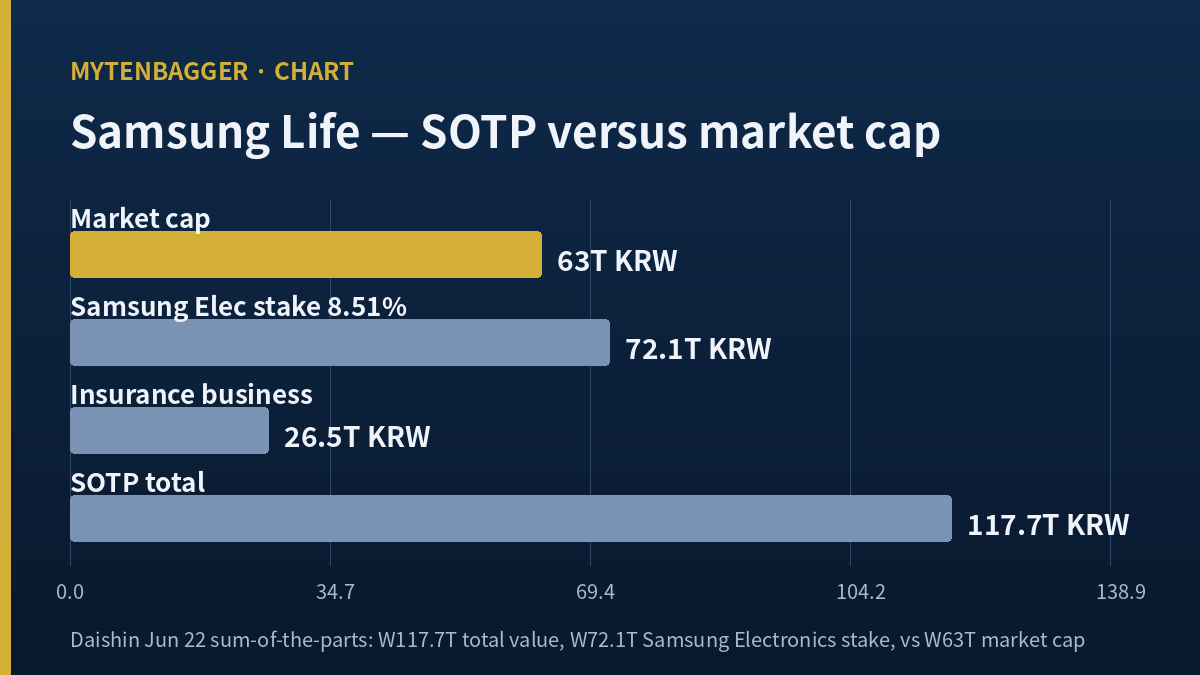
- Korean sell-side (Daishin, June 22) values the Samsung Electronics stake alone near $47B (₩72T) — more than Samsung Life’s entire $42B (₩63T) market cap. The core insurance business and the other stakes come almost for free. Its K-ICS solvency ratio sits at 210%.
- My thesis breaks if the Insurance Business Act (“Samsung Life Act”) passes with a forced-divestment mechanism, or if the Samsung Electronics rally itself reverses.
Three numbers on the Samsung Life stock page don’t sit together comfortably. A market cap around $42B (₩63T). A single block of Samsung Electronics shares this company holds, valued near $47B (₩72T) in a Korean sell-side sum-of-the-parts (Daishin, June 22). And a return on equity of 4.7%. A company holding a stake worth more than its own market value, yet earning a bank-deposit-like return on its actual book. For US readers new to the name: Samsung Life is the largest life insurer on the KOSPI, Korea’s main stock index — think of it as roughly Korea’s answer to the S&P 500. (USD conversions here use about ₩1,520 per dollar, mid-2026.)
Honestly, my first reaction was to write it off — a 27x P/E insurer with a single-digit ROE has no business on my buy list. Then I looked again, and I had the frame wrong. Samsung Life doesn’t earn its way through underwriting so much as it sits on a Samsung Electronics stake the size of its own market cap while trading at a holding-company discount. That’s when I moved the name out of my “insurance” folder and into my “indirect Samsung” folder, and started adding.
The shift wasn’t smooth. A few months back I had lumped the whole Korean insurance complex into the too-hard pile — rates, regulation, all of it — and Samsung Life went in with the rest. That was my mistake. This isn’t a rate-driven insurer; it’s a stock that moves with Samsung Electronics because that’s what it holds. Once I admitted that, it got simpler. Two variables carry the name: where Samsung Electronics trades, and how wide the holdco discount runs.

Contents
Why I’m Buying Samsung Life Stock — Three Reasons
I’m in this at these levels for three structural reasons, not a hunch. In order.
Reason one: a Samsung Electronics stake bigger than the whole company
Samsung Life holds an 8.51% stake in Samsung Electronics — a hard fact from Korean disclosure filings. In a June 22 sum-of-the-parts note, Daishin Securities analysts Park Hye-jin and Kwon Yong-soo put that stake at ₩72.1T ($47B), 61.3% of a total enterprise value of ₩117.7T ($77B). The core insurance operation came to ₩26.5T ($17B). The Samsung Electronics slice is about 2.7x the underwriting business.
What caught me wasn’t the direction — it was the size. That one stake ($47B) is larger than Samsung Life’s entire market cap ($42B). On the arithmetic, the market is handing you the ₩26.5T insurance business and the rest of the listed and unlisted subsidiaries for free — arguably at a negative value. The holding-company discount has stretched too far, in my read. I can’t tell you when it narrows. But the width of the discount is my margin of safety.
I actually ran the subtraction in a spreadsheet to make sure I wasn’t fooling myself. Take the market cap, back out the Daishin stake value, and the implied price for everything else — Korea’s largest life insurance book, the listed and unlisted subsidiaries, the net cash — comes out below zero. You can argue the stake should carry a holding-tax haircut and a control discount, and it should; even haircutting the stake by a third, the leftover value assigned to the operating business is still deeply negative. That’s the number that got me off the fence. I’m not paying for growth here; I’m paying for a Samsung Electronics stake and being handed an insurer as a rebate.
Reason two: earnings and capital improved together
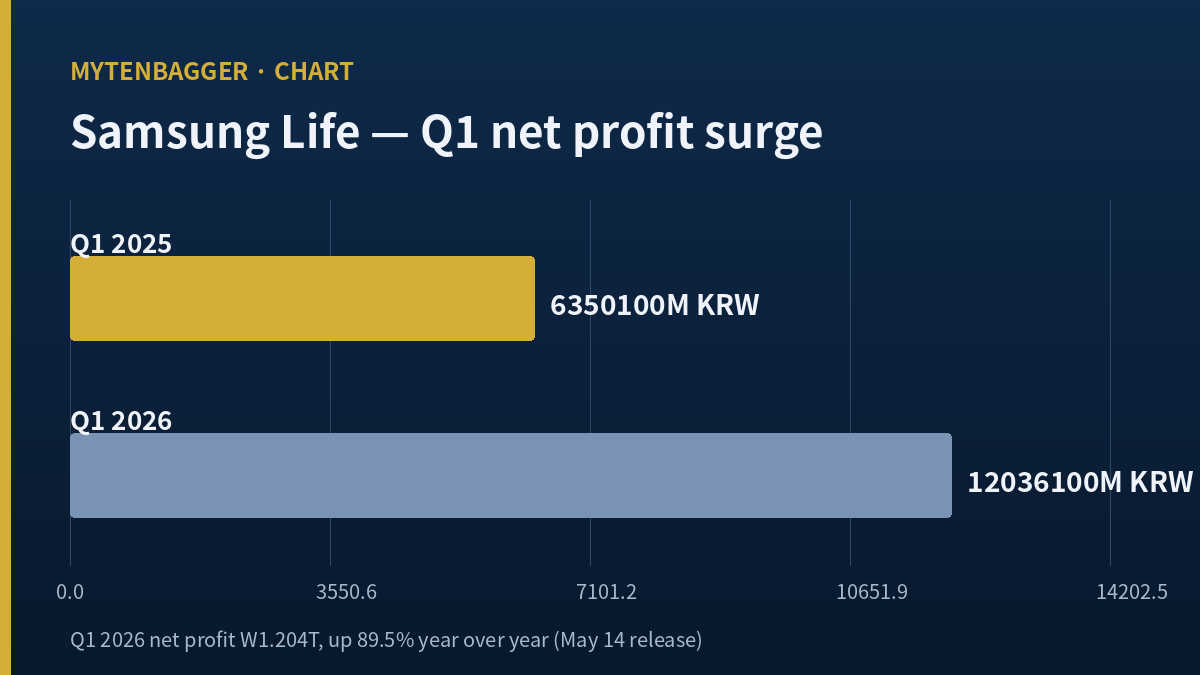
First-quarter 2026 net income (reported May 14) came to ₩1.20T ($790M), up 89.5% year over year — half of last year’s full-year profit booked in a single quarter. Management attributed it to a wider protection-type new-business margin, a jump in investment income, and subsidiary contributions including Samsung Electronics dividends. New-business CSM (contractual service margin, the stored future profit in an insurer’s book under IFRS 17) rose to ₩849B ($560M), up 11% sequentially, with total CSM at ₩13.6T ($8.9B).
In an insurer I look at solvency before I look at the P/E. The K-ICS ratio stood at 210% at the end of March, up 12 points from year-end — comfortably above the ~150% level regulators generally look for. Earnings grew and the capital base strengthened at the same time. The dividend has climbed three straight years, from ₩3,000 in 2022 to ₩5,300 in 2025 (per company dividend disclosures). The yield itself is still modest at around 1.6%, but the direction matters more to me than the level right now.
One footnote for US readers on the CSM number, since it doesn’t have a clean US-GAAP twin. Under IFRS 17 — the accounting regime Korean insurers adopted in 2023 — CSM is the unearned profit already locked into policies in force, released into earnings over the life of the book. A rising new-business CSM means the insurer is writing tomorrow’s profit today, and Samsung Life’s ₩849B ($560M) of new-business CSM growing 11% in a quarter is a healthier signal than a single quarter’s net income, which the ₩1.27T ($835M) of investment income can swing around. I weight the CSM trend and the K-ICS ratio more than the headline profit for exactly that reason — the underwriting engine is doing what I need it to do underneath the Samsung Electronics noise.
Reason three: value-up and a possible special dividend
The third leg is the catalyst. Korean sell-side (NH Investment, June 16) lifted its price target to ₩450,000 from ₩418,000, and the reasoning was that Samsung Electronics’ appreciation flows straight into the stake value; NH flagged the possibility of a ~₩5T special dividend from Samsung Electronics in early 2027 as a swing factor for shareholder value. If Samsung Electronics raises its payout, an 8.51% holder collects that cash flow directly. It also sits inside Korea’s broader value-up push, where Samsung’s financial affiliates have been widening shareholder returns — Samsung Group’s March value-up plan is part of that backdrop. I’m not adopting anyone’s price target as my own. I read the direction as a market signal that points the same way my thesis does.
Samsung Life Stock by the Numbers — Earnings, CSM, Capital
Here is the core table I keep on this name. It’s the spine of the trade. USD at ~₩1,520/$.
| Metric | Value | Note / attribution |
|---|---|---|
| Price / market cap | $207 / $42B | ₩315,000 / ₩63T, 2026-07-14 |
| Q1 2026 net income | $790M | ₩1.20T, company print, +89.5% YoY |
| New / total CSM | $560M / $8.9B | ₩849B / ₩13.6T, company print |
| K-ICS solvency ratio | 210% | company, end-March, +12pt QoQ |
| P/B / ROE | 0.98 / 4.7% | market data, BPS ≈ ₩324,000 |
| Dividend per share (2025) | $3.49 | ₩5,300, company disclosure, 3 yrs rising |
| Samsung Electronics stake / SOTP value | 8.51% / $47B | stake=filings; ₩72.1T=Daishin SOTP (6/22) |
Sources: company Q1 print (2026-05-14); Daishin SOTP note (2026-06-22); market data as of 2026-07-14; USD at ~₩1,520/$.
The picture behind the table is simple. The underwriting side — net income, CSM, K-ICS — is improving at the same time the Samsung Electronics stake ($47B) is pulling the equity value up. Two engines turning the same way. A 0.98 P/B looks ordinary for an insurer, but it reads differently once you remember the balance sheet carries a chunk of Samsung Electronics. The 4.7% ROE is genuinely low — I won’t argue that away. But that 4.7% is the pure underwriting number, and what I’m buying isn’t the underwriting; it’s the stake-revaluation function sitting on top of it.
The tape matters too. Over twelve months Samsung Life stock ran from a ₩117,000 low ($77) to a ₩516,500 high ($340), then gave back about 25% in the last month. At the ~₩315,000 ($207) zone it’s above its 120-day line (~₩286,000 / $188) and below its 60-day line. The long trend is intact; the short-term froth has come off. To me that reads as a pullback inside an uptrend. It could be wrong — a pullback is only a pullback until it isn’t — so I’m adding in pieces rather than all at once. I’ve been caught buying one of these in a single clip before, and it kept going down.
The Holdco Discount the Market Misses on Samsung Life Stock
This is where I read the name differently from the crowd. Most of the market sees Samsung Life one of two ways. One camp calls it “an expensive insurer at 27x P/E and 4.7% ROE.” The other calls it “just a Samsung Electronics proxy.” I think both are half-right.
The first view’s error is measuring Samsung Life on the insurance income statement alone. Judging a company that carries a Samsung Electronics stake the size of its own market cap by its underwriting ROE leaves out half the balance sheet. The second view gets the proxy nature right but misses the discount. On the Daishin sum-of-the-parts, a ₩117.7T ($77B) pile of asset value trades at ₩63T ($42B). Buying Samsung Electronics directly and buying a company that holds Samsung Electronics at roughly half price are not the same trade. The latter comes with a holdco-discount cushion and a 210% K-ICS capital base attached.
I own Samsung Life as an unlevered way to hold Samsung Electronics at a discount. I’m buying the discount, not paying a premium.
There’s a further wrinkle the market often skips. When Samsung Electronics cancels treasury shares, the total share count shrinks and Samsung Life’s 8.51% ownership drifts up on its own. A higher ownership ratio pushes it closer to the total-asset threshold at the heart of the Insurance Business Act debate. Samsung Life and Samsung Fire selling some Samsung Electronics shares this spring was partly a pre-emptive move against that buyback effect — The Korea Herald reported the ~₩1.32T sale, and KED Global covered an earlier tranche. I read that both ways: a rising ownership ratio lifts the asset value and pushes the company toward the forced-sale threshold at the same time. Treating Samsung Life as a plain proxy hides that two-sidedness.
For a global peer, the closest frame US readers already know is the holdco discount — SoftBank Group persistently trading below the net asset value of stakes like Arm, or Prosus/Naspers against Tencent. Asset-holding companies trading below the market value of what they hold is not a Korea-only quirk; it’s a well-documented global phenomenon. What separates Samsung Life is what sits under the discount: a 210% solvency ratio and a dividend that has risen three years running. Same discount, different floor beneath it.
The peer frame also tells me how these discounts actually close, and it’s rarely a single event. SoftBank’s discount has narrowed in stretches when it bought back stock and when a marquee holding (Arm) re-rated — the mechanism is buybacks, asset monetization, or the underlying stake running. Samsung Life has the same three levers: Samsung Electronics re-rating, its own capital returns, and the periodic stake trims. That’s part of why I hold it as a multi-year position rather than an event trade — I don’t need a catalyst next week, I need the levers to exist. There’s a Korea-specific tailwind on top: the government’s value-up program is explicitly pushing chaebol-affiliated holders toward higher payouts and cleaner structures. Samsung Life sees only limited near-term hit from the affiliate reshuffle, per Korea Herald reporting, and value-up disclosures now cover the bulk of the market’s cap, per Seoul Economic Daily. A structural push toward narrowing discounts is exactly the wind an over-discounted holder wants at its back.
Samsung Life Stock Scenarios — It All Rides on Samsung Electronics
A proxy cuts both ways. When Samsung Electronics rises, the stake value climbs and sell-side price targets follow — Daishin took its target from ₩278,000 in May to ₩590,000 in June, more than doubling it. When Samsung Electronics falls, Samsung Life falls with it. So I frame the scenarios on the Samsung Electronics axis.
The path I see as most likely (~55%)
Samsung Electronics holds or grinds higher, and the value-up and special-dividend hopes stay alive. In that case the holdco discount narrows gradually while Samsung Life books both the underwriting improvement and the stake revaluation. The spread of Korean sell-side price targets — from ₩320,000 (KB, May 14, rated Hold) to ₩450,000 (NH, June 16) to ₩590,000 (Daishin, June 22) — is itself a map of this range. I treat the low end as a floor and the high end as the alpha.
Why is the spread that wide? Three shops looking at the same company from ₩320,000 to ₩590,000 aren’t disagreeing about underwriting — they’re disagreeing about what value and what discount to put on the Samsung Electronics stake. Daishin’s jump from ₩278,000 to ₩590,000 came from switching to a sum-of-the-parts that reflects the stake in full. In the end, most of the valuation is a function of two variables: the Samsung Electronics price and the holdco discount. Right now I think both sit on the over-discounted side.
What the re-rating actually looks like, if it comes, is unglamorous and slow. It’s a few quarters of the discount grinding from deep to merely wide as value-up disclosures firm up, as the special-dividend question resolves, and as each Samsung Electronics up-leg drags the SOTP higher. I don’t expect a gap up on a single headline; proxies of this kind tend to close their discounts in steps, with plenty of backsliding in between. That’s fine for how I’m positioned. I’m adding on the pullbacks and letting the two engines — underwriting and stake value — do the work over time, rather than betting on one date. If the discount never closes, the dividend and the 210% capital base are what I’m paid to wait.
Where I could be wrong (~30%)
The Samsung Electronics rally reverses. If the memory cycle or the won turns and Samsung Electronics corrects, the ₩72T stake shrinks and Samsung Life drops right along with it, proxy that it is. This isn’t a stretch — the 25% pullback of the last month was itself Samsung Electronics volatility and cooling value-up expectations feeding through. It’s exactly why KB kept a Hold even while raising its number, citing valuation.
There’s a currency layer under this that US holders feel directly. The won sat near ₩1,520 to the dollar in mid-2026, historically weak. A weak won flatters Korean exporters like Samsung Electronics in local terms, which props up the stake value — but it also erodes the dollar return on a KOSPI position for a US investor and can reverse quickly if the Fed or the Bank of Korea shifts. So the Samsung Electronics rally that drives my thesis in won is partly an FX story too, and a sharp won reversal would show up in my dollar P&L even if the Korean-tape thesis holds. I don’t hedge it; I just size the position knowing the FX is a live variable, not a constant.
The other paths (~15%)
The best case (~10%) is the Samsung Electronics special dividend actually landing while the Insurance Business Act stalls, and the discount closing fast. The worst case (~5%) is the Act — covered below — passing in a forced-divestment form. The probabilities are my own feel, nothing more. What’s clear is that the two hinges are Samsung Electronics and legislation.
Where My Samsung Life Stock Thesis Breaks
The more conviction I carry, the earlier I write down what would end it. I’ve ordered these by which one answers first.
The first thing I watch is the Insurance Business Act — the so-called “Samsung Life Act.” Insurers currently value affiliate stakes at acquisition cost; the amendment would switch that to market value, at which point the Samsung Electronics stake exceeds 3% of total assets and the excess has to be sold down. The Korea Herald has reported that the proposed rules could force Samsung Life to unload Samsung Electronics shares, with knock-on effects for the whole Samsung ownership chain. The March share sales show the company already managing around the edges of this. If the National Assembly moves the amendment toward a forced-sale mechanism, the premise of my “buying the discount” logic changes. That’s my first breakpoint.
Next is Samsung Electronics itself. Since the entire case rests on the stake value, a structural break in Samsung Electronics breaks my thesis with it. I’m watching whether Samsung Life stock loses its 120-day line (~₩286,000 / $188) on a sustained basis, and whether that coincides with a Samsung Electronics correction. Last is capital: if the 210% K-ICS ratio erodes sharply or the three-year dividend climb stalls, the second reason — that underwriting backs the name — goes away. Of the three, the legislation should answer first, and that’s where I’ll start looking.
Where I Land Right Now
So: I’ve been accumulating Samsung Life stock in the ~$207 (₩315,000) zone, and I hold it as a capital-backed Samsung Electronics wrapper trading at a holdco discount, not as an insurer. Inside a $42B market cap sits a $47B Samsung Electronics stake, while the underwriting book improves across net income, CSM, and solvency. The conditions that would make me admit I’m wrong are a forced-divestment Insurance Business Act and a structural reversal in the Samsung Electronics rally. My next checkpoints are the Q2 print and the National Assembly’s handling of the Act. I wrote this name off as an expensive insurer once and turned around late — and the lateness is what made me sit with it. One line — a $42B company holding a $47B stake — is the whole reason I keep adding.
Related reading