Samyang Foods Stock: I Bet on Capacity, Not Buldak Hype
Samyang Foods stock topped out near 1.67 million won (about $1,120) last summer and now trades around 1.07 million won ($720). That is a drop of roughly a third from the peak. I did not buy it at the top, and so far that call was right. Yet over the past few days I opened a small first position at this level. A company printing record quarterly profit has watched its shares bleed for a year — and I want to write down why, and why I finally clicked buy, before I forget the reasoning. I will also mark the exact condition that would tell me I was wrong. (All figures are in US dollars first, with Korean won in parentheses, converted at roughly 1,490 won to the dollar unless a source gives its own USD figure.)
Contents
Why Samyang Foods Stock Fell a Third From Its Peak
Let me start with my own mistake. Back in 2023, when Buldak ramen went viral on US TikTok and stores kept selling out, I filed it under “passing fad.” Spicy-noodle challenges felt like a meme that would fade, so I skipped the shares. They proceeded to multiply several times over. It took me the better part of a year to admit my “fad” read was flat wrong. That admission is the starting point for everything I do here — this time I am trying not to shove the stock away on the single feeling that it has “run too far.”
The reasons for the pullback are not complicated. First, the price climbed too steeply over two years and profit-taking hit. Second, the 25% US reciprocal tariff announced in April 2025 cast a shadow over every Korean ramen exporter. Third, grain and edible-oil costs firmed, reviving a “peak margin” debate. Those three combined to push the shares below their 20-, 60-, and 120-day moving averages. Today’s price sits only about 9% above the 250-day low (roughly 981,000 won) and about 36% under the high.
What caught my eye was not why it fell but what did not fall. Price and multiple came down; earnings and shipped volume did not. That gap is the whole reason I am writing.
A Record Quarter the Samyang Foods Stock Price Ignored
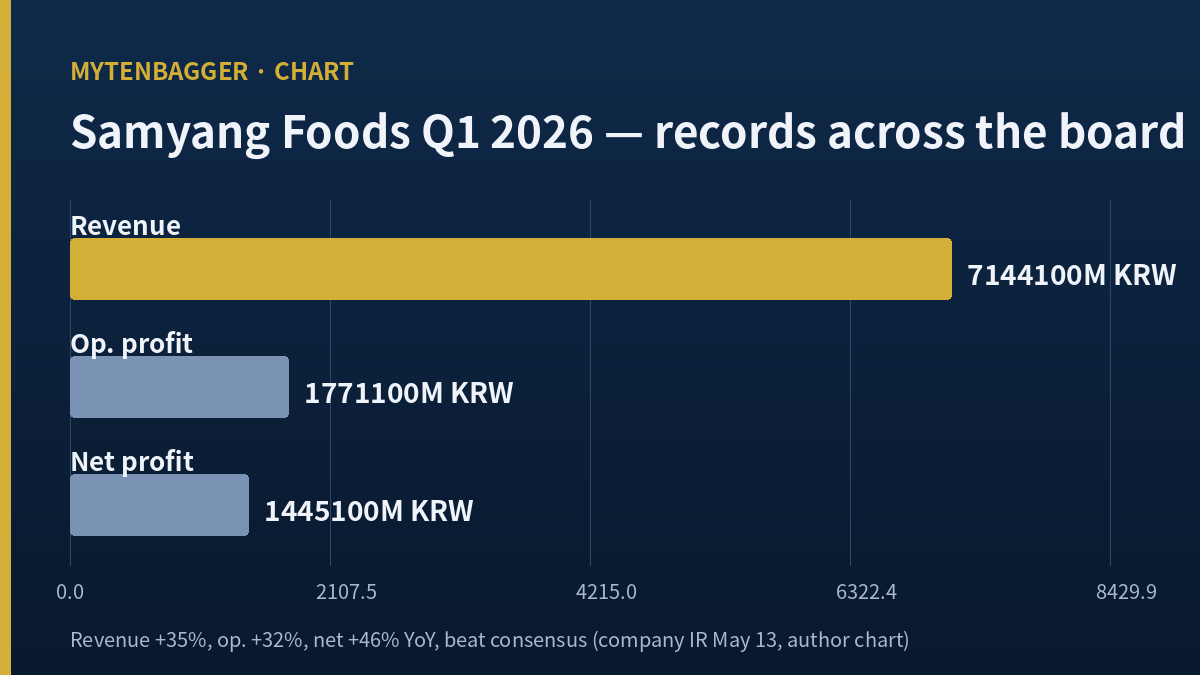
I reread the first-quarter 2026 print more than once. Revenue was 714.4 billion won (about $480 million per The Korea Herald), up 35% year over year; operating profit 177.1 billion won, up 32%; net profit 144.5 billion won, up 46%. All were quarterly records, and both revenue and operating profit beat consensus by 5.9% and 8.1% respectively (per Seoul Shinmun and Businesspost). Operating margin ran above 22% — a number you rarely see from a noodle maker.
The regional split impressed me more. Company figures put first-quarter overseas revenue at 585 billion won, more than 80% of the total, up 38%. Europe came in at 77 billion won (up 215%), the US at 185 billion won (up 37%), and China at 171 billion won (up 36%). The Korea Herald noted the European jump leaned on a new UK subsidiary and expanded distribution in Germany and the Netherlands. What I read into that is simple: this growth stands on three legs — Europe, the US, China — not just one. If tariffs shake one leg, the other two can carry it.
A neighbor in the same aisle has run that structure out much further. Orion books 68.2% of its 1.8343 trillion won of cumulative net sales through June outside Korea, split across three overseas units, and its fastest first-quarter profit growth came from Russia at 66.2% rather than the China story the market actually prices at 42.7%. Samyang is still building its legs; Orion has stood on its own long enough to show what the finished shape earns.
And yet on the day those numbers landed, Samyang Foods stock barely moved. Record earnings, a quiet tape. For a transaction-minded buyer, that temperature gap is a signal, not a warning. If the price were falling because earnings were breaking, I would not go near it. Earnings at a record while the price sags is a different animal — that is when I dig.
Two structural currents sit under this that I do not want to gloss over. One is the K-food export wave itself: per The Korea Herald’s tariff reporting, ramen made up $1.36 billion — 19.4% — of Korea’s $7.02 billion in food exports in 2024, with the US the single largest destination at roughly 20.8% of total K-food exports. This is not one company’s fluke; it is a national export category in which Samyang happens to hold the hottest brand. The other current is the currency. The company itself listed a weaker Korean won among the drivers of the first quarter, and the won has hovered near 1,500 per dollar — well weaker than a year ago. For an exporter that books most of its sales abroad and most of its costs at home, a soft won is a quiet, recurring tailwind that flatters exactly the overseas revenue that is growing fastest. I do not build a thesis on a currency, but I note which way the wind is blowing.
What I Actually Bought: Capacity, Not the Buldak Meme
Here is the part I most want to say. The market prices this company on Buldak demand — how many more people run the challenge this month. I think the true bottleneck of the past two years was not demand but supply. One brokerage titled its report “Shortage, Shortage, Shortage.” Orders overflowed; the factories could not keep up.
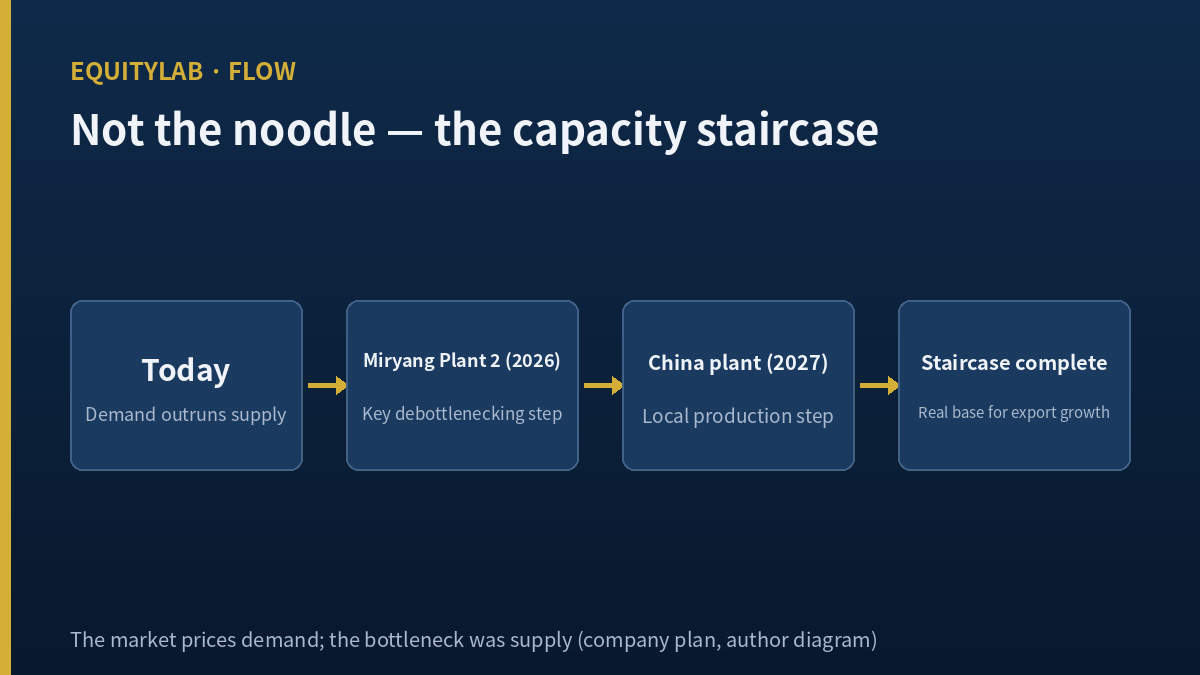
So I watch the Miryang No.2 plant. Pulling together reporting from Electronic Times and Insight Korea, Miryang No.2 is being completed in 2026 and reaches full capacity around September; once it runs, annual production capacity rises from roughly 1.8 billion to about 2.5 billion units, a 37% increase. Investment was raised from 164.3 billion to 183.8 billion won, and lines went from five to six. Wonju and Iksan account for 1.2 billion units, Miryang No.1 for 600 million, and Miryang No.2 for 700 million — 2.5 billion in total.
Why this matters: until now, demand existed but there was no product to ship. When the plant opens, revenue that lived only on order sheets converts into actual sales. I treat that as a far more reliable driver than a single new flavor landing. Flavor hits are hard to forecast; a plant has a completion date filed in disclosures. KB Securities layered a 2027 China plant on top as the next step up. So the supply staircase has two steps: Miryang in 2026, China in 2027. While the crowd watches the meme, I watch those two steps.
What makes a supply unlock dangerous — in a good way — is operating leverage. Fixed costs for plant and people are already sunk, so when volume rises 37%, a large share of the incremental revenue drops straight to profit. Whether that 22% operating margin widens further during the volume ramp is the key number I will be checking in the second and third quarters. The flip side: if the new line runs poorly at first, the added fixed cost lands before the volume does and margin dips for a spell. That is why I care less about the company’s “full capacity” calendar than about the quarter it shows up as real shipments and real margin.
The Real Risk to Samyang Foods Stock — US Tariffs and No US Plant
If I do not write the other side honestly, this stops being a journal and turns into a cheer. Samyang’s biggest weakness is plain: it has no factory in the United States.
The US imposed a 25% tariff on Korean goods effective April 9, 2025, per The Korea Herald. Samyang ships everything from Wonju, Iksan, and Miryang across the ocean — its US subsidiary revenue had jumped 127% to around $280 million, and all of it sits in the tariff-exposed lane. The comparison stings: The Korea Herald notes Nongshim has run US plants for years and CJ CheilJedang has a broad US manufacturing base, while Samyang has no domestic-production buffer at all. Its first overseas plant, due in 2027, will be in China — which faces even steeper tariffs. In the tariff era, two rivals hold the “made-in-America” shield and Samyang does not.
The response looks two-pronged. One lever is price. The Korea Herald reported Buldak prices rose in the US for the first time in three years. But ramen is a value food, and passing a tariff through as a price hike can push shoppers away. CEO Kim Dong-chan framed it as “a multifaceted approach… diversifying into other regional markets or improving cost structures.” The other lever is time — the tariff has moved through delays and negotiation, and its final shape is unsettled. There is a counter-view worth respecting: because Chinese-made noodles face higher duties still, Korean products may hold a relative edge, so tariffs are “not purely negative,” as some analysts put it. I grant that, but I still judge the missing US plant a structural weakness. This is the weakest link in my thesis, and I want it named.
Analysts See Samyang Foods Stock Nearly Doubling
I will lay out how the sell side sees it, plainly. These are not my numbers and I do not adopt them as my own — I record them only as observation. LS Securities set a 1.75 million won level on February 2, 2026; Hana Securities 1.80 million won on May 19; and KB Securities’ Ryu Eun-ae went to 1.95 million won with a buy view on June 4, applying 26 times 2026 estimated EPS. The high is Hanwha Investment & Securities at 2.0 million won, and the Newspim-compiled average is roughly 1.86 million won. Against today’s 1.07 million won, that average sits about 73% higher.
I do not believe those figures are “right.” I know sell-side numbers skew optimistic. What I read is direction: from 1.75 million in February to 1.95 million in June, the estimates kept rising — and they rose while the shares fell. Earnings pushing estimates up as the price drifts down is an uncommon divergence, and it is the kind of divergence I like to lean into rather than away from.
How Samyang Foods Stock Stacks Up Against Nissin and Nongshim
Two comparisons frame it for me. At home, Nongshim and Ottogi are the obvious peers. On current market metrics, Nongshim trades near 12 times earnings at 0.74 times book with a return on equity in the mid-single digits; Ottogi sits near 18 times earnings but below book at 0.51 times, with an operating margin under 5% and operating profit that recently went backward by about a fifth. Both are steady, domestically anchored companies whose growth engines have cooled. Samyang, at roughly 20 times earnings and above 6 times book, is clearly the expensive one — but it pairs that with a return on equity in the high-30s, a 22% operating margin, and revenue growing in the mid-30s. Nongshim and Ottogi are “cheap and safe”; Samyang is “pricey but compounding.” My income and defense slot is already filled, so what I was buying is the growth leg.
One qualification to my own shorthand, added later. Reading Nongshim’s first quarter on its own terms made “steady and domestically anchored” look like half a description: revenue rose ₩41.1bn and operating profit rose ₩11.4bn, a 27.7% incremental margin against a 7.22% consolidated margin. The trouble is that the company breaks out overseas revenue for seven countries and publishes no profit figure for any of them, so nobody outside can say where that 27.7% came from. Before sorting these names into growth and defensive buckets, it is worth asking how far each income statement can actually be taken apart.
There are also food names where lining up the multiples does not work at all. CJ CheilJedang earned 1.2336 trillion won in operating profit in 2025 and still closed the year with a net loss of 417.0 billion won, which leaves the P/E cell empty rather than high or low. It clears three of seven checklist items for a score of 43, and three of the four it fails — EPS, return on equity, and P/E — trace back to that single year of net loss. I wrote up the gap between operating profit and the bottom line there. A blank multiple does not mean cheap or expensive; it means not yet measured.
Globally, the reference points are Japan’s Nissin Foods (maker of Cup Noodles) and Toyo Suisan (Maruchan) — the mature giants of instant noodles. I am not going to quote their multiples here because I could not verify them to my standard, and I would rather leave a peer number out than print one I cannot stand behind. What I will say qualitatively is the contrast that matters: those Japanese majors grow their home market at low single digits, while Samyang is compounding overseas revenue in the mid-30s. This is a Korean challenger taking share in a category the Japanese incumbents defined. That framing, not a precise PE gap, is what I am underwriting.
Valuation — Is 20x Earnings Too Rich for Samyang Foods Stock?
This is where I have to be most honest. The stock is not cheap. It trades near 20 times earnings and above 6 times book, and the dividend yield is only about 0.4% (2025 dividend per share 4,800 won) — this is not an income name. On multiples alone, it is the kind of level my hands usually avoid.
What makes the multiple bearable to me is the quality of the growth: return on equity in the high-30s, operating margin above 22%, revenue up in the mid-30s. For a business compounding profit at that clip, 20 times earnings is not obviously expensive by growth-stock standards — and the 26 times KB used to build its number tells me the lens is not my own illusion. Of course, the moment growth slows, 20 times turns pricey in a hurry. So this is not a “buy it because it is cheap” purchase; it is a “bet that the growth continues” purchase. I am walking in with that distinction fully in mind.
The trajectory frames why the multiple has support. Samyang crossed 2 trillion won in annual revenue in 2025, and industry sources cited by Seoul Economic Daily peg a 3 trillion won target for 2026, contingent on sustained overseas momentum. The half-year mark reinforced it: The Investor reported first-half sales broke 1 trillion won (about $720 million) for the first time, with overseas revenue up 33%. A company moving from 2 to a possible 3 trillion won in a single year is not being valued on trailing earnings alone — it is being valued on a forward ramp, and the Miryang capacity is precisely what has to be in place for that ramp to be physically possible. That is the thread that ties the valuation back to the plant: the multiple is a bet on volume the factory now has to deliver.
Two Scenarios I Mapped Before Buying
I always write down two branches before I put money in, so that later I move on a rule I set in advance rather than on the emotion of the moment.
The bull branch runs like this. The August second-quarter print shows Miryang No.2 volume flowing through as revenue; Europe and China keep compounding at double digits; and the US tariff lands lower than feared, gets delayed again, or is offset by a negotiated deal. In that case the “tariff cliff” the market has been pricing fades, and the compressed multiple has room to re-expand toward the earnings that never stopped growing. The first hard confirmation — second-quarter shipments — is where I add my second slice.
The bear branch is the mirror. The 25% tariff is locked in, US margin gets shaved, the company pushes price to defend it and American shoppers drift to cheaper shelves, and grain costs press on the cost line at the same time. Layer on a Miryang ramp that stumbles on early yield problems, and the extra fixed cost eats margin before the volume arrives. If that combination shows up, I stop at the first slice. My single most-watched tell is the three legs: the moment two of Europe, the US, and China turn negative in the same quarter, the “supply-constrained, not demand-constrained” premise is broken. Real prices will settle somewhere between these two branches — and the fact that a confirming event (the Q2 print, the tariff outcome) is right in front of me is exactly why I sized the first slice small and kept powder dry.
How I’m Sizing My Samyang Foods Stock Position
So here is my frame. Earnings are at a record, growth stands on three regions, and a supply unlock — Miryang No.2 — is filed on the calendar. On the other side sit the US tariff, the missing US plant, and a rich multiple. The scale does not tip hard one way. So I do not buy it all at once: I take a small first slice now and hold the rest back. What decides whether I add: first, whether the August second-quarter print shows Miryang volume converting into actual sales; if orders become shipments, I add the second slice. Second, the final form of the US tariff; if 25% lands, US margin visibly erodes, and management shows no offsetting card, I stop at the first slice and step back to watching. That is my line.
The clearest signal that I am simply wrong is elsewhere: if the growth rate snaps to the low teens, or if two of the three overseas legs turn to negative growth at once, then my premise — “it sells once supply is freed” — has broken, and I put the name back in the watch drawer until the multiple normalizes. I missed this stock in 2023 by calling it a fad; this time I am trying not to miss it by calling it expensive, so I wrote down the reasoning and the tripwire and put a small foot in. How this reads to me in six months is a question the earnings will answer. This is a record of my own account.
Sources I leaned on: The Korea Herald — record quarter on Europe growth, The Investor — half-year sales break 1 trillion won, The Korea Herald — US tariffs on Korean ramyeon, The Korea Times — can Buldak defy US tariffs, The Korea Herald — Buldak prices rise in the US, Seoul Economic Daily — Korean food giants’ record Q1.
Related reading