Asia Holdings Stock Has No Visible Analyst and Two Sets of Owners
I opened this company expecting to argue about cement. I ended up arguing about who owns the equity, because the consolidated balance sheet turned out to have two answers and the market only prices one of them.
Contents
The KOSPI, and where Asia Holdings stock sits on it
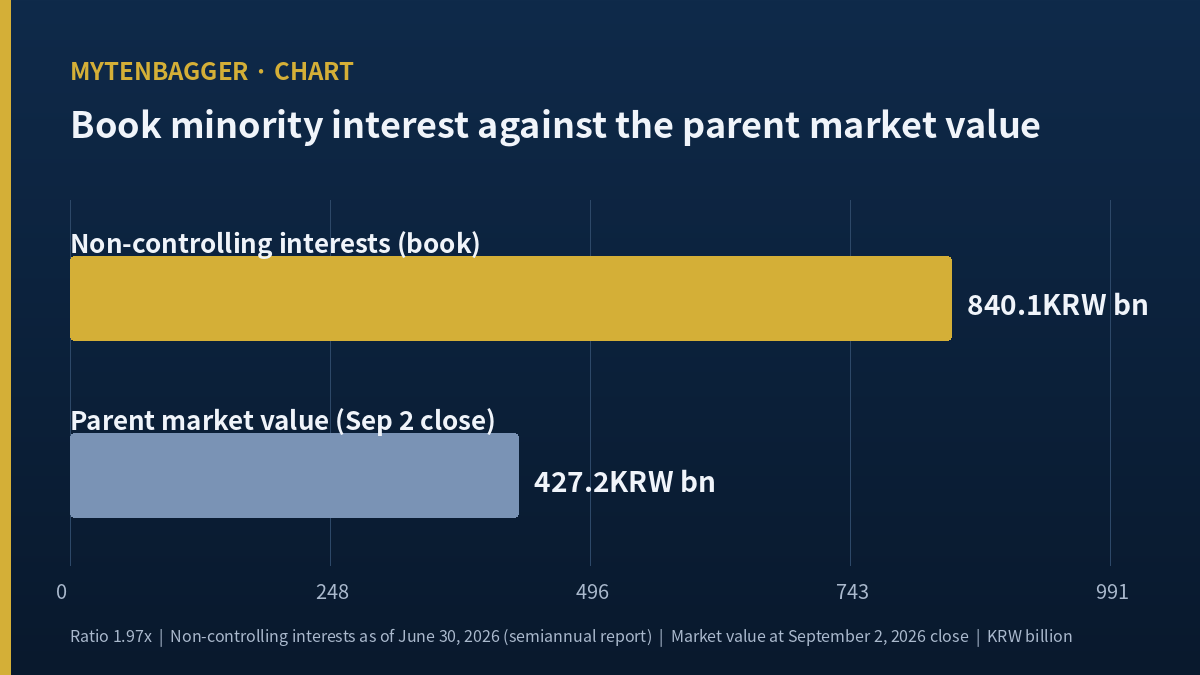
Three things came out of this session. First, non-controlling interests on the consolidated balance sheet stood at KRW 840.1 billion at the June 30 reporting date, against a market value of KRW 427.2 billion for the whole listed parent at the September 2 close, 64 days later. Second, none of the four consensus venues I checked carries an estimate on this company, while three houses publish on its listed cement subsidiary. Third, 1,905 shares changed hands on the September 2 session, which comes to roughly KRW 395 million of turnover.
What I did not confirm: the acquisition method behind the 21.2 percent treasury block, the names and stakes of the fourteen companies inside the consolidation, and why a dividend-implied count of 1,645,219 shares sits 22,843 above the 1,622,375 that remain once the 21.20 percent treasury block is removed.
What I did: nothing. I hold no position and placed no order.
The exchange
The KOSPI is the senior board of the Korea Exchange in Seoul, the venue where the country’s large industrial names list. It is not an over-the-counter tier and it is not the venture board, which is called the KOSDAQ. Asia Holdings Co., Ltd. trades on the KOSPI under 002030 and closed at KRW 207,500 on Wednesday, September 2, 2026. At 2,058,852 shares outstanding on WiseReport’s company screen, that is KRW 427.2 billion by my own multiplication, or about USD 312 million.
What the company actually is
I could not find an operating business it runs under its own name. It owns 58.41 percent of Asia Cement Co. (183190) and 53.57 percent of Asia Paper Manufacturing Co. (002310), both separately listed on the same exchange. Those two stakes are the current figures on WiseReport’s shareholding screens; the 2025 annual filings put them at 56.91 and 52.20 percent, and I used the screen values because they are the later ones. WiseReport’s company profile counts fourteen companies inside the consolidation in total, and I could not establish whether the two listed ones sit among that fourteen or outside it. By 2025 segment mix, paper is the larger contributor at 60.50 percent of sales against cement at 54.03 percent, with 4.82 percent other and minus 19.35 percent of intra-group elimination. The four figures sum to exactly 100.00.
The consolidated balance sheet splits into two owners
The June 30 numbers
| Item, consolidated, as of 2026-06-30 | KRW bn | Share of total equity |
|---|---|---|
| Total equity | 2,050.8 | 100.00% |
| Equity attributable to owners of the parent | 1,210.7 | 59.04% |
| Non-controlling interests | 840.1 | 40.96% |
| Total assets | 3,308.6 | n/a |
| Total liabilities | 1,257.8 | n/a |
The figures come from a data feed carrying the consolidated statements of the half-year report filed with the Korean regulator on Friday, August 14, 2026, receipt number 20260814002416. I could not open the filing document itself; the regulator’s full-text system refused me throughout this session. I converted the million-won figures to billions and checked that the two owner lines add back to total equity exactly.
Why the split is this wide
Because the two operating businesses are themselves listed. When a parent consolidates a subsidiary it owns 58 percent of, the other 42 percent of that subsidiary’s book equity still appears on the parent’s balance sheet, tagged as belonging to someone else. Do that twice and the tag covers 40.96 percent of everything. On plenty of Korean balance sheets that line is small enough to skip past. Here it is 40.96 percent of consolidated equity and larger than the market value of the whole listed parent.
Forty-one percent of the equity behind Asia Holdings stock belongs to somebody else
One number against another
KRW 840.1 billion of non-controlling interest against KRW 427.2 billion of market value for the entire parent. The ratio comes out to 1.97 times. The book value of the slice that is explicitly not the parent’s is almost twice what the market pays for the parent in full. In dollars, roughly USD 614 million against USD 312 million.
What that comparison does and does not prove
It does not prove the parent is cheap. Book and market are different measurements, and a company can carry large minority book value while being expensively priced on earnings. What it does establish is that anyone reading a headline price-to-book for this name has to say which equity they mean. Against owners’ equity of KRW 1,210.7 billion the multiple is 0.35. Against total equity of KRW 2,050.8 billion it is 0.21. Those are not two opinions. They are two denominators, and screens do not always tell you which one they used.
A check I ran on the minority slice
The listed portion of that minority can be priced directly. Outsiders hold 41.59 percent of Asia Cement and 46.43 percent of Asia Paper, which at the September 2 closes is KRW 156.2 billion and KRW 154.7 billion, KRW 310.9 billion together. Against KRW 840.1 billion of book minority interest that is 37 percent, and that comparison is mine, not a filing’s. The gap has two innocent explanations: the book figure also covers minorities in companies that are not listed, and a book number and a price are different measurements. Still, the direction is worth stating plainly. Where the market can vote on the minority slice it votes at 37 percent of book, close to the 35 percent at which it prices the parent.
The sum I did not build
A reader who knows Korean holding companies will ask why I have not priced the two listed stakes at market and set the total against the parent’s own market value. I ran that calculation, and I kept it out of this piece deliberately. It is the whole subject of the Korean-language edition of this journal for the same company, published on the same date, and repeating it here would give me two pieces making one argument. The balance sheet question in front of me is a different one: not what the stakes fetch, but who the consolidated equity says it belongs to.
Three houses cover the subsidiary and none covers Asia Holdings stock
Four places I looked
WiseReport’s company screen returns the line that no opinion has been submitted in the last three months. The same site’s research page has been discontinued. ValueLine Korea and Alphasquare carry no consensus field for this code at all. Four venues, four blanks.
Three that do cover the subsidiary
NH Investment and Securities, Shinhan Investment and Hyundai Motor Securities all publish on Asia Cement, the 58.41 percent subsidiary. I looked at that company separately in an earlier piece on its book multiple, and the coverage was there then too. Same group, same construction cycle, same reporting calendar. The estimates attach to the company one level down.
Why I did not build a valuation table
I have no figure of my own to print and no third-party figure that belongs to this company. The three houses publish on the subsidiary, and their numbers are the subsidiary’s. Lifting them up a level and labeling them as the parent’s would be transplanting, not quoting. So this piece has no such column at all.
What a coverage gap actually removes
Not a forecast, a second reader
The obvious loss is the forward estimate. The larger loss, for a piece like this one, is that nobody outside the company is checking the sums I just ran. When three houses publish on a name, a mistake in my reading of the segment mix or the minority line eventually collides with somebody else’s published version of it. Here there is no collision to have.
Who stands in the analysts’ place
Ownership, mostly. A company called Kyesan Industrial and three related parties hold 240,862 shares, or 11.70 percent. The Korean outlet Dealsite reported the block on Wednesday, June 17, 2026, put cumulative purchases at about KRW 60.7 billion and called it a swing vote; that is the report’s date, not necessarily the stake’s reference date. VIP Asset Management holds 9.54 percent. It cut from 11.81 to 10.61 percent on December 18, 2025 and moved its stated purpose from general investment to simple investment, a downgrade in the Korean filing categories. I found no record of a campaign it was running, so I read the change as a step back from involvement and not as the end of one. I could not establish when the position fell further to 9.54 percent.
The half-year numbers under Asia Holdings stock
| Consolidated, KRW bn | H1 2026 | H1 2025 | Change |
|---|---|---|---|
| Revenue | 968.2 | 935.4 | +3.50% |
| Operating profit | 60.1 | 76.7 | -21.57% |
| Net income, consolidated | 42.0 | 48.9 | -14.04% |
| Net income, owners of the parent | 25.2 | 28.3 | -10.81% |
Two years of decline before that
Full-year operating profit went from KRW 240.4 billion in 2023 to KRW 172.4 billion in 2024 to KRW 111.0 billion in 2025, a fall of 53.81 percent across two years. Net income attributable to owners went from KRW 93.3 billion to KRW 31.0 billion over the same stretch, down 66.84 percent. Note that 2023 was itself an up year on every line, so the run of declines is two years long and not three. The two decline rates differ because interest and tax cut again below the operating line: consolidated net income fell 70.80 percent over the same span, more than the owners’ line, so the minority share cushioned the parent instead of widening the gap. Figures come from a data feed that carries the 2025 annual consolidated statements, filing receipt number 20260326000458; I could not open the filing document itself.
The subsidiary’s own half
Asia Cement reported first-half revenue of KRW 518.3 billion, up 2.7 percent, with operating profit of KRW 35.0 billion, down 30.8 percent. In the Korean daily Edaily’s August 31 table of five cement producers, that was the steepest operating decline of the group. Hanil Cement rose 21.9 percent, Ssangyong rose 46.3 percent, Sungshin rose 21.6 percent and Sampyo fell 28.9 percent.
Leverage, and what the interest line costs
Consolidated liabilities of KRW 1,257.8 billion against equity of KRW 2,050.8 billion puts the debt-to-equity ratio at 61.33 percent, which is unremarkable for a group carrying two heavy-industry balance sheets. Interest expense ran KRW 17.6 billion in the half. Set against operating profit of KRW 60.1 billion, that is 3.41 times cover on the same six months. The number is comfortable now and it was more comfortable before: on the 2025 full year the same two lines were KRW 111.0 billion and KRW 34.5 billion, or 3.22 times, and in 2023 they were KRW 240.4 billion and KRW 35.3 billion, or 6.82 times. Interest barely moved across those three years. Operating profit did all of the work.
Two ways to read the words net income here
Two figures for the same second quarter sit on two Korean screens: ValueLine shows about KRW 15.8 billion and Alphasquare about KRW 25.7 billion. I settled it against the half-year statements. Discrete second-quarter net income attributable to owners was KRW 15.9 billion; discrete second-quarter consolidated net income was KRW 25.3 billion. The screens were counting different things and neither was inventing one, though Alphasquare’s figure also runs 1.3 percent above the consolidated number in the statements and I did not resolve that residue.
This is the failure mode a large minority creates. Minorities took KRW 16.8 billion of the KRW 42.0 billion half-year consolidated profit, which is 40.0 percent of it by my calculation. Where that share is small the two definitions differ by noise and nobody has to specify. Here they differ by 59 percent of the smaller number. Any ratio built on the word earnings for this company needs the qualifier attached.
Liquidity, and what one session says about Asia Holdings stock
One session of volume
Alphasquare records 1,905 shares traded on Wednesday, September 2, 2026. At the closing price that is KRW 395 million, or roughly USD 289,000, against a KRW 427.2 billion market value. The day’s turnover was 0.09 percent of the company.
And most of it does not move
The founding family and related parties hold 45.72 percent across ten names, led by chairman Lee Hoon-bum at 14.62 percent and honorary chairman Lee Byung-moo at 12.18 percent. The company itself holds 21.20 percent in treasury. Add those and 66.92 percent is not available. Whatever the balance sheet says about value, the mechanism that would express it has this much room to work in.
Global operating holdings for comparison
| Company | Revenue, TTM to 2026-06-30 | Operating income, same period | Market cap | Price to book |
|---|---|---|---|---|
| Loews Corporation (NYSE: L) | USD 18,694m | USD 2,625m | USD 22.13bn | 1.16 |
| Bouygues SA (EPA: EN) | EUR 56,329m | EUR 2,297m | EUR 17.13bn | 1.20 |
| Asia Holdings (KRX: 002030) | KRW 1,884.5bn, FY2025 | KRW 111.0bn, FY2025 | KRW 427.2bn | 0.35 on owners’ equity |
The rule I used to pick them, and where it strains
The rule selects peers, not my own row. I looked for listed operating holdings whose trailing period ends on the same date as my balance-sheet date, June 30, 2026, so their figures sit as close as possible to what I am reading here, and I compared them on price to book only. Loews holds a listed insurance subsidiary, CNA Financial, which is structurally the same arrangement as the one here. Bouygues is a French construction and telecoms group, and conglomerate discounts are routinely discussed in connection with it. Revenue, operating income, market capitalization and price to book for both peers come from stockanalysis.com as displayed on September 2, 2026; the site does not state which equity its price-to-book figure uses.
Three strains I will name instead of hiding. My own row breaks the rule that picked the peers: its revenue and operating profit are full-year 2025, because the Korean statements do not present a rolling annual figure and I chose not to build one. I did not convert the three currencies, so the size columns cannot be read across rows and sit there only to show the order of size within each row. And the last column, the one column meant to be read across, has a denominator I specified for my row and did not learn for theirs.
What the last column says
Both global operating holdings trade above book. This one trades at roughly a third of it on the owners’ measure and a fifth on the consolidated measure. That is a gap of a different order from the peer rows, and the Korean holding company discount is the standard explanation. SK Securities analyst Choi Kwan-soon put the average net asset value discount across nine covered Korean holding companies at 53.9 percent in a May 28, 2026 note, down from above 60 percent in 2020.
Where the screens disagreed with the filings
| Item | Values I found | What I used and why |
|---|---|---|
| September 2 close | 207,500 on three screens; 214,500 on one | 207,500, the value three sources agree on |
| Shares outstanding | 2,058,852 / 2,058,795 / 2,058,579 | 2,058,852; the spread is 273 shares, 0.013% |
| Book value per share | 591,929 / 588,045 / 722,172 | 588,045, the only one I could reproduce by dividing |
| Dividend yield | 2.61% and 2.70% | 2.70%, which is 5,600 over the close I used |
| 250-day high and low | 402,000 and 157,800, marked as adjusted closes | Used as given; my recomputation matched to one decimal |
The last row deserves a note because it went the other way on the names I worked through in August 2026. There, that high and low pair turned out to be intraday extremes while carrying a closing-price label, which threw drawdown calculations off by several percentage points. Here the label and the values agree: at 207,500 the drawdown from the high is 48.38 percent and the recovery from the low is 31.50 percent, against 48.4 and 31.5 on the screen.
Ten arguments against what I wrote about Asia Holdings stock
- Comparing book minority interest with market capitalization puts two different measurements side by side. The 1.97 times figure is arithmetically true and economically loose.
- The Korean holding company discount has a tax basis. The Korea Capital Market Institute’s September 5, 2025 report puts the combined burden on dividend income at 37.8 percent under separate taxation and 58.8 percent at the top comprehensive rate. A holding company is an extra layer in that chain.
- The same discount is already narrowing on the sell-side’s own measure, from above 60 percent in 2020 to 53.9 percent in May 2026. If so, the gap I am describing is a known and shrinking one.
- Two consecutive down years, with a third running in the half just reported, is the simplest explanation for a low multiple and I have not ruled it out.
- Cement demand is genuinely poor. Domestic shipments of 38.1 million tonnes in 2025 were the lowest since 1991, and 2026 is forecast near 36 million.
- Industrial electricity prices in Korea have risen roughly 70 percent since 2022, and power is a large share of what it costs to make cement.
- Hyundai Motor Securities analyst Shin Dong-hyun, quoted by the Korean outlet Biz Tribune on March 19, 2026, argued that with 2025 first-half construction starts down 17.4 percent, meaningful shipment growth in 2026 is hard to expect.
- The largest outside institutional holder cut its stake and downgraded its stated purpose to simple investment, removing the most visible outside pressure I could identify, whatever it had been pressing for.
- I could not verify the acquisition method or the reference date of the 21.2 percent treasury block, and both matter to any argument about it.
- I valued the unlisted part of the consolidation at nothing because I could not name a single company in it. Zero is not conservative when it is simply unknown, and two of the fourteen may be the listed companies I already counted.
My position on Asia Holdings stock and what would end it
Where I stand
I hold none of it and I placed no order. At KRW 427.2 billion the market value is well down the exchange’s size table, and below the size line I set for myself I do not take a buying or holding stance at all. My stance here is narrower than usual: I will not lean on a gap that nobody outside the company is measuring. The balance sheet says one thing, the price says another, and none of the four venues I checked carries a published view on which is right.
Two conditions, both about the split and neither about the price
Condition one. If the third-quarter report, due after Monday, November 16, 2026, shows non-controlling interests falling as a share of consolidated equity, then the two-owner split is closing, whether because the parent bought minorities out or because the subsidiaries retired their own shares. That would date this piece, and I would rewrite it against the new split.
Condition two. If any house initiates coverage on the parent, the part of my stance that rests on nobody checking the sums ends that day. I would read their split of the equity before repeating mine, because the first thing a published model has to choose is the same denominator I had to choose.
One known event sits inside that window and does not settle either condition. The company signed a KRW 8.0 billion treasury-share trust on Wednesday, June 10, 2026 with NH Investment and Securities, running to Wednesday, December 9, 2026. Buying its own shares changes the count of claims on the parent’s own equity; it does not move the line between owners and minorities, which is where this piece lives. I record no buying decision either way.
Where I will look, decided now
Last time I fixed in advance where a failed condition would be recorded. This time I am fixing where the evidence will come from, because the regulator’s full-text system was closed to me throughout this session and I expect it to refuse me the next time as well. The equity split comes from the same data feed that carried the half-year statements, the two subsidiary stakes from each company’s WiseReport shareholding screen, and any coverage initiation from the WiseReport company screen that told me there was none. Naming the venue now is the difference between a condition and a wish.
Prices, dates and conversion
Prices and multiples reflect the Wednesday, September 2, 2026 close as checked at the time of writing and the difference grows with that gap. Korean won is the reference currency throughout, and dollar figures are approximate conversions at about KRW 1,368.7 per dollar, the Seoul market rate quoted at 15:30 on the same date by Money Today and Asia Economy. Financial figures come from a data feed carrying the consolidated filings, restated from millions to billions of won, because the regulator’s own document system was closed to me. Every ratio, percentage change and difference in this piece is my own arithmetic on those figures rather than a line lifted from a statement, whether or not the sentence around it says so.
Related reading: a recent piece on cash flow at a paper mill
Sources: WiseReport company screen, WiseReport shareholding screen, Alphasquare, Kiwoom disclosure viewer, Edaily on first-half cement results, Dealsite on the Kyesan Industrial block, Korea Capital Market Institute on dividend taxation, stockanalysis.com for Loews, stockanalysis.com for Bouygues, Money Today on the September 2 exchange rate.
Related reading