HIGEN RNM Gross Profit Fell 74% on Nearly Flat Motor Sales
“The motors kept selling. What each motor left behind is what disappeared.”
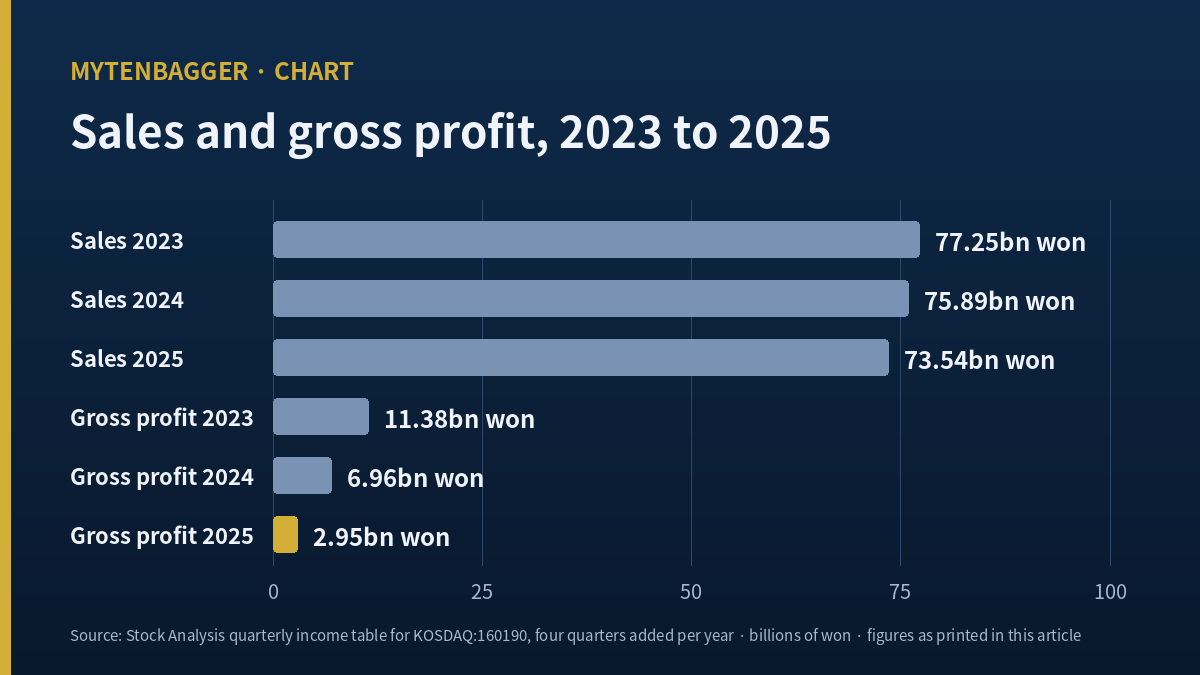
sales, 2023 to 2025 (77.25bn to 73.54bn won)
kept after production costs, same years (11.38bn to 2.95bn won)
Where I stand on HIGEN RNM stock: watching, no shares. I want to see sales minus the cost of making them climb back above zero in the September quarter before the robot story gets any credit from me.
HIGEN RNM stock closed at 29,400 won on September 23, 2026, and the first thing I did was set aside the robot headlines and line up three years of sales next to three years of gross profit. Sales barely moved. In 2023 the company sold 77.25 billion won of motors and related products; in 2025 it sold 73.54 billion won. Gross profit, the amount left after the direct cost of making those motors, went from 11.38 billion won to 2.95 billion won over the same span. Then, in the October to December 2025 quarter and again in January to March 2026, it went below zero.
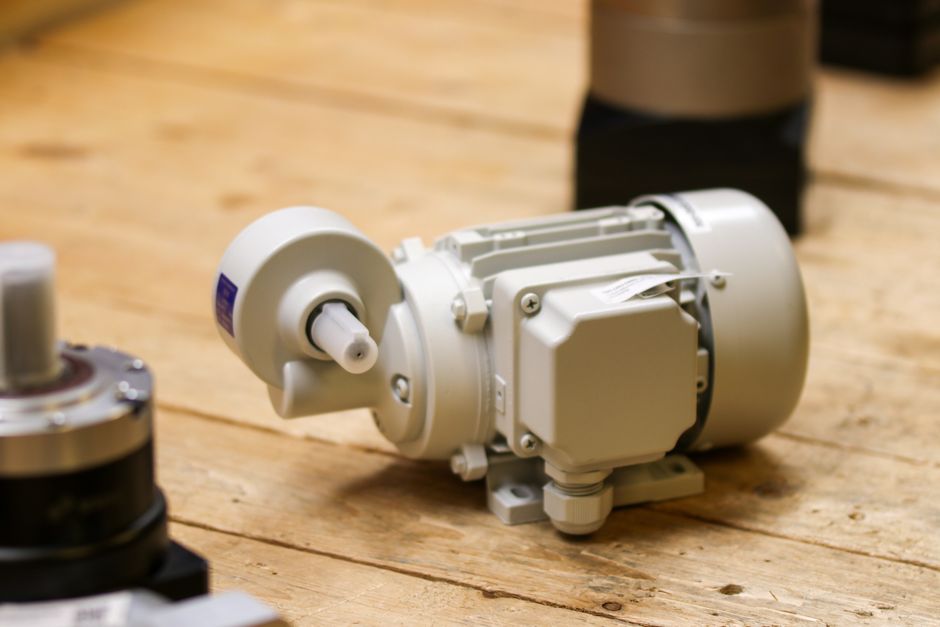
I do not own this stock. HIGEN RNM (listed on KOSDAQ, Korea’s growth-company board, and known as HIGEN Motor before a name change) makes industrial electric motors, and in the last year its share price has swung by a factor of about eight between its low and its high as investors attached robot-joint actuators to the name. Before I have any view on that swing, I want to understand why a factory that sells about the same amount every year now keeps almost nothing from those sales.
Contents
HIGEN RNM stock and three years of nearly the same sales
The sales record is steady enough to be almost dull, and that steadiness is what makes the rest of the picture odd. According to the company’s 2024 listing prospectus, as Asia Economy described it in May 2024, annual sales were 85.2 billion won in 2021, 87.5 billion won in 2022 and 77.2 billion won in 2023. The quarterly table on Stock Analysis puts 2024 at 75.89 billion won and 2025 at 73.54 billion won when I add up the four quarters of each year.
So from 2022 to 2025, sales fell about 16%, by my arithmetic, and from 2023 to 2025 only 4.8%. Individual quarters stayed between 15.89 billion won and 22.78 billion won for the whole stretch from January 2023 to March 2026. There is no quarter in that table where demand simply vanished.
The two sources agree where they overlap. The prospectus figure for 2023 sales, 77.2 billion won, matches the 77.25 billion won I get by adding the four 2023 quarters on Stock Analysis, and the 4.3 billion won operating profit Asia Economy cited for 2023 matches the 4.33 billion won sum of those quarters. I did not find gross figures for 2021 or 2022, so my comparison of what the factory kept starts in 2023.
I mention this first because the easy story for a loss-making motor maker is that construction slowed, orders dried up and the factory ran empty. That story needs sales to fall hard. They did not fall hard. Whatever went wrong happened inside each sale.
What HIGEN RNM stock buyers get from each won of sales
Here is the same three years with the amount kept next to sales. The percentages are my own division of the two columns.
| Year | Sales (bn won) | Gross profit (bn won) | Share of sales kept | Operating result (bn won) |
|---|---|---|---|---|
| 2023 | 77.25 | 11.38 | 14.7% | +4.33 |
| 2024 | 75.89 | 6.96 | 9.2% | −0.37 |
| 2025 | 73.54 | 2.95 | 4.0% | −8.91 |
| Jan-Mar 2026 | 18.63 | −0.29 | −1.5% | −3.40 |
Source: Stock Analysis quarterly income table for KOSDAQ:160190, four quarters added per year. Share of sales kept and all annual sums are my own arithmetic.
Out of every 100 won of sales in 2023, the company kept about 14.7 won after paying for materials, factory labor and the other direct costs of production. By 2025 it kept about 4 won. In the first three months of 2026 it kept less than nothing: each 100 won of motors sold cost roughly 101.5 won to make.
The quarter-by-quarter slide
The annual sums hide how uneven the slide was. Going quarter by quarter, the share of sales kept was 15.6% in January to March 2023, then 4.3%, 8.5% and 4.9% in the first three quarters of 2025, then about −0.1% in October to December 2025 and −1.5% in January to March 2026. The worst quarter for sales in that run, July to September 2025 at 15.89 billion won, was not the worst quarter at the gross level. The two quarters below zero came with sales of 22.78 billion won and 18.63 billion won, which are among the better sales quarters in the table.
That last detail is the one I keep coming back to. If a factory loses money on its product only when volume drops, fixed costs are the villain and volume is the cure. Here the losses at the gross level showed up in quarters with normal or even strong sales. More volume at these prices would not obviously have helped.
I also checked whether the company had been building up unsold motors, because a factory that produces far ahead of demand can end up cutting prices to clear the shelves. It had not. Inventory on the ValueLine balance sheet page (Korean data service) was 16.67 billion won at the end of 2024, 16.37 billion won at the end of 2025 and 17.12 billion won at the end of June 2026. That is close to one quarter of sales at each point and barely moved. Whatever pushed the gross level below zero, it does not look like a warehouse full of motors being dumped at a loss.
That leaves two broad explanations, and I cannot yet choose between them. One is on the cost side: steel, copper and other inputs, or factory labor, rising faster than the company could pass on. The other is on the price side: customers or imported competitors forcing prices down on standard motors. The two can happen together. The company’s reports should say which, and until they do I am treating both as open.
HIGEN RNM stock and the costs below the factory line
Gross profit is only the first cut. Below it sit selling, general and administrative costs, research spending and everything else that separates the gross line from operating profit. The company’s detailed split is in its reports, which I did not open line by line for this entry, so I backed out one total: the gross line minus operating result.
That total was about 7.04 billion won in 2023, 7.33 billion won in 2024 and 11.86 billion won in 2025, by my arithmetic from the same table. Over two years it rose roughly 68%, while sales fell 4.8%. So the operating loss of 8.91 billion won in 2025 came from two directions at once: the factory kept about 8.4 billion won less per year at the gross level than in 2023, and the spending below that grew by 4.82 billion won.
I read the second number with some care. A company preparing a new product family, such as actuators for robot joints, would be expected to spend more on engineers and prototypes before any of it shows up in sales. The company’s own listing prospectus earmarked money for actuator development and a robot assembly and test site. Some of that 4.82 billion won increase is probably exactly that. But the first number, the collapse at the gross level, is not a research cost. It is the existing motor business earning less on each unit it already sells.
The operating result tells the same story in a sharper way when I set the quarters side by side. In 2023 all four quarters were positive: 1.48, 0.45, 1.85 and 0.55 billion won. In 2024 the first two were still positive at 0.58 and 0.34 billion won, and then the sign flipped: −0.43 and −0.85 billion won. Every quarter since has been a loss, −2.38, −1.39, −2.09 and −3.05 billion won through 2025, and −3.40 and −1.47 billion won in the first two quarters of 2026. The last profitable quarter at the operating level was April to June 2024, more than two years before the September 2026 close I am writing against.
That timing matters for how I think about the robot program. If the losses had begun only once the company ramped up actuator work, I could treat them as the cost of an option. They began earlier, in the same quarters where the gross level started to fall, and they widened as that level kept falling.
Where my first read went wrong
The operating loss fooled me at the start. When I first opened the numbers, I saw the operating loss widen from 0.37 billion won to 8.91 billion won between 2024 and 2025 and assumed most of it was robot spending, the cost of a bet that the market was already paying for. That would have been a comfortable story: the old business steady, the new one burning cash on purpose. It took the gross column to show me that nearly all of the damage had started above the spending lines, in the plain motor business, and that it began in 2024, before the robot excitement pushed the share price up.
I am still not sure what drove it. Input costs, pricing pressure from imported motors, the product mix, or preparation for the 2026 efficiency rule could each play a part, and I have not seen the company break it out. What I can say is that the loss is not where I first assumed it was.
HIGEN RNM stock next to a US motor maker
To check whether a gross-level collapse is simply what the motor business looks like right now, I lined HIGEN RNM up against one listed US maker of motors and power transmission parts, Regal Rexnord (NYSE: RRX). I took only one thing from it: whether its gross line stayed above zero in the same five quarters, January 2025 through March 2026. I did not compare size, valuation or growth, because a company with more than a billion dollars of sales a quarter is not a like-for-like peer for a 20 billion won quarter.
On the Stock Analysis quarterly table for Regal Rexnord, gross profit as a share of sales was 37.59%, 37.95%, 37.28%, 37.46% and 37.60% across those five quarters. None of them went below zero. For HIGEN RNM, two of the same five did.
For context on scale only, Regal Rexnord’s quarterly sales in that stretch sat between $1.42 billion and $1.56 billion, which means a single one of its quarters is roughly 26 times HIGEN RNM’s annual sales at about 1,358 won per dollar. I did not use that to argue anything about value. The only point of the comparison is that a motor maker with its own cost pressures from metals and labor still kept well above zero in every one of the five quarters.
That tells me the problem is not a sector-wide price war that every motor maker is living through at once. At least one large competitor held its gross level steady to within about 0.7 of a percentage point while HIGEN RNM’s went from positive to negative. The comparison does not tell me why, and a US company selling into different end markets is only a partial check. It is enough to stop me from blaming the whole industry.
Other Korean robot-parts names show different patterns again. SPG Co, the gear reducer maker, stays profitable even if it earns less per won of sales than its Japanese peer, and Doosan Robotics grew sales fast while losses barely narrowed. HIGEN RNM sits in a third group: sales roughly unchanged, and the loss building from the product itself.
HIGEN RNM stock and the robot case I am not pricing in
I want to be fair to the people buying this stock, because there is a real case on the other side. Here are six points that argue against my caution.
- The efficiency rule. Korea’s move in 2026 to require IE4, the super-premium class in the international motor efficiency scale that runs from IE1 to IE5, for industrial motors, should force customers to replace older motors. A July 2025 company-visit note from Daishin Securities (Korean sell-side, in Korean) framed this as a source of both volume and better pricing. If that pricing shows up, the gross level could recover quickly.
- The actuator option. The same Daishin note described humanoid robots as needing dozens of joint actuators each. HIGEN RNM’s servo and actuator line is small today, but if it wins even a modest supply role, the mix of what it sells would change.
- Sector momentum. Korean robot-component stocks rallied in September 2026 as large conglomerates named robotics as a growth area, and Pinpoint News (Korean press) singled out HIGEN RNM’s precision motors and controllers on September 18. Buyers are pricing a future business, and the current gross numbers may simply be irrelevant to them.
- The worst quarter may be behind it. The April to June 2026 quarter produced sales of 20.80 billion won and an operating loss of 1.47 billion won, from the company’s own filing via Kiwoom data. That operating loss is smaller than the 3.40 billion won loss in January to March, which could mean the gross level improved in the second quarter. I do not have the gross figure for that quarter yet.
- A price-sensitive rule change can cut both ways. If the company deliberately priced low in 2025 to win share before IE4, the negative quarters might be an investment and not a breakdown.
- Cash is not the problem today. The company holds enough cash and short-term deposits to fund these losses for some time, so it can afford to wait for either the efficiency cycle or the robot orders.
Every one of these is plausible. What none of them does is show me a quarter where the existing motor business earned more per unit than it did in 2023. That is the evidence I am waiting for.
I also found no named brokerage that has put a number on 2026 or 2027 profit in the last twelve months. The Daishin note is marked not rated and carries no price objective, and it was written more than a year ago. For a stock that has moved this much, the absence of a current forecast from anyone who has to sign their name to it is itself something I note.
Two paths into the November report
The company’s report for July to September 2026 is due by November 16, 2026 (Mon). I see two broad outcomes and put rough odds on them, as a personal view and nothing more.
Path one: the gross level stays near zero (about 60%)
Sales land somewhere between 17 and 22 billion won, as they have for three years, and the gross line stays within a few hundred million won of zero either way. In that case the operating loss for the first nine months stays large, the spending below the factory line keeps growing with the robot program, and the stock keeps trading on stories about customers it has not yet named. I think this is the more likely path because nothing in the public record so far shows the cause of the slide being fixed.
Path two: IE4 pricing arrives (about 40%)
Customers replacing old motors under the new rule accept higher prices, and the company keeps, say, 8 won or more out of each 100 won of sales again, back toward its April to June 2025 level. That would not fix the operating loss by itself, since the spending below has grown, but it would show the core business can still earn at the gross level. To put that in money: at about 20 billion won of sales a quarter, keeping 8% would mean roughly 1.6 billion won at the gross level, while the spending below that line averaged close to 3 billion won a quarter in 2025. In that case the quarterly operating loss would shrink from roughly 3 billion won to somewhere near 1.37 billion won, by my arithmetic, and it would still be a loss. That is why I treat the gross line as the first test and not the last one. If this path shows up in the November report, I would start to take the robot option more seriously, because the motor business would no longer be draining it.
What would put HIGEN RNM stock back on my watch list
These are the conditions that would change my stance. Any one of them would make me reopen the file; several together would make me consider owning it.
- Gross profit for July to September 2026 is positive and above 5% of sales.
- Gross profit for the first nine months of 2026 is positive in total, which would mean the second and third quarters more than made up for the first.
- The company explains the 2025 decline in its own words, by product or by cost item, in a report or a disclosure.
- A named customer or a disclosed supply contract for actuators appears, with an amount attached.
- A named brokerage publishes a numeric forecast for 2027, whatever it says.
- The spending below the factory line stops growing faster than sales for two straight quarters.
The opposite result matters too. If the November report shows another quarter below zero at the gross level while sales hold steady, I would treat that as the pattern confirming itself and stop looking until the company says something about pricing.
The figures I left out
A few numbers I looked at and chose not to lean on, with the reason for each.
The company’s price-to-sales and price-to-equity multiples. With the gross level near zero, a sales multiple mostly tells me how hopeful the market is, which I can already see from the share price. I left multiples out of the argument on purpose.
The market value in dollars. At the September 23 close, 29,400 won times the shares in issue gives a market value of about 908 billion won, roughly $669 million at about 1,358 won per dollar. I note it for scale only. Nothing in my case depends on it.
The gross figure for April to June 2026. Stock Analysis had not yet posted it when I checked, and I did not want to back it out from partial information. It is the single number I most want to see next.
Closing this entry
I started this entry expecting to write about robots and ended up writing about the cost of making a standard industrial motor. That is not the story the market is paying for, and it may never be the story that moves the share price. But it is the part of HIGEN RNM stock I can check every quarter, and right now it says that the business the company already has keeps less from each sale than it did two years ago, and in the two most recent quarters I can see, it kept nothing.
If the robot business arrives, it will arrive on top of that. I would rather wait one more report and see whether the old motors can pay their own way again.
Prices and market value reflect the September 23, 2026 close (29,400 won, matched on Kokstock and Chickstock). The dollar figure is approximate, at roughly 1,358 won per dollar on the same date. Annual figures are sums of quarters from the Stock Analysis table; the April to June 2026 figures come from the company’s six-month report via Kiwoom data.
Related reading