Samwha Electric Q2 Results: Net Worth Grew 18 Times Its Profit
Samwha Electric closed at KRW 25,850 (about USD 18.94) on September 28, 2026. In April through June, net worth attributable to its owners rose by KRW 21.06bn. Profit attributable to the same owners in those three months was KRW 1.14bn. The rest arrived outside the income line, through the value of shares the company holds in its own sister companies. By my arithmetic, a 2.24% stake in Samwha Capacitor alone gained about KRW 23.08bn before tax as that stock went from KRW 51,900 to KRW 151,000. That single move is why the stock now screens at about 1.45 times owners’ net worth, down from about 1.82 times on the year-end figure. I do not treat a cheaper multiple as a reason to buy when a sister company’s share price produced it. I hold no shares and I am watching. My next look comes with the third-quarter report due around November 16 (Mon).
Samwha Electric reported its Q2 results in August, and the line that stopped me was not on the income statement. Between March 31 and June 30, 2026, the net worth that belongs to the company’s owners went from KRW 97.03bn to KRW 118.09bn, a gain of KRW 21.06bn. Profit attributable to those owners over the same three months was KRW 1.14bn. So net worth grew about 18.5 times faster than profit, and I wanted to know where the other KRW 19.9bn came from.
The short answer, which the rest of this entry works through: almost all of it is a mark-to-market gain on shares of Samwha Capacitor, a sister company in the same small Korean group whose stock rallied on data-center and MLCC headlines. That is real value on paper. It is also value the company did not earn by making capacitors, and it can go away with the next move in someone else’s share price.
For readers new to the name: Samwha Electric (KRX: 009470) trades on KOSPI, Korea’s main board, and makes aluminum electrolytic capacitors, electric double-layer capacitors, chip electrolytic parts and hybrid capacitors. It was founded in 1973 under the name Samwha Nichicon and took its current name in 1974, and it belongs to the same family-controlled group as Samwha Capacitor and Samwha Electronics (Business Report, May 8, 2023). At about KRW 171.0bn (USD 125.3m) in market value, it sits far outside the KOSPI top 100, so this is a watch entry and not a buy entry.
Contents
Samwha Electric Q2 results: where the KRW 21 billion came from
I started with three quarter-end snapshots of the capital section, pulled from the period-by-period sheet on Stock Analysis, which carries the company’s own DART figures in KRW millions. Three lines moved, and they did not move together.
Retained profit, which is where operating profit ends up after dividends, rose from KRW 64.35bn to KRW 65.37bn in April to June. That is KRW 1.02bn, close to the KRW 1.14bn of owners’ profit. So the income line did its small job and then stopped.
The line called comprehensive income and other rose from KRW 17.01bn to KRW 37.06bn, up KRW 20.05bn in one quarter. Under Korean IFRS, this is where changes in the value of certain long-term stakes go when a company elects to hold them outside profit and loss. Nothing in it passes through the operating result.
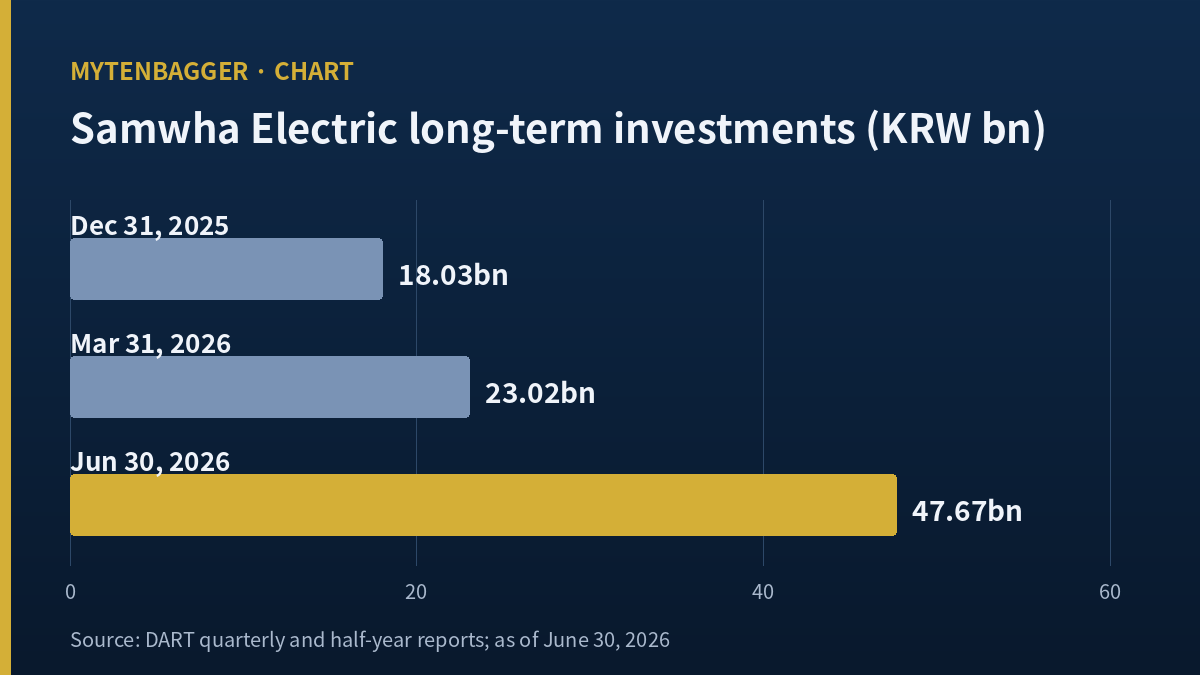
Long-term investments rose from KRW 23.02bn to KRW 47.67bn, up KRW 24.65bn. That is the asset side of the same event. The gap between KRW 24.65bn and KRW 20.05bn is about what a deferred tax charge of roughly 19% would take off, though I have not opened the note that would confirm the rate.
Why the gain never touched profit
Korean listed companies report under K-IFRS, which follows the international IFRS 9 rules on stakes in other companies. A company that holds a stake for strategic reasons, such as a cross-holding inside a family group, can elect at the start to carry it at fair value through other comprehensive income. Once that election is made, price gains and losses on the stake skip the income statement for good. Even on a sale, the accumulated gain moves straight into retained profit inside the capital section and is never shown as profit for the year.
I am inferring the election from how the figures behave: the investment line and the other-income line jumped together, and retained profit barely moved. I have not read the policy note in the June report, because the DART site does not open from where I work. Had the stakes been carried through profit and loss, the April to June profit would have been roughly KRW 20bn higher, and it was KRW 1.14bn attributable to owners. So the reported numbers themselves rule that version out.
This matters for anyone looking at the company through a price-to-earnings screen. Earnings per share will never show the Samwha Capacitor rally. Only the net-worth side will, and only in the capital section most screens refresh once a year.
The stake in Samwha Capacitor
Korean trade press reported on June 18, 2026 that the company holds 2.24% of Samwha Capacitor and 11.24% of Samwha Electronics, while Samwha Capacitor in turn holds a stake in it (EBN, June 18, 2026). Samwha Capacitor has 10,395,010 shares outstanding in Kiwoom data, so 2.24% works out to about 232,848 shares.
Samwha Capacitor closed at KRW 51,900 on March 31 and KRW 151,000 on June 30 in the same Kiwoom daily series. The difference is KRW 99,100 a share. On 232,848 shares, that is about KRW 23.08bn before tax, by my arithmetic. The long-term investment line rose KRW 24.65bn. One stake in one sister company covers about 93.6% of the increase.
The stake in Samwha Electronics
The remaining KRW 1.6bn or so fits the second stake. In October 2025 the company took 37.5% of a KRW 8bn third-party share issue by Samwha Electronics at KRW 3,535 a share, alongside Samwha Capacitor’s 62.5% (Korean press report carried on Daum, October 10, 2025). That stock went from KRW 2,575 on March 31 to KRW 3,195 on June 30. Using the Kiwoom market value to back out its number of shares, the 11.24% stake is about 2.16 million shares, and the move is worth roughly KRW 1.34bn. Put the two together and I get about KRW 24.41bn against a reported KRW 24.65bn. I would not claim more precision than that, since the share numbers are my approximations, but the direction is not in doubt.
What the Samwha Electric capital table shows
Here are the four lines I care about at each quarter end, plus the owners’ total. Minority interests are left out of the last column, because they belong to outside partners in subsidiaries.
| KRW bn, period end | Long-term investments | Comprehensive income & other | Retained profit | Owners’ net worth |
|---|---|---|---|---|
| Dec 31, 2025 | 18.03 | 11.32 | 67.06 | 94.04 |
| Mar 31, 2026 | 23.02 | 17.01 | 64.35 | 97.03 |
| Jun 30, 2026 | 47.67 | 37.06 | 65.37 | 118.09 |
| Change, Apr to Jun | +24.65 | +20.05 | +1.02 | +21.06 |
Sources: Stock Analysis period sheet for KRX: 009470 (DART data, KRW millions, rounded here to KRW bn); owners’ net worth is total minus minority interests, matching the DART figures carried by the luxrix server (Kiwoom data).
Two things in this table changed how I think about the stock. The first is the January to March row. Retained profit fell KRW 2.71bn in that quarter, because the 2025 dividend (KRW 600 a share, about KRW 3.97bn in total) came out after the March shareholder meeting. Even so, owners’ net worth rose KRW 2.99bn, again because the other-income line added about KRW 5.69bn. So this is the second quarter in a row where the owners got richer mostly through a sister company’s share price.
The second is the price multiple. At KRW 25,850 the market value is about KRW 171.0bn. Divide that by year-end owners’ net worth of KRW 94.04bn and you get about 1.82 times, which is the figure Kiwoom data still showed on September 28; ValueLine’s page had already moved to the lower June basis. Divide by the June figure of KRW 118.09bn and it falls to about 1.45 times. The stock looks roughly one-fifth cheaper on this measure, and almost none of that came from the capacitor business.
The same group pattern shows up elsewhere in Korean electronics. When I looked at Samsung Electro-Mechanics, the question was who sets MLCC prices. Here the question comes one step earlier: how much of the company’s own net worth rides on the price of a related stock. And when I studied Haesung DS, the worry was plant spending ahead of cash. This company’s worry is different. Its newest money on paper is not cash at all.
Minority interests and the dividend
Two smaller lines complete the picture. Minority interests, the part of subsidiaries owned by outside partners, went from KRW 26.39bn at year-end to KRW 28.20bn in March and KRW 28.85bn in June. They grew by about KRW 0.65bn in April to June, far less than the owners’ side, which fits a gain sitting at the parent level where the cross-held stakes are.
The dividend tells me what management does with money it actually earns. According to DART dividend records carried by luxrix, the per-share payout was KRW 100 for 2019 and 2020, KRW 300 for 2021 through 2023, KRW 500 for 2024 and KRW 600 for 2025. Total cash paid for 2025 was about KRW 3.97bn, or 42% of 2025 profit attributable to owners (KRW 9.44bn). The company has raised its payout while profit fell, which I read as confidence from the controlling family. It also means the capacitor business sends a real share of each year’s profit out the door, and the money that stays is modest next to what a single sister-stock rally can add on paper.
For a U.S. reader, a simple way to hold this in mind: KOSPI is the main board of the Korea Exchange, roughly the local equivalent of the NYSE, and many mid-sized Korean firms sit inside small groups that own pieces of one another. Cross-stakes like this one are common. What is unusual here is the size of the swing relative to the company’s own net worth.
Two figures I checked and set aside
Operating cash flow for January to June 2026 was KRW 14.72bn, already well above the KRW 8.37bn for all of 2025 (DART via luxrix). That looks like good news for the core. I left it out of the main argument because I could not tell from the headline lines how much came from inventory running down, and inventory did fall, from KRW 25.80bn at year-end to KRW 21.47bn in June. Cash freed from stock on the shelf is real, but it does not repeat the way profit does. If the third-quarter report shows cash flow holding up while inventory stops falling, I will give this figure more weight.
The other figure is the size of the stakes against the whole company. Long-term investments of KRW 47.67bn equal about 28% of today’s market value of KRW 171.0bn. A reader could argue the market is paying very little for the operating business once the stakes are taken out. I did not build that case, for two reasons. The stakes are in group companies whose prices swing hard, and group cross-stakes in Korea are rarely sold on the open market. A value that is unlikely ever to be realized in cash is a weak floor under a share price.
Samwha Electric and the name it started with
The global peer I chose for this entry is Nichicon (TSE: 6996), the Kyoto capacitor maker whose name the company carried at its founding. Korean Wikipedia describes the original company as a joint venture with Nichicon; I could not confirm that in a primary source, so I lean only on the name. I picked it for one reason: it shows what the core trade earns for a much larger, older player. I am comparing a single figure and nothing else.
For the fiscal year ended March 31, 2026, Nichicon reported revenue of JPY 169,724m and operating income of JPY 6,125m, according to Stock Analysis. Operating income came to 3.61% of revenue. Capacitor making is not a business where a year of good pricing turns into a fat pile of retained profit. The Japanese maker’s figure says the same thing the Korean company’s own retained-profit line says: the core earns slowly.
A word on what the company sells, since it explains why the core trade earns so little. An aluminum electrolytic capacitor is a small can that stores and releases charge to smooth out power in everything from TV sets to car chargers. Hundreds of makers in Japan, China and Korea produce them, and customers switch among qualified suppliers on price. The newer products, electric double-layer parts (sold under the S-CAP name) and hybrid capacitors for vehicles, carry better pricing because fewer makers can supply them, but they are still a minority of sales. That mix is why the Hanyang Securities view below matters, and why I want to see it in profit first.
Against that slow core, the April to June jump in net worth stands out. If the capacitor side adds about KRW 1bn to retained profit every three months, a single KRW 10,000 move in Samwha Capacitor’s share price is worth more than six months of that, before tax. By my arithmetic, 232,848 shares times KRW 10,000 is about KRW 2.33bn.
The other side of my argument
- Hanyang Securities analyst Lee Jun-seok argued in April that the company should be seen as a power-protection supplier for AI data-center enterprise SSDs, citing S-CAP parts co-developed with Samsung Electronics in 2019 and supplied to SK Hynix from 2024 (Asia Economy, April 22, 2026, my paraphrase of the Korean report). If that business scales, the core could start adding real money to retained profit, and the sister stake becomes a side story.
- The cross-held shares are real value. A mark that rose can also be sold. If the company ever turns part of the Samwha Capacitor stake into cash, the gain stops being a paper figure, and I would read the balance sheet differently.
I take both seriously. Neither has happened yet in a form I can see in the reported figures. I also found no named Korean broker with a 2026 or 2027 estimate for this company, so there is no forward number to test the first point against.
Three ways the September 30 mark could come in
The third-quarter figures will value both stakes at their September 30 closing prices. I do not know those prices yet, so I worked from where the two stocks stood on September 28 in the Kiwoom daily series and asked what happens from there. I am not putting odds on these.
If both stocks hold near September 28 levels. Samwha Capacitor at KRW 143,600 is KRW 7,400 below its June 30 close, which takes about KRW 1.72bn off the first stake before tax. Samwha Electronics at KRW 2,685 is KRW 510 lower, taking roughly KRW 1.10bn off the second. Owners’ net worth would give back around KRW 2.8bn before tax, and the capacitor side would need several quarters to replace it.
If Samwha Capacitor rallies again. Every KRW 10,000 higher adds about KRW 2.33bn before tax. A return to KRW 196,800, its highest close of the past year, would add about KRW 10.66bn before tax on this stake compared with June 30. The price multiple would drop further, and screens would make the stock look cheaper still, for the same reason as before.
If the sister stocks give back the rally. Should Samwha Capacitor fall back toward its March 31 price, the stake would lose close to the KRW 23bn it gained, and owners’ net worth would slide back near the March figure of KRW 97.03bn. On today’s market value, the multiple would climb back toward 1.76 times.
In none of these does the company’s own trading result change. That is the whole point of this entry. The number that moves most in this company’s capital section is set on a different ticker.
What would make me look at Samwha Electric again
I own none of this stock. Two conditions would bring me back to it, and the first one answers sooner.
- Two quarters in a row in which retained profit, after dividends, adds more to owners’ net worth than the other-income line does. That would mean the capacitor business is carrying the company again. The third-quarter report, due around November 16 (Mon), is the first test; the March 2027 annual report is the second.
- A disclosed sale or pledge of the Samwha Capacitor shares, or any change in the 2.24% holding. A sale would turn paper value into cash; a pledge would tell me the stake is doing work of another kind. Either way I would redo every figure above.
The order in which answers arrive is simple. The September 30 closing prices of the two sister stocks will fix the size of the third-quarter mark two days after this entry’s price date. The report itself follows around November 16 (Mon), when I can check whether retained profit grew by more than the roughly KRW 1bn it added in April to June. The annual report in March 2027 then shows the full year, and it will be the first time most data screens update their net-worth figure. If the screens show a much lower multiple next spring, I now know where to look first.
Here is where I went wrong at first. A price-to-net-worth multiple of 1.45 was the first thing I saw on a data screen, and my reflex was to call the stock cheap for a profitable electronics maker. I had the column open for an hour before it occurred to me to ask when that net worth figure had jumped, and why. The answer was a sister company’s share price in late June. A year of good trading had nothing to do with it. I closed the screen feeling a little foolish, and then opened the capital table and started again.
The multiple may keep falling if Samwha Capacitor keeps rising. I will not treat that as progress. I am waiting for the line that only the company’s own customers can move.
Prices reflect the September 28, 2026 close. The KRW 25,850 close matches ValueLine (16:55, down KRW 100 from KRW 25,950) and the luxrix quote server; other sites showed KRW 25,800 to KRW 26,000, and I did not use those. Sister-company prices are from the Kiwoom daily series via luxrix. USD figures are approximate, at roughly KRW 1,365 per dollar, the Seoul close on the same date (Seoul Finance). Stake values and tax effects are my own rounded estimates.