HD Hyundai Electric Stock: I Bought the 40% Correction
- I started accumulating HD Hyundai Electric stock in this correction, around ₩880,000 (roughly $570) — nearly 40% below the ₩1.43M 52-week high.
- June’s selloff was triggered by a 5.2% US 30-year yield and AI-capex jitters, not by the company. Q1 new orders hit a record $1.797B; the backlog stands at $7.89B.
- My thesis breaks if quarterly new orders fall year-over-year for two straight quarters. First checkpoint: the Q2 print, due August 26.
Three numbers, side by side. HD Hyundai Electric stock booked Q1 new orders of $1.797 billion — a quarterly record. Its order backlog sits at $7.89 billion, up 17.2% from year-end. And the share price went from ₩1.42M on June 7 to ₩1.066M by June 20, then toward ₩880,000 by month-end. In the same quarter it posted a record order intake, the stock shed almost 40% in a month.
That gap is where this journal starts. I decided to bet that the price side is the one that’s wrong. I’ll be honest: when this crossed ₩1.4M in May, I thought it was too expensive to touch. Now that it’s down 40%, fear is what’s stopping my hand. Same company. I’m writing this to override that comedy of emotion with data instead of mood — and to open what I plan as a three-name Korean power-equipment series.
For readers outside Korea: HD Hyundai Electric (KRX: 267260) trades on the KOSPI, Korea’s main stock index — think of it as the local equivalent of the S&P 500. It’s the power-equipment arm spun out of Hyundai Heavy Industries in 2017, making transformers, high-voltage circuit breakers, switchgear and rotating machines. US investors can reach it via Interactive Brokers with direct KRX access; there’s no US-listed ADR.
One piece of history matters for judging durability. For years after the 2017 spinoff, this was the group’s problem child — it turned a small profit in its first year, then couldn’t escape losses through 2021, and its price-to-book sat at 0.5–0.6x while brokers cut targets and drifted to neutral (per a domestic long-form retrospective from mid-2024). I ignored it back then too. I’m not raising that to lament a missed multi-bagger. The point is narrower: the climb from that floor to today’s backlog wasn’t just cyclical luck — it was pre-boom capacity investment and product-mix choices made when nobody cared. That track record is part of how I judge whether the company holds up through this correction, rather than folding at the first soft print.
Contents
Why I’m buying the HD Hyundai Electric stock correction — three reasons
First: on the days it crashed, there was no company news — what sold was the rate
My biggest reason is the source of this decline. Walk June day by day and there’s no company-specific bad news. Korean power-equipment names fell in lockstep off their early-June highs, and HD Hyundai Electric dropped 24.9% from ₩1.42M on June 7 to ₩1.066M on June 20 (Korean market data as reported by domestic press). The trigger everyone cited: the US 30-year Treasury yield spiking to 5.20% intraday — a level not seen since July 2007. According to Reuters coverage of the long-end move, the back-up in long rates was the dominant macro story that week.
AI sentiment piled on. US AI mega-cap market value shed a large chunk in June, and strategists began framing hyperscalers as the “funding short” behind the entire AI-infrastructure trade — power and semis included. The logic: when the funding dries up, the whole value chain sells together. As the Financial Times has documented on hyperscaler capex concerns, free-cash-flow strain is the market’s recurring worry. Power equipment got thrown out with that basket.
But over the same stretch, the news from the company itself pointed the other way. On May 7 it disclosed a ₩173B (about $112M at ₩1,550, my conversion) order for 765kV ultra-high-voltage transformers and reactors from a large utility in the US central region — signed on the floor of the IEEE show in Chicago, feeding the SPP 765kV backbone project, and equal to 4.24% of trailing revenue. The demand read was consistent too: North American revenue rose 26.6% year-over-year in Q1, and Europe grew 17.0%. Where it sells, it kept selling. My read is simple — this drawdown is a discount-rate event, not an earnings event. Rates compressed the multiple; nothing happened to the order book. When the source of a selloff sits outside the company, the drop is a change in the price tag, not a change in the business.
Second: three-year lead times — 2028 revenue is already locked in backlog
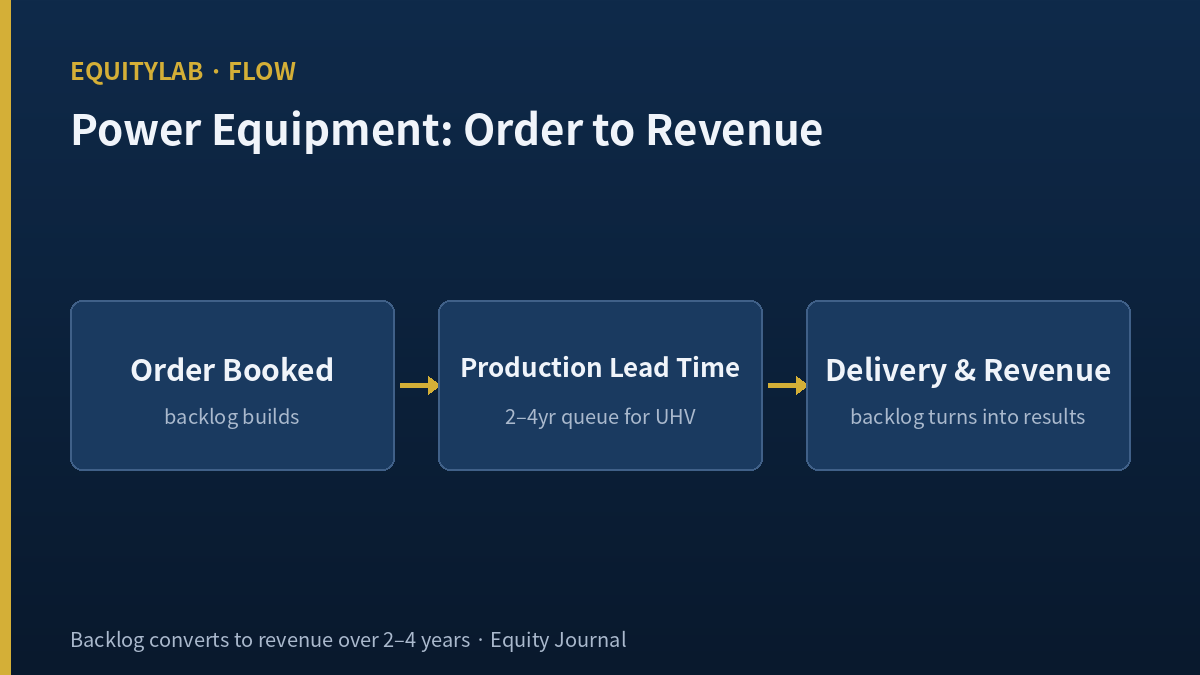
The second reason is how revenue works in this industry. Per a Daishin Securities note dated April 13 (analyst Min-ho Heo), order lead times have stretched past three years, with effective slot reservations running around five. Convert the $7.89B backlog and you get roughly three years of the 2025 revenue base (₩4.08T, about $2.6B a year) already contracted. That conversion is mine.
What it means: rates can compress the multiple, but they can’t compress revenue recognition on work already booked. This is a different cycle from memory chips, where spot pricing whips quarterly results around. HD Hyundai Electric’s 2026–2028 revenue is substantially pre-loaded in the backlog; the company’s job is to finish its Ulsan, Alabama and Cheongju expansions on time and hit delivery dates. And a thicker backlog reshapes the earnings profile — one brokerage (BNK) noted in May that the old Q1-trough / Q4-peak seasonality is compressing, with filled production slots supporting north of ₩1T of revenue every quarter in 2026. Q1 already cleared ₩1T, so the first box is checked. Currency helps too: with the won near ₩1,550 per dollar, a level last seen around the global financial crisis, the same dollar-denominated backlog books as more won revenue.
Third: 765kV backbone references — a market not everyone can enter
The third reason is order quality. 765kV is the highest transmission-voltage class in the US, and backbone grids are run by a handful of large utilities that qualify only proven suppliers. HD Hyundai Electric strung together a Texas utility order (₩277.8B, Sept 2025), a US grid operator order (₩98.6B, Jan 2026), and the SPP backbone deal (₩173B, May 2026). Once you’re a backbone reference, you hold the entry ticket for follow-on projects.
Then there’s the Alabama plant. This isn’t a Korea-only story: as POWER Magazine’s 2026 transformer survey notes, HD Hyundai Electric is enlarging its Alabama footprint to lift US production by 30% by 2026 — placing it alongside Hitachi Energy, Siemens Energy and GE Vernova in the US onshoring wave. In a period where tariffs remain a live variable, local production is itself a hedge. Daishin sees North American revenue mix climbing from 47% in 2026 to 54% in 2027, and the domestic plant underwrites that shift. The product line is widening in parallel: the company debuted a 362kV dead-tank breaker for the US market at IEEE, and its SF6-free breaker line already cleared final testing at 145kV with a Finnish utility contract, with the 420kV variant — the one with the largest latent European demand — targeted for completion in the first half of this year. A transformer company is becoming a transmission-to-distribution company.
The demand base also broadens beyond transformers. Company and market descriptions point to energy storage — a US utility-scale battery project and a domestic ESS project reportedly slated to break ground in early 2026 — and to European offshore wind via offshore substation transformer supply. None of these are the core thesis on their own; the point is that the order book isn’t a single-product bet on one demand curve. When one leg of the buildout slows, the tree has other branches.
HD Hyundai Electric stock: the data says nothing broke
Conviction is worthless without numbers, so here they are — company disclosures, fair-disclosure guidance, and Daishin estimates in one table.
| Metric | FY2025 | Q1 2026 | 2026 target / est. |
|---|---|---|---|
| Revenue | ₩4.08T / ~$2.6B (+22.8%) | ₩1.04T (+2.1%) | Co. target ₩4.35T / Daishin est. ₩4.81T |
| Operating profit | ₩995B (+48.8%) | ₩258B (+18.4%) | Daishin est. ₩1.28T (+28%) |
| Operating margin | 24.4% | 24.9% | ~26.6% (my calc off Daishin est.) |
| New orders | $4.274B | $1.797B (record) | Co. target $4.222B (42.6% hit in Q1) |
Sources: company disclosures & fair disclosure (2026-01-06, 04-28), Daishin Securities (2026-04-13). FX ~₩1,550/$ | As of: July 2026
The only soft-looking number is Q1 revenue at +2.1%; press coverage at the print noted Q1 came in a touch below consensus on the top line. But operating profit rose 18.4% the same quarter, and the 24.9% margin edged above the full-year 2025 margin of 24.4%. As management framed it, profitability-first selective ordering chose margin over volume. The regional mix shows where that margin comes from: on a full-year 2025 basis North America was 47% of revenue and Europe grew 38.3%, and both high-margin markets kept expanding into Q1.
Notice the tension between two rows: revenue grew just 2.1% while new orders grew 34.6%. That divergence is the whole thesis in miniature. In a book-to-bill business with multi-year lead times, orders are the leading indicator and revenue is the trailing one — a quarter where orders sprint ahead of revenue is exactly what a backlog-building phase looks like. The $7.89B backlog is up 17.2% from year-end precisely because intake is running well ahead of what converts to revenue in any single quarter. A market pricing the stock off the trailing 2.1% is reading the wrong row.
On valuation: the June 26 close of ₩879,000 divided by LS Securities’ 2026 EPS estimate of ₩25,525 (Jan 19 note) puts the forward P/E near 34x — again, my calc. That same note applied a 45.1x multiple to reach its ₩1.15M target, so today’s price sits roughly a quarter off the early-year sell-side multiple. It’s worth holding that 34x next to GE Vernova’s ~27x: the Korean name is not obviously cheap on a bare multiple, but it carries faster order growth (Q1 orders +34.6% YoY) and a backlog that already covers three years, which is what a growth multiple is paying for. Per Investing.com’s analyst compilation, all 19 covering analysts rate it a buy with an average target of ₩1.387M — but that’s an average built from pre-correction reports, so I read it only as “the pre-correction bar.” The target range itself runs from ₩588,727 to ₩1.6M, meaning lower expectations genuinely exist in the market too.
What this HD Hyundai Electric selloff is missing
Transcribe the bear case and it reads: hyperscaler funding dries up → data-center capex cut → power-equipment orders fall. But break down this company’s order mix and it doesn’t run on direct data-center demand alone. The SPP 765kV backbone is transmission buildout in wind-dense territory; aging-grid replacement is a utility chore that turns independent of data centers. The physical bottleneck is bigger than the AI theme: per Wood Mackenzie analysis widely cited in trade press, the US transformer supply deficit ran near 100% in 2025 and won’t normalize below 10% until around 2030 — a multi-year shortage that data-center capex timing alone doesn’t switch off. Building a data center takes two to three years; securing utility power can take seven to ten. The order cadence is simply different.
Here’s the differentiation worth sitting with — and it’s a peer point US readers can price. GE Vernova’s Q1 2026 8-K shows Electrification orders up 86% organically to $7.1B on a book-to-bill near 2.5, and the stock trades around $1,138 at roughly a 27x P/E on a ~$253B market cap. Big data-center operators are expected to reach 25% of GE Vernova’s customer mix in 2026, up from 10% in 2025, per Bloomberg reporting cited in analyst coverage — a reminder that the demand wave is being validated by the largest Western name in the space, not just Korean brokers. On the transformer side specifically, Hitachi Energy has committed some $4.5B globally to grid-equipment capacity, and Siemens Energy is building its first US large-power-transformer plant in Charlotte. The Western grid majors are validating the exact demand curve HD Hyundai Electric is selling into — but the Korean name trades at a fraction of GE Vernova’s market cap while carrying a comparable structural tailwind and a US local-production hedge. That gap isn’t free money — GE Vernova has gas-turbine and services breadth HD Hyundai Electric doesn’t, and scale that commands a premium — but the direction of the discount is worth naming. I was tallying quarterly orders in a spreadsheet when it clicked that 42.6% of the full-year $4.222B target was already booked in Q1; the stock the market dumped as an “AI theme” is really riding a utility investment cycle.
Rates compressed the multiple. A three-year-lead-time backlog doesn’t compress with rates.
HD Hyundai Electric stock: my three paths
Base path (my probability 55%)
Rates settle and utility ordering continues. 2026 revenue lands somewhere between the ₩4.35T company target and Daishin’s ₩4.81T estimate, and margin holds in the mid-20s. The company’s own January guidance already set orders +10.5% and revenue +11.8% above last year’s targets — and last year it beat a $3.822B order target with $4.274B actual. A management team that low-balls and beats is one I’ll take at the low end. The compressing seasonality helps here too: if each quarter now clears ₩1T rather than back-loading into Q4, the path to the full-year number is smoother and less headline-risk-prone than it used to be. Here the correction resolves as a multiple round-trip and earnings reset the price. How far it round-trips is ultimately a rates question, but this is the path the data supports best.
Where I could be wrong (my probability 30%)
Hyperscaler pullback shows up in order metrics, not just sentiment. If quarterly new orders roll over year-over-year and pricing softens, the market frame flips from “correction” to “margin peak passed.” That’s precisely what June feared, and it isn’t a stretch — outlets have already flagged hyperscaler free cash flow tightening as AI buildout gets more expensive. In this path the multiple compresses toward the low 20s, and ₩880K isn’t guaranteed to be a floor. That’s why I split the correction buy rather than taking it in one shot. A 30% wrong-probability is something you carry in position size, not in words.
The tails (my probability 15%)
The bull tail: rates reverse lower and a fresh 765kV award lands on top — with backbone references acting as entry tickets, follow-on odds aren’t low, and BNK flagged in May that cumulative North American AI-related capex forecasts had roughly doubled toward $3T. The bear tail: the AI capex cycle breaks outright and booked orders start slipping or cancelling. Given the seven-to-ten-year rhythm of utility ordering that runs separate from data centers, I keep this one low — but low isn’t zero, so its trigger goes into the breakpoints below.
HD Hyundai Electric stock: where my thesis breaks
Three breakpoints. One: quarterly new orders decline year-over-year for two consecutive quarters — Q1’s +34.6% is my baseline. Orders lead revenue in this business by two to three years, so if they roll over, the comfort of a thick backlog gets an expiry date. Two: the annual $4.222B order target’s run-rate falls badly behind on a three-quarter cumulative basis. A pace that already hit 42.6% in Q1 suddenly stalling would be an ordering-environment change, not seasonality. Three: Daishin’s North American mix path (47% in 2026 → 54% in 2027) reverses — a retreat in the high-margin region would read to me as a failure to pass through tariffs.
In order of which answers first, breakpoint one is fastest. I’ll read quarterly orders straight off the Q2 print scheduled for August 26. Breakpoints two and three run through year-end, so if the first one goes, I have less reason to wait on the others. There’s a fourth thing I watch but don’t yet weight as a breakpoint: order pricing. The whole margin story rests on the transformer shortage giving suppliers pricing power; if Wood Mackenzie’s deficit normalizes faster than the 2030 timeline — or if the 2027–2028 wave of Hitachi, Siemens and Eaton US plants comes online ahead of schedule — unit prices, not order counts, are where it would show first. Conversely, price declines while quarterly orders hold are a price problem to me, not a thesis problem. The zone I’m accumulating in is this correction. Chasing on the way back to the old high isn’t how I work.
What I bought in this correction
I started accumulating HD Hyundai Electric stock in the correction, and the spine of the call is one sentence: rates compressed the multiple, not the backlog. The me who wouldn’t buy at ₩1.4M in May and the me who hesitated in fear now are the same person — both were watching price instead of the book. This time I watched the backlog and the lead times. The next entry lands after the August Q2 print. I plan to walk through three power-equipment names in turn, and this is the first page. The second is already written: LS Electric, where a 100x filing typo erased 15% and I started buying, and the third with Hyosung Heavy Industries, where I bought the mega-project give-back.