Hwashin Earnings: The Parent Company Out-Earned the Whole Group
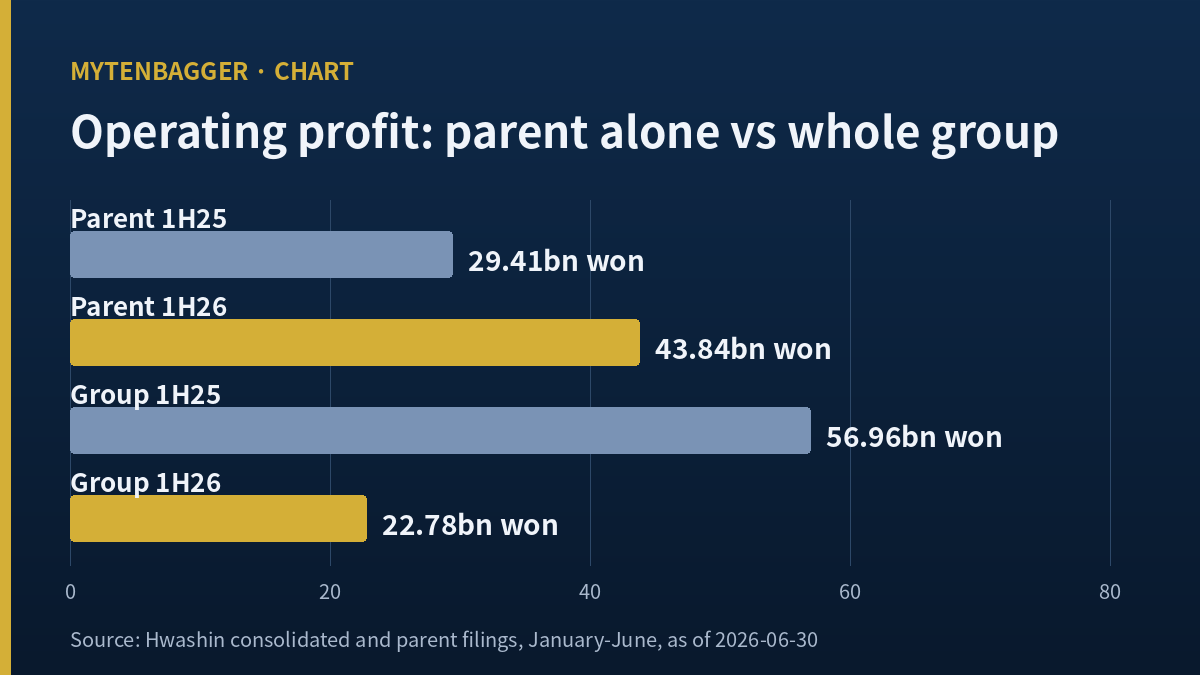
Hwashin stock closed at 7,340 won (about $5.40) on September 23, 2026, and the number I cannot get past is this: from January through June, the Korean parent company alone made 43.8 billion won of operating profit while the whole group, parent plus every overseas plant, made 22.8 billion won. The parent out-earned the group that contains it. I do not own the shares, and until I understand where that gap went I am staying out.
- Group revenue: 1,003.96 billion won, up 4.12% on a year earlier.
- Group operating profit: 22.78 billion won, down 60.00%.
- Group net profit: 35.33 billion won, up 20.36%.
- Parent revenue: 650.45 billion won, up 21.65%.
- Parent operating profit: 43.84 billion won, up 49.08%.
- Parent share of group revenue: 64.79%, from 55.45%.
- June quarter group operating profit: 5.80 billion won on 498.39 billion won of sales.
- Share of Samsung Securities’ February full-year operating profit forecast already delivered: 19.14%.
- My position on Hwashin stock: not held, no order, watching the September quarter.
Contents
Why Hwashin stock looks different when the parent files alone
Hwashin is a Korean auto parts maker listed on the KOSPI, Korea’s main board. It stamps and welds chassis and body parts, mostly for Hyundai and Kia, from a head plant in Yeongcheon in southeastern Korea and from plants in Alabama, Georgia, India and Brazil. It is small: at the September 23 close the company was worth about 256.3 billion won, roughly $189 million.
Korean listed companies publish two sets of numbers every quarter. One covers the whole group, every subsidiary folded in. The other covers the parent company on its own. Most readers, me included, look only at the group figures because that is what the headlines quote. I opened the parent-only columns on Hwashin’s investor relations finance page almost by accident, looking for a dividend line, and the two sets of numbers were telling opposite stories about the same six months.
That is the whole reason for this entry. I am writing down what the two sets say, what I think explains the gap, and what I still cannot prove.
The group view: six months of Hwashin stock earnings, side by side
Here is the group, January to June 2026 against the same months of 2025, from the company’s own filing. All three lines moved, and they did not move together.
Revenue rose 4.12%
Sales went from 964.25 billion won to 1,003.96 billion won, or from about $710 million to about $739 million at the September 23 exchange rate. That is modest growth for a year in which Hyundai’s Georgia plant was ramping. It is the least interesting of the three numbers, and I mention it first only because the other two need it as the thing they are measured against.
Operating profit fell 60.00%
Operating profit went from 56.96 billion won to 22.78 billion won. Put per 100 won of sales, the group kept 5.91 won in the first six months of 2025 and 2.27 won in the same months of 2026. More revenue, much less profit from running the plants. By my calculation the drop is 34.17 billion won, roughly $25 million, and it happened while sales were rising.
Net profit rose 20.36%
And then the bottom line went the other way. Net profit rose from 29.35 billion won to 35.33 billion won. When operating profit falls 60% and net profit rises 20%, something below the operating line did a lot of lifting. I have not seen the notes that say what. Foreign-exchange gains on dollar balances are the obvious suspect for a company with a big US footprint, but that is my guess and I am labeling it as one.
Sales up 4%, operating profit down 60%, net profit up 20%. Three honest numbers from one filing, and they point in three different directions.
The parent view: the same six months in Yeongcheon
Now the parent company alone, over the same January to June comparison. Revenue rose 21.65%, from 534.69 billion won to 650.45 billion won. Operating profit rose 49.08%, from 29.41 billion won to 43.84 billion won. Per 100 won of sales, the parent kept 5.50 won a year ago and 6.74 won this year.
So the Korean head company had a good six months by any measure I know. It sold more, and it kept more of each won it sold. The parent’s share of group revenue rose from 55.45% to 64.79%, which means the overseas side supplied a shrinking slice of sales at the same time.
Put the two views together and the arithmetic is uncomfortable. The parent alone reported 43.84 billion won of operating profit. The group, which includes the parent, reported 22.78 billion won. For those two numbers to sit in the same filing, the rest of the group, once sales between Hwashin companies are netted out, must have come in roughly 21 billion won below zero at the operating level over six months. I did the subtraction once to size it. I am not building a table out of it, because a parent-minus-group figure also nets out sales between Hwashin companies, and I have not seen how large those are.
The June quarter is where it happened
The parent files a March-quarter figure and a six-month figure, so I split those too. In January to March 2026 the parent made 15.12 billion won of operating profit on 277.92 billion won of sales, and the group made 16.98 billion won. The group was slightly ahead, which is the normal order: the parent plus overseas plants earning a little more than the parent alone.
In April to June the order flipped hard. By my arithmetic the parent made 28.73 billion won of operating profit on 372.53 billion won of sales, keeping 7.71 won per 100 won of sales against 5.44 won three months earlier. The group made 5.80 billion won. So nearly all of the six-month damage landed in one quarter, the June quarter, and it landed outside Korea.
Two more things from that quarter bother me. The parent’s own sales jumped 34.04% from the March quarter, and the parent’s sales were 74.75% of group sales in the June quarter against 54.97% in March. A jump that sharp at the parent, with no matching jump at the group, is what you would see if the parent were shipping parts or tooling to its own overseas plants. Those sales count at the parent and then disappear when the group adds everything up. I cannot confirm that from the columns I have. And the parent’s June-quarter net profit, again by my subtraction, came out at minus 3.26 billion won while its operating profit was strongly positive. Below the operating line, the parent lost money in the same quarter that the group gained. Whatever those items are, they moved in opposite directions at the two levels.
The Korean outlet Top Daily ran a piece headlined, roughly, that Hwashin’s profit strength had dropped with its overseas subsidiaries dragging it down. I could not open the article itself, only the headline, so I am citing the direction and nothing else. The filing gets me to the same direction without it.
Four quarters where the bottom line kept outrunning operations
I wanted to know whether the June quarter was a one-off, so I took the group’s cumulative filings apart into single quarters. The September 2025 quarter is the nine-month total less the six-month total, the December quarter is the full year less nine months, and so on. Each quarter below is my own subtraction from the company’s cumulative figures.
| Quarter (group) | Revenue (bn won) | Operating profit (bn won) | Net profit (bn won) | Op. profit per 100 won |
|---|---|---|---|---|
| Jul to Sep 2025 | 485.88 | 11.57 | 17.97 | 2.38 |
| Oct to Dec 2025 | 512.36 | 33.92 | 19.37 | 6.62 |
| Jan to Mar 2026 | 505.58 | 16.98 | 28.30 | 3.36 |
| Apr to Jun 2026 | 498.39 | 5.80 | 7.03 | 1.16 |
Source: Hwashin investor relations, group figures, cumulative filings split by me. Last column is operating profit divided by revenue, times 100, my calculation.
Sales barely moved; operating profit swung almost sixfold
Across the four quarters, revenue stayed between 485.88 and 512.36 billion won, a spread of about 5.4%. Operating profit ran from 5.80 to 33.92 billion won. The best quarter earned almost six times the worst on nearly the same sales. That tells me the problem sits in cost, and on the group side of the business, since the parent’s numbers improved.
Net profit beat operating profit in three of four
In three of the four quarters, net profit came in above operating profit. Only the December quarter ran the ordinary way, with 33.92 billion won of operating profit and 19.37 billion won of net. Added up, the four quarters produced 68.27 billion won of operating profit and 72.67 billion won of net profit. Over a full year of trading, this company earned more at the bottom than it did from making parts. I do not trust that as a pattern to carry forward, because whatever sits between those two lines is the part I can see least.
A company with a similar gap, where a big order backlog had to be turned into profit that held, was HL Mando, which I looked at earlier. The question there was whether demand would turn into money. With Hwashin I am asking something smaller and more annoying: whether the money it already earns at home is being spent abroad.
What Hwashin stock was priced on in February
The one named sell-side view I could find is a Samsung Securities note from February 2026 by team leader Lim Eun-young (the Korean-language PDF). It carried a buy rating and a valuation well above where the shares traded that day, and the shares have fallen a long way since. The forecast inside it had 2026 revenue at 2,146 billion won and 2026 operating profit at 119.0 billion won.
Six months in, revenue is at 46.78% of that full-year forecast. That is close to on pace. Operating profit is at 19.14%. To reach 119.0 billion won the group would need about 96.2 billion won of operating profit from July through December, more than four times what it made in the first six months. I do not think any analyst would still stand behind that number after the June quarter, and I have not found a revised one. Samsung’s reasoning, as I read the note, leaned on spare US capacity after the Georgia plant opened and on a later pivot toward robot body modules. The first part of that reasoning is exactly what the filing now questions.
A consensus page from Korea Economic Daily also lists a higher aggregate valuation with no firm or date attached. I am leaving it out. An unnamed figure is not something I can check against the note that produced it.
Using the trailing earnings per share of 2,105 won shown by one Korean data service, the September 23 close works out to roughly 3.5 times trailing earnings by my calculation. Cheap. But trailing earnings here include the bottom-line lift I just said I do not understand, so the multiple inherits the same blind spot.
Samsung’s own February forecast put 2026 earnings per share at 2,542 won, which would put the September 23 close at about 2.9 times forward earnings. That figure is even cheaper, and even older. It was built before the June quarter, on an operating profit number the group is now far behind, so I read it as a record of what the market expected in February and nothing more.
Another supplier where I had to pull apart what the money was actually buying was SNT Motiv and its heavy capital spending. There I could see the spending and not the result. With Hwashin I can see a result and cannot yet see the plant-level cause.
A Canadian peer with a quiet band
For a peer I picked Martinrea International (TSX: MRE), a Canadian maker of metal structures and lightweight parts for carmakers, with plants across North America and Europe. I chose it for one reason only: it is a stamping-and-structures supplier whose operating return on sales I can read for several years in one line, and I wanted to see what a steady band looks like next to Hwashin’s swings. I am not ranking the two companies.
According to Stock Analysis, Martinrea’s operating profit as a share of revenue was 5.55% in 2023, 5.32% in 2024, 5.42% in 2025 and 5.21% over the twelve months to June 2026. Four readings within 0.34 of a percentage point of each other. Hwashin’s group, quarter by quarter over the last four quarters, ran between 1.16% and 6.62%, a spread of 5.46 points. That is the only comparison I am making. I am writing no revenue, no earnings and no multiple for Martinrea, because a single steady line is all I need from it.
What the comparison does is make Hwashin’s swing look less like the auto parts business in general and more like something specific to this group right now. A new plant in a new country is the most obvious specific thing.
What I think is happening overseas, and what I cannot prove
The Georgia governor’s office announced in October 2023 that Hwashin would put more than $176 million into a chassis and body parts plant in Dublin, Georgia, with more than 460 jobs, supplying Hyundai Motor Group Metaplant America and Kia’s Georgia plant. Production was due to start in late 2025. Hwashin has run a plant in Greenville, Alabama since 2003.
My best guess is simple. A new plant runs below capacity in its first year, carries full labor and depreciation, and loses money until volumes catch up. That would show up exactly as a group operating profit collapse with a healthy parent. It fits. It is also a guess, since the filing does not break out profit by plant in the columns I could open.
There is a reason to think volumes could catch up. The Korean outlet Newspim reported on August 21, 2026 that Hyundai CEO José Muñoz told CNBC the Georgia site could grow from 500,000 vehicles a year to 700,000 to 800,000 by 2028. Hyundai said afterward that the plan was under review and not final. I am treating it as a possibility with a named source, and nothing firmer.
A parent-company column I used to skip
I have looked at Korean auto suppliers for years and almost never opened the parent-only figures. My reasoning was that the group is what you own, so the group is what matters. That is true for valuing the shares. It is useless for finding where a problem lives. With Hwashin, the group figures alone would have told me profits fell. Only the parent column told me the home business was fine and the damage was abroad. I missed this on at least one earlier supplier, and it stings a little to see how cheap the fix was. From now on, when a Korean supplier’s group profit drops, I open the parent column before I write anything.
The case against my caution on Hwashin stock
I tried hard to argue myself back in. These are the best points I found.
- The parent company is doing well: revenue up 21.65% and operating profit up 49.08% in six months. The core business is not broken.
- New plants usually lose money early and then turn. If Georgia is simply young, the group number fixes itself as volumes build.
- Hyundai’s Georgia expansion, if confirmed, would feed exactly the plant that is dragging now.
- At roughly 3.5 times trailing earnings, a lot of bad news may already be in the price. The shares are down sharply over twelve months.
- The December 2025 quarter showed 6.62 won of operating profit per 100 won of sales, the best of the four. The group can earn well when the plants run.
- Net profit has held up, rising 20.36% in six months. Whatever the source, it is income on the filing for now.
- Samsung Securities pointed to a robot body module business built on the same chassis know-how. If that arrives, the same presses get a second customer.
- The company pays a dividend and kept paying one for 2025 despite the weaker year at the group level.
Eight points, and my view does not move much. Points 2, 3 and 7 are about what might happen. The 60% fall already happened. Point 6 is the one I respect least, because I cannot name what drove it.
Nine checkpoints that would reopen Hwashin stock for me
Before the list, the two ways I think the September quarter could read. I am not putting odds on them; I do not know enough.
In the first, the Georgia plant is simply young. Volumes build through the autumn, the overseas loss shrinks, and group operating profit climbs back toward the ten-billion-won-a-quarter level while the parent keeps doing what it did in the spring. In that version the June quarter looks, in hindsight, like the bottom of a start-up curve, and the cheap multiple was the market being too pessimistic.
In the second, the overseas plants keep losing at the June rate. The parent keeps posting good numbers, partly on sales to its own subsidiaries, and the group total stays near five billion won a quarter. Net profit stops getting help from below the operating line. In that version the trailing multiple is flattering, and the forward one is worse than it looks. I cannot yet rule this second version out, and that is why I am waiting.
These are the signals that would get me to look again, roughly in the order they can be answered.
- The September 2026 quarter shows group operating profit above the 5.80 billion won of the June quarter.
- The same quarter shows group operating profit above the 16.98 billion won of the March quarter, meaning the slide has ended and not just paused.
- For January to September, group operating profit per 100 won of sales climbs back above 3 won.
- The gap between parent and group operating profit narrows for the first nine months.
- The notes to the June filing show what lifted net profit above operating profit, and it turns out to be something recurring.
- Hyundai confirms the Georgia expansion officially.
- Samsung Securities or another named broker publishes a new forecast after the June quarter.
- The company breaks out profit by region or by plant.
- The parent keeps its own operating profit growth above 20% for the nine months.
The first four are answered by one document: the September quarter filing, due by November 16, 2026. The fifth is already sitting in the June filing’s notes, and the only thing missing is me reading them.
Where Hwashin stock leaves me today
I am not buying, and it is not because I think the company is weak. Its home business had a strong six months. I am staying out because the group profit that I would actually own fell 60% for reasons I can locate only roughly, on another continent, and the bottom line is being held up by something I cannot yet name.
There are two things I do not know, and each has a document that answers it. What lifted net profit above operating profit is in the June filing’s notes. Whether the overseas losses are shrinking is in the September filing, due by November 16. When either one is in my hands, I will reopen this entry and write down what it says, whichever way it points.
Prices and market value reflect the September 23, 2026 close; Korean markets were shut on September 24 and 25 for the Chuseok holiday. USD figures are approximate, converted at roughly 1,358.4 won per dollar, the Seoul foreign-exchange close on the same date. Financial figures are Hwashin’s own group and parent-company filings; single-quarter figures and per-100-won ratios are my arithmetic on them and are rounded.