Why Cheonil Express Shares Rose While Equity Fell Below Capital
Cheonil Express stock closed at KRW 142,000 (about USD 105) on September 23, 2026, which puts the whole company at KRW 202.9bn, or roughly USD 149m. On June 30 its shareholders’ equity was KRW 6.4bn, so the market is paying about 31.5 times what the company’s own balance sheet says belongs to shareholders. That equity is also already smaller than the company’s paid-in share capital, and the question I am tracking in this journal is simple: does it fall to less than 50% of that capital by December 31, 2026?
Where I stand, in seven sentences
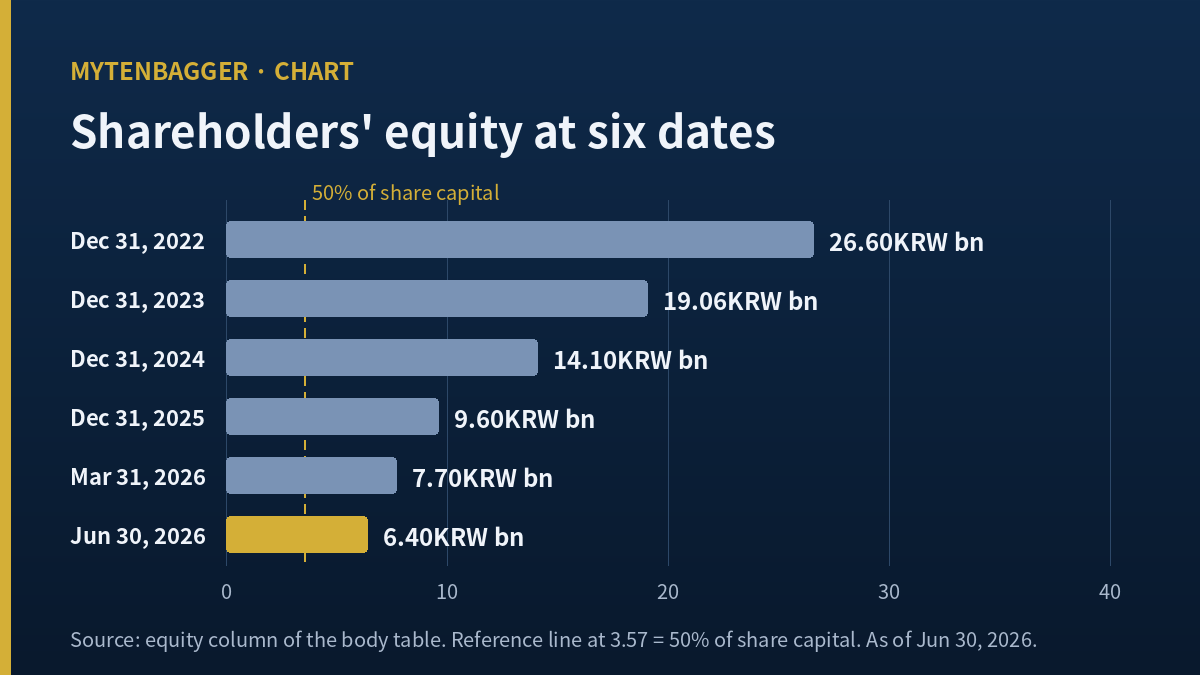
I do not own Cheonil Express, a KOSPI-listed intercity bus operator with a market value near USD 149m. The share price is driven by one thing it owns: about a sixth of the company that runs the Seoul Express Bus Terminal, a site the city has put into redevelopment talks. The bus business itself has lost money at the operating line every year since 2020. Those losses have taken equity from KRW 26.6bn at the end of 2022 to KRW 6.4bn in June 2026. That June figure is already below the roughly KRW 7.1bn of share capital. If equity ends 2026 under about KRW 3.6bn, the company meets the exchange’s condition for administrative-issue designation, and the January-June loss alone was larger than the room left. So I watch the year-end number before I watch the redevelopment news.
Contents
Why Cheonil Express stock went vertical in late 2025
For readers who do not follow Korea’s small caps: KOSPI is the country’s main board, the Korean counterpart of a large-cap exchange listing. Cheonil Express sits near the bottom of it by size. Chickstock ranks it 491st of 942 KOSPI companies by market value. It runs express bus routes, and its revenue in 2025 was KRW 45.6bn, or about USD 34m.
What moved the shares was not the buses. In November 2025 the Seoul city government said it would start formal pre-negotiations with Shinsegae Central and the Seoul Express Bus Terminal company on a mixed-use redevelopment of the terminal site in Banpo, southern Seoul (Seoul Metropolitan Government press release). The Financial News later reported a plan of up to 60 stories, with public contributions expected around KRW 2tn and the city aiming to finish the pre-negotiation within 2026 (Financial News, June 14, 2026).
Cheonil Express owns 16.67% of the terminal company and is its second-largest shareholder behind Shinsegae Central City, which holds a large majority. Korean press put the move at nine straight limit-up sessions; Herald Business reported an intraday peak of KRW 518,000 on December 4, 2025 (Herald Business, in Korean). The September 23 close is roughly a quarter of that peak.
Two facts about who owns the shares matter for everything that follows. The same Herald Business piece put the shares in issue at 1,429,220, of which the largest shareholder and related parties held 1,225,467, or 85.74%. The chief executive, Park Do-hyun, held 642,725 shares, 44.97% on his own. Only about one share in seven trades freely. My data tool carries 1,428,873 shares, 347 fewer; I could not confirm whether the gap is treasury stock, and it moves the market value by well under 0.1%, so I use the Herald figure.
Cheonil Express stock and an equity line that keeps shrinking
This is the part of the story that the redevelopment headlines leave out. The table uses the company’s separate financial statements from DART, Korea’s electronic disclosure system, as served by my data tool. Cheonil Express reports no subsidiaries, so stand-alone and group figures are the same thing here.
| Date | Equity (KRW bn) | Liabilities (KRW bn) | Liabilities / equity |
|---|---|---|---|
| Dec 31, 2022 | 26.6 | 28.2 | 106% |
| Dec 31, 2023 | 19.06 | 35.7 | 187% |
| Dec 31, 2024 | 14.1 | 39.4 | 280% |
| Dec 31, 2025 | 9.6 | 44.0 | 459% |
| Mar 31, 2026 | 7.7 | 44.7 | 580% |
| Jun 30, 2026 | 6.4 | 45.5 | 707% |
Source: Cheonil Express stand-alone accounts (DART) via my data tool. Ratios are liabilities divided by equity at each date.
Total resources on the balance sheet barely moved between those dates: KRW 54.8bn at the end of 2022, KRW 51.9bn in June 2026. What changed is who funds them. Equity lost KRW 20.2bn and liabilities grew by KRW 17.3bn. In plain terms, lenders and creditors have been replacing shareholders as the source of money inside the company, one loss at a time.
What the capital line says
Korean companies show paid-in share capital as its own line inside equity, apart from retained results. My data tool shows it at KRW 7.1bn for Cheonil Express. That fits 1,429,220 shares at a par value of KRW 5,000, which gives KRW 7.15bn, though I did not see the par value in a company document myself. With June equity at KRW 6.435bn, the company has already eaten into its capital by about 10% by my arithmetic. Korean practice calls this partial capital impairment.
The exchange rule that matters is short. On the KOSPI main board, a company whose capital is at least 50% impaired is designated an administrative issue, and full impairment is a delisting cause (Korean government law information portal, in Korean). The test is taken on the fiscal year-end numbers in the annual report. Fifty percent of KRW 7.15bn is about KRW 3.57bn. June equity sits roughly KRW 2.86bn above that line.
How fast the room is disappearing
The January-June 2026 net loss was KRW 3.10bn. On its own, that is bigger than the KRW 2.86bn of room left. If July-December 2026 simply repeats January-June, equity ends near KRW 3.3bn at year end, a little over 50% impaired. If it repeats the second six months of 2025, when the net loss was KRW 4.53bn (the full-year KRW 5.62bn less the first six months’ KRW 1.10bn), equity ends near KRW 1.9bn, around 73% impaired. Both paths cross the line.
Two things could keep it above water. Equity can move for reasons other than profit and loss: in 2025 it fell KRW 4.50bn while the net loss was KRW 5.62bn, so about KRW 1.1bn came in from other items I have not been able to identify line by line. And the bus fare increase from October 1 should help the last three months of 2026. How much those two can do depends on a line most readers skip, and I work through it in the next section. The answer arrives with the FY2026 annual report.
A comparison I keep in mind from another Korean transport name: Jeju Air’s remaining aircraft order was worth many times its market value when I wrote about it, a case where a commitment dwarfed the company (Jeju Air). Cheonil Express runs the other way. Here it is one holding that dwarfs the company, and everything else on the balance sheet is shrinking under it.
Cheonil Express stock and the year-end test, worked three ways
The simple repeats above ignore the fare change, so I rebuilt July-December 2026 from its parts. Operating results first. In the second six months of 2025 the operating loss was KRW 1.64bn in July-September and KRW 0.83bn in October-December. A nine percent fare increase applied to October-December 2025 revenue of KRW 12.5bn adds about KRW 1.1bn, if passenger numbers and costs stay where they were. That turns the October-December operating result slightly positive and brings the six-month operating loss to about KRW 1.35bn.
Then the line below operating profit, where interest and one-off items sit. This is where the two halves of recent history disagree sharply. In January-June 2026 the net loss was only KRW 0.43bn worse than the operating loss. In July-December 2025 it was KRW 2.06bn worse, almost all of it in October-December, when the company lost KRW 2.86bn net on an operating loss of KRW 0.83bn. I could not identify that charge from the data I have; it may be an impairment, a valuation loss or something else booked at year end.
| July-December 2026 assumption | Net loss (KRW bn) | Year-end equity (KRW bn) | Capital impaired |
|---|---|---|---|
| Fare helps, below-the-line items as mild as January-June 2026 | 1.78 | 4.65 | 34.9% |
| Break-even for the test | 2.86 | 3.57 | 50.0% |
| Fare helps, below-the-line items as heavy as July-December 2025 | 3.41 | 3.02 | 57.7% |
| No fare effect, July-December 2025 repeated | 4.53 | 1.90 | 73.3% |
My arithmetic on DART figures. Share capital taken as KRW 7.15bn; other equity movements assumed zero.
This table changed my own view while I was building it. Before it, I assumed the company would cross the line almost automatically. After it, the honest statement is narrower: the fare increase is probably enough to keep the operating side from breaking the test, and the outcome turns on whether another year-end charge of the 2025 kind appears. That is a question about one line in the fourth-quarter accounts, and nobody outside the company can answer it before the annual report.
There is one more variable I cannot model. The controlling group owns 85.74% of the shares. A company this close to an exchange threshold, with owners this concentrated, has both the motive and the means to add equity before the books close. I have seen no sign of it. If it happens, the table above stops mattering.
Shinsegae is the other side of the same terminal, and I looked separately at how its own earnings have been priced (Shinsegae). I mention it because the party with the deciding share of the site is a very different company from the one with the small share.
What Cheonil Express stock is really priced on
Here is a rough way to see what the market is paying for. Suppose the bus business is worth nothing and the company’s KRW 45.5bn of liabilities do not exist. Then the entire KRW 202.9bn market value is a price for 16.67% of the terminal company. Dividing one by the other implies a value of about KRW 1.22tn (roughly USD 0.9bn) for the whole terminal company. That is my arithmetic, and both assumptions flatter the result.
How does that compare with what others think the terminal company is worth? Herald Business cited market estimates of KRW 1tn to 2tn for the terminal’s total value. On that view the stock already prices in the low end, before any deduction for the debts and the loss-making bus operation. I do not have my own estimate of the terminal company’s value, and I am not going to build one from the redevelopment headlines.
Two timelines that do not meet
Even if the market’s valuation of the stake proves right, the value has to travel a long way before it reaches Cheonil Express’s own equity. Opinion News, writing in December 2025, noted that the terminal side and the city had only just entered pre-negotiation, with nothing concrete fixed (Opinion News, in Korean). It set that against two other Seoul transport-site projects. The Dong Seoul bus terminal was chosen for pre-negotiation in 2009, targets completion in 2031, and had not broken ground at the time of writing. The Yangjae freight terminal site targets 2029.
Put those two timelines next to each other. The equity test falls on December 31, 2026. A redevelopment of this size, if it follows the Dong Seoul pattern, pays out over years after that, through dividends from the terminal company, a sale of the stake, or a revaluation if accounting rules allow one. None of those routes shows up in Cheonil Express’s accounts by this December unless the company chooses to sell or pledge the stake, and I have seen no sign of either.
That is the core of my hesitation. The stock is priced on a prize that may be large but is years away, while the balance sheet has a deadline that is months away. A shareholder buying today is betting that the owners, the lenders or the exchange will bridge that gap on terms that do not dilute them. I do not know how to price that bet, so I am not making it.
A number I found and chose not to use
The same Herald Business article said the latest valuation of the 16.67% stake in the September 2025 quarterly report was about KRW 306.5bn. I could not reconcile that. The company’s total balance sheet on September 30, 2025 was KRW 53.8bn and its equity was KRW 11.28bn. A KRW 306.5bn stake cannot sit inside a KRW 53.8bn balance sheet. It may be a note figure, a different measure, or a unit error in the article. I tried to open the report on the exchange’s disclosure site and was refused, so the figure stays out of every calculation here.
Cash in, cash out
The cash-flow record explains the rising liabilities. Operating cash flow was negative KRW 1.39bn in 2023, negative KRW 0.11bn in 2024, positive KRW 0.31bn in 2025, and negative KRW 0.50bn in January-June 2026. Over 2023-2025 the company spent KRW 9.29bn on capital expenditure, mostly buses, while operations produced a net outflow of KRW 1.19bn. The gap was borrowed. Herald Business put cash at about KRW 0.57bn and short-term borrowings at about KRW 14.75bn at September 30, 2025. Interest expense was KRW 0.77bn in 2025 and KRW 0.44bn in January-June 2026; my tool warns that this line can fall back to total finance costs when a pure interest line is missing, so I treat it as an upper figure.
Dividends stopped some time ago. The last payout in my data is KRW 2,500 a share for fiscal 2021. With equity where it is, I do not expect that to change.
A global peer: the company that split the buses from the terminals
My peer this time is FirstGroup plc (LSE: FGP), the British transport group. I picked it for one reason: it is a bus company that sold the bus operation and kept the terminal property. In October 2021 FirstGroup agreed to sell Greyhound Lines in the United States to FlixMobility for USD 172m, with USD 140m paid up front and USD 32m deferred over 18 months (Scottish Financial Review). It retained Greyhound’s real estate, estimated at USD 176m, leased it back to Greyhound at market rent and said it expected to sell those properties over three to five years. Reuters, via Investing.com, reported the same retained properties and older liabilities (Reuters via Investing.com).
I put the two FirstGroup dollar figures side by side and nothing else: USD 172m for the buses, USD 176m for the terminal property. I did not scale them against Cheonil Express, because the countries, sizes and years are all different. What the case shows is structural. When a bus operator’s terminals sit on valuable ground, the property can be worth as much as the whole running business, and a clean way to unlock it is to pull the two apart. Cheonil Express cannot do that on its own. It is a minority holder in the terminal company, and the decisions sit with Shinsegae and the city.
Cheonil Express stock: what would change my mind
I list the counter-case first, because it is strong.
- The stake may simply matter more than the losses. If the terminal company were ever valued near the top of the KRW 1tn-2tn estimates Herald Business cited, a 16.67% share would be worth far more than today’s market value. The equity problem I describe would then look like a timing issue.
- The controlling family has a reason to protect the listing. With 85.74% held by the largest shareholder and related parties, a capital injection or a sale of some holding to rebuild equity before year end is possible. I have seen no announcement, but I cannot rule it out.
- The fare increase arrives exactly in the months that matter. Korea’s transport ministry approved a nine percent intercity bus fare increase from October 1, 2026 (Newspim, in Korean). October-December is also the company’s strongest season, so the final three months of 2026 may lose much less than the run rate.
- Other equity items helped in 2025. About KRW 1.1bn reached equity through lines other than profit and loss last year. If that repeats, the gap to the 50% line narrows further.
And the conditions I am watching, in the order their answers arrive:
- The Q3 report, due by November 16, 2026: does equity at September 30 stay above KRW 5bn?
- Any capital raise, rights issue or third-party share issue announced before December 31, 2026.
- Any sale, pledge or revaluation of the terminal stake disclosed before year end.
- The FY2026 annual report: is year-end equity above or below about KRW 3.57bn?
- If below, the exchange’s administrative-issue designation, which would follow that report.
- Short-term borrowings: do they rise again from the KRW 14.75bn Herald Business reported?
- Operating cash flow for all of 2026: positive or negative?
- News from the terminal pre-negotiation, which the city aimed to finish within 2026.
- Any change in the controlling group’s 1,225,467 shares.
The first answer is only seven weeks away. The heaviest one comes with the annual report, and I will not change my stance on the strength of the redevelopment headlines alone.
Where I leave Cheonil Express stock for now
A trading halt was how I first noticed this company. Late in 2025 its name kept showing up among stocks suspended after limit-up runs, and my first instinct was to read it as a pure real-estate option on a famous piece of Seoul. I only opened the balance sheet weeks later. What I found was that the option is held by a company whose own equity has been falling by roughly a quarter to a third every year, and which is now below its paid-in capital. I had been looking at the prize and not at the holder.
So I stay on the sidelines. I do not own Cheonil Express, and at a market value near USD 149m it sits far outside the top 100 KOSPI names, where my rule is to observe and not to take positions. No named broker publishes forecasts on this stock that I could find, so the only forward view I have is my own arithmetic on the reported numbers.
If the stake is worth what the enthusiasts hope, that value will show up whenever the terminal company or its owners decide it does. The equity test, on the other hand, has a fixed date. On December 31, 2026 the balance sheet closes, and the number that decides the stock’s status is small: about KRW 3.57bn. That is the figure I will look for first when the annual report comes out.
Prices reflect the September 23, 2026 close of KRW 142,000, confirmed on two Korean quote sites; the previous close was KRW 144,500. USD figures are approximate, at roughly KRW 1,358 per dollar on the same date. Financial figures are from Cheonil Express’s stand-alone accounts on DART.