
Trinity Air Stock Up 321%? Blame a Five-for-One Consolidation
One screen tells me Trinity Air stock gained 321.73 percent over one month and lost 70.84 percent over twelve. Both lines were pulled on the same day from the same table for the same ticker. For a quadrupling inside a year of two thirds decline to be arithmetically possible, something about the unit of measurement has to change somewhere in between. I went looking for that place, and I found a three digit number sitting in fourteen consecutive rows of the daily tape.
The number is 626. Between August 10 and August 28, 2026, the daily series carries a close of 626 won with zero volume on every trading date. The row immediately before that block, August 7, carries 3,130 won and also zero volume. Divide 3,130 by 626 and the result is exactly 5. There is no remainder. This piece follows how far that 5 travels through the rest of the screen.
Contents
Five ways to price Trinity Air stock produced three answers
Before building anything on top of a per share number, I had to pick one. I pulled the September 23, 2026 close from five places and got three values, and the prior close split two ways as well.
The indicator screen and the daily tape part ways
| Source | Sep 23 close | Prior close | Internal check |
|---|---|---|---|
| Indicator screen, last price | 2,590 won | not shown | Closes against its own market cap field |
| Valueline | 2,590 won | 2,600 won | Down 10 won, printed as minus 0.38 percent |
| Chickstock | 2,585 won | 2,600 won | Down 15 won, printed as minus 0.58 percent |
| Daily tape, flagged final | 2,640 won | 2,620 won | Falls inside its own 2,500 to 2,665 range |
| Tape header, latest price | 2,640 won | not shown | Inherits the same table as the flagged row |
My standing rule for a split like this was to multiply each candidate by the share register and keep the one that reproduces the published market capitalization. Run it and 2,590 wins: 102,123,552 shares times 2,590 won is 264,499,999,680 won, which matches the 264.5 billion won printed one field over, to the last digit. At 2,640 the product is 269.6 billion won and lands on nothing.
The trouble is that this multiplication proves nothing. A market cap field is built by multiplying the last price field by the register, so inside one screen any last price closes it. That restates the field and tests nothing. What actually settled the question was a pair of outside facts. Two independent sites printed the same string, 2,590. And the price to book multiple that Valueline prints, 2.92 times, reverses into 2,590 when I supply my own book value per share: consolidated equity of 90.5 billion won from the half year filing over the current register gives 886.35 won, and 2,590 over 886.35 is 2.9221. Using 2,640 would have produced 2.9785, which prints as 2.98.
So every per share figure below uses 2,590 won, with a prior close of 2,600 won and a one day move of minus 10 won. At the September 23, 2026 rate of 1,358.4 won to the dollar, that is USD 1.91 a share and a market value near USD 194.7 million. The 2,640 figure living inside the vendor tape with a final flag on it stays in my list of objections further down.
Dividing two prices on Trinity Air stock returns a share count
On July 24, 2026 an extraordinary shareholder meeting approved merging five common shares into one. Par value moved from 100 won to 500 won, and the share register fell from 510.53 million to 102.11 million. The record date was August 11, trading was suspended from August 7 through August 28, and the shares were relisted on August 31. The stated purpose in the filing was keeping the free float at an appropriate size, and Korean coverage placed it against a regulatory push to clear out issues trading under 1,000 won. On July 23, the last session before the vote, the stock closed at 600 won.
A consolidation of this kind leaves assets, liabilities and earnings untouched. Five certificates become one, and that one carries five certificates worth of price. Historical closes are therefore multiplied by five so the past can be read on today’s unit. That is why August 6, where the tape actually printed 626 won, appears as 3,130 won in the series. Six hundred twenty six times five is three thousand one hundred thirty.
All of that is correct behavior. The failure is that the suspended stretch did not pass through the same conversion. August 7 shows 3,130 won. August 10 through August 28, fourteen rows, show 626 won. Every one of those rows has zero volume, and every one of them is carrying forward the same last traded price. The identical number was written once on the post consolidation unit and fourteen times on the pre consolidation unit, inside a single suspension.
The 321.73 percent line on Trinity Air stock measures certificates
A one month return field compares the newest close with the close one month back. One month back is a 626 won row. Take 2,640, the price the tape header carries as latest, divide by 626 and subtract one, and the result is 321.7252 percent. The screen prints 321.73 percent, matching to the second decimal. With the 2,590 I adopted, the same arithmetic gives 313.74 percent.
The field is therefore not measuring price movement. Its numerator is one post consolidation certificate and its divisor is one pre consolidation certificate. An event that merged five pieces of paper into one has taken a seat in a percentage field. The unit that the division hands back is neither won nor percent. It is certificates.
Measured on a consistent unit, the same stretch points the other way. The relisting reference price was 3,130 won and the September 23 close is 2,590 won, which is a decline of 17.25 percent since the shares came back. Against 2,995 won, the close on the first session after the halt, it is a decline of 13.52 percent. Over the window the screen labels plus 321.73 percent, a holder experienced a double digit loss. I ran into the same class of problem when I worked backward from a 25,690 won appraisal line on Korean Air, where the truth of a sentence depended entirely on which reference date its per share number belonged to.
Fifteen rows with no executions sit in every Trinity Air stock average
If the damage stopped at one return field I would have left this alone. The same 626 rows feed the moving averages, because an average of the last N rows counts rows, and a row with no trades is still a row.
I checked the arithmetic directly. Of the newest twenty rows, two are 626 won, dated August 27 and August 28. The other eighteen closes add to 49,165 won. Add 626 twice, divide by twenty, and the answer is 2,520.85, which is what the screen prints as 2,521. That reproduction tells me the calculation path is a simple average of raw rows. Drop the two and divide the eighteen, and the answer is 2,731.39 won.
| Window | As printed | Traded rows only | Difference | Rows removed |
|---|---|---|---|---|
| 20 day | 2,521 won | 2,731.39 won | 210.54 won low | 2 |
| 60 day | 2,425 won | 2,968.56 won | 543.91 won low | 15 |
| 120 day | 3,408 won | 3,782.10 won | 373.65 won low | 15 |
| Relative gap | 20 day 7.71% | 60 day 18.32% | 120 day 9.88% | vs traded rows |
The 60 day window takes the hardest hit. All fifteen dead rows fit inside it, and it is half the length of the 120 day window, so the same ballast weighs twice as much. Choosing a window length is choosing an answer, which is the lesson I keep relearning, most recently when one parcel price under CJ Logistics turned out to have three values depending on the period it was cut from.
Whether Trinity Air stock is above its 20 day line is decided by those rows
Here the sign turns over. Against the printed 2,521 won average, my adopted close of 2,590 won sits above the line, a gap of plus 2.74 percent. Against the same average, the tape’s own 2,640 gives plus 4.73 percent, and that is the number the screen actually displays.
Rebuild the average without the two dead rows and it becomes 2,731.39 won. Now 2,590 is below it, at minus 5.18 percent. Even 2,640 comes out at minus 3.35 percent. Whichever close I adopt, the sign reverses. The longer lines were already negative, but the depth changes: on traded rows alone, 2,590 sits 12.75 percent under the 60 day line and 31.52 percent under the 120 day line.
For anyone who treats these lines as triggers, that is not a rounding matter. A rule set to fire when price crosses above the 20 day average would have been satisfied in the days after the August 31 restart without the price doing anything, because the ballast was holding the average down. I have no such rule running on this name and I am not going to build one. The transferable part is narrower and more useful: the sign of a gap to a moving average can be an artifact of how a vendor stores a trading halt.

One price, written on two different units
Of the fifteen suspended rows, one carries 3,130 won and fourteen carry 626 won. All fifteen have zero volume and all fifteen are repeating the August 6 execution price. The basis flag the series attaches to each row says the August 7 entry is on adjusted prices while the August 10 through August 28 entries are on raw prices, with a single row, August 19, left in a state where the two cannot be told apart.
I could not establish why they diverged. The rows may have been collected at different times, or the batch that applied the consolidation factor may have reached only the first row of the halt. The consequence is clear enough either way. Fifteen empty rows exist on two units, and fourteen of them flow into the averages and into the divisor of the return field. Had all fifteen been stored as 3,130, the one month return would have printed as minus 17.25 percent and the 20 day line would sit near 2,731 won.
Vendors duplicating one underlying quantity into two fields is a pattern I have written about before, including the session where the same used car showed up twice inside Lotte Rental. The difference is that there the duplication was in the accounts, and here it is in the price history itself.

The business under Trinity Air stock, read on its own
The consolidation changed nothing operational, so the operating record has to be read separately, the way I read one Korean carrier whose aircraft order book ran to eleven times its own market value, where the filed quantities carried the argument and the screen carried nothing. On a consolidated basis, annual revenue went from 525.8 billion won in 2022 to 1,798.2 billion won in 2025, a factor of 3.4198. Operating profit over those same four years reads minus 103.9, plus 139.4, minus 12.3 and minus 265.5 billion won, and the four sum to minus 242.3 billion won. Revenue tripled while the cumulative operating result stayed negative. As margins, that sequence is minus 19.7653, plus 10.3362, minus 0.7986 and minus 14.7631 percent.
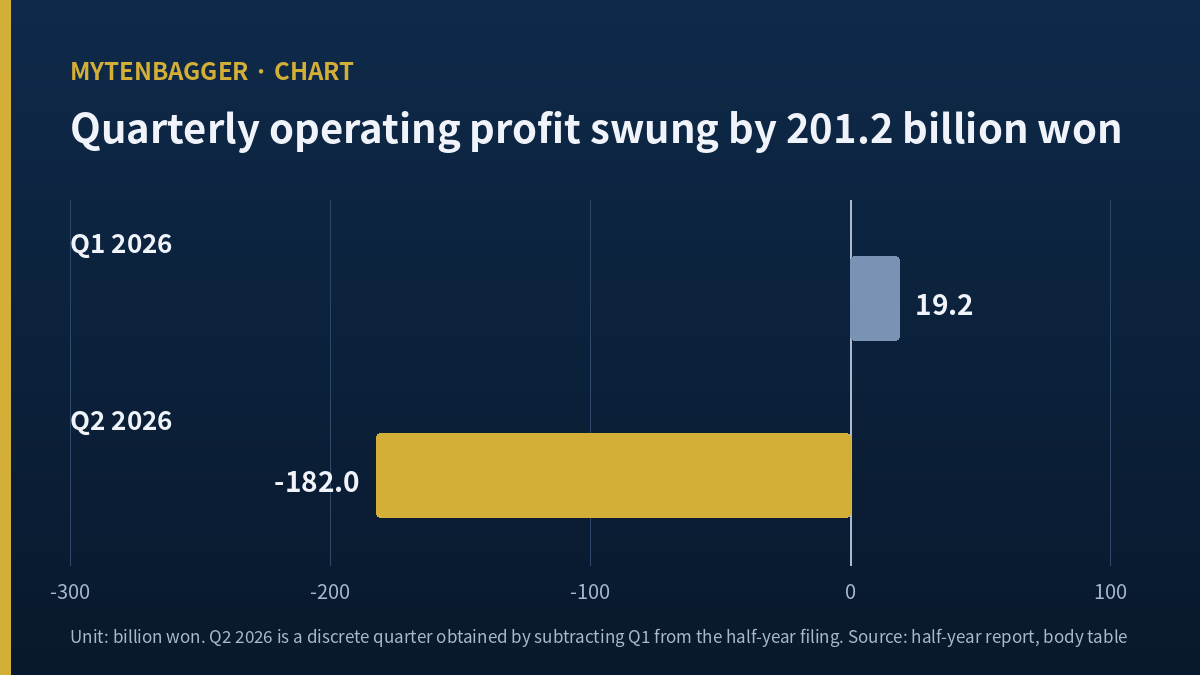
The first half of 2026 has to be split. The first quarter produced 612.1 billion won of revenue and 19.2 billion won of operating profit, a margin of 3.1352 percent. The discrete second quarter produced 469.7 billion won of revenue and an operating loss of 182.0 billion won, a margin of minus 38.7444 percent. Totals for the six months are 1,081.8 billion won of revenue, an operating loss of 162.8 billion won and a net loss of 228.1 billion won. The company’s own exchange filing, prepared on a parent only basis, shows a second quarter of 469.8 billion won, an operating loss of 182.6 billion won and a net loss of 209.9 billion won. I did not open the interim notes to reconcile the two.
Equity moved the other way. Consolidated equity was minus 42.3 billion won at the end of June 2025, meaning the capital base was fully impaired, and it is plus 90.5 billion won at the end of June 2026. Paid in capital at that date is 51.1 billion won, so equity is 1.7727 times capital and there is no impairment on the consolidated books. A Korean aviation trade outlet reported an impairment risk on the separate books and put the debt to equity ratio at 2,575.30 percent, while my own division of the consolidated filing gives 2,311.61 percent. The two rest on different bases, so I am printing both and picking neither.
One cash line completes the picture. Operating cash flow was 171.1 billion won for full year 2025 and 2.6 billion won for the six months to June 2026, with the discrete second quarter at minus 146.6 billion won. That is the kind of swing a fleet transition produces, and this carrier is in one: it has been taking A330 family aircraft for longer European sectors and repositioning away from a pure low cost identity.
A carrier that cut its share count twenty times deeper
For an outside reference I wanted an airline that has done the same thing to its own share register, because what I am measuring here is not a business but how a chart reads after the register changes. Norwegian Air Shuttle ASA, listed in Oslo under NAS, went through a 1 for 100 consolidation effective December 18, 2020. That is twenty times deeper than the 1 for 5 in front of me.
Six years on, the Norwegian numbers close on themselves. On September 23, 2026 the shares were 12.67 Norwegian kroner with a market value of 13.43 billion kroner, which implies about 1.06 billion shares against the 1.05 billion the same page reports. Trailing revenue is 38.09 billion kroner and trailing net income is 1.62 billion kroner, a net margin of 4.25 percent. The page prints a price to earnings multiple of 8.31, and dividing market value by net income gives 8.29, so the two agree within rounding.
I am printing that multiple and then leaving it alone. I am not placing it beside anything on the Korean side, because the company I am writing about has negative trailing earnings and the same ratio does not exist for it. What the comparison does establish is narrower and worth stating plainly: consolidating a share register is not itself a verdict on an airline. One carrier did it at twenty times the depth and now trades on an earnings multiple that reconciles. The screen artifact I spent this piece on is about storage and display, and it should not be mistaken for a statement about aircraft, routes or demand.
Nothing forward to check Trinity Air stock against
I found no forward estimates. The domestic aggregator’s financial overview page carries no 2026 or 2027 estimate columns at all, and the two Korean research archives that would carry broker notes are blocked to automated retrieval. Not one named sell side note reached me. This is a coverage gap and I am labeling it as one.
The gap has a direction. Backward looking figures arrived from two sources that agree with each other, while forward looking figures arrived from none. So I record the absence and decline to use it as evidence. Coverage thinning out around a widening loss is ordinary, and ordinary is not a forecast. The same thinness showed up the last time I worked on a Korean carrier, and the useful move there was also to build the piece on filed numbers alone.
Two dates anchor what comes next. The brand switch to Trinity took effect in service on September 10, 2026, after shareholders approved the new name on March 31. And the third quarter report is due by November 16, 2026, which is the first filing that will show a full quarter on the new share register.
My position on Trinity Air stock and eight things against it
My position is no holding and no order, watching only. At roughly USD 194.7 million of market value this sits far outside the domestic top one hundred, which settles the format question on its own. Beyond format, what this piece verified is a measurement unit and never a direction for the business. Correct the unit and the picture is a 17.25 percent decline from the relisting reference, sitting on top of the largest quarterly operating loss this airline has filed. Neither sentence is a reason to buy.
Here is what would break the piece. Each item names who raises it.
- Data vendors. My choice of 2,590 rests on two printed strings and one multiple reversed by hand. The vendor tape holds the same date as a final flagged row with open 2,635, high 2,665, low 2,500, close 2,640 and volume of 54,101 shares. If that row is right, most percentages here move.
- Data vendors. The prior close splits too. Two sites say 2,600 and the tape says 2,620. I took the pair, and I verified neither against an exchange record.
- Data vendors. The share register has three values: 102,123,552 on the indicator screen, 102,106,091 in the consolidation filing, and 82.59 million on one aggregator. The first two differ by 17,461 shares, which is 87,305 on the old unit. The third does not close against that same aggregator’s own market cap field, so I left it out.
- Me. My rebuild assumes a simple average. The 20 day figure reproducing exactly at 2,520.85 is strong evidence for that, but I did not reproduce the 60 and 120 day figures the same way before comparing them.
- The company. Management gave free float maintenance as the purpose. I have not examined whether that purpose was served, and I did not measure whether tick behavior improved after the relisting.
- The exchange. If market rules prescribe how a suspended session is to be quoted, then what I am calling an artifact may be the prescribed treatment. I did not locate the rule.
- Me. I could not open the composition of the 182.0 billion won quarterly operating loss. How much of it is one time, from fleet returns or maintenance provisioning, changes the read on the business substantially, and this piece does not make that read.
- Me. I treated the two halves of this article as independent, but a holder does not. Someone who bought at 600 won in July holds one fifth as many certificates now, and no arithmetic I ran speaks to whether that was a good outcome for them.
The rule I rewrote in the middle of this
I am closing with a correction to my own method instead of a verdict. In my previous session I set a rule: when closing prices disagree, multiply each candidate by the share register and keep the one that reproduces the published market capitalization. The rule did return an answer here, but it did not earn it. Within one screen the market cap field is manufactured from the last price field, so the product always closes.
The revised rule is this. Run the multiplication only against a market capitalization printed by an independent source. Two fields from the same vendor multiplied together are not a check. What actually decided this case was a division, not a multiplication: somebody else’s printed multiple, reversed through a book value I built myself from the filing. That division goes first from now on.
And one sentence remains. A screen puts price fields and percentage fields side by side, but a percentage field is not built from price alone. If the window contains a day on which the number of certificates changed, the field is reporting certificates. The 321.73 percent was never this airline’s price. It was the day five pieces of paper became one.
Values I checked and left out
Five things were verified and then kept out of the argument. Cumulative interest expense of 399.7 billion won across 2022 to 2025 against the cumulative operating result over the same span. The October 2025 par value reduction from 500 won to 100 won, an 80 percent writedown, and how its sequence relates to this year’s consolidation. The adjustment magnitude in the two conversion price notices filed on August 11, 2026. The composition of 60.7 billion won of capital expenditure in the six months to June. And the share of second quarter cost attributable to the incoming A330 family aircraft. The first two overlap axes I have already used elsewhere. The last three stayed out because I could not open the source documents.
Sources and bases. Price, share register, market capitalization and moving averages come from a Kiwoom based indicator screen and its daily candle series, on the September 23, 2026 close. Annual and quarterly financials are filed figures from Korea’s electronic disclosure system, latest period June 30, 2026. Consolidation terms are from Newdaily, July 24, 2026; second quarter results and the separate basis leverage figure from an aviation trade outlet, August 13, 2026; the 2025 par value reduction from Financial News, August 7, 2025; closing price and multiples cross checked at Valueline and Chickstock; the absence of estimate columns confirmed at Hankyung’s corporate financials page; Norwegian Air Shuttle figures from StockAnalysis, September 23, 2026. The exchange rate of 1,358.4 won to the dollar is the September 23, 2026 Seoul close, reported by Money Today. Korean press cited here appears in my own rendering and never as quoted translation. KOSPI is the main board of the Korea Exchange, where this issue is listed.