Korea’s Paradise Co Casino Results: How Hold Rate Drives Revenue
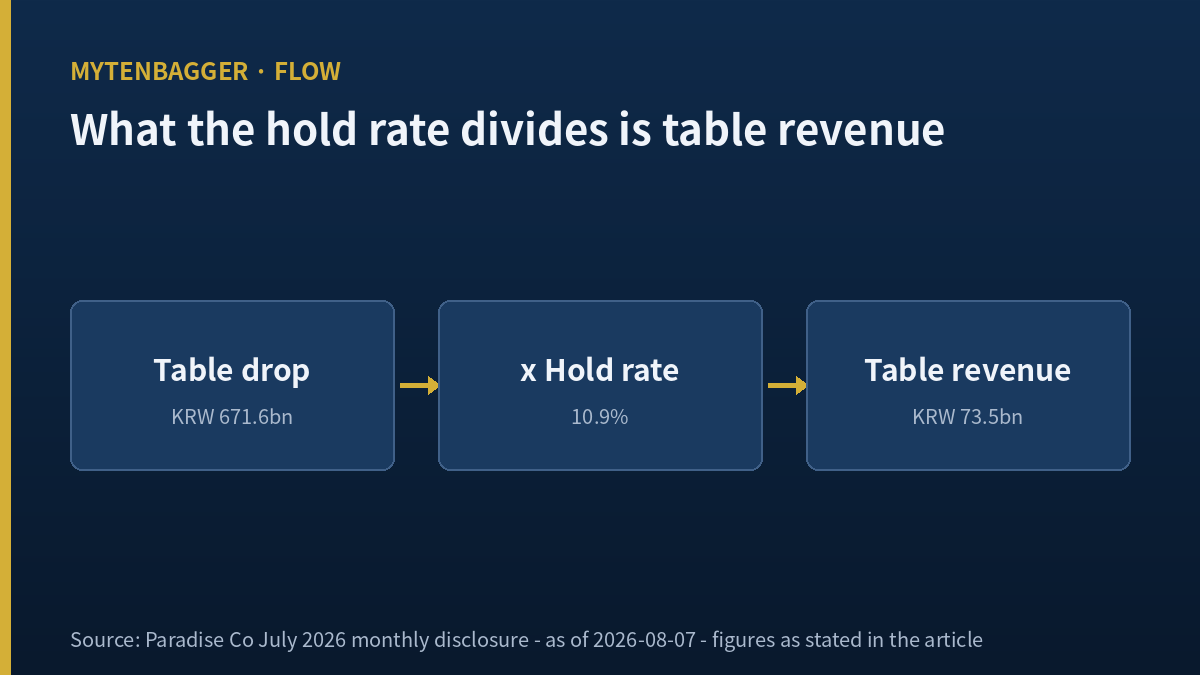
I opened Paradise Co stock expecting to look at a price chart and ended up looking at one piece of arithmetic instead. In July 2026, table drop at Korea’s largest foreigner-only casino operator was 671.63 billion won, about US$474 million. That is the amount guests converted into chips, and it was 15.0% higher than a year earlier. Table revenue in the same month was 73.46 billion won, about US$52 million, up 3.6%.
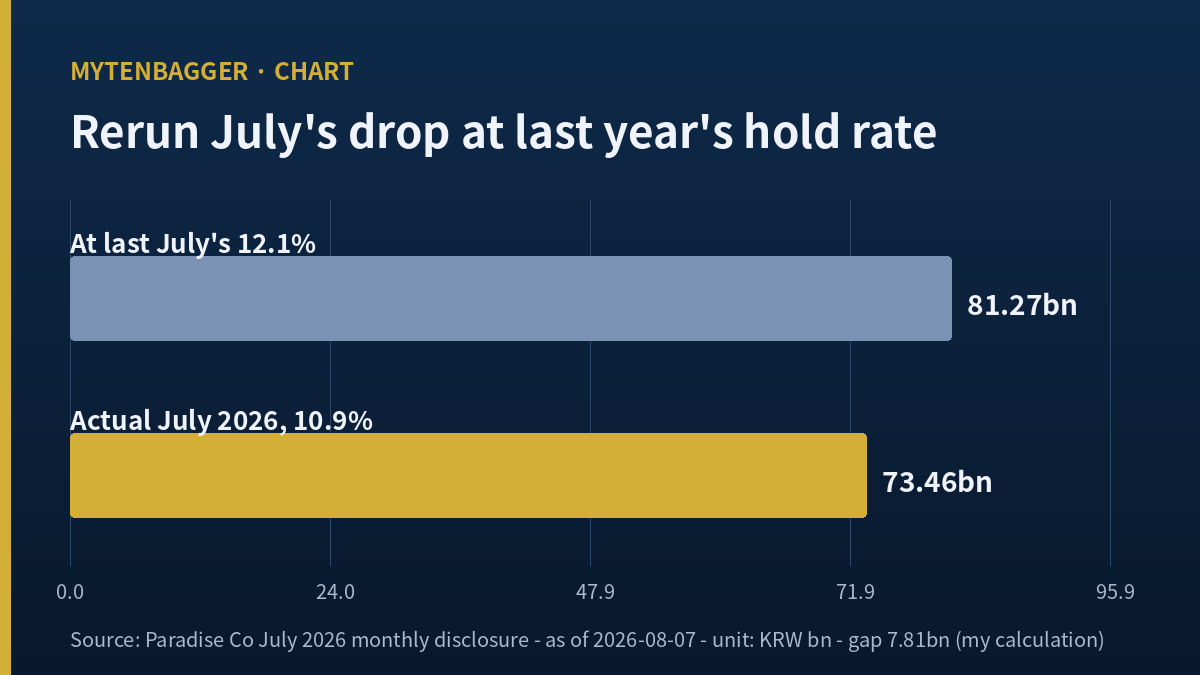
One number connects those two. Last July the hold rate was 12.1%. This July it was 10.9%. I wanted to see what 1.2 percentage points is worth in won, so I multiplied July’s drop by last year’s rate: 671.63 billion won times 12.1% gives 81.27 billion won. Actual table revenue was 73.46 billion. The gap is 7.81 billion won, roughly US$5.5 million, in a single month. The company’s entire operating profit for the three months of the second quarter was 35.55 billion won.
July 2026, two versions of the same month
| As filed | At last July’s 12.1% hold | |
|---|---|---|
| Table drop | 671.63bn won | 671.63bn won (held fixed) |
| Table revenue | 73.46bn won | 81.27bn won |
| Total casino revenue | 77.89bn won | 85.71bn won |
| Year-on-year headline | +3.6% | +14.0% |
Right-hand column is my calculation. Nothing about guest traffic changes between the two columns; only the fraction the house kept does.
Contents
What Paradise Co stock shows on a screener, and what it leaves out
Paradise Co (KRX: 034230) trades on the KOSPI, the senior board of the Korea Exchange, where the country’s larger listed companies sit; the KOSDAQ is the separate junior board. Paradise runs foreigner-only casinos at four Korean sites, the largest being Paradise City on Yeongjong Island next to Incheon airport, and it is legally barred from admitting Korean nationals. That single rule is the whole reason its revenue tracks inbound tourism instead of domestic consumption.
On 7 August 2026 (Fri) the shares closed at 10,100 won, about US$7.13. Market capitalization was 935.6 billion won, roughly US$661 million. The stock sat at 42.08% of its 250-day intraday high of 24,000 won, a drawdown of 57.92%, both on a closing-price basis and both matching the vendor’s displayed 42.1% and -57.9%. It was 8.37% above the 250-day low of 9,320 won and below its 20-, 60- and 120-day moving averages of 10,288, 12,901 and 14,949 won. Trailing one-month, three-month and twelve-month returns were -21.83%, -36.88% and -45.32%.
The valuation column points the other way: trailing P/E of 9.92, price-to-book of 0.53, price-to-sales of 0.81, and six of seven boxes ticked on the Kiwoom seven-metric checklist for a score of 86, with only return on equity at 5.6% failing. When a screen looks that cheap, the job I give myself is to find what the screen is not showing. Here there were two items. One is regulatory. The other is what this piece is about.
Metrics I verified myself (Kiwoom data, 7 August 2026 (Fri) close of 10,100 won)
| Item | Vendor value | My check |
|---|---|---|
| Market cap | 935.6bn won | 10,100 won × 92,633,663 shares = 935.60bn (matches) |
| P/E | 9.92x | 10,100 ÷ EPS 1,018.15 won = 9.9200 (matches) |
| P/B | 0.53x | 10,100 ÷ BPS 18,895 won = 0.5345 (matches, controlling-interest basis) |
| FY2025 revenue / operating profit / net profit | 1,149.9bn / 155.8bn / 144.8bn won | Operating margin 13.55%, net margin 12.59% reproduced. About US$812m / US$110m / US$102m |
| Dividend (FY2025) | 150 won per share | 87,535,391 shares × 150 = 13.13bn won, matching the filed total |
| Payout ratio | 14.7% | Total dividend ÷ controlling net profit = 14.73%; yield 1.49% × P/E 9.92 = 14.78% (three routes agree) |
| Equity | 2,214.0bn won consolidated | BPS × shares = 1,750.3bn, so 463.7bn is non-controlling (my calculation) |
Prices and multiples reflect the 7 August 2026 (Fri) close as I checked them while writing; this piece may be read later, so live quotes can differ. Dollar figures are approximate, converted at roughly 1,416 won per dollar, the Seoul market close on the same date. The Korean won is the reference currency throughout, and every dollar figure here is a convenience conversion I made, not a reported number.
The hold rate divides table revenue, not total revenue
I reached for a calculator before I reached for an explanation. Korean business daily Edaily reported on 5 August 2026 (Wed) that Paradise’s July casino revenue was 77.89 billion won and its drop was 671.63 billion won, and printed the hold rate as 10.9%. Divide the two printed numbers and you get 11.60%. Seven-tenths of a point is unaccounted for.
My first thought was that the article had made an error. The error was in what I put on top. Paradise files monthly casino results with table-game revenue and machine-game revenue separated, and July’s 77.89 billion won total is 73.46 billion of table revenue plus 4.44 billion of machine revenue. Drop exists only for table games; a slot machine has no chip-exchange step, so no drop is recorded for it at all.
So the hold rate is table revenue ÷ table drop: 73.46 ÷ 671.63 = 10.94%, which agrees with the reported 10.9% to one decimal place.
One match could be luck, so I ran six
I applied the same test across three operators and two months. Paradise in June 2026: 57.61 ÷ 641.13 = 8.99%, against the reported “around 9%”. Grand Korea Leisure, the state-owned operator listed as GKL, in July: 38.02 ÷ 325.17 = 11.69% against a reported 11.7%. Lotte Tour Development in July: 48.91 ÷ 216.76 = 22.56% against a reported 22.6%. All six close at the same precision.
This matters because casino coverage almost always prints revenue and drop side by side, and dividing the two printed figures overstates the hold whenever machine revenue is large. In July the overstatement was 0.66 points. At this company 1.2 points of hold was worth 7.81 billion won, so 0.66 points is roughly 4.4 billion. For a business whose quarterly operating profit is 35.55 billion won, I am not willing to round that away.
Substituting last July’s rate into this July’s drop
Before substituting I checked that 12.1% was really last year’s figure. This July’s drop of 671.63 billion won represents a 15.0% increase, implying 584.03 billion a year earlier. This July’s table revenue of 73.46 billion represents a 3.6% increase, implying 70.91 billion. Dividing those two reconstructed figures gives 12.14%, which agrees with the reported 12.1%. Two published growth rates were enough to rebuild the prior-year ratio, so I was willing to substitute it.
The result is the 7.81 billion won I opened with, equal to 21.96% of second-quarter operating profit. June was worse. June’s hold was 8.99%, and rebuilding the prior year the same way gives 12.97%. Put the two months together and my calculated shortfall runs into the tens of billions of won.
There is a reason I stop the calculation there. It rests on treating 12.1% as the normal rate, and Paradise does not publish what it considers normal. Its monthly filings contain realized revenue and realized drop, and no baseline. So I cannot call 7.81 billion won lost profit. The most I can call it is a deviation measured against a reference I chose myself.
What actually broke Paradise Co stock was not the hold rate
I want to be straight about proportion. Most of the 45% twelve-month decline came from two dates that have nothing to do with my arithmetic.
On 3 July 2026 (Fri) the company disclosed June casino revenue of 63.17 billion won, down 21.2% year on year, and the shares fell 13.56% in one session. On 15 July 2026 (Wed), Korean media reported that the Ministry of Culture, Sports and Tourism was considering raising the cap on the tourism promotion fund levy paid by foreigner-only casinos from 10% to 15% of revenue. Paradise fell 13.5% that day, Lotte Tour Development 14.6% and GKL 10.8%, and all three hit 52-week lows.
The following day, 16 July 2026 (Thu), two houses cut their valuations. Hana Securities moved from 25,000 to 18,000 won, a 28.0% cut by my calculation, and lowered the sector target multiple from 18x to 15x, estimating that a 15% levy would reduce operating profit by 19% to 28%. iM Securities moved from 23,000 to 17,000 won, down 26.09%. KB Securities put the extra annual burden on Paradise at roughly 50 billion won, which is 32% of FY2025 operating profit by my calculation. The same bill read against another operator did not converge: four houses covering GKL split between about 26 billion won by 2028 and no added cost at all.
That is an order of magnitude above the hold-rate effect, and I am not going to pretend otherwise. Regulation is the first item and hold is the second. What makes the second one worth writing about is that the first is still a proposal with no confirmed number attached, while the second is already published every month and nobody divides it.
Three operators, one month, three directions
There is a straightforward way to test whether hold reflects management skill: line up three companies serving overlapping customer pools in the same month. July 2026 supplied that sample.
| July 2026 | Casino revenue | Table drop | Hold | Change vs 2025 |
|---|---|---|---|---|
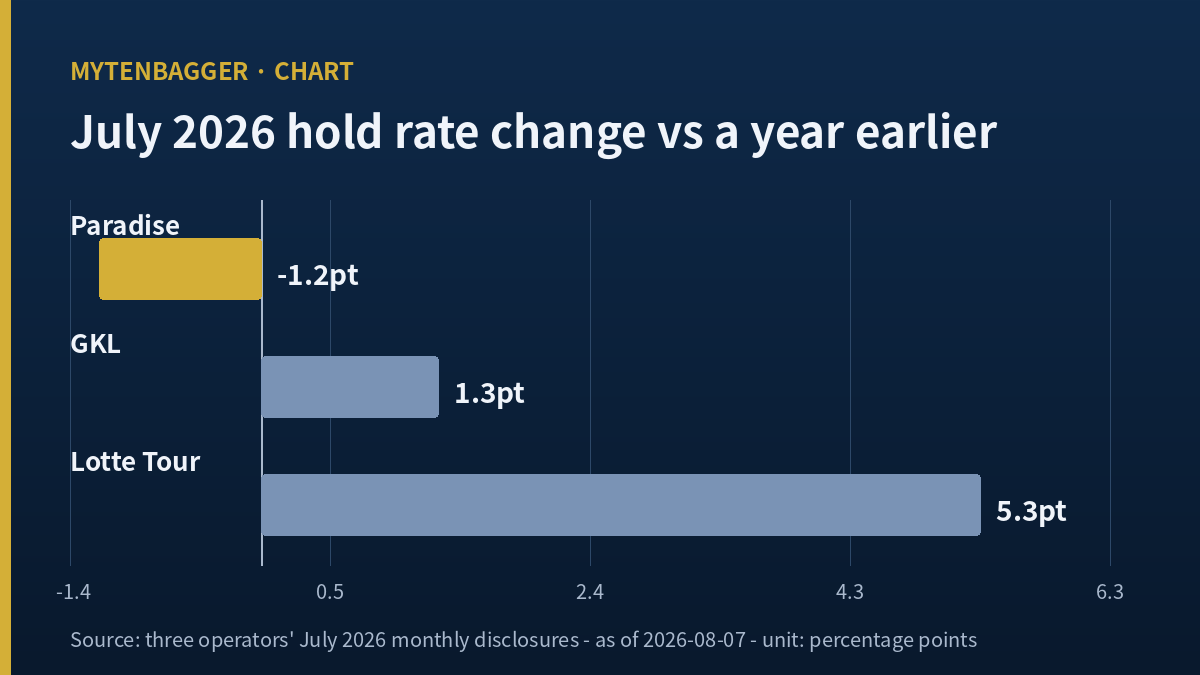
| Paradise Co | 77.89bn (+3.6%) | 671.63bn (+15.0%) | 10.9% | -1.2pt |
| GKL | 41.68bn (+6.9%) | 325.17bn (-4.1%) | 11.7% | +1.3pt |
| Lotte Tour Development | 51.59bn (+18.8%) | 216.76bn (-9.9%) | 22.6% | +5.3pt |
Same month, three different directions: -1.2, +1.3 and +5.3 points. The movement does not follow traffic either. Paradise was the only one of the three whose drop grew, and it posted the weakest revenue growth of the three. Both of the others saw drop shrink and revenue rise.
Absolute hold levels are not comparable across these operators. Lotte Tour’s 22.6% comes from a different table and game mix, not from being twice as good at anything. What is comparable is direction and size of change, and those scattered three ways in a single month. That points away from operating performance and toward sample size.
Las Vegas Sands publishes the baseline that Paradise Co stock investors have to build
I wondered whether any operator does this arithmetic for its shareholders. One does. In its second-quarter release on 22 July 2026 (Wed), Las Vegas Sands attached a hold-normalization exhibit. It states in advance what its Rolling Chip win percentage should have been, 3.3% for Macao and 4.2% for Marina Bay Sands, and reports what results would have looked like at those figures: an adjustment of positive US$87 million in Macao, negative US$37 million at Marina Bay Sands, positive US$50 million combined. The chief executive’s letter says plainly that “unusually low hold in rolling play negatively impacted our reported financial results.”
When a company states its expected rate, a shareholder can separate a bad quarter caused by trading from a bad quarter caused by cards. When it does not, the shareholder runs that calculation alone and picks the reference alone. That is exactly why I will not describe 7.81 billion won as a confirmed loss.
The size gap is worth stating too. Las Vegas Sands closed at US$45.77 on 7 August 2026 (Fri) with a market capitalization of US$29.64 billion, per stockanalysis.com. At the same day’s 1,416.10 won rate that is roughly 42.0 trillion won, about 44.9 times Paradise’s 935.6 billion. Yet trailing net margins are nearly identical: 12.61% at Las Vegas Sands, from US$1.73 billion of net profit on US$13.72 billion of revenue, against Paradise’s 12.59% for FY2025. The difference between them is not profitability. It is that one of them tells you how much of that profitability was the deal of the cards.
Numbers on the Paradise Co stock screen that I did not use
- All cash-flow fields. Operating cash flow of -21,324, free cash flow of -254,349 and EBITDA of 37,304 do not reconcile with 155.8 billion won of operating profit under any scaling I tried, so I dropped the whole group.
- Interest coverage of 2.18x. That implies interest expense of 71.47 billion won by my calculation. Korea Ratings, upgrading the company from A to A+ on 22 April 2026 (Wed), put FY2025 net borrowings at 377.3 billion won. Getting 71.47 billion of interest from 377.3 billion of net debt needs a 19% coupon, so I left it out.
- Three-year revenue CAGR of 25.08%. It is anchored on the pandemic trough and says nothing about the current growth rate.
- Raw payout ratio of 49.6%. Two independent routes arrive at 14.7%, so I used the formal field.
- Return on equity of 5.6%. On controlling equity I get 5.10% and on consolidated equity 6.54%, neither of which reproduces the vendor figure, which appears to use average equity. It stays in the table and out of the argument.
- Edaily’s 13 July 2026 (Mon) second-quarter figures of 321.1 billion won revenue and 38.7 billion won operating profit were explicitly framed as estimates in the original text. The 7 August (Fri) filing showed 318.09 billion and 35.55 billion. I kept estimates and results apart.
- The consensus valuation average. An offshore aggregator shows a 14-analyst average of 20,285 won, but that pool mixes values published before the 15 July (Wed) levy report. An average across inconsistent dates is not a number I can use.
Where I stand on Paradise Co stock, and what would move me
At 935.6 billion won of market value it sits outside the KOSPI top 100. What I am doing is watching.
My reason for staying out is not the valuation, which is genuinely low at 0.53 times book and 9.92 times trailing earnings. It is that a number outside the company’s control moves its quarterly profit by material amounts, and the company does not publish what that number is supposed to be. If 12.1% is normal and 10.9% is an outlier, this stock is cheap. If 10.9% is the new normal, the 7.81 billion won I calculated was never there. I have not built the evidence that separates those two cases, and the proposed levy sits on top of both.
The reference I will judge myself against
I am fixing one source in advance: the monthly cross-section of hold rates across all three Korean foreigner-only operators. One company’s number cannot separate a company problem from an industry problem. Three companies in the same month can.
- Evidence I am wrong: Paradise’s hold returns to around 12% in the August or September filings while GKL and Lotte Tour barely move. That would make July’s 10.9% sampling noise, and me the person who mistook noise for a thesis.
- Grounds to discard this piece entirely: Paradise stays in the 10% range for two consecutive months and the other two fall with it. Then it is not a company story at all, and writing it at the single-stock level was the wrong frame.
- What brings me back: the company starting to state an expected or long-run hold rate in its investor materials. That one line converts my calculation from guesswork into something checkable.
Eight arguments against my Paradise Co stock case
- The tourism promotion fund levy. Reported under ministry review on 15 July 2026 (Wed), with KB Securities estimating roughly 50 billion won of extra annual cost for Paradise and Hana Securities estimating a 19% to 28% hit to operating profit. If that passes, this article’s center of gravity is in the wrong place.
- The assumption inside my own counterfactual. The 7.81 billion figure treats last July’s 12.1% as normal, and I do not know that. I did not go back to 2024 or 2023 July hold rates, so 12.1% could itself have been a high month.
- Persistence. June was 8.99% and July 10.94%. Two consecutive months below the prior year. Kiwoom Securities analyst Lim Su-jin wrote on 11 May 2026 (Mon) that “March hold was temporarily weak, and April hold rose 5.1 percentage points month on month to 12.6%.” That recovery did not carry into June and July.
- Inspire Entertainment Resort. The Mohegan-backed property on the same island reported FY2025 casino revenue of 267.2 billion won, up 147.6%, per Asia Economy on 9 January 2026 (Fri). Its stated core customers are Chinese and Japanese, the same pool Paradise serves.
- Cost base. After acquiring the Grand Hyatt Incheon west tower for 210 billion won, payroll and depreciation rose about 11 billion won year on year and marketing about 3.5 billion, on KB Securities’ first-quarter breakdown. First-quarter operating profit of 37.31 billion won missed a 44.8 billion consensus, and first-half operating profit fell 27.2%.
- Jeju re-entry. The company is pursuing the Maison Glad Jeju hotel at around 250 billion won with a decision due during August, per Bloter on 10 June 2026 (Wed). KB Securities expects casino synergies only from the second half of 2027, meaning cost arrives first.
- The Seoul flagship hotel. A 575 billion won project in Jangchung-dong funded 96% by bank borrowing, targeting completion in 2028, per News1. The 87.49% debt-to-equity ratio has room to rise from here.
- Sell-side silence. I could not find a single note published after the 7 August 2026 (Fri) results. The newest valuations in circulation are the 17,000 to 18,000 won marks from 16 July (Thu), set without sight of the second quarter, and they sit 68.32% to 78.22% above the closing price by my calculation. Forward EPS, forward P/E and peer multiple are all blank in the metrics database, which is not the same as nobody having looked. Six houses have published on this name and four of them cut their valuation after 7 May 2026 (Thu).
I put items one and two first not because they are the largest but because they are the least settled. One is still a proposal without a confirmed figure, and two is an assumption I made myself.
the Korean brewer whose highest sector yield sat next to its thinnest margin, The food maker whose numbers went a full quarter without a single note, the noodle maker that mapped revenue across seven countries and profit across none, the engineering contractor whose unrevised full-year target implied a much weaker second h
One line would make this article unnecessary
Everything above exists because of an absence. If Paradise stated an expected hold rate in its investor materials the way Las Vegas Sands states 3.3% and 4.2%, then a reader could look at any quarter and see immediately how much of the result was operations and how much was variance. Nobody would need to rebuild the prior year from two growth rates.
Until that line appears, I will do it monthly: take the three operators’ filings when they appear in the first week of each month, divide table revenue by table drop for each, and record whether the three moved together or apart. Five or six months of that will show me roughly where normal sits. I would rather the company saved me the trouble.
Sources: eToday (7 August 2026 (Fri), Q2 results) · Edaily (5 August 2026 (Wed), July casino results for the three operators) · GGRAsia (4 August 2026 (Tue), table and machine split) · Electronic Times (3 July 2026 (Fri), June revenue) · Financial News (16 July 2026 (Thu), levy proposal and valuation cuts) · Money Today (22 April 2026 (Wed), Korea Ratings upgrade) · Money Today (7 August 2026 (Fri), won-dollar close of 1,416.10). Korean-language press and Korean sell-side notes are cited as such; quotations from them are my translations.