Hyundai E&C Stock: The Nuclear Clock Points to 2027, My Read
Hyundai E&C stock has fallen from an intraday April high of ₩198,400 (about $139) to the mid-₩94,000s (about $66). I hold no position and I’m not reaching for this dip. Second-quarter operating profit beat consensus by 22–23%, yet three Korean brokerages cut their valuations anyway — because the problem isn’t earnings, it’s the nuclear contract timeline. I’ve set three signals that would tell me the clock has actually started ticking.
Last Friday evening I was going through Korean half-year filings when I pulled up Hyundai E&C stock again. What struck me first wasn’t the numbers — it was the memory of April, when Korea’s nuclear trade was running hot and this name touched ₩198,400 intraday. I didn’t chase it then, and honestly that was laziness more than judgment. Three months later the company printed 261.8 billion won ($184 million) in quarterly operating profit and a record order backlog above 100 trillion won, and the stock sits near ₩94,500 ($66).† The lazy version of me lost nothing. That bothered me enough to finally sit down and do the work.
Contents
Hyundai E&C Stock Fell by Half While the Business Didn’t
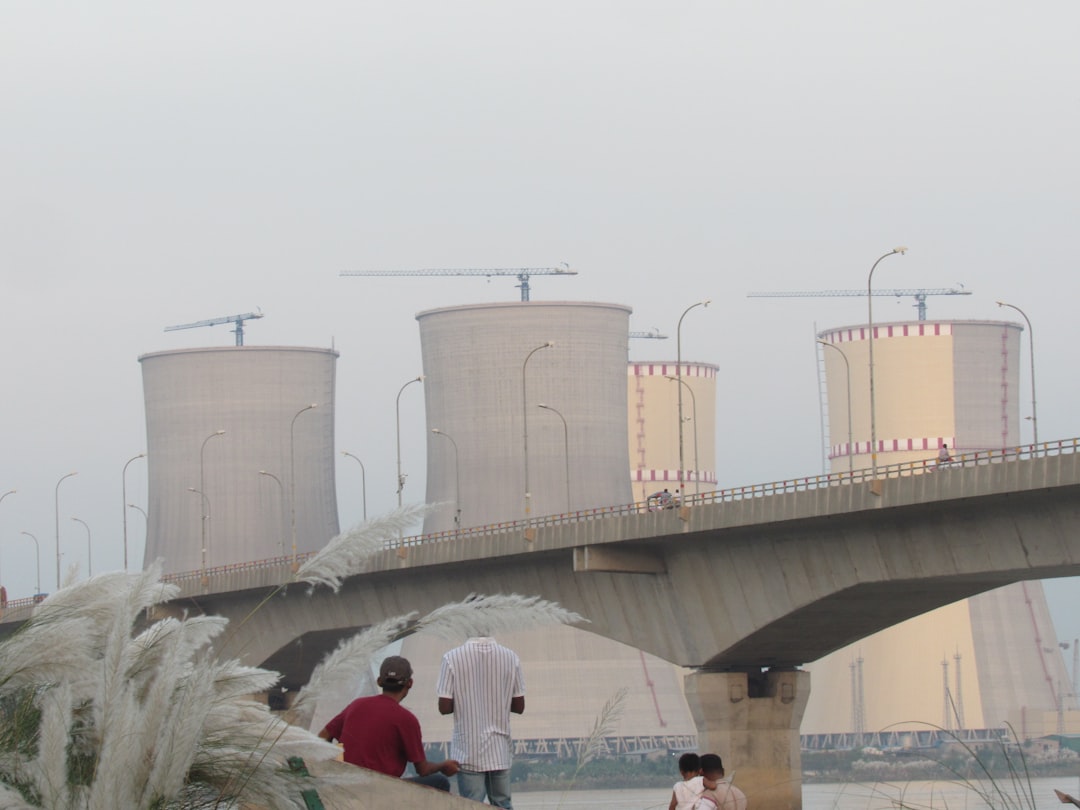
First, what this company is, for readers who don’t follow Korea daily. Hyundai E&C (000720) is Korea’s flagship general contractor, listed on the KOSPI — Korea’s main board, home to the country’s large caps, the index you see quoted when headlines say “Korean stocks rose.” Its ticker won’t show up in a U.S. brokerage search because it has no American listing; I’ll come back to access below. The company builds apartments under the Hillstate and The H brands, infrastructure, LNG plants, and — the part that matters here — nuclear power stations. It is the only Korean builder with an active overseas large-reactor construction role: in November 2024 it signed the engineering contract for Bulgaria’s Kozloduy units 7 and 8 alongside Westinghouse, which is supplying its AP1000 reactor design. Korean press framed that signing as the country’s return to overseas large-scale nuclear work after 15 years, per Hankyung’s coverage at the time (Korean source).
A word on why that 15-year figure matters to the thesis. Korea built its export-nuclear reputation on the Barakah plant in the UAE — delivered at a cost and pace that became the industry’s counterexample to the West’s blowouts. But the construction muscle behind that reputation had no overseas large-reactor project to work on for over a decade. Kozloduy is the re-entry ticket, and it comes with a twist that makes it strategically bigger than one plant: this time the Korean builder is constructing an American reactor design, Westinghouse’s AP1000, rather than Korea’s own APR1400. If that pairing works — American design, Korean execution — it is a template that can be resold across every AP1000 order in Eastern Europe and beyond. That is the size of the option the market was pricing in April, and it’s why I don’t dismiss the premium as retail froth even after the crash.
One more piece of context on the dividend, because U.S. income investors will ask. The FY2025 payout of ₩800 per share (about $0.56) was the first raise after three consecutive years flat at ₩600 — a 33% bump, but on a base so low that the yield still rounds to 0.85%. Nobody owns this name for income, and management was explicit on the call about the order of operations: capital goes to the balance sheet and the 2028 credit-rating target first, shareholder returns later. I think that sequencing is correct for a company heading into a nuclear construction cycle. But it also means there is no internal cushion — no buyback program, no meaningful yield — standing under the share price while the contract calendar does its slow work. What you own in the meantime is the option, undamped.
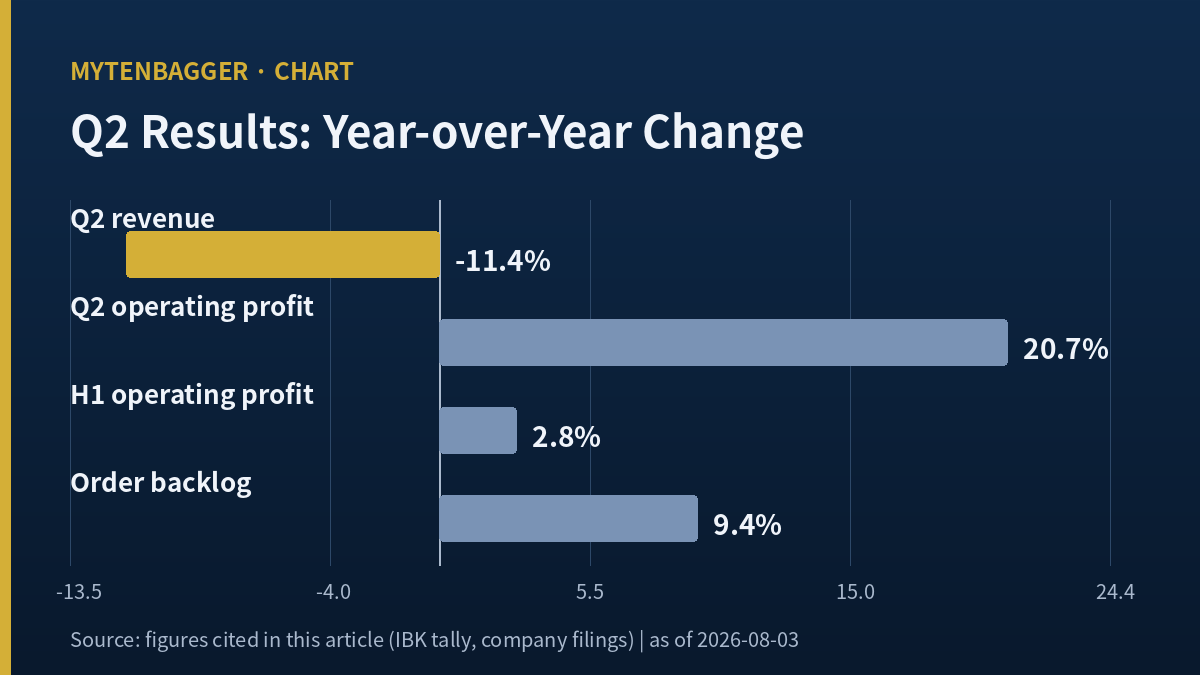
That nuclear story is what carried the stock to ₩198,400 in April. And it’s what has been unwinding since. The drawdown math: roughly 52% off the April intraday high, and about 44% over the past three months alone.† Meanwhile the June-half results released July 31 showed operating profit up 20.7% year-over-year for the quarter, a beat of 22–23% against the consensus figures brokerages cited, and an order backlog of 103.98 trillion won ($73.0 billion) — the first time in the company’s history it has crossed the 100 trillion mark. Half the price, better earnings, record backlog. When a chart and an income statement disagree this loudly, one of them is answering a different question. My job in this piece is to figure out which question the market is actually asking.
The Nuclear Pipeline Behind Hyundai E&C Stock
The market’s question, it turns out, is about time. Hyundai E&C’s nuclear pipeline is three projects at three very different stages, and lumping them together — “the nuclear story” — is exactly how I’d get this name wrong.
Kozloduy: the deepest project, stuck at the price
Bulgaria is the furthest along — engineering work is contracted and underway. What’s pending is the full EPC (engineering, procurement, construction) contract, and that’s where things got tense this spring. In mid-April, Bulgaria’s acting energy minister publicly insisted the two AP1000 units “must be built at a fixed price,” as World Nuclear News reported, days before the engineering contract period was extended by 14 months. Korean outlet TheGuru, covering the same standoff (Korean source), noted that local Bulgarian media already estimate the project’s cost at around $16 billion against an initial $14 billion — and that Bulgaria carries the scar of Belene, a plant that ballooned from 4 billion to 10 billion euros before being scrapped in 2021.
Here’s where my read splits from the tape. The market sold this as “the contract is slipping.” I read it as a pricing negotiation — and one where slow may be smart. If input costs are rising and the buyer wants a fixed price, the worst outcome for the builder isn’t delay; it’s signing quickly. A contractor that walks into a fixed-price commitment on a ~$16 billion project locks the ceiling on its own margins for years. Hyundai E&C’s entire trailing-twelve-month revenue is about $21.8 billion (31 trillion won, derived from Kiwoom data) — this single project is close to a full year of the company. I hold the unpopular view that the delay, by itself, is not the bad news here. The bad news would be a fast signature on the buyer’s terms.
Palisades and Fermi: the American clocks
The second project is the Palisades SMR work with Holtec in Michigan — on the company’s own guidance from its July 31 earnings call (relayed by Money Today, Korean source), a partial contract is targeted for the second half of this year. That makes it the most likely first signature of the three. The third is Fermi America’s large-reactor project in Texas, which hasn’t yet converted to an EPC contract; Shinhan Securities lists that conversion among its fourth-quarter catalysts. Three projects, three stages: one negotiating price, one approaching a partial signing, one pre-contract. No single delay is a funeral for the whole pipeline — but no single signature has happened yet either, and that asymmetry is the whole stock right now.
Hyundai E&C Stock by the Numbers
| Item | Value | Note |
|---|---|---|
| Q2 revenue | $4.80B (₩6.84T) | -11.4% YoY (IBK tally) |
| Q2 operating profit | $184M (₩261.8B) | +20.7% YoY, 22–23% above cited consensus |
| Order backlog | $73.0B (₩103.98T) | First-ever 100T won cross, +9.4% YoY, ~3.8 years of work |
| H1 new orders | $16.0B (₩22.82T) | +36.4% YoY; includes a US electric-arc steel mill |
| Cash / debt ratio | $2.7B / 155.2% | Debt ratio improved 19.6pp YoY |
| P/E / P/B / ROE | 28.5x / 1.29x / 4.6% | Trailing basis‡ |
| Dividend (FY2025) | $0.56/sh (₩800) | First raise after three flat years; ~0.85% yield |
Sources: company H1 results and earnings-call coverage (July 31, 2026, Korean press); brokerage figures as relayed by Korean media. | †Drawdowns derived from the April intraday high of ₩198,400; 3-month figure from Kiwoom daily data. | ‡Price and multiples from Kiwoom data as of July 31, 2026; the intraday snapshot and the daily series differ by ₩100 (₩94,500–94,600), so I write “mid-₩94,000s.” | USD figures converted at ₩1,424.0 per dollar, the Seoul FX close of July 31, 2026.
Two rows in that table carry my notes in the margin. The debt ratio is one — on the earnings call the company committed to a credit-rating upgrade target by 2028, has already placed a $351 million (₩500B) convertible bond, and says the rating agencies’ 100% standalone debt-ratio threshold is reachable if profits hold. Tightening the balance sheet before a multi-year nuclear campaign is the right order of operations, and I’ll give management credit for sequencing it that way. The full half-year picture supports the same read: H1 revenue of $9.2 billion (₩13.12T) fell 13.5% from a year earlier, yet operating profit rose 2.8% to $311 million (₩442.7B) and net profit climbed 11.8% to $255 million (₩363.7B) — profit growing on shrinking volume, three lines in a row. The company already holds an AA- domestic credit rating, the top tier among Korean builders; the 2028 target is about moving up from strength, not repairing distress. That revenue-versus-profit divergence is the second margin note: volume is shrinking and margins are beating it. The company says higher-margin urban-redevelopment housing is taking a bigger share of the mix, and the numbers are consistent with that claim. It also disclosed the cracks: four of its fourteen Middle East sites are running behind schedule (management expects no profit impact — their claim, not mine), and the Shaheen project in Ulsan may book extra costs in a year-end push.
Hyundai E&C Stock vs. Fluor: Same Size, Different Question
Here’s the comparison I couldn’t find in Korean coverage. At the July 31 close, Hyundai E&C’s market cap works out to about $7.4 billion. Fluor (NYSE: FLR) — America’s closest listed analogue, an E&C contractor with its own nuclear history — carries a market cap of about $7.0 billion as of August 1, trading at 22.8x trailing earnings with $15.2 billion in TTM revenue. The two companies are almost the same size in equity value. But Hyundai E&C generates roughly $21.8 billion in trailing revenue to Fluor’s $15.2 billion, and still trades at a higher trailing multiple — 28.5x against 22.8x.
Read that pair of numbers slowly and the market’s verdict becomes legible: investors are paying a premium over a comparable American contractor for the nuclear option — the possibility that Kozloduy, Palisades, and Fermi convert into a decade of high-visibility reactor revenue. In April that premium was much larger. What the last three months did was shrink it, not erase it. Which tells me the market hasn’t abandoned the thesis; it has repriced the waiting time. Direct ownership also means direct won exposure: every dollar figure in this piece is converted at ₩1,424.0, the July 31 Seoul close, and a Korean holding can move against you in currency terms even when the KOSPI quote goes nowhere. And Korea’s market runs settlement and disclosure in Korean — the primary documents I cite (DART filings, earnings-call reports) have no official English versions, which is part of why the information gap this piece tries to bridge exists at all.
What the Analysts Did — and What I Do With It
The week of the earnings beat, the sell side cut. Per a Herald Business roundup (Korean source), Mirae Asset moved its valuation on the name from ₩213,000 to ₩175,000 and Shinhan from ₩180,000 to ₩170,000 — Shinhan’s July 16 note carried the title “only the share price has changed,” as analyst Kim Sun-mi framed it (Newspim’s report brief, Korean source). Then on August 3, IBK Securities went further, from ₩260,000 to ₩160,000 — a 38% cut — with analyst Cho Jung-hyun pointing at delayed reactor contracts and delayed cash collection, and putting the realistic window for major nuclear awards at 2027 to 2029 (via Edaily, Korean source). All three kept buy ratings.
Two details in the coverage deserve a flag before I interpret anything. The consensus that Q2 “beat by 22–23%” isn’t one number: Shinhan’s note cited a 200.5 billion won consensus, IBK’s cited 213.7 billion — different snapshots of the same estimate pool, so I carry both rather than pretending to precision. And Shinhan’s July note contained a quiet paradox: it calculated 67.7% upside from the prior close to its own valuation — and cut that valuation anyway. That’s not a bullish math error. It’s an analyst saying the destination hasn’t moved much, but the road got longer. I find that framing more honest than either the April euphoria or the July panic.
An earnings beat and a valuation cut in the same week is not a contradiction — it’s a diagnosis. The numerator (profit) is fine; the denominator (the price of waiting) got bigger. What the market bought in April was “a nuclear contract in 2026.” What it is being handed is “nuclear contracts from 2027, maybe 2029.” I classify this as duration risk, not earnings risk, and the distinction matters because the things I’d need to monitor are different. For earnings risk I’d watch cost ratios and housing pre-sales. For duration risk I’m watching a Bulgarian power-purchase agreement, a US utility’s financing calendar, and a state visit schedule — variables I have no edge in forecasting. When the top of my watch list is made of things I cannot verify from Seoul or from a filing, my conviction has no foundation to stand on. So I don’t manufacture one. I wait for the signatures.
Scenarios for Hyundai E&C Stock — Three Speeds of the Clock
The clock starts in the second half (my estimate: 40%)
This is the path where the company’s own guidance holds: a Palisades partial contract lands, Kozloduy’s second-stage contract gets signed, and Shinhan’s fourth-quarter catalyst list — Team Korea nuclear awards, Palisades, the Fermi EPC conversion — starts converting from a list into filings. The important mechanic here is that the market doesn’t need dollar amounts to reprice; it needs proof that the timeline exists. One real signature on any of the three pipelines re-anchors the other two, because the sell side’s cuts were about timing, not about whether the projects are real. In this path, the current zone gets remembered as the pullback inside an intact story — and I will have watched it happen from the sidelines, which is a cost I’ve decided I can live with.
The clock slips to 2027 (40%)
This is IBK’s timetable — power-purchase agreements and project financing push real awards into the 2027–2029 window. In that world, what supports the stock for the rest of this year is not nuclear at all but the base business: the housing-mix improvement, the two data-center wins the company guided above $700 million combined, the $840 million Wando offshore wind project, Papua New Guinea LNG. Those are real, and the H1 new-order growth of 36.4% happened without a single reactor in it. But a 2.1% operating margin and 4.6% ROE cannot hold a 28.5x trailing multiple on their own — Fluor does 22.8x with a cleaner margin profile. So this path most likely looks like a long, boring box, punctuated by rallies every time a Bulgarian official gives an optimistic interview. I’d rather re-enter late in this scenario than early.
A fast signature at a fixed price (20%)
The scenario I watch most warily is the one that will look best on a headline. If Hyundai E&C signs the Kozloduy EPC quickly at Bulgaria’s fixed number, the backlog jumps by something approaching a year of revenue — and the margin ceiling on that revenue gets welded shut in a rising-cost environment. Bulgaria’s own history explains its insistence: Belene went from 4 billion to 10 billion euros and died. But the same history is exactly why a builder should be slow to absorb that risk on the buyer’s terms. If this signature comes, the day it prints I will be reading the escalation clauses, not the celebration coverage. A win on bad terms is how construction companies convert record backlogs into decade-long margin problems — the industry’s graveyards are full of exactly this trade.
A margin ceiling does not have to be written into a contract to exist. Samsung E&A left its own full-year target — 10tn won of revenue, 800bn won of operating profit — untouched after a first half that had already outrun it, and subtracting the half from the target leaves an implied second-half margin of 6.61% (derived). Same industry, two ways to cap a margin: one written by the buyer, one left standing by the seller.
My Watch Conditions
I weight my three signals instead of treating them equally. The heaviest is Bulgaria’s final investment decision — the state nuclear company has pointed to the second half of this year, and FID is the moment the fixed-price question stops being rhetoric and becomes contract language. If that language shows meaningful escalation clauses, half of my remaining doubt resolves on the spot; if it’s a hard fixed price at the buyer’s number, the “win” will be worth less than the headline suggests. The middle weight is the Palisades partial contract — small in dollars, but it validates the “American SMR builder” label that no other Korean contractor holds. The lightest weight is quarterly earnings. Profit is already good; another good quarter, by itself, does not move me from watching to owning.
There’s also an exit from the watchlist itself. If Kozloduy slips again wholesale and the year ends with no progress disclosure from either American project, I’ll treat the nuclear premium as unrecoverable for the time being and re-run the numbers on the construction business alone — housing mix, data centers (the company guided to two wins above $700 million combined), the $840 million Wando offshore wind job, the Papua New Guinea LNG EPC. On those numbers alone, at 28.5x trailing earnings with a 2.1% operating margin and a 4.6% ROE, there is no hurry in any direction.
I skipped this stock in April out of laziness, and I’m skipping it in August out of reasoning. I’d rather be the second kind of wrong. My next checkpoints are the Palisades partial contract and Bulgaria’s FID, both flagged for the second half — when either lands, I’ll pull this file back up and redo the arithmetic with a real contract in it.
Related reading
- Doosan Enerbility Stock: Price Halved, Targets Twice as High
- Kumho E&C Stock Ran Limit-Up on the Chip Cluster
- Samsung C&T Stock: 29% Drop, Stakes Worth Twice the Cap