Korean Air Stock: The Merger Math Behind a 25,690 Won Line
I opened a calculator on Korean Air stock because of a division problem, not a chart. Asiana Airlines shareholders who object to the merger will be paid ₩7,030 per share in cash. The exchange ratio is 0.2736432 Korean Air shares for every Asiana share. Divide the first number by the second and you get ₩25,690. That figure is not a valuation anybody published and not a line I drew on a price chart. It was sitting inside the merger filing the whole time.
Here is where I landed before I get into the detail. The August 3, 2026 close of ₩26,150 sits 1.79% above that ₩25,690 crossover, and the gap becomes a live decision for Asiana holders from August 12 (Wednesday) through September 1 (Tuesday). The quarter underneath it reads stranger than the headline: operating profit fell 34% year over year, yet the cargo division added more revenue in absolute won than the passenger division did, and the company posted an operating profit while swinging to a net loss. I do not own the shares, and I am not treating August’s structural floor as a reason to buy. What I can do is write down the date that floor expires.
Contents
Where the ₩25,690 line under Korean Air stock comes from
A short recap for readers outside Korea. Korean Air (KRX: 003490) trades on the KOSPI, the main board of the Korea Exchange in Seoul, where daily moves are capped at plus or minus 30% and settlement runs T+2. It has been absorbing Asiana Airlines since taking a 63.88% stake in December 2024, and on May 13, 2026 the two carriers signed the final merger agreement. The exchange ratio is 0.2736432 Korean Air common shares per Asiana common share, the merger record date is midnight on December 16 (Wednesday), and the combined carrier launches the following day, December 17 (Thursday). Korean Air will issue 20,337,721 new shares to complete it, per the company’s own announcement.
Korean corporate law gives dissenting shareholders an appraisal right, which functions much like the cash-out election US readers know from Delaware appraisal cases, except the price is set by statute rather than litigated. Asiana holders who vote against get ₩7,030 per share. Per Korean press reporting, that price was derived from two-month, one-month and one-week weighted average prices measured backward from the day before the May 13 board resolution, the shareholder meeting falls on August 12 (Wednesday), the exercise window runs to September 1 (Tuesday), and cash settles on October 1 (Thursday) (HuffPost Korea, July 28, 2026).
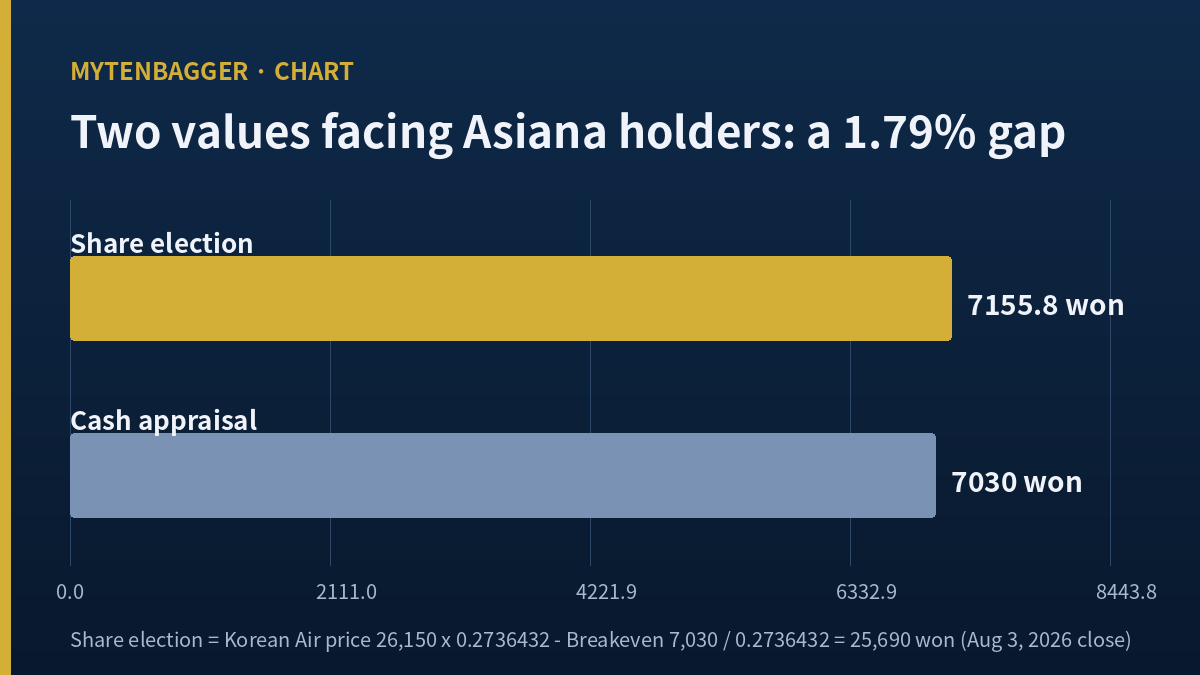
So an Asiana holder faces two numbers. Take the stock and you receive Korean Air shares worth 0.2736432 times whatever Korean Air stock is trading at. Take the cash and you receive ₩7,030. The two are equal when Korean Air trades at ₩7,030 ÷ 0.2736432, which is ₩25,690. Below that, cash wins. Above it, shares win. I ran that division before I looked at any coverage, and the reported figure matched. When two independent routes produce the same number, I am willing to build on it.
At the August 3 close of ₩26,150, the share election is worth ₩7,155.8. That is ₩125.8 above the cash price, or 1.79%. It is not a comfortable cushion. A 2% slip in the stock during that three-week window flips the arithmetic for every Asiana holder still deciding.
What actually carried Korean Air stock last quarter was freight
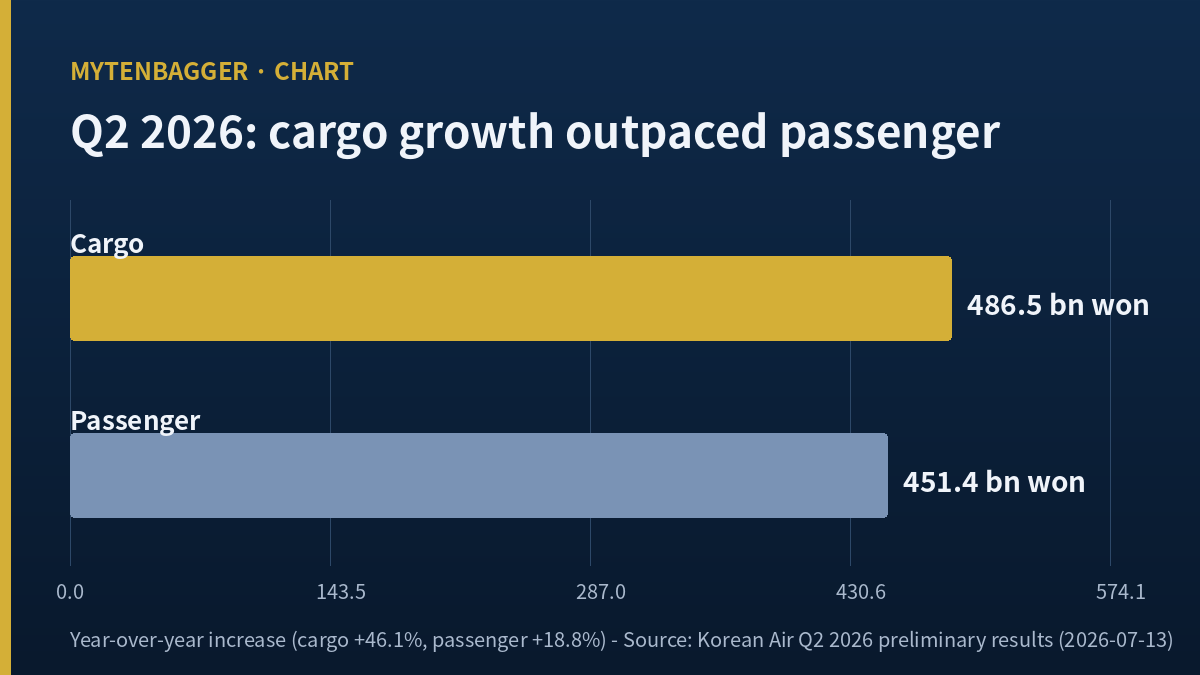
The second-quarter print on July 13, 2026 looks bad from the top line down. Revenue hit ₩5.0199 trillion, a record for a second quarter and up 26% year over year, while operating profit fell 34% to ₩261.8 billion. Split it by division and the story changes. Passenger revenue came in at ₩2.8479 trillion, up ₩451.4 billion from a year earlier. Cargo revenue came in at ₩1.5419 trillion, up ₩486.5 billion (Korean Air Q2 2026 preliminary results).
A division roughly half the size of the other one contributed more incremental revenue. Working the increments back to the prior-year bases gives cargo growth of 46.1% off ₩1.0554 trillion and passenger growth of 18.8% off ₩2.3965 trillion. Both of those growth rates are my own back-calculation from the disclosed figures. I have spent years reading this company as a passenger-cycle story, and this quarter simply does not fit that frame.
I also refused to judge the year on one quarter. First-half revenue was ₩9.535 trillion, up 20%, and first-half operating profit was ₩778.7 billion, up 4%. Down 34% for the quarter and up 4% for the half describe the same six months at the same company. Subtracting the quarter from the half implies a first-quarter operating profit of ₩516.9 billion, which is where the strength actually was. The company’s own outlook points to a passenger rebound in the third quarter on lower fuel surcharges and peak summer season effects. I filed this quarter under “costs ran ahead” rather than “demand broke.”
What is in the containers is documented. A Reuters analysis carried on Yahoo Finance attributed Korean Air’s 46% cargo revenue jump to AI chips, server racks and data centre infrastructure, and cited an IATA estimate that AI-linked freight accounted for 53.5% of air cargo value in 2025 while making up only 7% of volume (Reuters, July 29, 2026). Small, dense, expensive boxes are what lifted yields. iM Securities analyst Bae Se-ho put second-quarter cargo yield at ₩703 per kilometre, up 41.8% year over year.
The industry backdrop supports it without fully explaining it. IATA reported global cargo tonne-kilometres up 8.5% in June 2026 against capacity growth of 4.4%, with Asia-Pacific carriers up 7.9% at a 51.8% load factor (IATA, July 29, 2026). Korea-origin lanes moved differently, though. In the week ended July 27, TAC Index data showed Korea-to-Americas and Korea-to-Europe rates soft, which trade press attributed to extra belly capacity from summer passenger flying (STAT Times / TAC Index, July 28, 2026). Anyone reading the cargo strength as uniform across the quarter is reading it wrong.
The rate indices make that split concrete. In the same week ended July 27, the Baltic Air Freight Index was down 0.6% week over week yet up 16.8% against a year earlier, with the Hong Kong sub-index up 16.5% and the Shanghai sub-index up 23.3% year over year. Cargo pricing in mid-2026 is therefore strong on an annual comparison and flat to falling on a weekly one, which is exactly the shape that produces a great year-over-year print followed by a disappointing sequential one. That combination is the reason I want a third-quarter number before I do anything, rather than extrapolating a 41.8% yield gain forward.
The currency bill attached to Korean Air stock
The same quarter produced a net loss of ₩97.3 billion against a ₩395.9 billion net profit a year earlier. Earning ₩261.8 billion at the operating line and finishing below zero means the damage happened underneath operations, and for an airline that gap is usually foreign-currency debt revaluation and interest. Korean Air buys aircraft in dollars and borrows in dollars, so a weaker won shows up on the balance sheet before it shows up in the cabin.
Fuel is the other measurable pressure. iM Securities put second-quarter fuel costs up 110.9% year over year, an increase of roughly ₩1.05 trillion on its own. Jet fuel was quoted at $149.40 per barrel for the week ended July 17 on IATA’s fuel monitor (Forbes, July 24, 2026), and IATA’s June 7 outlook assumed a $152 average for 2026 while cutting its industry net profit forecast to $23.0 billion (IATA, June 7, 2026). That is a sector-wide squeeze, not a Korean one.
On August 3 metrics, the stock carries a price-to-earnings ratio of about 12.4, price-to-book of 0.88, return on equity of 7.3%, an operating margin of 4.41% and a debt-to-equity ratio of 372.81% (Kiwoom data, August 3, 2026 close). Market capitalisation works out to ₩9.63 trillion, or roughly $6.7 billion at the exchange rate cited in the footnote, from 368,221,374 shares at ₩26,150. The asset-based measure looks cheap while the profitability measures sit below my own screens of a 5% operating margin and a 10% return on equity. Cheap and weak are both true here, and they are printed in the same table.
Why the “₩1 trillion kills the deal” story cannot happen
The HuffPost Korea piece cited above reports a contract provision: if total appraisal claims exceed ₩1 trillion, the two carriers may renegotiate terms or terminate the agreement. Every time that clause surfaces in coverage, a companion narrative follows about the merger collapsing if the stock slips in August. I wanted to know whether the threshold is reachable at all.
The claimable share count falls straight out of the new-share figure. Take 20,337,721 merger shares, divide by the 0.2736432 ratio, and you get 74,322,041 Asiana shares, which is the block not already held by Korean Air. Multiply by ₩7,030 and the total is ₩522.5 billion. That is the ceiling if every single minority holder elects cash and none elects stock.
I checked it a second way. Korean Air received 131,578,947 newly issued Asiana shares in a third-party allotment on December 12, 2024, taking its stake to 63.88% (Korean Air newsroom, December 2024). Subtracting that from Asiana’s roughly 205,990,000 shares outstanding (stockanalysis, August 3, 2026) leaves 74,411,053 shares, or ₩523.1 billion at the same price. The two routes agree within 1%, and both land a little over half of the ₩1 trillion trigger.
So I removed “appraisal claims blow up the deal” from my risk list for this transaction. Korean Air says it will handle its side by board resolution on the same day as Asiana’s shareholder meeting, and as I read that structure, Korean Air’s own shareholders never acquire a separate appraisal right. If that holds, the Asiana minority is the entire universe of claimants, and the ceiling stands. What remains is quieter and more useful: from August 12 to September 1, the company has a structural reason to want Korean Air stock above ₩25,690. That reason expires when the window closes.
One level above that window sits the holding company. What Hanjin KAL itself has earned from its own operations across those years is a separate ledger, and I worked through it in What Has Hanjin KAL Stock Earned From Operations Since 2022.
How Korean Air stock screens against Delta and United
Global comparison is where a Korean carrier usually looks either mispriced or correctly discounted, and I think both readings survive the data. On August 3, 2026, Delta Air Lines carried a $59.60 billion market capitalisation on a trailing P/E of 14.51, a forward P/E of 10.40, price-to-book of 2.62 and an operating margin of 7.76%. United Airlines stood at $41.76 billion, trailing P/E 11.35, forward P/E 8.95, price-to-book 2.36 and an operating margin of 6.95%.
Set Korean Air’s 0.88 price-to-book beside those and the discount is roughly two-thirds. Set its 4.41% operating margin beside them and it earns a little over half what the US majors earn on each revenue dollar. I do not think one of those numbers explains the other away. A carrier with a 372.81% debt-to-equity ratio, a fleet order book denominated in dollars and an unfinished merger should trade below Delta’s book multiple. Whether it should trade at a third of it is a different question, and it is the one I keep coming back to.
Regional economics are worth holding alongside that gap, because they cut against reading the margin difference as pure management failure. IATA’s June 7 outlook put Asia-Pacific carriers at $6.6 billion of net profit for 2026, a 2.1% net margin, and about $3.40 of profit per passenger carried, on passenger traffic growth of 5.1% against capacity growth of 3.6%. Delta and United operate a domestic market with transcontinental flying, fortress hubs and a corporate fare base that has no equivalent in Korea. Korean Air’s home market has no meaningful domestic long-haul segment at all, so almost everything it earns depends on international traffic and on Incheon working as a transfer hub. That structure is why I benchmark this company on price-to-book and cargo yield rather than on the margin comparison alone.
I deliberately left Asian peers out. The valuation snapshots I could retrieve for Singapore Airlines and Japan Airlines were dated to mid-June 2026 and disagreed with each other across pages on the same aggregator, so I have no figure I would defend. Publishing a stale multiple beside a same-day one would make the comparison look tighter than my evidence is.
For US-based readers, access is the practical constraint. Direct ownership also means unhedged won exposure on top of the equity call, which matters more than usual in a quarter where currency moves were the difference between an operating profit and a net loss.
Three mechanical details are worth knowing before anyone acts on the arithmetic in this piece. KRX equities do not trade in fractional shares, so a position is built in whole units at roughly ₩26,000 apiece rather than in dollar amounts. The daily limit of plus or minus 30% means the ₩25,690 crossover can be cleared or breached inside a single session, which is a different risk profile from a US listing where a merger-related move usually unfolds over days. And the won conversion happens twice, once on the way in and once on the way out, so a thesis that turns on a 1.79% spread can be eaten by the round trip before the equity call is even tested. None of that argues against the analysis; it argues that the analysis is about how the market prices this company, not about a trade with a three-week clock on it. I would be making a much larger mistake if I confused those two things.
The sell side raised, the balance sheet did not move
Analysts marked up after the print. Yuanta Securities analyst Choi Ji-woon lifted his valuation on Korean Air from ₩32,000 to ₩38,000 on July 15 (Wednesday) while keeping a buy rating, citing operating profit well ahead of market consensus and simultaneous strength in international passenger and cargo (Newspim, July 15, 2026). The same day, iM Securities’ Bae Se-ho held at ₩40,000 and projected third-quarter standalone revenue of ₩4.6 trillion, up 16.0%, with operating profit of ₩552.0 billion, up 46.7%, on wider US route capacity, higher AI freight yields and a fuel surcharge spread effect. Both are my paraphrase of Korean-language notes rather than direct quotation.
The other side reads the balance sheet. EBN cited consolidated total liabilities of ₩38.9469 trillion, a current ratio near 64%, and cash and equivalents down to ₩1.8699 trillion, with a Boeing order for 103 aircraft worth about ₩54 trillion sitting on top of that (EBN, May 7, 2026). The same article reported NH Investment & Securities cutting its 2026 and 2027 operating profit estimates by 27% and 7%, and quoted Eugene Investment analyst Yang Seung-yoon on fuel and currency cost pressure alongside softening travel demand.
Shareholder returns tell their own story. The dividend has been ₩750 per share for the 2022 through 2025 fiscal years, giving a 2.9% yield at the August 3 close (Kiwoom data). Four consecutive years at the identical figure says more about where the cash is going than the yield does. One variable is still open: the two carriers’ mileage integration plan remains under discussion with the Korea Fair Trade Commission, and the company has said only that it will announce terms once settled. Frequent-flyer miles sit on the balance sheet as deferred revenue, so the conversion terms can leave a mark on the first combined quarter.
These camps are not contradicting each other. The sell side is pricing quarterly earnings resilience; the bears are pricing the debt those earnings rest on. I weight the longer clock more heavily. At a 372.81% debt-to-equity ratio there is not much room for buybacks or dividend growth, and folding Asiana’s losses into one set of books does not relieve that.
My position on Korean Air stock, and what would change it
I am watching, not holding. I have not bought, and I do not plan to buy on the strength of an August floor, for a simple reason: that floor comes from a calendar rather than from earnings, and the calendar ends on September 1 (Tuesday). Entering a position because the company has a structural incentive to defend the price, then still holding it the morning that incentive disappears, is not something I can justify to myself.
Two things would move me from watching to buying. First, evidence that cargo yield survives the peak-season belly capacity that softened Korea-origin lanes in late July; iM Securities’ ₩552.0 billion third-quarter standalone forecast is the test I will mark it against. Second, the first post-merger quarter after December 17 (Thursday), specifically how much of Asiana’s loss dilutes the combined result. The 20,337,721 merger shares equal 5.52% of the 368,221,374 currently outstanding, so every multiple quoted above is on a pre-merger share count and the whole scale gets redrawn.
The scale of what gets folded in is the part I have not seen priced anywhere. Asiana carried a trailing twelve-month net loss of ₩672.3 billion as of August 3, 2026 (stockanalysis). Korean Air already consolidates the subsidiary, so that loss is not arriving for the first time in December; what changes is that the minority interest line disappears and the last 36% of that loss stops being attributed elsewhere. Set ₩672.3 billion of trailing loss against 5.52% more shares and the dilution question stops being about the share count and becomes about how quickly integration turns Asiana’s operating base around. That is an execution question with a multi-year answer, and it is not one I can settle from a filing.
The thesis dies in a specific place. If jet fuel stays clearly above IATA’s $152 average assumption through the third quarter and cargo yield falls back toward last year’s level at the same time, I lose the reason to keep watching, and the ₩38.9 trillion debt figure EBN flagged becomes the only fact left standing.
For context on where this sits in my own notes, I keep Korean Air in the same drawer as two other Korean large caps I have written up. The pattern of a heavy drawdown that exposes asset value long before cash flow follows is the one I worked through on HD Hyundai Heavy Industries after its 32% decline. The pattern of a corporate-structure event resetting the entire measuring stick is closer to the Samsung C&T holding-company discount. Korean Air happens to be both at once, which is why I find it interesting and why I am still on the sidelines.
Where my arithmetic could break
This whole piece rests on one division, which makes its weak points easy to name. First, ₩25,690 assumes Asiana holders act on economics alone, when in practice tax position, holding period and cash needs differ per investor, and a 1.79% gap is narrow enough to vanish inside those differences. Second, the ₩522.5 billion ceiling assumes every remaining Asiana share is tendered, which is the extreme case; if the stock rallies instead, almost nothing gets tendered. Either way the conclusion holds that ₩1 trillion is out of reach, but I want the assumption visible rather than buried. Third, merger terms can be amended by agreement, so the existence of a clause never settles an outcome by itself. Fourth, the ₩7,030 side of my division is fixed by a statutory formula applied back in May and does not move with the market, which is what makes the crossover a genuine line rather than a moving average; if a court or a negotiated settlement ever adjusted that figure, every number downstream of it in this piece would shift with it.
I would still rather do the division early. Knowing what ₩25,690 means before August 12 (Wednesday) arrives, versus meeting the phrase “merger collapse risk” cold in a headline, produces two completely different versions of the same day.
Prices and multiples reflect the August 3, 2026 close as checked at the time of writing. The Korean won is the reference currency throughout, and dollar conversions are approximate, at roughly ₩1,429.8 per dollar on the Seoul market at 3:30 p.m. on the same date (reported by News1 and Asia Economy). Dollar-denominated figures for jet fuel and industry profit are carried in the units their sources used. Share-price and ratio data are from Kiwoom; every derived figure is flagged in the text as a back-calculation.
Related reading