IS Dongseo Q2 Results: Why Standalone Revenue Turned Negative
- IS Dongseo stock closed at 14,960 won on September 23, 2026.
- Standalone revenue for the second quarter of 2026 printed as minus 63.2 billion won.
- The company points to undone presales at one site, worth 180.7 billion won.
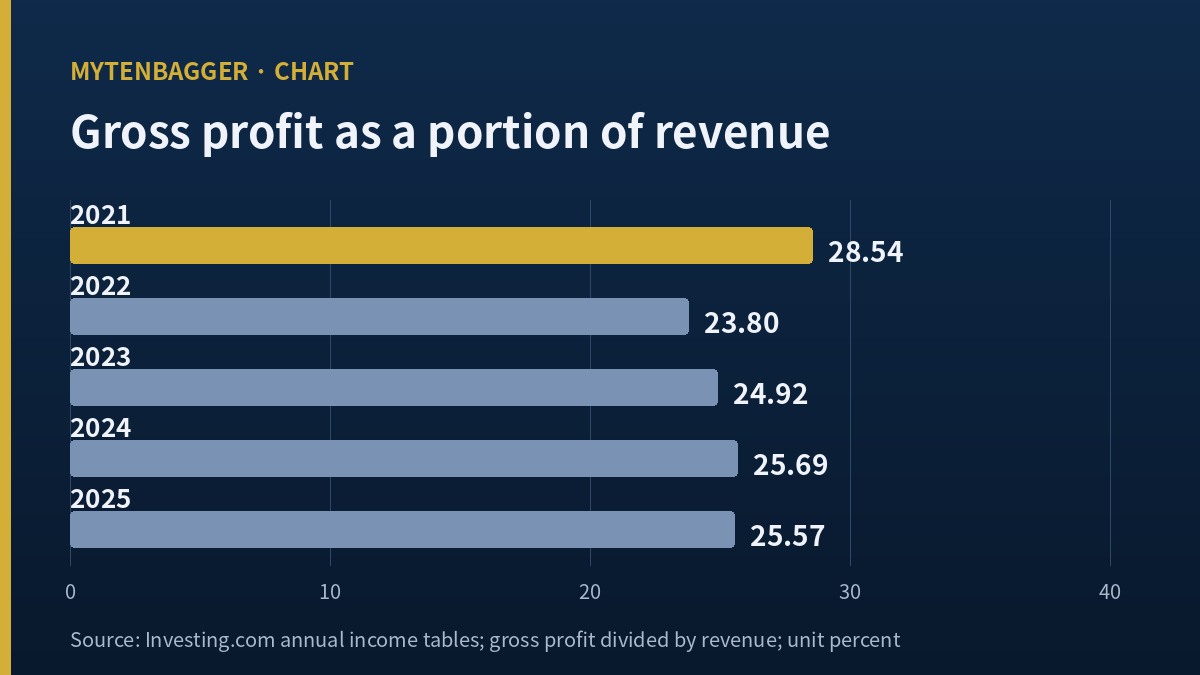
- Across 2021 to 2025, gross profit as a portion of revenue moved 4.74 points.
Contents
A quarter that ran backwards in IS Dongseo stock’s own books
I have read a lot of bad quarters. I had never read one where the top line itself went below zero. That is what this one does: for the three months ended June 2026, on a standalone reading, this company’s revenue printed as minus 63.2 billion won (about minus $46.5 million at 1,358.4 won to the dollar), alongside an operating loss of 9.5 billion won.
The company’s explanation, carried in Korean press on August 14, 2026, is that presale contracts at a knowledge-industry complex in Goyang’s Deok-eun district were undone, and revenue already taken into earlier periods had to be pulled back out in that quarter. The pull-back it names is 180.7 billion won (about $133.0 million). If that were the only moving piece, the quarter would have taken in 117.5 billion won before the reversal. That last figure is my own subtraction and it carries the assumption that nothing else moved.
For readers outside Korea: this is a KOSPI name, the main Korean exchange board, roughly the Korean equivalent of the S&P 500’s listing venue. The company builds and sells housing, makes precast concrete piles, runs a waste-handling arm and a rental arm. Housing is the piece that matters here, because in Korean practice a residential project’s revenue lands when buyers take delivery; it does not accrue evenly across the build. That timing is the whole story of the two quarters I read next.
Scale matters for how much weight to put on any of this. Of roughly 942 names on the KOSPI board, this one sits around 332nd by market value. It is a mid-cap by Korean standards and a small-cap by US ones, and a single project site can move its quarterly revenue by more than a third of a year’s takings. That last comparison is mine: 180.7 billion won against 1,234.36 billion won of 2025 revenue is 14.64 percent, and against the 437.0 billion won that the first quarter of 2026 took in it is 41.35 percent.
Five years of revenue and cost under IS Dongseo stock
| Item (billion won) | 2021 | 2022 | 2023 | 2024 | 2025 |
|---|---|---|---|---|---|
| Revenue | 1,608.44 | 2,278.44 | 2,029.44 | 1,514.57 | 1,234.36 |
| Cost of sales (my subtraction) | 1,149.33 | 1,736.14 | 1,523.64 | 1,125.51 | 918.71 |
| Gross profit | 459.11 | 542.31 | 505.80 | 389.07 | 315.65 |
| Gross profit / revenue | 28.54% | 23.80% | 24.92% | 25.69% | 25.57% |
| Operating profit / revenue | 19.33% | 15.09% | 16.76% | 10.91% | 5.52% |
Source: Investing.com annual income tables for IS Dongseo | cost of sales and both percentage rows are my own arithmetic on the printed figures
I read this table top to bottom twice before I trusted it. Revenue peaks in 2022 and then falls in three straight steps. Cost of sales tracks it down almost exactly. Gross profit falls too, and yet gross profit as a portion of revenue goes up between the peak year and the last full year.
What the cost line did while revenue fell 45.82 percent
Three decline rates, one point apart
From 2022 to 2025, by my arithmetic on the table above: revenue fell 45.82 percent, cost of sales fell 47.08 percent, and gross profit fell 41.80 percent. Cost came down 1.26 points faster than revenue did, which is why gross profit as a portion of revenue rose 1.77 points, from 23.80 to 25.57 percent.
The fall came in three steps, and they are not the same size. Revenue dropped 10.93 percent from 2022 to 2023, then 25.37 percent to 2024, then 18.50 percent to 2025. All three are my own divisions on the table above. The last one is the only figure in this piece that somebody else checked for me: an overseas screen states the 2025 decline as 18.50 percent against the prior year, the same number to two decimals. One independent match on one row out of fifteen is thin, and it is more than I usually get.
I want to be precise about what that does and does not tell me. It tells me the company kept the economics of each unit it sold roughly intact while selling far less. It does not tell me the company is healthy. Operating profit as a portion of revenue went from 15.09 to 5.52 percent over the same three years, and the reported bottom line turned to a loss in 2024 and stayed there in 2025. Everything that happened, happened below the two lines in my table.
One more check on my own arithmetic, since the cost row is mine and not printed anywhere. Cost of sales as a portion of revenue reads 71.46, 76.20, 75.08, 74.31 and 74.43 percent across the five years. Add each of those to the gross figures in the table and every year sums to exactly 100.00. That is not a discovery, it is a closure test: it confirms the subtraction is internally consistent and that I have not mixed a perimeter between the two rows I started from. It is the kind of test I skip when I am in a hurry, and the years I have skipped it are the years I have had to publish a correction.
The line I am choosing not to build on
There is a third line between gross profit and operating profit, and I can see its size by subtraction. I am deliberately not making it the spine of this piece, for one reason: I could not open the note that breaks it into pieces. Korean quarterly and semi-annual filings carry that breakdown in the notes, and the exchange’s document viewer is closed to the tooling I have. A number whose composition I cannot see is a number I can size but not explain, and I would rather say so than write a paragraph that sounds explanatory.
Korean builders with heavy order intake sit at the other end of this problem. I looked at one in a piece on a contractor that booked order intake worth more than 1.5 times its revenue three years running. Order intake is a promise about future revenue. What I am reading here is a promise that was already turned into revenue and then taken back.
So the claim I am willing to sign is narrow. The cost of what this company sells did not deteriorate. That is five years of evidence from one source, reckoned the same way in every year.
The two quarters that IS Dongseo stock cannot add together
The first quarter of 2026 was, by the numbers, excellent. Revenue of 437.0 billion won, up 46.1 percent from a year earlier. Operating profit of 118.1 billion won, which is 27.03 percent of that revenue by my division, against 5.52 percent for all of 2025. Reported profit after tax of 154.5 billion won, disclosed on May 13, 2026. Backing out the growth rate, the same quarter a year earlier was around 299.1 billion won, which is my own reverse calculation.
Then the second quarter printed minus 63.2 billion won on a standalone reading. And here is the part I keep turning over: the sell-side note written after that first quarter was titled, in translation, the surprise that Deok-eun move-ins made. The same project site that produced the first quarter’s number is the site whose undone presales produced the second quarter’s.
There is one window that holds both quarters at once. As of September 23, 2026 an overseas aggregator prints trailing revenue of 1.15 trillion won and trailing profit of 81.96 billion won, positive. That window already contains the quarter that printed below zero and it still comes out above water, which tells me the first quarter of 2026 was large enough to carry the second. It also puts a sign flip inside twelve months: 2025 closed with a reported loss of 53.80 billion won for owners of the parent, and the trailing reading is a profit. I note that the aggregator states its revenue decline as 13.2 percent while my own division against 2025 gives 6.8 percent, so the two of us are measuring over different windows.
I am not adding these two quarters. The first is a group reading and the second is a standalone one, and those are different perimeters. I looked for the group figure for the second quarter and did not find it. Anyone who adds 437.0 and minus 63.2 is mixing two scopes, and I am not going to be the person who prints that sum.
A nearby case sits in my notes: the affiliate where this company is the largest shareholder had three years in which the loss showed up in one particular quarter every time. I wrote that up in a piece about a waste handler whose year was decided in its final quarter. That company’s problem was when the loss arrived. This one’s is whether the revenue arrived at all.
Why the exchange stopped trading for two days
On August 12 and 13, 2026, trading in the shares was suspended. I expected, when I first saw those two rows, to find a scandal behind them. What I found was a procedural question. Under Korean listing rules a company whose quarterly revenue comes in under 500 million won draws an exchange inquiry, because that threshold is one of the markers for administrative-issue designation. A quarter that prints below zero is, trivially, below 500 million won. So the exchange asked, the company answered, and trading resumed.
The price around those dates: 19,540 won on August 11, and 16,730 won by the 14th, when the board announced it would retire treasury shares. As of September 23, 2026 the shares closed at 14,960 won, down 410 won on the day, for a market value near 444.7 billion won (roughly $327.4 million). I take that closing price from three places that print the same string; a fourth shows 15,050 won, and its own market-value cell does not agree with its own price. The Korean market was shut on September 24 and 25 for the Chuseok holiday, so September 28 is the next trading day.
One segment grew 69 percent while IS Dongseo stock fell
The only 2026 segment figures I could verify belong to the smallest arm. Korean trade press reported on August 21, 2026 that the battery-recycling business took in 102.2 billion won over the first six months of 2026, up about 69 percent from 60.6 billion won a year earlier, with operating profit of 14.8 billion won, or 14.5 percent of its revenue. The second quarter alone was 47.2 billion won with 6.8 billion won of operating profit, at 14.4 percent.
Builders that pay out while their profit shrinks are a different face of the same industry. I put one down in a note on a cement maker that paid out 99 percent of a profit that had halved. This company went the other way in the first six months of 2026: it paid down borrowings first and retired shares second.
Converted at the same rate, 2025 revenue is about $908.7 million and 2025 gross profit about $232.4 million. That is the scale I hold in my head when I read the reversal: a single site took back 180.7 billion won, which is 57.25 percent of one whole year’s gross profit by my division. The pull-back was not a rounding item in this company’s economics.
Two things about that. First, an arm growing at 69 percent with a steady portion of profit is the opposite of what the group’s top line was doing in the same six months. Second, the same article states a share of group revenue for that arm which I cannot make agree with the first-quarter figure I already have, so I am not repeating it. When an article’s own ratio and an article’s own inputs disagree, I keep the inputs.
Toll Brothers and the part of IS Dongseo stock I could not check
My global comparison this time is Toll Brothers (NYSE: TOL). I did not pick it for size or for cheapness. I picked it because it sits on the same institutional fact: a homebuilder takes revenue in when the buyer takes delivery, which makes any one quarter a statement about a delivery schedule as much as about a year of business.
Its own numbers, as of September 24, 2026: market value of $12.45 billion, shares at $135.15, a price-to-earnings reading of 10.86, trailing revenue of $10.76 billion and trailing profit of $1.20 billion. I am printing those and then stopping. I am not setting them beside this company’s figures, because the one question that would make the comparison mean something, whether a US builder’s quarterly revenue can print below zero when contracts unwind, is a question I did not answer. I looked at the multiple; I did not look at the mechanism. Saying which of those I did is more useful to me later than a table would be.
What would a re-sale of that space do? If the same floors find new buyers, the 180.7 billion won comes back into revenue in whatever quarter those buyers take delivery, and a future quarter reads abnormally large for the same reason this one read abnormally small. That is the pattern I am actually watching for. A second outsized quarter in the other direction would do it, and a slow recovery would not. A company can be perfectly solvent and still produce a revenue series that nobody can read one quarter at a time.
The note I found and did not open
A named report exists, and its file is shut
There is a named Korean brokerage note on this company: an earnings review published May 14, 2026 by Hana Securities, titled, in translation, the surprise that Deok-eun move-ins made. I have the house, the date and the title. I do not have the document, because the file path is closed to me. So I am printing no per-share valuation from it, and I am not going to describe what it argued.
That matters for how I label the coverage picture. This is not an uncovered name. It is a covered name whose coverage I could not reach, and those two things should not share a sentence. The forward multiple that one overseas aggregator prints is in my Korean-language notes, where I backed it out into an implied profit figure; I am leaving that arithmetic where it sits, and I am not repeating it here on a different currency footing.
Twelve ways I could be wrong about IS Dongseo stock
- The minus 63.2 billion won is a standalone figure. The group number for that quarter may read very differently and I never saw it.
- The 180.7 billion won pull-back reaches me through press, quoting the company. I did not read the filing that states it.
- My 117.5 billion won pre-reversal figure assumes the reversal was the only moving piece in that quarter.
- Cost of sales is my subtraction from two printed rows. If either row is on a different perimeter, the whole column is off.
- One source supplies all five years of revenue and gross profit. A second source prints different operating profit figures for all five years.
- A stable portion of gross profit across falling revenue can also come from a changing product mix, which I did not test.
- Trailing profit reads as positive on one screen and negative on another, with opposite signs, because the trailing windows differ.
- The first-quarter figures are a group reading, the second-quarter figure is standalone, and I did not reconcile the two.
- Undone presales can be re-sold. I have no read on whether that site has found new buyers.
- The recycling arm’s growth is six months of one small segment, reported by one outlet.
- Toll Brothers’ own market value divided by its own trailing profit does not reproduce its printed multiple exactly, so I treat its figures as rounded.
- My whole reading rests on revenue being reversible. If Korean practice treats this differently than I think, the piece is wrong at its root.
Six conditions that end my IS Dongseo stock thesis
- The third-quarter report shows revenue back above 300 billion won with no reversal in it.
- That report discloses new contracts at the Deok-eun site covering most of the 180.7 billion won.
- Gross profit as a portion of revenue drops below 20 percent, which would break the one stable thing I found.
- A second reversal of any size appears in any quarter through 2027.
- The group figure for the second quarter of 2026 turns out to be positive, which would mean I read the wrong perimeter.
- The exchange raises the revenue-threshold inquiry a second time.
The filing that answers the first two is the third-quarter report, whose statutory filing date is November 16, 2026. Quarterly reports in Korea are thinner than annual ones, so it may answer neither.
What I left out, and where I stand on IS Dongseo stock
Three figures I checked and did not use
Book value per share and the multiple it produces. I have both. Every second Korean name I read this month could be written up as a share trading under its stated book value, and a reading that common tells me nothing specific about this company.
Inventory. It sat between 1,183.23 and 1,373.36 billion won across four year-ends and barely moved, which for a company that builds and sells homes is its own question. It is a question about what did not move, and this piece is about what moved backwards.
The dividend. Five hundred won per share, near 3.3 percent against the current price, held while the reported bottom line was negative. I checked it, I believe it, and it belongs to a piece about payout policy that I have not written.
A revenue line, and what I assumed about it
A revenue line was, in my head, the one row that could only be large or small. Falling was possible. Flat was possible. Backwards was not a state I had a slot for, and I have spent years reading these tables. I built that assumption out of manufacturers, where the sale ends when the goods ship. Here the sale can be undone years after the number was printed, and that means the row is a claim about a contract and never a record of a shipment.
The routine I am changing: when I meet a revenue row I now ask what could undo it, before I ask whether it grew. For a builder the answer is a buyer walking away. For most of what I read the answer is nothing, which is exactly why I never asked.
Where I stand: I hold none of this and I have no order in. I am watching. Not because the price looks high, but because I cannot yet tell whether this quarter was one project site behaving oddly or a pattern in how this company turns contracts into revenue. Two data points on the same site, pointing opposite ways, is not a pattern and it is not nothing either.
Prices and share data reflect the September 23, 2026 close. Dollar figures are approximate, at roughly 1,358.4 won per dollar on the same date (Seoul close, Money Today). Balance-sheet and income figures come from Valueline, Hankyung and StockAnalysis; the quarterly figures and the share retirement from Chickstock’s filing page; the segment figures from Lives News, August 21, 2026.
Related reading
- LG Display Q2 Results: A Fifth Second-Quarter Operating Loss
- Kolon Global Debt Extension: What Changed and What Did Not