Kakao Games Outlook Rests on a Book Value Two Screens Missed
A filing dated March 25, 2026 set out 17,458,354 new common shares at 13,747 won each, or USD 10.13. Six months later, on Monday, September 29, 2026, the stock closed at 9,520 won, or USD 7.02. I did not open this piece to measure the distance between those two prices. Any Kakao Games outlook has to begin at a book value, because no usable earnings multiple exists here, so I went looking for the balance sheet date behind the 11,093 won, or USD 8.18, that one screen prints. The search led me back to that March filing.
The numerator turned out to be owners equity as of December 31, 2025. The divisor was the share total as it stands after the placement settled. The 240 billion won, or USD 176.90 million, that arrived in June had reached the lower half of the ratio and not the upper half. So I pulled eight labels that the screens set for themselves and tested each one. Four held up. Four did not.
The 2025 net loss attributable to owners of 100,043 million won, or USD 73.74 million, over average owners equity of 1,261,095.5 million won, or USD 929.53 million, resolves to -7.9330 percent.
An independent host, Hankyung, prints the same two figures as its 52-week high and low.
Smaller than the 106,750,000 listed shares by 5,000 shares. The inequality runs the way it should.
The screen says it does not know, and it is right. The 2022 finance cost of 246,603 million won, or USD 181.77 million, exceeds that year’s operating profit of 175,817 million won, or USD 129.59 million.
Loss per share is 1,186 won, so that field has no value to print. Zero is not one. A second screen puts -8.26 in the same position, and 9,520 won over that screen’s 1,152 won loss per share gives -8.2639, so it closes against itself.
The field it is supposed to be checked against is empty. There is no second figure to test it on.
Numerator is December 31, 2025 owners equity of 1,184,083 million won, or USD 872.77 million. Divisor is the post-placement share total. My June 30, 2026 figure is 12,394.9040 won, or USD 9.14.
It implies equity of 1,468,453 million won, or USD 1,082.37 million. I could not find that figure at any balance sheet date from December 2023 through June 2026.

Contents
What the Kakao Games Outlook Is Priced On
Kakao Games trades under 293490 on the KOSDAQ market. The Korea Exchange runs two boards: KOSPI, which holds the large capitalizations, and KOSDAQ, which holds smaller and growth names. This company develops mobile and PC games, publishes titles built by others in Korea and abroad, and collects money from player payments. It also owns golf and screen-golf businesses through subsidiaries.
For the three months from April through June 2026, revenue was 75,021 million won, or USD 55.30 million, against an operating loss of 23,026 million won, or USD 16.97 million. Taken as a half year, revenue was 157,946 million won, or USD 116.42 million, with an operating loss of 48,486 million won, or USD 35.74 million. The same half of 2025 produced revenue of 238,662 million won, or USD 175.91 million, which makes the 2026 half 33.8202 percent smaller.
Revenue fell by less than profit did
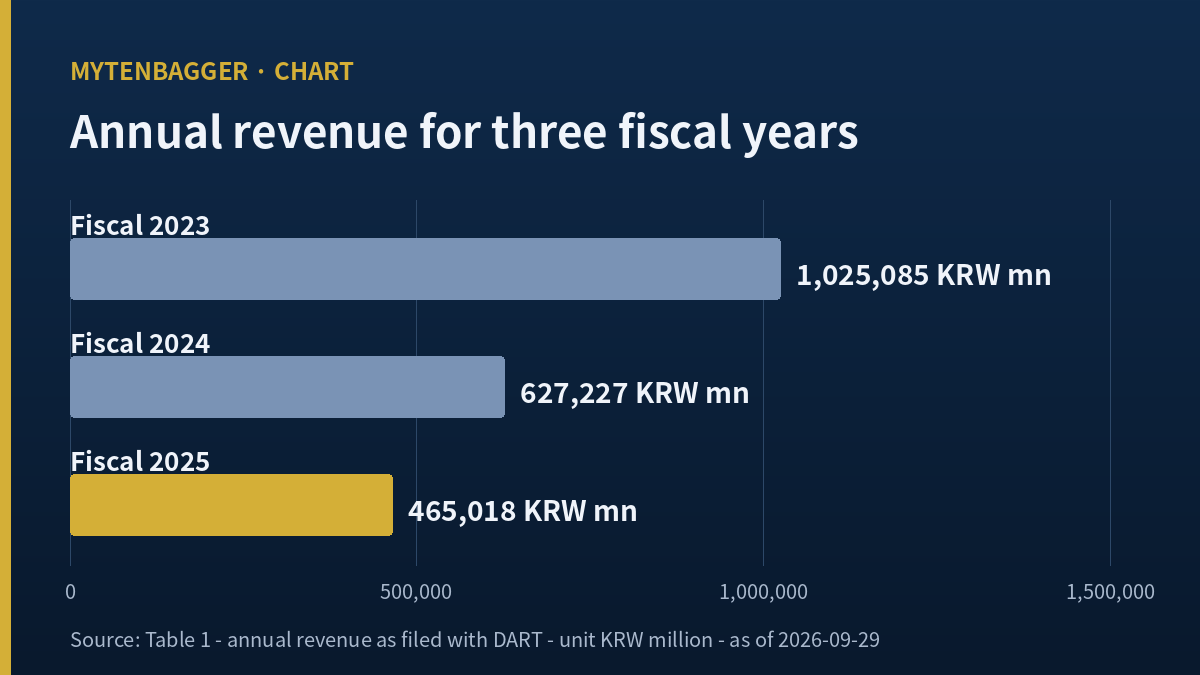
The annual series is blunter. Revenue was 1,025,085 million won, or USD 755.57 million, in 2023 with operating profit of 74,516 million won, or USD 54.92 million. In 2024 it was 627,227 million won, or USD 462.32 million, with operating profit of 19,148 million won, or USD 14.11 million. In 2025 it was 465,018 million won, or USD 342.76 million, with an operating loss of 39,591 million won, or USD 29.18 million. Revenue fell 54.6362 percent across those two years, from 1,025,085 million won to 465,018 million won, while the operating margin went from 7.2693 percent to -8.5139 percent.
| Fiscal year | Revenue | Operating result | Operating margin | Owners net result |
|---|---|---|---|---|
| 2022 | not available to me | 175,817 | not available to me | -233,642 |
| 2023 | 1,025,085 | 74,516 | 7.2693% | -228,746 |
| 2024 | 627,227 | 19,148 | 3.0528% | -108,918 |
| 2025 | 465,018 | -39,591 | -8.5139% | -100,043 |
The right-hand column is the part I sat with. Every one of those four years carries a net loss attributable to owners, including the three years when operating profit was positive. The four add to 671,349 million won of losses, or USD 494.84 million. My financial series reaches back only to fiscal 2022, and the revenue figure for that year comes back empty from the data source, so I am not going to write anything about a record low. What I can see is the run from 2023 through 2025.
Six Quarters of Operating Losses Behind the Kakao Games Outlook
Korean filings do not work the way a US 10-Q does. A Korean quarterly report states flow figures as a cumulative year-to-date total, and no separate fourth-quarter report is filed at all: the annual report carries the full year, and anyone who wants the last three months has to subtract. So I built the single-quarter figures myself by taking each cumulative total and removing the prior one. On that basis, the six quarters from the first of 2025 through the second of 2026 are all operating losses.
| Quarter | Revenue | Operating loss | Operating margin |
|---|---|---|---|
| 2025 Q1 | 122,854 | -12,441 | -10.1267% |
| 2025 Q2 | 115,808 | -8,615 | -7.4390% |
| 2025 Q3 | 127,467 | -5,446 | -4.2725% |
| 2025 Q4 | 98,889 | -13,089 | -13.2361% |
| 2026 Q1 | 82,925 | -25,460 | -30.7024% |
| 2026 Q2 | 75,021 | -23,026 | -30.6927% |
A narrower loss and a flat margin are both true here
Korean press reported the second quarter of 2026 as a seventh consecutive quarterly operating loss. My own series can only confirm six, because the single-quarter figure for the fourth quarter of 2024 comes back empty in my data. So I write six. The reason my number differs from the reported one is that a different person did the checking, and I am saying which one I did.
On the loss alone, things improved. The 2026 second-quarter operating loss of 23,026 million won is 2,434 million won, or USD 1.79 million, smaller than the first quarter’s 25,460 million won, which works out to 9.5601 percent of the first-quarter loss. The margin barely moved though, going from -30.7024 percent to -30.6927 percent, a change of 0.0097 percentage points. Revenue shrank alongside the loss, from 82,925 million won to 75,021 million won, a fall of 7,904 million won, or USD 5.83 million.
Cash from operations is also negative. The 2026 first half produced negative 45,727 million won, or negative USD 33.70 million, and the April-to-June stretch on its own produced negative 30,800 million won, or negative USD 22.70 million. Full-year 2025 was negative 44,268 million won and full-year 2024 was positive 27,387 million won. When earnings and cash are both negative, equity usually falls. In the second quarter of 2026, equity rose.
When revenue slides like this I like to see how far a company’s own published forecast follows it down. Pearl Abyss cut its annual revenue guidance by 169.2 billion won inside three months, which at least gave me a company figure to test. Kakao Games publishes no annual revenue guidance, so the only forward figures I can use are sell-side estimates, and those come further down.
A March Placement That Reached Equity in June
Owners equity went from 1,131,150 million won, or USD 833.75 million, at the end of March 2026 to 1,323,156 million won, or USD 975.28 million, at the end of June. That is an increase of 192,006 million won, or USD 141.53 million. The same quarter carried a net loss attributable to owners of 49,026 million won, so the part that arrived from outside the income statement is 241,032 million won, or USD 177.66 million. The paid-in capital increase was 240,000 million won. The difference between the two is 1,032 million won, which is 0.4300 percent of that subscription amount. Essentially all of the equity increase is that one transaction.
Here is what was filed. On March 25, 2026, Kakao Games resolved on a third-party allotment share issue of 239,999,990,000 won to L Triple A Investment, with 17,458,354 new common shares at 13,747 won each. A convertible bond of 60,000 million won, or USD 44.22 million, came with the same deal at a conversion price of 13,812 won. On June 19, 2026 the controlling shareholder changed. L Triple A Investment holds 33.43 percent, or 35,566,086 shares, and Kakao holds 14.68 percent, or 15,622,268 shares. Kakao’s prior holding was 37.93 percent, which against the pre-issue total of 88,932,902 shares works out to 33,732,250 shares. That share figure is one I multiplied out myself. L Triple A Investment is a special purpose company funded by Japan’s LY Corporation.
One share issue, two dilution percentages
Total shares before the issue were 88,932,902 and after it 106,391,256, as filed. The difference between those two equals the 17,458,354 new shares exactly. Yet the same new shares produce two dilution figures depending on what they are measured against. Divided by the pre-issue total of 88,932,902 shares, the new shares are 19.6309 percent. Divided by the post-issue total of 106,391,256 shares, they are 16.4096 percent. One sell-side house printed 16.3 percent, which is close to the second calculation. Neither is wrong, and if the basis is left unstated the reader ends up picking one. I have learned to read a sell-side figure together with the basis underneath it: Neowiz drew three sell-side cuts inside ninety days for one reason, and once a house has started cutting I stop treating its standing figure as a floor.
Something else snags here. The screen lists 106,750,000 shares as issued. That is 358,744 shares more than the 106,391,256 in the June 19 filing, a gap equal to 0.3372 percent of the filed share total. I could not establish where those 358,744 shares came from. The convertible bond’s conversion price of 13,812 won sits 4,292 won above the September 29 close, so conversion is a poor explanation: getting from 9,520 won to 13,812 won takes a rise of 45.0840 percent. I have therefore run every calculation below on both share totals to see whether the conclusion moves.
Three Book Values Under the Kakao Games Outlook, on One Day
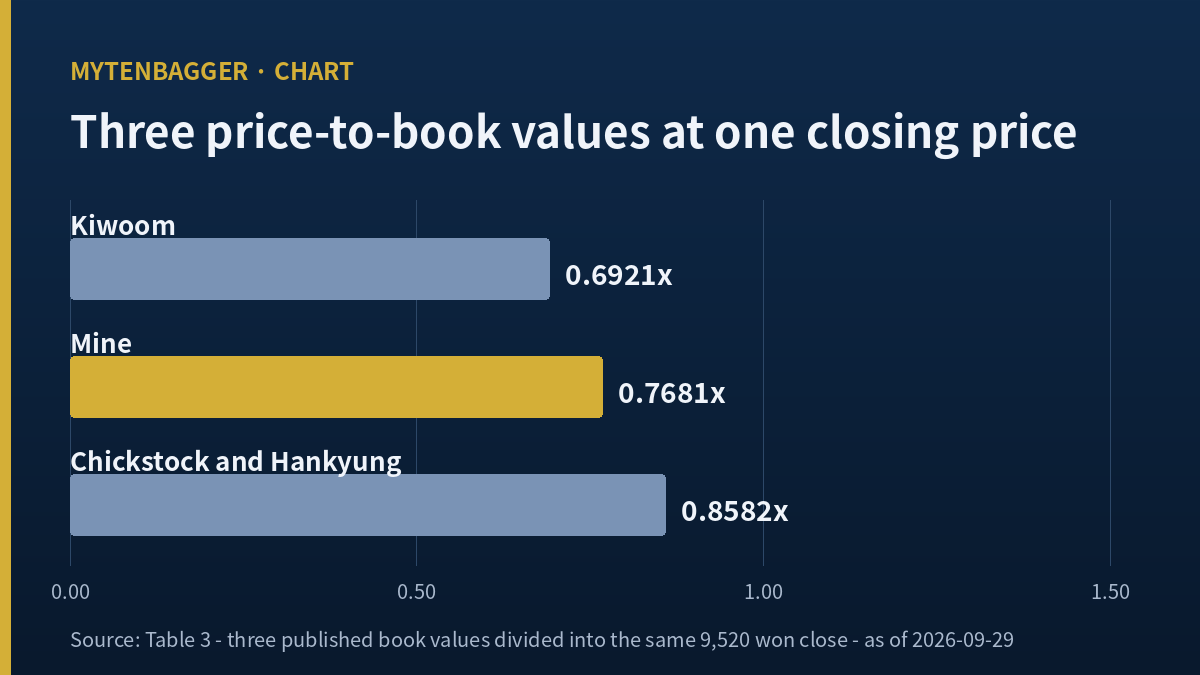
Book value per share is owners equity over shares. On one trading day it came out three ways. One is mine and two were printed for me.
| Source | Book value per share (KRW) | Equity used | Shares used | P/B |
|---|---|---|---|---|
| Mine | 12,394.9040 | June 30, 2026: 1,323,156 | 106,750,000 | 0.7681 |
| Mine, filed share total | 12,436.6987 | June 30, 2026: 1,323,156 | 106,391,256 | 0.7655 |
| Chickstock and Hankyung | 11,093 | December 31, 2025: 1,184,083 | 106,750,000 | 0.8582 |
| Kiwoom | 13,756 | not traced, implies 1,468,453 | not established | 0.6921 |
Start at the third row. December 31, 2025 owners equity of 1,184,083 million won over the 106,750,000 shares that screen lists resolves to 11,092.1124 won, which is 0.8876 won away from the printed 11,093. The numerator predates the arrival of 240,000 million won and the divisor includes the shares that money bought. The issue reached the lower half only. That leaves the printed figure 1,301.9040 won below my June 2026 figure of 12,394.9040 won, a gap worth 11.7363 percent of the printed value.
Which way a stale numerator errs depends on whether equity is rising or falling. Here a share issue pushed equity up, so the older figure makes book value smaller and the P/B larger. I have met the reverse in another company whose equity was shrinking, where the stale figure made the P/B smaller. The direction is not fixed, and it has to be established every time.
I never found the numerator behind 13,756 won
The Kiwoom screen’s 13,756 won implies equity of 1,468,453 million won. I tried December 2023 at 1,398,425 million won, December 2024 at 1,338,108 million won, December 2025 at 1,184,083 million won, March 2026 at 1,131,150 million won and June 2026 at 1,323,156 million won. None of the five produced it, and swapping in each of the three share totals on record did not close it either. That one is a failure to establish, and I am recording it as such.
One observation goes alongside it. The figure 13,756 sits 9 won from the March placement price of 13,747 won, and 9 won is 0.0655 percent of that placement price. Whether that is wiring or coincidence I did not establish, and I do not build on what I have not established. NCSoft had two multiples sitting on one screen, but that case was two multiples drawn from different periods. Here one multiple has a numerator I could not locate at all.
Five Objections to the Kakao Games Outlook and What Would Settle Each
I am not going to assign probabilities to these. Instead each objection gets one observation that would show it to be wrong. I cannot manufacture a probability, but I can name an observation.
First, 300 billion won arrived, so the company can absorb losses longer. The 240,000 million won share issue and the 60,000 million won convertible bond did land as equity and debt. The observation that would settle it is third-quarter cash from operations. If it is more negative than the first half’s 45,727 million won outflow, the money did not change the earning power.
Second, the loss has started to narrow. The second-quarter operating loss of 23,026 million won is below the first quarter’s 25,460 million won. The observation that would settle it is the third-quarter operating margin. A narrower loss with the margin still near -30 percent means revenue shrank alongside it.
Third, two sell-side houses both carry a 10,000 won valuation, above the current price. Kim Jin-gu at Kiwoom Securities set 10,000 won on August 13, 2026, down from 16,000 won. Oh Dong-hwan at Samsung Securities set a hold rating and 10,000 won on May 27, 2026, down from 13,000 won. From the September 29 close of 9,520 won, 10,000 won is 5.0420 percent away, or USD 7.37. The observation that would settle it is the direction of the next note from either house. Both have already cut once.
Fourth, operating profit turns positive in 2027. Samsung Securities estimates an operating loss of 102,400 million won, or USD 75.48 million, for 2026 and operating profit of 16,200 million won, or USD 11.94 million, for 2027. The observation that would settle it is whether a second-half 2026 title slips again. Both notes put delayed launches first among the reasons the loss widened.
Fifth, a new controlling shareholder means the business changes. The observation that would settle it is the revenue mix in the third-quarter report. Control changed on June 19, 2026, so July through September is the first full quarter under it. If the mix looks like the quarter before, nothing has changed yet.
One overseas screen labels its own reference dates
I looked at one screen for Nexon (Tokyo: 3659), an Asian game publisher of comparable business type, and took one thing from it. It prints a market value of 2.45 trillion yen, 784.38 million shares and a P/E of 18.28. Dividing the market value by the shares gives 3,123.49 yen per share, so the screen closes against itself. What I actually wanted from it was not a multiple or a size. Next to its revenue growth it writes “ttm,” next to its newest quarter it writes “Q2 2026, ended June 30, 2026,” and next to its figures it writes “September 4, 2026, 2:06 PM JST.” Neither of the two screens I worked with here says which balance sheet date sits above their book value. That absence is why I spent this piece testing five equity dates by hand.
Where I Stand on the Kakao Games Outlook, and Three Checks for November 15, 2026
I am watching and hold no position. Market value is 1,016,260 million won, or USD 749.07 million. My own rule puts anything outside the top 100 by market value into a watching stance, and this company is outside it. I did not measure the exact rank this time. The seven-point checklist passes on revenue scale and on P/B and fails the other five. The debt-to-equity ratio is 114.9314 percent, from total liabilities of 1,474,024 million won, or USD 1,086.48 million, over total equity of 1,282,525 million won, or USD 945.33 million, and that closes against the screen’s printed 114.93. At the end of 2022 the same ratio was 92.2653 percent, from liabilities of 1,859,048 million won over equity of 2,014,893 million won.
There is also a point about the checklist score itself. The screen reports two passes, zero unresolved and a score of 29. Of those seven boxes, the P/E box cannot be judged, because earnings per share is negative. The tool’s own notes say that an empty result means unresolved and does not mean a fail, yet this box was counted as a fail. On six boxes the score is 33.33 and on seven it is 28.57, a difference of 4.76 points. Reading “two of seven work” is not the same as reading “two of six work.”
The close needed the same treatment. Three hosts print September 29 differently: 9,520 won, 9,570 won and 9,600 won. The band is 80 won wide, which is 0.8403 percent of the lowest. I used 9,520 won, because Hankyung’s independent September 28 close of 9,610 won minus the 90 won move Chickstock prints gives exactly 9,520, and that was the only value where the arithmetic closed across two independent hosts. At each of the three closes the P/B lands at 0.7681, 0.7721 and 0.7745, all inside 0.76 to 0.78. The conclusion does not move.
Multiples cannot price this company right now. There is no P/E, and the P/B runs from 0.6921 to 0.8582 once I re-divide each screen’s book value by 9,520 won. The screens themselves print 0.70 and 0.86. Mine is 0.7681. So I am not using a multiple as a reference point. The statutory filing deadline for the third-quarter report is November 15, 2026, and three things go on my list for that date.
One, whether July-to-September revenue comes in above 75,021 million won. Across six quarters revenue fell from its highest reading of 127,467 million won, or USD 93.95 million, in the third quarter of 2025 to 75,021 million won. The first sign the slide has stopped is a single quarter of growth.
Two, whether that quarter’s operating loss is smaller than 23,026 million won, and whether the margin leaves the -30 percent area at the same time. Both have to happen together for a narrower loss to mean something other than a smaller top line.
Three, whether September owners equity exceeds 1,323,156 million won. The June figure is inflated by the share issue. If losses continue, that equity gets cut back, and a smaller numerator would leave the 0.7681 unchanged while the value underneath it shrinks.
Non-controlling interests belong on the same list. At June 30, 2026 they stood at negative 40,632 million won, or negative USD 29.95 million, against positive 120,777 million won at September 30, 2025. That is why owners equity of 1,323,156 million won is currently larger than consolidated total equity of 1,282,525 million won. Adding the two gives 1,282,524 million won against the filed 1,282,525 million won, a 1 million won difference that looks like rounding. How far the subsidiary side falls is half of that third check.
Which sentences here disappear if the tools get fixed, and which need the company to change
The answer this piece produced was four out of eight. Having written it down, I sorted my own sentences into two piles. One pile disappears if the vendors fix their screens: the zero in the P/E field, a cross-verified flag with nothing to check against, a book value that divides December 2025 equity by today’s shares, the 13,756 won whose numerator I could not locate, a checklist that counted an unresolved box as a fail, and a close printed three ways. Six sentences. If a vendor wrote one line naming its reference date, I would have no reason to write any of the six.
The other pile needs the company to change. Six consecutive quarters of operating losses. A first-half revenue figure that fell from 238,662 million won to 157,946 million won. Cash from operations at negative 45,727 million won. Four straight years of losses attributable to owners adding to 671,349 million won. Four sentences. No amount of tool maintenance removes those.
So the part of this piece that is more than screen-reading is the second pile. The first six make the figures easy to misread; the last four are the figures. All three of my November 15 checks sit in the second pile. On that day I will take the revenue, the operating loss and the equity, and if the first six are still standing then, I will write that down separately.
Figures I gathered and did not use
Recording what I left out. Operating cash flow and free cash flow arrive on the screen as -45,727 and -46,682 with no unit stated, so I read them as millions of won by comparing against revenue. The screen’s total equity field was empty. The one, three, six and twelve-month change rates and the 20, 60 and 120-day moving averages were discarded whole, because the price series mixes in an intraday row from the current session and carries two different market scopes. Dividend figures do not apply, since this company pays none, and although a payout figure of 66.2 sits on the screen, the dividend itself is flagged as undisclosed, so I left it alone. I also could not establish the per-share price at which Kakao transferred its existing shares.
Sources
- Edaily Marketin, March 25, 2026: third-party allotment share issue of 239,999,990,000 won, 17,458,354 new shares at 13,747 won, subscriber L Triple A Investment (Korean press)
- Invest Chosun, March 25, 2026: 240 billion won share issue plus 60 billion won convertible bond at a 13,812 won conversion price, funded through an LY Corporation vehicle (Korean press)
- Financial News, June 19, 2026: controlling shareholder change, L Triple A Investment 33.43 percent or 35,566,086 shares, Kakao 14.68 percent or 15,622,268 shares, total shares from 88,932,902 to 106,391,256 (Korean press)
- Gametoc, June 19, 2026: Kakao’s prior holding of 37.93 percent (Korean press)
- Money Today, August 13, 2026: Kiwoom Securities analyst Kim Jin-gu sets 10,000 won, down from 16,000 won (Korean sell-side, reported)
- Newspim, May 27, 2026: Samsung Securities analyst Oh Dong-hwan sets a hold rating and 10,000 won, down from 13,000 won, with a 2026 operating loss estimate of 102.4 billion won, 2027 operating profit of 16.2 billion won and 16.3 percent dilution (Korean sell-side, reported)
- Hankyung Markets: September 28, 2026 close 9,610 won, high 9,770 won, low 8,910 won, 52-week high 18,440 won and low 6,780 won
- Chickstock: September 29, 2026 regular-session close 9,520 won, P/E -8.26, P/B 0.86, EPS -1,152 won, BPS 11,093 won, ROE -10.4 percent
- stockanalysis.com: Nexon (Tokyo 3659) market value 2.45 trillion yen, 784.38 million shares, P/E 18.28, as of September 4, 2026, 2:06 PM JST
- Money Today, September 29, 2026: Seoul foreign exchange market daytime closing session settled at 1,356.7 KRW per USD, down 8.4 won at 3:30 PM
Financial figures come from DART consolidated statements: the 2026 half-year report, filing number 20260813001508, and the 2025 annual report, filing number 20260318001659. Price and market value are at the September 29, 2026 close. US dollar figures use the Seoul foreign exchange market daytime close of 1,356.7 KRW per USD on that same date, September 29, 2026. Single-quarter figures are ones I derived by subtracting prior cumulative totals from DART filings.