Hanmi Science Stake Math Puts a Price on the Ownership Fight
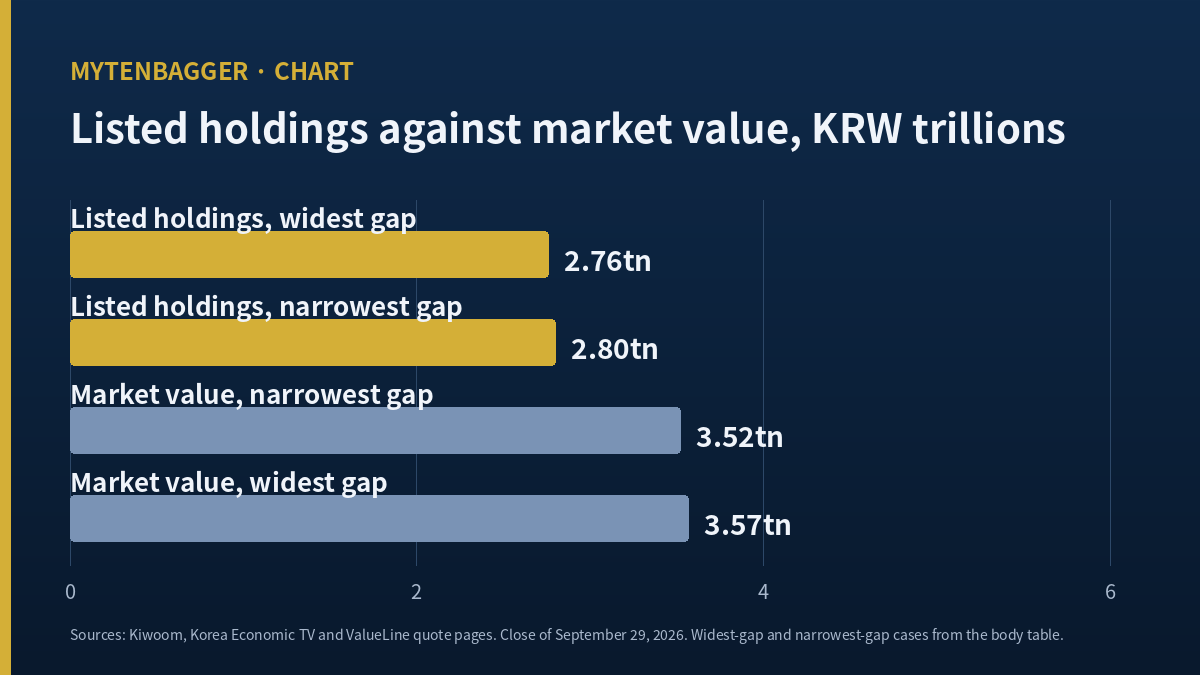
The Hanmi Science stake that matters most is the 41.4 percent it holds in Hanmi Pharmaceutical, and at the September 29, 2026 close that stake plus a smaller listed holding in JVM was worth KRW 2.76tn to 2.80tn (about USD 2.03bn to 2.07bn) while Hanmi Science itself was valued at KRW 3.52tn to 3.57tn. I am not used to seeing a Korean holding company priced above the listed shares it owns. I think the extra KRW 0.71tn to 0.81tn is mostly the price of a fight over who controls the company, and I am watching it without owning it.
Hanmi Science (KRX: 008930) is listed on KOSPI, Korea’s main board and the rough counterpart of the NYSE. It sits at the top of the Hanmi Pharmaceutical group. It owns 100 percent of Onlinepharm, a drug wholesaler that brings in most of its revenue, plus 41.4 percent of Hanmi Pharmaceutical and just under 40 percent of JVM, a pharmacy automation maker (both percentages per Korean financial outlet Pinpoint News on September 26). Hanmi Pharmaceutical is not consolidated; Hanmi Science carries it under the equity method, so the drugmaker’s profit shows up as a single share-of-profit line.
I do not own Hanmi Science. I spent this session on one question: what is the Hanmi Science stake in its listed affiliates worth next to the price of Hanmi Science itself? The answer surprised me. The two listed holdings come to KRW 2.76tn to 2.80tn at the September 29 close. Hanmi Science was valued at KRW 3.52tn to 3.57tn the same day. That puts the parent a quarter to 30 percent above the listed pieces. Onlinepharm and the in-house healthcare lines are real businesses, and they deserve some value. Their trailing operating profit was KRW 67.0bn, though, and I would struggle to pay KRW 0.71tn for that alone. A European holding company I use as a contrast trades 56 percent below its own asset value. The other thing pushing this price is an open contest between the founding family and a large outside shareholder. On September 29 a disclosure showed more of the group’s Hanmi Pharmaceutical shares tied up as collateral. Nobody publishes earnings forecasts on this company that I could find. My thesis breaks if the contest ends and the price holds, or if the healthcare side starts to earn far more. Until one of those happens I stay out, and the first date I will check is November 16.
Contents
What the Hanmi Science stake in Hanmi Pharmaceutical is worth
I started with the biggest piece. Hanmi Pharmaceutical has 12,811,045 shares outstanding, per the Kiwoom data I pull through my indicator server. Using the more precise holding figure Korean daily Edaily reported, which rounds to that 41.4 percent, the stake works out to about 5,306,335 shares by my calculation.
The closing price is where it got messy. The Korea Economic TV quote page showed KRW 507,000 for September 29, up KRW 3,000, and the September 28 afternoon price of KRW 504,000 in an Asia Economy report matches that move. The regular-session daily candle in my own database closed at KRW 498,000. I could not tell which of the two is the official exchange close, so I carry both through every number that follows. At KRW 498,000 the stake is worth KRW 2.64tn; at KRW 507,000 it is worth KRW 2.69tn. In dollars that is roughly USD 1.95bn to 1.98bn.
JVM is small next to that. Its market value was KRW 289.6bn on the same data, so a holding of just under 40 percent is about KRW 113.5bn. Onlinepharm is unlisted and has no market price at all.
How a Korean holding company carries a listed affiliate
For readers who follow US conglomerates, one detail changes how the income statement reads. Korean groups often hold a controlling bloc in a listed affiliate without owning a majority. Hanmi Science has the largest single holding in Hanmi Pharmaceutical, yet under Korean accounting it records the drugmaker with the equity method. Revenue from the drugmaker never reaches Hanmi Science’s top line. Only Hanmi Science’s portion of the drugmaker’s profit does, and it arrives below operating profit in the version of the accounts that the Korean data vendor ValueLine displays.
That line has become large. On the ValueLine income page, the trailing twelve months to June 30, 2026 show equity-method income of KRW 116.0bn against pre-tax profit of KRW 176.8bn. By my calculation that is about 65.6 percent of pre-tax profit coming from affiliates the company does not run day to day. The same page puts trailing operating profit from Hanmi Science’s own businesses at KRW 67.0bn.
So when I value Hanmi Science, I am really valuing two things: a share of other companies’ profits, which the stock market already prices every day, and a wholesaler plus a set of healthcare products, which it does not price directly. That is why I went after the listed stakes first.
What Korea’s large-holding reports tell an outsider
Much of what I know about this contest comes from one kind of Korean disclosure, and it helps to know how it works. Anyone who holds 5 percent or more of a listed Korean company, counting related parties together, has to file a large-holding report, and has to file again when the holding moves by 1 percentage point or when the purpose or the terms change. Pledges are one of those terms. That is why a report can arrive with no change in the number of shares held and still carry news, as the September 29 report did.
The reports have a blind spot that matters here. They group the controlling shareholder with everyone legally related to it. In the Hanmi case, people who are openly on opposite sides of a boardroom contest can still sit inside one reporting group because of older agreements and family ties. A US reader used to Schedule 13D filings should read the Korean totals as a legal bloc, which can hold people who vote against each other.
What the drugmaker itself has been reporting
Hanmi Pharmaceutical, the biggest affiliate, has had a mixed year. It signed large licensing deals, but in my piece on Hanmi Pharmaceutical I focused on its Beijing unit, whose April-to-June operating profit fell 96.6 percent from a year earlier. Hanmi Science picks up its share of all of that through the equity-method line, the good licensing news and the weak China result together.
The Hanmi Science stake math at both ends of the quotes
Hanmi Science’s own September 29 close was just as unsettled. Across the quote pages I opened, it ran from KRW 51,400 to KRW 52,200. With 68.4 million shares, that puts its market value between KRW 3.52tn and 3.57tn. I set the two ends against each other so that the conclusion does not depend on which quote is right.
| Item (September 29, 2026 close) | Widest gap | Narrowest gap |
|---|---|---|
| Hanmi Pharmaceutical price used | KRW 498,000 | KRW 507,000 |
| Hanmi Science price used | KRW 52,200 | KRW 51,400 |
| Hanmi Pharmaceutical holding, about 5.31m shares | KRW 2.64tn (USD 1.95bn) | KRW 2.69tn (USD 1.98bn) |
| JVM holding, just under 40 percent | KRW 0.11tn (USD 0.08bn) | KRW 0.11tn (USD 0.08bn) |
| Listed holdings combined | KRW 2.76tn | KRW 2.80tn |
| Hanmi Science market value | KRW 3.57tn (USD 2.63bn) | KRW 3.52tn (USD 2.59bn) |
| Market value above the listed holdings | KRW 0.81tn | KRW 0.71tn |
| Listed holdings as a share of market value | 77.2% | 79.8% |
Sources: Kiwoom share totals and quotes via my indicator server, Korea Economic TV and ValueLine quote pages, Pinpoint News and Edaily for the holding percentages. The widest-gap column pairs the lower Hanmi Pharmaceutical quote with the higher Hanmi Science quote, and the narrowest-gap column does the reverse. All USD figures use KRW 1,356.7 per dollar.
Whichever end I use, the listed holdings cover a little under four-fifths of Hanmi Science’s price. The remaining KRW 0.71tn to 0.81tn (about USD 0.52bn to 0.60bn) has to be explained by Onlinepharm, the in-house healthcare lines, whatever net debt or cash the parent carries, and anything the market is willing to pay for control.
This was not the picture twelve weeks earlier. On July 7, the day before the off-market deal became public, the regular-session candle in my database shows Hanmi Pharmaceutical at KRW 430,000 and Hanmi Science at a market value of about KRW 2.16tn. At that price the drugmaker holding alone was worth about KRW 2.28tn, so the parent traded roughly 5 percent below that one holding, before counting JVM or Onlinepharm at all. By September 29 the parent sat 31 to 35 percent above the same holding. In other words, the parent went from the usual Korean pattern, priced below its parts, to the reverse in under three months. The drugmaker’s own price rose over that stretch too, which is why the holding’s value climbed, yet the parent’s price rose a good deal faster. I only have the July figures from one source, so I treat the 5 percent as approximate.
Korean holding companies can surprise in other ways too. I have written about LG Corp, another Korean holding company, where revenue stayed flat for four years while operating profit fell by more than a factor of two. That piece was about earnings. This one is about control, and control is much harder to put in a table.
I tried to give the operating businesses a fair hearing. Trailing operating profit from them was KRW 67.0bn on ValueLine. Paying KRW 0.71tn for that would mean about 10.6 times that operating profit; at KRW 0.81tn it is about 12.1 times. For a wholesaler whose revenue runs to the trillions of won and whose profit per sale is small, those multiples look generous to me. I did not adjust for the parent’s own borrowings, because I could not pull a clean net debt figure for the holding company alone, and that adjustment would push the implied multiple higher if the parent owes more than it holds.
The wholesaler deserves a closer look before I dismiss it. Korean outlet The Inthenews reported that Onlinepharm’s January-to-March revenue was KRW 299.8bn, up KRW 23.4bn from a year earlier, driven by prescription drugs sold into the domestic market. That is a large business by sales. The same report credited the parent’s profit jump in that period partly to a rise in equity-method income from Beijing Hanmi, which tells me that even in a good wholesale period, the profit story was being written by an affiliate.
There is also the in-house healthcare side, which the same report described as medical devices, soy milk and health supplements. I could not find a separate profit figure for those lines, so I leave them inside the KRW 67.0bn and do not try to value them on their own.
A European holding company priced the opposite way
My peer for this piece is Exor (Euronext Amsterdam: EXO), the Agnelli family holding company whose largest investment is Ferrari. I picked it for one reason: it publishes its own asset value and talks openly about how far below that value its shares trade. On its September 23, 2026 results call, as reported by GuruFocus, the gap was 56 percent, and management was answering it with a EUR 500 million buyback over six months.
I am using exactly one number from Exor and I am not comparing profits, portfolios or currencies. The point is direction. A family-controlled holding company with a trophy asset trades at about 44 percent of what its parts are worth in the Exor case. Hanmi Science trades above the market value of its listed parts. Both can be rational, but they cannot be priced by the same logic, and the logic behind Hanmi Science is the part I want explained before I pay for it.
The pledged Hanmi Science stake in Hanmi Pharmaceutical
The newest disclosure touching the Hanmi Science stake arrived on September 29. In a large-holding report on Hanmi Pharmaceutical, which I read through the Chickstock disclosure page, Hanmi Science and its related parties reported 6,348,167 shares, or 49.55 percent, with no change in the total. What did change was the number of those shares subject to a collateral contract. It went from 1,759,522 shares (13.73 percent of the drugmaker) to 1,836,605 shares (14.34 percent), an increase of 77,083 shares. The stated reason was a change in collateral agreements.
By my calculation, the pledged portion rose from 27.7 percent to 28.9 percent of the group’s Hanmi Pharmaceutical shares. At KRW 507,000 a share, the pledged block is worth about KRW 0.93tn. The report covers the whole reporting group, which includes family members and related parties and, going by Edaily’s figures, Shin’s own holding as well, so I cannot say from it how much of the pledge sits with Hanmi Science itself and how much with individuals.
Why do I care? Pledged shares are borrowed against. If the lenders ever need to sell, the seller is not choosing the timing. It is also one more sign that people inside the group need cash or collateral while the contest goes on. I want to see whether the next report shows that number rising or falling.
Who is fighting over the Hanmi Science stake
The contest is about Hanmi Science’s own shares. On one side is the founding family, led by chairwoman Song Young-sook and her daughter Lim Joo-hyun. On the other is Shin Dong-kook, chairman of Hanyang Precision, who was once an ally of the founder’s sons and has been buying heavily. In July, Shin agreed to buy about 3.6 million more shares off-market from relatives of Lim Jong-yoon, the elder son, as Korean business daily Etoday reported. That deal left his camp with roughly a third of the company and the founding family’s camp with a little over two-fifths, according to the same report.
The fight reaches down into Hanmi Pharmaceutical too. Edaily reported that Shin also holds 7.72 percent of the drugmaker personally, with Hanyang Precision adding 0.95 percent, and that a four-party agreement signed in December 2024 limits his voting on the related shares for three years. That puts the drugmaker’s ten-member board, where six votes decide, at the center of any change in management there.
None of this changes how much medicine Onlinepharm ships. What it changes is who might pay how much for a block of Hanmi Science shares. The market seems to be pricing the chance that someone will pay a premium again, the way the July buyer did.
I can see two ways the gap closes, and they feel very different to a holder. In the first, the price stays where it is and the parent grows into it: the equity-method line keeps climbing, the healthcare side earns more, and a year from now the same market value covers the listed stakes plus a sensible multiple on the rest. In the second, the contest ends, nobody needs to buy another block at a premium, and the price drifts toward the value of what the company owns. I have no way to weigh those two with any honesty yet, so I am not putting numbers on them. What I can say is that the first needs the business to do something it has not yet shown, and the second only needs the fight to stop.
Hanmi Science stake arguments that cut against me
Three things could make my caution expensive.
- The affiliate profits are growing. Equity-method income on ValueLine rose from KRW 55.2bn in the twelve months to June 2025 to KRW 116.0bn in the twelve months to June 2026. If that keeps up, the listed stakes are not the whole story, because the parent’s share of those profits roughly doubled in a year, faster than the drugmaker’s own share price, which rose about 68 percent over twelve months on my indicator server.
- A Korean broker sees a rerating case. Pinpoint News reported that iM Securities described Hanmi Science as an operating holding company with room for a higher valuation. It gave no numbers, so I cannot test it, but it is a named, credible view on the other side of mine.
- Few shares trade. With the two camps and their related parties holding most of the company, the free float is small. Scarce shares can hold a high price longer than fundamentals suggest, and that alone could keep me on the wrong side for a long time.
No brokerage I could find publishes earnings estimates on this company. The iM Securities comment is the only named sell-side view I found, and it is qualitative.
What would change my view of the Hanmi Science stake
These are the conditions I will check, starting with the fastest.
- The third-quarter report, due by Monday, November 16, 2026, shows own-business operating profit well above the trailing KRW 67.0bn pace, enough that the KRW 0.71tn gap starts to look like a normal multiple.
- The next large-holding report on Hanmi Pharmaceutical shows the pledged total falling back below 1.76 million shares.
- The contest ends, by agreement or by one side selling, and Hanmi Science still trades above its listed holdings a month later.
- The parent publishes a clean net debt or cash figure that turns out to be a large net cash position, which would shrink the gap on its own.
- A named Korean broker starts publishing estimates and a valuation for the company.
The first two answer before the year ends. If both go in the company’s favor, I will redo this table and I expect the gap to look smaller than it does today.
Where I leave it for now
The first number I trusted here was the wrong one. When I first sat down with this company, I looked at the price chart, saw a stock that had nearly doubled since late June, and assumed the drugmaker’s licensing deals were flowing up to the parent and doing the work. Some of that is true; the equity-method line did grow. When I actually multiplied the shares by the prices, though, the listed pieces did not add up to the parent. I had been carrying a picture of a holding company priced below its parts, the way most Korean holding companies I have looked at are priced, and this one is the reverse.
That reversal is the whole reason I am not buying. Paying above the market value of what a company owns is a bet that someone will want control badly enough to pay even more. I can see why the two camps might. I do not see why I should. I will check the November 16 report and the next pledge disclosure, and I will redo the stake math with whatever prices are on the page that day.
Prices and market values reflect the September 29, 2026 close. Quote pages disagreed by a few hundred won, so both ends are shown where it matters. Dollar figures are approximate, at KRW 1,356.7 per dollar, the Seoul daytime close on the same date as reported by Money Today.
Related reading