SK Bioscience Operating Loss: One German Plant Did the Work
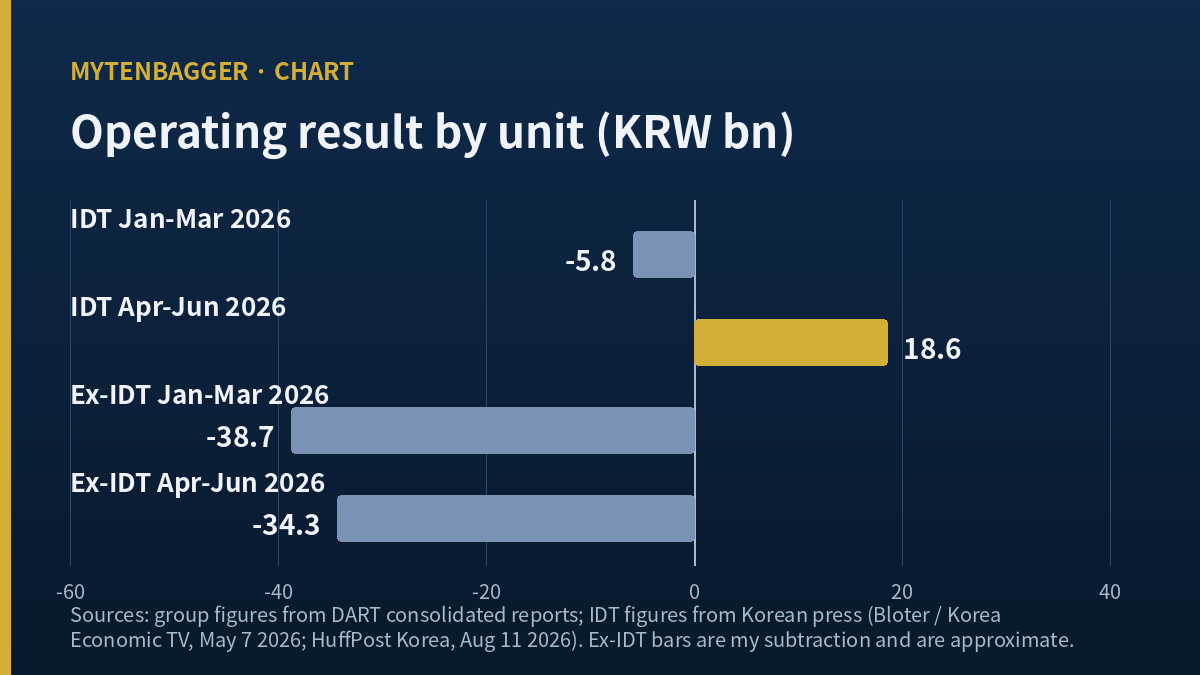
The SK Bioscience operating loss for April to June was KRW 15.7bn (about $11.6m), down from 37.4bn a year earlier, and when I split the group into its German contract plant and everything else, the plant explains most of the improvement. IDT Biologika, the German manufacturer SK Bioscience took control of in 2024, went from a 5.8bn loss in January to March to an 18.6bn operating profit in April to June. The vaccine business outside it lost roughly 34bn in the same quarter, close to what it lost in the one before.
A short letter to myself before I read the next report. You looked at a Korean vaccine maker whose quarterly loss shrank to less than 42 percent of its year-earlier size, and the press coverage gave the credit, correctly, to the German plant. When you subtracted that plant from the group, the rest of the company still lost about the same amount it lost in January to March. Revenue outside the plant was small, around KRW 26bn in the quarter, and it fell.
So you are watching, and you hold nothing. What would change your mind is the vaccine side itself: the flu shipments the company says moved into July to September, the UNICEF and PAHO supply deals, and the pneumococcal Phase 3 with Sanofi. If the July to September report shows the part outside Germany losing less, write this again with a different title.
I do not own SK Bioscience (KOSPI: 302440). At a market value near KRW 2.83tn (about $2.09bn at the September 30, 2026 close), it sits outside the top 100 names on the KOSPI, Korea’s main board for large companies, and for names in that zone I keep a watch journal and do not take a position. I came to it with one question that I ask every loss-making drugmaker: which part of the business is getting better, and is it the part the share price cares about?
Contents
The SK Bioscience operating loss, quarter by quarter
The company reported its April to June numbers on August 10, 2026 (Monday). Here are the consolidated figures next to the prior two periods I could source, all in KRW bn with dollar figures at the September 30 close of about ₩1,353 per dollar.
| KRW bn (USD m) | Apr-Jun 2025 | Jan-Mar 2026 | Apr-Jun 2026 |
|---|---|---|---|
| Group revenue | 161.9 (119.7) | 168.6 (124.6) | 155.7 (115.1) |
| Group operating result | -37.4 (-27.6) | -44.5 (-32.9) | -15.7 (-11.6) |
| IDT Biologika revenue | not found | 128.3 (94.8) | 129.5 (95.7) |
| IDT Biologika operating result | not found | -5.8 (-4.3) | 18.6 (13.7) |
| Group minus IDT, revenue (my math) | not found | about 40.3 | about 26.2 |
| Group minus IDT, operating result (my math) | not found | about -38.7 | about -34.3 |
Sources: group figures from DART consolidated reports via Kiwoom and Korean press (Edaily, Asia Economy, August 10, 2026). IDT Jan-Mar figures from a Eugene Investment & Securities note (analyst Kwon Hae-soon, May 7, 2026) as reported by Bloter, and from Korea Economic TV; IDT Apr-Jun figures from HuffPost Korea (August 11, 2026). The last two rows are my subtraction and ignore any sales between the two units.
The first two rows are clean. Group revenue slipped 3.8 percent against April to June 2025, and the group operating loss fell by KRW 21.7bn. Between January to March and April to June the loss shrank by 28.8bn.
The next four rows are where I spent my evening. The IDT figures come from Korean press reports, and the subtraction assumes there is no revenue flowing between SK Bioscience and IDT that gets removed on consolidation. If there is, the “outside Germany” rows are off by that amount. I could not find a disclosure that settles it, so I treat those rows as rough directions, good to within a few KRW bn.
Six quarters of group results, side by side
Before splitting the group, I wanted a longer run of consolidated numbers. Korean companies file quarterly reports with DART, the country’s disclosure system and its closest equivalent to EDGAR, but the income statement in those reports is cumulative for the year to date, and there is no separate report for October to December. The fourth quarter has to be worked out as the full-year figure minus the first nine months. Kiwoom’s data service does that subtraction, and I used its figures.
| Quarter | Revenue, KRW bn | Operating result, KRW bn | Loss as % of revenue |
|---|---|---|---|
| Jan-Mar 2025 | 154.6 | -15.1 | 9.8 |
| Jul-Sep 2025 | 150.8 | -19.4 | 12.8 |
| Oct-Dec 2025 (derived) | 184.2 | -51.6 | 28.0 |
| Jan-Mar 2026 | 168.6 | -44.5 | 26.4 |
| Apr-Jun 2026 | 155.7 | -15.7 | 10.1 |
Source: DART consolidated reports via Kiwoom (the Apr-Jun 2025 row is in the first table). The four 2025 quarters add up to the reported full-year revenue of 651.4 and operating loss of 123.5. Last column is my calculation.
Three things stand out to me. First, revenue barely moves. Across these six quarters it stays between roughly KRW 150bn and 185bn, and the highest figure came in October to December 2025. Second, the loss moves a great deal. It ran from about 10 percent of revenue to about 28 percent and back to about 10 percent inside a year, with revenue nearly unchanged. Third, the worst two quarters were back to back, from October 2025 to March 2026, and Korean coverage ties the heavier 2026 losses to the Songdo move and Phase 3 spending.
When revenue is that stable and the loss is that jumpy, the cause almost always sits in costs. That is what sent me looking for the unit-level split below. If I had stopped at this table, I would have written that the loss rate simply returned to where it was in early 2025. The split says the return came from a different place than the original level did.
One more detail from this table. IDT reported an operating profit of KRW 9.9bn for all of 2025, according to HuffPost Korea. The group lost 51.6bn in October to December alone, so a plant that was profitable across the year is an unlikely main cause of that quarter. I do not have IDT’s quarterly split for 2025, so I cannot go further than that.
Where the SK Bioscience operating loss improvement came from
Put the two quarters of 2026 side by side and the arithmetic is short. The group loss improved by KRW 28.8bn. IDT’s operating result moved from -5.8bn to +18.6bn, a swing of 24.4bn. That single unit covers about 85 percent of the group improvement by my calculation. What is left for everything else, which means the Korean vaccine plants, the research spending, and the new Songdo headquarters, is an improvement of roughly 4.4bn, from about -38.7bn to about -34.3bn.
One qualification belongs here. The consolidated balance sheet carried KRW 260.7bn of equity belonging to outside shareholders at the end of June, a line that was zero at the end of 2023 and appeared with the 2024 deal. If, as that timing suggests, those holders sit mainly in IDT, part of the German profit belongs to them, and the share of the improvement that reaches SK Bioscience shareholders is smaller than the headline swing.
The company said as much in its own words. As Korean outlets paraphrased the release, IDT raised customer production volumes, trimmed its workforce, and improved yields, and that is what narrowed the loss. Edaily also reported that the first six months as a whole got worse because of the Songdo relocation and higher research spending. Both statements fit the table: Germany improved, the rest did not.
The quarter improved because a contract plant in Germany started making money. The vaccine company that gives SK Bioscience its name lost about the same amount it lost three months earlier.
I first read the August headline the way most people did. A loss cut by more than KRW 20bn in a year sounded like the vaccine business turning. I even started sketching a note about Korean flu vaccine pricing. It was only when I found the HuffPost Korea piece with IDT’s own April to June numbers that the picture changed. I had been giving credit to the wrong unit, and the correction took one subtraction.
Another SK drugmaker I wrote about, SK Biopharm, had the opposite problem: its US revenue grew faster than its prescriptions, and I could not tell why. At SK Bioscience I can tell why the loss shrank, and it is the reason itself that keeps me cautious.
How much of the SK Bioscience operating loss sits outside Germany
This is the part that surprised me most. In April to June, IDT’s KRW 129.5bn was about 83 percent of group revenue of 155.7bn. In January to March it was about 76 percent (128.3bn of 168.6bn). For all of 2025, HuffPost Korea reported IDT revenue of 465.7bn, up 17 percent, against group revenue of 651.4bn, which puts IDT near 71 percent for the year.
Read the other way, the business outside Germany is shrinking as a share and, in this quarter, in absolute terms. My rough figure for revenue outside IDT fell from about 40.3bn in January to March to about 26.2bn in April to June. Korean reports say some flu vaccine supply was pushed from the second quarter into July to September, so part of that drop is timing. I cannot size how much.
For 2025 as a whole the picture is the same. Group revenue of 651.4bn minus IDT’s 465.7bn leaves about 185.7bn for everything else, while the group lost 123.5bn at the operating line and IDT made 9.9bn. So outside IDT the operating loss was about 133.4bn on roughly 185.7bn of sales. That is a company spending heavily on a pipeline and waiting for it.
I looked at a similar split at Binex, a smaller Korean contract manufacturer that funded a plant expansion with a zero-coupon exchangeable bond priced near three times its share price. There the question was how the plant was paid for. Here the plant already pays for itself, and the question is what it is paying for.
There is a sharper way to put the same numbers, and it is the one that worries me. Take the loss outside IDT and set it against the revenue outside IDT. For 2025 as a whole, that was a loss of about 133.4bn on about 185.7bn of sales, or roughly 72 won lost for every 100 won sold. In January to March 2026 it was about 38.7bn on about 40.3bn, close to 96 won per 100. In April to June it was about 34.3bn on about 26.2bn, which means the part of the company outside Germany lost more than it sold, about 131 won per 100.
That trend runs the opposite way from the headline. The group loss rate improved from about 26 percent to about 10 percent between the two quarters of 2026. The loss rate of the Korean vaccine business, by my rough subtraction, got worse in each of the three periods I can measure. Some of that is the flu timing shift, which shrinks the revenue side of the fraction in April to June. Some of it is research spending the company chose to take on. But I would want to see at least one period where it improves before I call the vaccine side a recovery.
I keep the three figures in a small spreadsheet now, and I added a fourth column the evening I found them, labeled simply “what’s left.” It is the column I will fill first when the next report arrives.
For a US reader it helps to think of SK Bioscience as two businesses under one ticker. One is a European contract manufacturer (a CDMO, in industry shorthand) that makes vaccines and biologics for other drug companies and now earns a profit. The other is a Korean vaccine developer with its own flu and chickenpox vaccines, a big late-stage bet on a pneumococcal vaccine co-developed with Sanofi, and losses that have not yet started to fall.
What the vaccine side has lined up
The company listed several revenue items in its August release, as Korean outlets reported it. The flu vaccine SkyCellflu won new supply contracts with PAHO and UNICEF and secured volumes for Korea’s national immunization program. The chickenpox vaccine SkyVaricella moved into a technology transfer and plant construction agreement with Colombia’s state drugmaker VECOL. None of these came with a won figure in the reports I read, so I do not put numbers on them.
The pipeline item that matters most is GBP410, a 21-valent pneumococcal conjugate vaccine being developed with Sanofi. It is in global Phase 3, and the company is aiming for interim results around mid-2027. In May the company’s board approved KRW 300bn of low-interest, long-term borrowing from Korea’s National Growth Fund, a state-backed program, to pay for that trial and for commercial preparation. That loan is a debt, so it does not change the share total.
There is also a newer research line: in August the company applied to start a global Phase 1b trial of an RSV preventive antibody. That is years from revenue.
A European vaccine maker going the other direction
For a global comparison I looked at Valneva (Euronext Paris: VLA; Nasdaq: VALN), a French vaccine company that reported its first six months of 2026 on August 13. Valneva’s total revenue fell to €65.8m from €97.6m, and its operating loss grew to €49.9m from €16.8m. Part of the revenue drop was deliberate: the company wound down its third-party distribution business, whose product sales fell 91.6 percent to €1.0m.
Scale the two against their own starting points and the gap is clear. Valneva’s revenue fell by about a third while its operating loss roughly tripled. SK Bioscience’s group revenue for January to June rose 2.5 percent to KRW 324.3bn while its group operating loss grew about 15 percent, to 60.3bn from 52.5bn. Neither company is making money on vaccines right now. The difference is that SK Bioscience has a profitable manufacturing arm absorbing part of the cost, and Valneva, having shed its distribution business, does not.
I chose Valneva for one reason. It stripped out the part of its revenue that was other companies’ products, and its loss got visibly bigger. SK Bioscience is the reverse: most of its revenue now comes from making other companies’ products, and that is the part that is profitable. I am comparing the direction of revenue and the direction of the loss, in euros and won as reported, and nothing more. I am deliberately not comparing valuations, because the two companies are at different points in their pipelines.
The case against my SK Bioscience operating loss reading
Six points push back on what I have written, and I think several of them are fair.
- IDT is part of SK Bioscience. Its profit is the company’s profit, and owning a contract manufacturer that swung to a full-year operating profit in 2025 is an achievement worth crediting.
- The flu supply shift into July to September means the April to June vaccine revenue understates the business. The next report could show the part outside Germany doing better on the same basis.
- Research spending is a choice. A company paying for a Phase 3 trial with Sanofi is supposed to lose money on the vaccine side until the trial reads out.
- The group loss for the first six months, KRW 60.3bn, is still well inside what Heungkuk Securities expected for the full year (149.3bn, as Korea Economic TV reported on May 21). Measured against that expectation, the year is going better than the sell-side feared.
- The state loan lowers the cost of waiting. Cheap long-term money is a real advantage for a company with a long trial.
- My “outside Germany” rows are my own subtraction. If there is inter-company revenue I missed, the gap between the two units is smaller than I show.
I take the fourth point seriously. If the full-year loss comes in far below 149.3bn, the market may care more about that than about which unit produced it.
On the forward view: Heungkuk Securities is the only named brokerage whose 2026 estimate I could read, a KRW 149.3bn operating loss, published alongside a lower valuation of ₩52,000 per share (cut from ₩60,000). A Korean business outlet ran a headline that DB Securities expects losses through 2027, but I could not open the article, so I carry no number from it. Shinyoung Securities and Korea Investment & Securities both published after the August results, and I did not see their estimates.
Four checks on the SK Bioscience operating loss
I will stay a watcher unless the vaccine business itself shows me something. These are the four things I will check, in the order they should arrive.
- The July to September report (due by mid-November) shows the group operating loss outside IDT smaller than roughly 34bn, once I redo the subtraction with IDT’s quarterly figures.
- Revenue outside IDT recovers above the January to March level of about 40bn, which would tell me the flu shift was timing and nothing worse.
- IDT keeps an operating profit for a second quarter in a row. One good quarter at a contract plant can come from a single customer batch.
- GBP410 interim data arrives on the mid-2027 timetable the company has given.
There is also a sell-side check running in the background. If Heungkuk’s full-year estimate of a 149.3bn operating loss is right, then July to December still has to absorb about 89.0bn, or roughly 44.5bn per quarter. That equals the January to March loss and is nearly three times the April to June loss. Either the second quarter was the start of a better run, or that estimate is too pessimistic, or July to December brings heavier trial costs than I am assuming. The July to September report will narrow those three options to one or two.
The first two are the ones that decide whether I write this again. If the part outside Germany starts losing less, the story becomes a vaccine story. If only IDT keeps improving, it stays a contract manufacturing story, and I would want to value it that way.
SK Bioscience operating loss: where I stand for now
The share price closed at KRW 36,050 on September 30, 2026, about $26.65. That is down about two-fifths from the highest close of roughly the past year, set in November 2025. I do not know how much of that fall is about the vaccine side and how much is about the broader Korean biotech mood, and I will not pretend to.
What I do know is that the one clearly improving unit is the one the company bought, and the unit it built is still losing roughly the same amount each quarter. I am comfortable owning nothing until the July to September numbers show me which of those two will set the tone for 2027. When that report comes out, the first thing I will do is subtract IDT again.
Prices and market value reflect the September 30, 2026 close (Kiwoom regular-session data, matched by ValueLine). Dollar figures are approximate, at roughly ₩1,352.8 per dollar, the Seoul foreign exchange close that day as reported by Money Today. Company figures come from consolidated DART reports and from Korean press coverage: Edaily, HuffPost Korea, Bloter, Korea Economic TV, Etoday. Valneva figures from its January to June results release. Korean-language sources are paraphrased in translation.
Related reading