Korea Data Center Power: Can 5GW Actually Get Built?
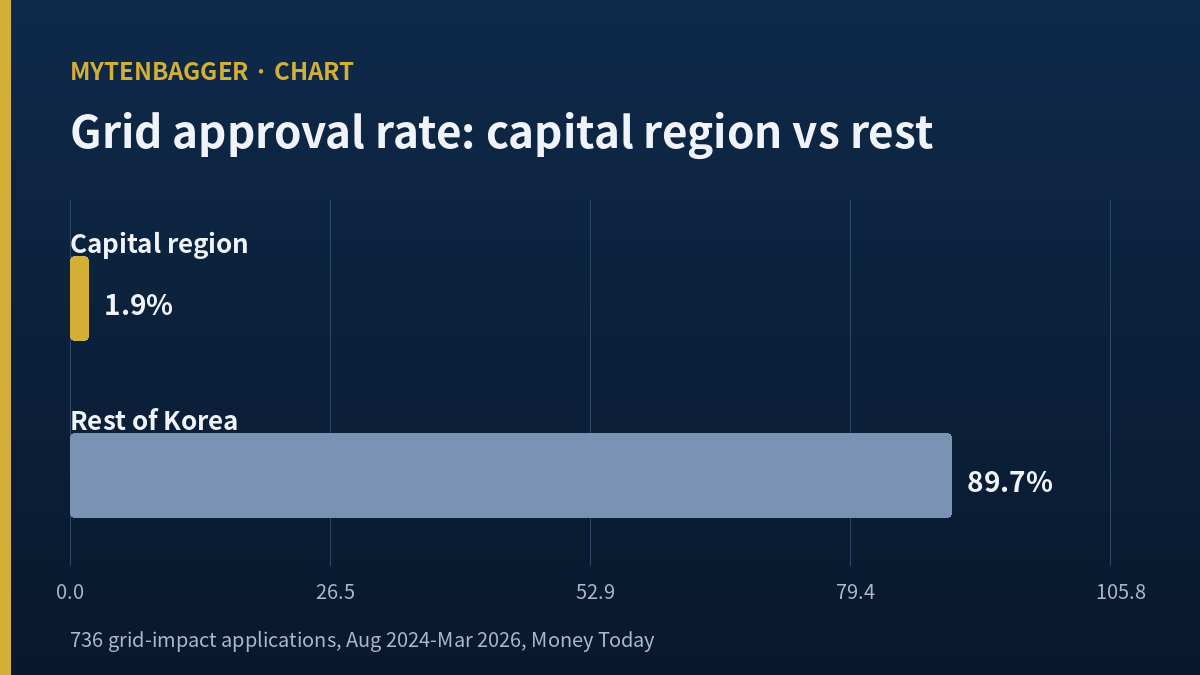
Of 736 grid-impact assessment applications filed in Korea between August 2024 and March 2026, the final approval rate in the Seoul capital region was 1.9%, with exactly one approval inside Seoul itself. So when I look at Korea data center power, I start with “how far can that electricity actually travel” rather than “who ordered what.” The 5GW flagged at the San Francisco summit is not order-constrained. It is wire-constrained and balance-sheet-constrained. And the conclusion that matters most for a US reader is at the bottom of this piece: you cannot buy Korea’s data center build-out, because Korea is not the one building it.
Three numbers, side by side.
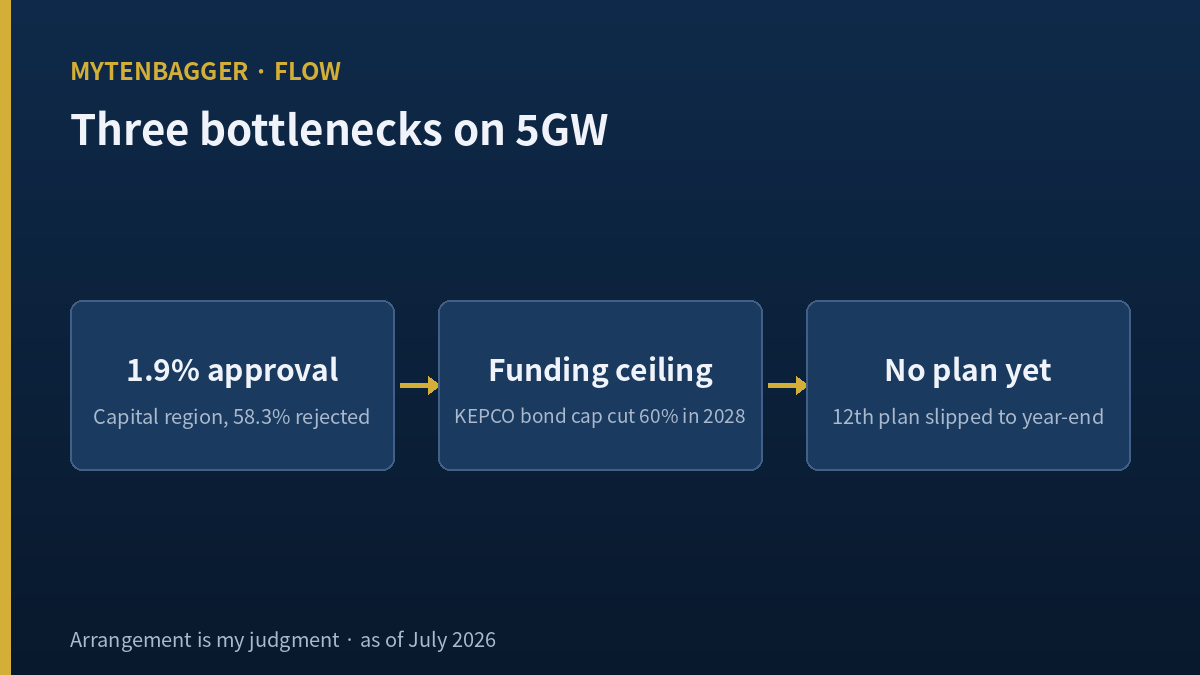
Contracted capacity on Korean grid-impact applications ran around 60MW before 2020. By 2023 it was 3,091MW — roughly fifty times higher in three years. Over the same programme, the final approval rate in the capital region was 1.9%, with a rejection rate of 58.3%. Outside the capital region the pass rate was 89.7%. Those figures come from an exclusive compilation by the Korean outlet Money Today covering August 2024 through March 2026.
Demand up fiftyfold. Two doors open out of a hundred around Seoul. Ninety open in the provinces. Those three numbers arriving together is what kept nagging at me. While the summit was talking about 5GW, this is what was actually happening on the ground.
Contents
What Korea data center power coverage keeps leaving out
In the first piece in this series I split the summit’s $950 billion across four axes and argued Korea’s weakest axis is not software but infrastructure. The second went after the hardware axis. This one is the infrastructure axis itself.
On Korean government projections, a single 1GW-class data center consumes what roughly a million households use simultaneously, and costs at least ₩60 trillion to build. Five gigawatts is therefore about ₩300 trillion, or roughly $206 billion at ₩1,455 to the dollar — that division and that conversion are both mine, and no source frames it that way. The number matters less than the category: this is a civil engineering and electrical problem, not a semiconductor one.
Beneficiary coverage tends to look only at the order side. Orders are genuinely arriving. The question is what they plug into.
Bottleneck one — lines that slip by decades
The reference case is the Bukdangjin–Shintangjeong transmission line, delayed 22 years, with associated losses tallied at ₩1.17 trillion. The 345kV Bukcheonan–Shingiheung section moved from “after 2032” in the 10th Basic Plan to December 2036 in the 11th.
The government’s headline fix, the West Coast Energy Highway, is a 1,070km, 8GW, ₩12.2 trillion programme. Construction begins in 2030. Its contribution to the bottleneck between now and 2029 is zero. The Yongin national industrial complex will ultimately need more than 10GW; its power supply infrastructure has a target completion of 2042.
Once you have those on one page, “we will build 5GW” becomes hard to read at face value. Not for want of intent. The physical path for the electricity does not get laid at that speed.
Bottleneck two — the buyer’s balance sheet
This is the part I spent longest on. The entity that actually orders transmission and distribution in Korea is KEPCO, the state utility — one of the few Korean names that carries a US-listed ADR line, so American readers can at least see it priced. Its 2025 results were the best in its history: revenue of ₩97.4 trillion and operating profit of ₩13.5 trillion, roughly $67 billion and $9.3 billion on my conversion.
The same company’s balance sheet reads: ₩36 trillion of accumulated deficit, ₩205.7 trillion of total debt, a debt-to-equity ratio of 444%, and ₩4.16 trillion of annual interest expense — about ₩11.4 billion a day. And from 2028 its statutory bond issuance ceiling drops from ₩90.5 trillion to ₩36.2 trillion, a 60% cut, at a company whose annual refinancing need runs near ₩20 trillion.
Estimated transmission and distribution investment needed through 2038 runs past ₩80 trillion, and the funding ceiling of the entity that has to write those cheques gets cut 60% in 2028. The real ceiling on Korea data center power is not demand. It is here.
Korea Investment & Securities projects KEPCO’s 2026 operating profit at ₩6.8 trillion, down 49.4% year on year — a halving in the year after a record. Whatever assumptions sit behind that on tariffs and fuel, none of the paths produce more ordering capacity.
Bottleneck three — there is no plan yet
The premise of Korea’s 11th Basic Plan for Electricity Supply and Demand has already broken. AI data centers at 18.4GW plus semiconductor fabs at 6.3GW total 216.4TWh, against a demand increment of 178TWh in the plan itself. The incoming load is larger than the planned increase.
The 12th Basic Plan, which has to reconcile this, has slipped from September to December. Which means there is currently no document in Korea specifying where or how the 5GW attaches. The earliest the summit’s numbers can enter national grid planning is year-end.
How I reordered the Korea data center power names
Run the three bottlenecks and the center of gravity moves. I used two filters: less exposure to capital-region permitting, and short enough lead times to convert into recognised revenue sooner.
| Company | Verified contracts and results | My read |
|---|---|---|
| LS Electric | Q2 2026 revenue ₩1.577tn (~$1.08bn, +32.2%), operating profit ₩178.5bn (~$123m, +64.4%) — record quarter. First-half North American big-tech orders about ₩1.2tn. July 2 completion of a DC-distribution plant in Cheonan; July 21 MOU with LG Uplus on 800V DC infrastructure for a 200MW facility in Paju targeting June 2027 | First — distribution mix and printed results both |
| HD Hyundai Electric | July 2 framework agreement with a global technology company worth up to ₩1.1212tn (~$770m), split ₩553.9bn distribution and ₩567.3bn power. July 6 full-year order target raised from $4.222bn to $5.185bn. Q1 2026 operating profit ₩258.3bn (+18.4%), North American revenue +26.6% | Second — largest contract, revenue from 2027 |
| Hyosung Heavy Industries | Q1 2026 new orders ₩4.1745tn. ₩310bn long-term EHV transformer and reactor supply to AusNet in Australia (reported July 13). Joint venture with US-listed Quanta Services on extra-high-voltage breakers | Third — strong but EHV-weighted |
| Taihan Cable & Solution | July 8 contract with Australia’s Transgrid worth about ₩45bn. The contract is described as an AI data center power network turnkey — one of the rare cases where the buyer named the end use | Watching — most direct link, smallest scale |
| SK Telecom | July 23 board approval of SK Hypher, a dedicated AI data center subsidiary, with ₩750bn (~$515m) committed through 2030. Q1 2026 AI data center revenue ₩131.4bn (~$90m), up 89.3% year on year | Watching — the only one already on the income statement |
| GS E&C | Han Hwa Investment analyst Song Yoo-rim models the Donghae project at 1.2GW in 2028 plus 1.2GW in 2029, around ₩8bn per megawatt (July 10). Shinhan Investment analyst Kim Sun-mi used ₩6–8bn per megawatt the same day | Watching — the only builder with a published unit cost |
Sources cited in each cell. Sell-side figures are citations, not values I have adopted. Won conversions use roughly ₩1,455 per dollar and are my own arithmetic.
What is not on the table matters too. Several names that circulate as cooling and HVAC plays have no verified data center orders — product lines exist, but the disclosed customer base is entirely semiconductor and substrate work, and in some cases nothing lands inside the last 90 days at all. Doosan Enerbility is also off this axis: strong in power generation equipment, but I could not find a direct AI data center link in this round, and manufacturing one would be an attribution error.
Two Korea data center power names the market priced in opposite directions
Inside the same axis, two telcos are valued as if they were in different industries.
At the July 24 close, SK Telecom traded at a trailing 52.6x earnings and 1.66x book, with the shares up 81% over twelve months. AI data center revenue grew 89.3% in the first quarter and it has now stood up a dedicated subsidiary, so the story is in the price.
KT, the same day, traded at 7.88x trailing earnings, 0.75x book, and a 4.44% dividend yield, with the shares down 12% over three months. This is a company that announced ₩18 trillion of investment over three years and allocated ₩5–6 trillion of it to AI data centers. NH Investment analyst Ahn Jae-min published ₩89,000 on July 9; SK Securities analyst Choi Kwan-soon published ₩72,000 on July 8.
One gets a growth multiple, the other a dividend multiple, on the same thesis. I read the gap as the axis telling you something. The market is pricing AI data centers on who is already earning, not on who has announced a capex number. KT’s first-quarter operating profit fell 29.9% year on year, which is the fair counterweight. Announced plans do not attract a multiple on their own.
The Korea data center power lever nobody is pulling
Something I only noticed while writing: tariffs. Not trade tariffs — electricity tariffs.
Korea’s average industrial power sales price was ₩168.17 per kWh in 2024, with general-use at ₩172.99. And Korea is the only major AI country with no data-center-specific tariff or incentive structure. In the United States, sharply higher PJM capacity prices push a market signal straight into generation investment. Japan attached roughly 50% subsidies to relevant capital investment at a scale near ¥210 billion.
In the first piece I graded Korea’s government-will axis as its strongest — fifth worldwide on the Oxford Insights readiness index, a ₩9.9 trillion national AI budget approved for 2026. I am not withdrawing that. But the budget is funded and the tariff design is empty. Price is the most powerful instrument for steering where data centers get built, and it is sitting unused. That, I think, is why applications keep piling into the capital region even though the pass rate outside it is 89.7%.
So I do not read the 12th Basic Plan as a supply-demand document. Whether it contains regional tariff differentiation or a data center rate class is what sets the direction of this entire axis.
The part that matters most if you are not in Korea
Here is where I land after all of the above, and it is the opposite of what a beneficiary list implies.
The IEA projects global data center electricity consumption rising from 415TWh in 2024 to 945TWh in 2030, with the 2024 split running roughly 45% United States, 25% China, 15% Europe. Korea is a rounding error in that distribution. Meanwhile the actual order books at Korea’s power equipment makers are overwhelmingly North America-facing — LS Electric’s ₩1.2 trillion of first-half big-tech orders, HD Hyundai Electric’s ₩1.12 trillion framework agreement, Hyosung’s Australian supply contract and its joint venture with Quanta Services. Korean extra-high-voltage transformer exports alone hit $701.52 million in the first half of 2026, up 6.7% and past ₩1 trillion for a first half for the first time on record.
So the trade here is not “own Korea’s AI build-out.” Korea’s own build-out is the part that is jammed. The trade, if there is one, is owning Korean electrical equipment that ships into American and Australian data centers — which means the relevant screen is North American revenue share and distribution mix, not domestic data center exposure. If you already hold Vertiv, Eaton or Quanta Services for the electrical layer of the AI build-out, these Korean names sit further upstream in the same supply chain, and none of the equipment makers carries a US-listed ADR. Direct access means the Korea Exchange — the KOSPI is the main board, the KOSDAQ the smaller-cap venue — generally through a broker with Korean market reach. The country funds EWY and FLKR do not help here, since both are dominated by Samsung Electronics and SK hynix.
If someone did want to work this properly, the screen I would build from what I found has three columns and none of them is “data center exposure.” First, North American revenue share and its trajectory — HD Hyundai Electric disclosed North American revenue up 26.6% in the first quarter, which is the kind of line that actually moves. Second, the distribution-to-power split inside the order book, because distribution converts to revenue faster than extra-high-voltage transformers do; the ₩553.9bn to ₩567.3bn split in HD Hyundai Electric’s July agreement is the cleanest disclosed example of that ratio I have. Third, the gap between contract date and revenue recognition, which on the sell-side modelling for that same agreement runs to 2027 and beyond.
Run those three and the ranking that falls out is not the ranking a summit headline produces. It puts a company with printed record quarterly results and a shortening product cycle ahead of a company with a larger signed number and a longer wait — which is exactly how I ended up ordering the table above.
Where the Korea data center power names actually sit in the stack
Since almost none of this is directly investable from a US account, the more useful thing I can do is place these companies against names an American reader already prices daily. The AI electrical build-out is not one market; it is four layers, and the Korean names cluster in exactly one of them.
Closest to the rack sits the in-facility power and thermal layer — uninterruptible supply, busway, rear-door and liquid cooling. That is Vertiv territory, and it is the layer with the shortest sales cycle and the tightest coupling to GPU shipments. One layer out is building and campus electrical distribution: switchgear, panelboards, breakers, the products Eaton and Schneider Electric sell into a data center shell. Further out again is the utility interface — substations, extra-high-voltage transformers, reactors, the equipment that connects a campus to a grid. Furthest out is the line construction itself, which in the United States is Quanta Services’ business.
Korea’s exporters live in the third layer, with LS Electric reaching into the second. HD Hyundai Electric and Hyosung Heavy Industries are substation and transformer businesses; that is why their order books are framed in “power” versus “distribution” rather than in racks or megawatts of IT load. LS Electric is the one straddling the boundary, which is precisely why its distribution mix and its 800V DC work with LG Uplus caught my attention in the first place. And Hyosung’s extra-high-voltage breaker joint venture is with Quanta Services — a fourth-layer American company reaching back into the third layer for supply.
Two consequences follow, and they cut in opposite directions. The good one: third-layer demand is set by grid interconnection and utility capex, which is a slower and stickier driver than GPU shipment schedules — it does not evaporate the week a hyperscaler trims a capex line. The bad one: third-layer revenue is recognised late. HD Hyundai Electric’s July contract does not start landing until 2027 on the sell-side modelling I could find. You are buying a delivery schedule, not a quarter. That is a legitimate reason to be patient with this axis and an equally legitimate reason not to pay a growth multiple for it, which is roughly where I have ended up.
Three paths for Korea data center power
My base case, roughly 50% — domestic slips, exports run. The 12th Basic Plan lands at year-end, capital-region approval rates do not materially improve, and Korea’s own 5GW stretches into the 2030s. The equipment makers’ earnings keep climbing on North American data center orders anyway. In this branch the selection criterion is North American revenue share and distribution mix. The current order composition points here.
Where I am wrong, roughly 30% — provincial development genuinely opens. The 12th Basic Plan includes regional tariff differentiation or a data center rate class, and that 89.7% provincial pass rate converts into actual construction. Longer distances mean more transmission and substation demand inside Korea, and warmth reaches the builders and the cable makers. GS E&C sitting at 0.54x book reads very differently in this branch.
The bad path, roughly 20% — KEPCO’s funding jams first. Tariff increases and state capital injections both get deferred politically ahead of the 2028 ceiling cut, and domestic transmission and distribution ordering slows outright. If that overlaps with a turn in the North American cycle, current multiples at the three equipment makers are not defensible. I hold it at 20% for one reason only: a record profit year buys some time.
What would shake my Korea data center power read
Four checkpoints, and this time what matters is less their order than whether they point the same way.
The interconnection approval rate. Whether that 1.9% improves, or whether formalising the assessment into statute simply makes the threshold more explicit. The programme is still running as a pilot, without statutory notice, two years in.
The contents of the 12th Basic Plan. What data center demand it assumes, and whether regional differentiation or a dedicated rate class appears. Year-end at the earliest.
KEPCO’s funding structure. What alternative emerges ahead of the 2028 ceiling cut, and which of tariff increases, state injection or private capital gets named first.
Q3 new orders at the three equipment makers. Whether the first-half North American pace holds, and whether HD Hyundai Electric’s $5.185 billion target gets raised again into year-end.
If these come in scattered, I stay in observation. If the first three read badly and only the fourth reads well, that confirms this is an export story rather than a Korean grid story — and the selection criterion shifts wholesale to North American revenue share. If all four point the same direction, I will stop treating observation as the endpoint. Right now they are scattered.
Closing the series
Three pieces, one event, three angles. The first established that $950 billion is not investment we receive but revenue we expect to book. The second found, in the primary release, that the sub-2nm volume is communications silicon rather than AI accelerators. This one finds that 5GW is constrained by wires and by a utility balance sheet rather than by orders.
All three landed in the same shape. Between the announced number and the number that actually turns, there was a missing step every time. I do not read that cynically. The moment that step gets filled is also the entry point. I have chosen to wait for it, and I accept that this flow may well leave me behind. I still think that beats going in early without grounds. Anyone weighing the same trade has to price that risk for themselves.
Material I worked from: the IEA’s Energy and AI report, Nvidia’s summit post, the Korea Economic Institute of America’s read on the summit, The Korea Times on the partnership package, Reuters on the $950 billion figure, and Korea’s government policy briefing. The Korean-language reporting behind the grid, KEPCO and order figures — Money Today, Korea Economic Daily, Edaily and Korean sell-side notes — is cited inline by outlet, analyst and date; those renderings are mine, not English-language originals.