
Hyundai Mobis Stock: Record Profit at 0.85x Book Value
I’ve begun scaling into Hyundai Mobis stock on this pullback — carefully, not with conviction. The company posted its best-ever year (2025 revenue of roughly $41 billion / ₩61.1 trillion and operating profit near $2.2 billion / ₩3.36 trillion), yet the shares fell about 27% in a single month and now trade at 0.85x book. What keeps me cautious is the other side: a loss-making module-manufacturing arm weighed down by new European plant costs, and a Korean sell-side price cut (Shinhan Securities trimmed its fair-value mark from ₩900,000 to ₩790,000). If the manufacturing arm doesn’t turn back to profit by late 2026, half my thesis wobbles.
The first time I looked hard at Hyundai Mobis stock, a few years back, I filed it away as a “group parts window” that just rode Hyundai Motor and Kia earnings up and down. I’d glance at it whenever Korea’s governance-reform chatter flared, then close the tab. A supplier, I figured, inherits every tariff and margin worry the carmakers carry, without the same upside.
I don’t think that read was entirely wrong. But it was half-lazy. Watching this company print a record 2025 and then keep growing into the first quarter of 2026 — revenue of about $10.4 billion (₩15.56 trillion) and operating profit near $535 million (₩803 billion), per the company’s April 24 results — made me re-open the income statement I’d waved off. This journal entry is where I lay out why Hyundai Mobis stock can drop into a record year, and whether that gap leaves room for me.

Contents
Why I Started Buying Hyundai Mobis Stock
Three things pulled me back in. I’ll take them in order.
One: record earnings, a valuation moving the other way
What I noticed first is that earnings and price are pointing in opposite directions. On the company’s own numbers, 2025 revenue rose 6.8% to ₩61.1 trillion and operating profit rose 9.2% to ₩3.36 trillion — both all-time highs. The first quarter of 2026 kept climbing: revenue up 5.5%, operating profit up 3.3%, and net income of about $590 million (₩883 billion), as Korean business press reported around the April print. Meanwhile the shares are down roughly 27% over the past month, trading near 0.85x book and about 11-12x trailing earnings (mid-July 2026 market data).
When I see a company at record earnings changing hands below book, I always ask “why” first. If the answer is “because the fundamentals cracked,” it isn’t cheap — it’s dangerous. But Hyundai Mobis is growing both the top and bottom line. So whatever pushed the price down isn’t the earnings; it’s something else, and if that something is temporary, it’s an opening for me. That question is where my buying started.
Two: the payout showed up as numbers, not slogans
My second reason is that the value-up program is being executed, not just announced. In August 2025 the company said it would cancel ₩610 billion (about $407 million) of treasury shares and raise its interim dividend by 50%, from ₩1,000 to ₩1,500 per share, according to Korean corporate disclosures. It set medium-term targets through 2027 of total shareholder return above 30%, annual revenue growth above 8%, and an operating margin of 5-6%.
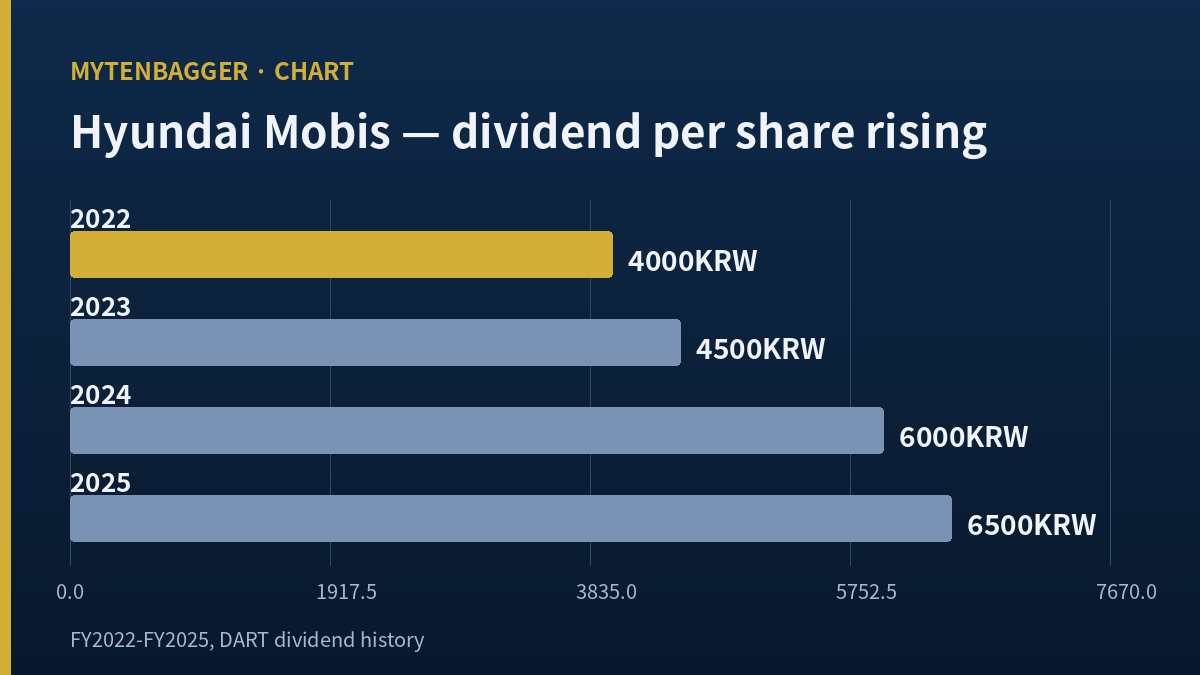
The dividend itself has been a staircase: ₩4,000 in 2022, ₩4,500 in 2023, ₩6,000 in 2024, and ₩6,500 in 2025 (per DART disclosure history) — three straight years of increases. Alongside the Q1 2026 results, management flagged a further ₩500 billion (about $333 million) buyback and held the dividend at ₩6,500. I don’t trust “we’ll return capital” language. I trust cancellations and hikes that actually print. Hyundai Mobis is in the second camp.
Three: the real profit engine isn’t the carmaker
The third point is the one I sat with longest. Mobis earns money two ways. One is module and core-component manufacturing — big revenue bolted onto the carmakers, thin margins, and right now a loss, because early costs at new European electrification sites (a PE-systems plant in Slovakia, a BSA facility in Spain) are eating into it. That’s where the market’s eyes are.
The other engine is aftermarket (A/S) parts: supplying genuine components across the roughly 20-year life of every car already on the road. Unlike the new-car cycle, the demand here is the installed base, so it’s less cyclical and carries fatter margins. I read this as a switching-cost moat — once a service network and genuine-parts supply chain lock in, they’re hard to displace. Let me be clear: this is not a pure monopoly. Non-genuine and independent aftermarket parts constantly chip at the edges. Even so, among auto-parts businesses, few throw off cash this steadily. That first-quarter net income ($590 million) actually topped operating profit, helped by equity-method income from Hyundai and Kia stakes — but the aftermarket’s defensive cash flow is, to me, what sets the floor under this valuation.
That equity-method line is worth sitting with, because it’s the second reason net income can outrun operating profit here. Mobis holds meaningful stakes in Hyundai Motor and Kia, and their earnings flow back through its income statement. I don’t try to put a precise look-through number on those holdings — I couldn’t verify one I’d trust — but directionally it means a chunk of Mobis’s reported profit is carried by two of the largest carmakers in the world, not just by its own factories. For a company trading below book, that’s a quiet source of value the “loss-making supplier” headline skips right over. It also ties into the ownership structure I’ll come back to in the tail scenarios: those cross-holdings are exactly what put Mobis near the center of any Hyundai Motor Group reshuffle.
The Numbers Behind Hyundai Mobis Stock
Here’s the picture I built, with the source of each figure kept separate.
| Metric | 2024 | 2025 | Q1 2026 |
|---|---|---|---|
| Revenue | ₩57.2tn | ₩61.1tn | ₩15.56tn |
| Operating profit | ₩3.08tn | ₩3.36tn | ₩803bn |
| Dividend per share | ₩6,000 | ₩6,500 | ₩6,500 (plan) |
| Price/Book | — | — | ~0.85x |
| ROE | — | — | ~7.7% |
Sources: 2025 and Q1 2026 revenue/operating profit/DPS from company results and DART filings; P/B and ROE from mid-July 2026 market data. 2024 revenue and operating profit are back-solved from the company’s reported YoY growth (+6.8% / +9.2%). USD conversions at roughly ₩1,500 per dollar.
Two rows hold my attention. First, ROE near 7.7% is nothing to brag about; the company’s own 5-6% operating-margin target reflects the thin economics of car parts. Second, even against that return, 0.85x book is on the low side. I didn’t build this table to prove “it’s cheap” — I built it to talk myself through “why this price.” A thin-margin business trading below book isn’t strange. But when a shrinking equity base (buyback cancellation) meets a rising payout, the denominator side of that low ROE gets room to improve. That’s my arithmetic. I cross-checked the earnings against Korean business-press coverage of the Q1 print and the payout policy against Korean reporting on the buyback disclosure.
How Korea’s sell-side frames it right now
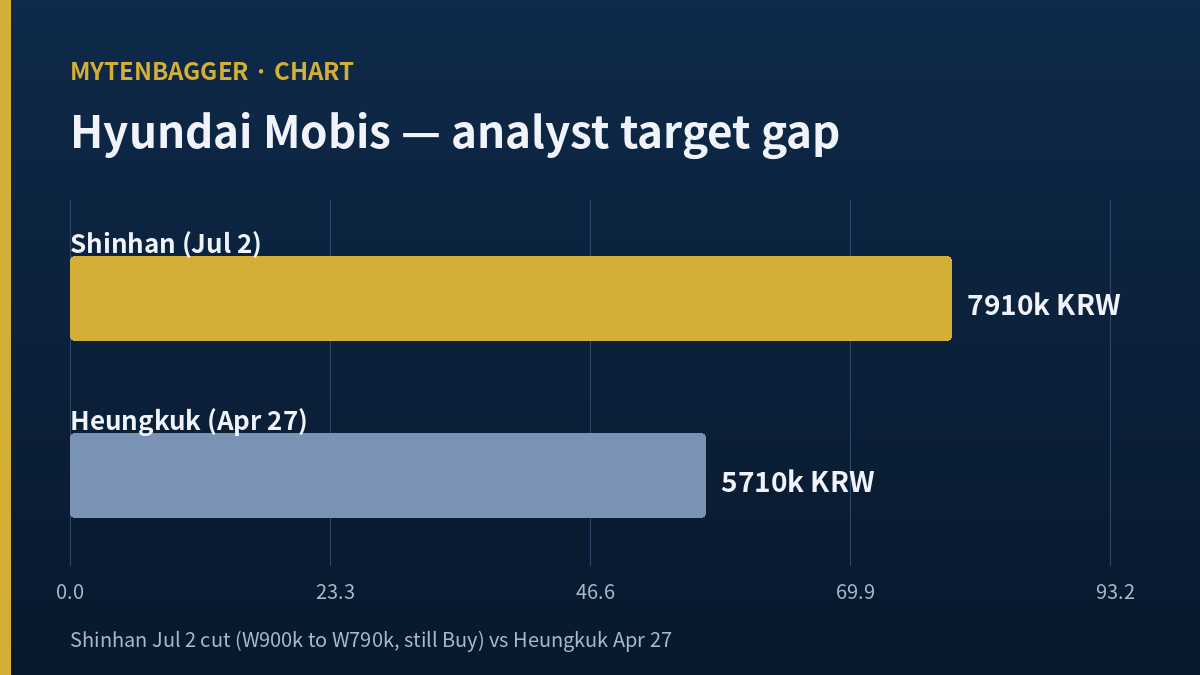
I don’t adopt anyone else’s number as my own. But I do read named research as a market signal for what’s moving the view. Three houses: Shinhan Securities cut its fair-value mark on July 2 from ₩900,000 to ₩790,000 while keeping a buy call, and — this matters — it blamed the cut not on earnings but on the share-price slide of global autonomous-driving and software-defined-vehicle peers (as Korean press summarized it). Heungkuk Securities carried a ₩570,000 mark on April 27, framing the recovery path as intact despite cost swings. DAOL Investment expects the electrification arm’s profitability to recover from the third quarter. The spread — ₩570,000 to ₩790,000 — is itself information: the debate is about the timing of the module turnaround and the recovery of peer multiples, both of which get tested by the second-half prints.
What the Market Misreads About Hyundai Mobis Stock
This is where my own read comes in. The story pushing Hyundai Mobis stock down runs roughly: electrification parts don’t earn yet, the European plants are in the red, and the SDV/autonomy dream has cooled. All true. But I think that story mislocates the center of gravity of the profits.
The market watches the loss-making manufacturing arm. I watch the profitable aftermarket, and a valuation pinned down by peer multiples rather than by earnings.
The first misread is the nature of the manufacturing loss. When I look at a loss, I separate a business that structurally can’t earn from one that isn’t earning because it’s spending. Mobis is closer to the second: the drag is start-up cost at the Slovakia and Spain electrification sites, and Q1 2026 manufacturing revenue actually rose 4.9%. This is a loss from laying down capacity, not from shrinking sales. As utilization fills those plants, the direction changes. Of course, if “start-up cost” repeats for several quarters it becomes an excuse — so I put a clock on it in my breakpoints below.
The second misread is more decisive. Shinhan’s own words are that the cut came from peers’ share prices, not from Hyundai Mobis fundamentals — the applied earnings multiple fell as SDV names de-rated. I read that twice. It says the price is being held down by a multiple, not by the business, and multiples snap back faster than earnings do. I won’t let that thought excite me, though; a de-rating that drags on is also a loss. But “cheap because earnings broke” and “cheap because sentiment soured” belong in completely different columns of a trading journal, and Mobis reads like the latter.
I’ll admit where this kind of read has burned me before. In the past I’ve under-owned “boring” suppliers precisely because the exciting growth line was in the red, and I let the loss-making segment define the whole company — only to watch the steady cash segment carry the stock while I waited on the sidelines. That memory cuts both ways here. It’s why I’m willing to start buying into a manufacturing loss instead of demanding it be fixed first. It’s also why I’m keeping the position small: the same instinct that says “don’t let the loss blind you to the annuity” can tip into “explain away every loss,” and I’ve paid for that mistake too. So I’m holding both thoughts at once — the aftermarket is real, and the manufacturing loss has to actually turn. The size of my position is where I express that tension, not the direction of it.
Hyundai Mobis Stock Against Its Global Peers
A quick word on the tape, since most readers here sit outside Korea. Hyundai Mobis trades on the KOSPI — the main board of the Korea Exchange (KRX), the large-cap counterpart to the smaller-cap KOSDAQ. At about $310 per share (₩466,000), the whole company is worth roughly $28 billion (₩42.3 trillion) — a top-15 KOSPI name.
Now the peer check, because I don’t want to overstate the discount. The global auto-parts group is broadly de-rated. Aptiv trades around 9.5x forward earnings (mid-July 2026), and Magna sits near 10x. The premium name, Japan’s Denso, runs higher — around 19x on macrotrends data. Hyundai Mobis at roughly 11-12x trailing sits mid-pack, so part of its cheapness is simply sector beta, not a Mobis-specific gift. I say that plainly because it tempers my own case.
What separates it, in my view, isn’t the earnings multiple — it’s the balance sheet and the annuity. Mobis carries low debt and a large book, trades below that book at 0.85x, and pairs a defensive aftermarket cash stream with an accelerating buyback that the pure EV-component peers don’t have. Aptiv and Magna are betting the transition; Mobis is being paid by the installed base while it invests in the transition. That’s a different risk shape, and it’s the one my temperament prefers here. My conversions above use roughly ₩1,500 to the dollar, and the earnings figures trace back to the company’s own IR disclosures.
The balance sheet is the other half of why the 0.85x book matters to me. Mobis runs a debt ratio around 46% (mid-2026 data), which for an industrial of this size is conservative, and it sits on a large equity base against modest borrowings. When I pay below book for a business like that, I’m effectively buying the net assets at a discount and getting the aftermarket earnings stream and the carmaker stakes on top. Contrast that with Aptiv and Magna, whose valuations lean harder on winning the software-and-electrification race — if that race disappoints, there’s less asset backing to catch the fall. I’m not claiming Mobis is safer in every state of the world; a demand shock hits parts volume regardless. But the shape of the downside is cushioned differently, and for a position I’m building slowly, that cushion is part of why I can start now rather than wait for perfect clarity.
There’s a second-order point I keep reminding myself of: a cheap multiple in a cheap sector is only an edge if something closes the gap. For Mobis, the two candidates are the module turnaround and the buyback. Aptiv and Magna are also cheap, but neither is canceling stock at the pace Mobis has committed to, and neither has an aftermarket annuity of this scale under it. So the case isn’t “Mobis is cheaper than its peers” — on the earnings multiple it barely is. The case is “Mobis is cheap and has two specific levers, backed by assets, to re-rate.” That’s a narrower, more honest claim, and it’s the one I’m actually betting on.
My Scenarios for Hyundai Mobis Stock
I write these as probabilities. The probabilities are my own subjective call.
My base case (about 55%)
The manufacturing loss narrows through the second half as the European plants ramp. DAOL expects the electrification arm to recover from Q3, and Shinhan modeled a Q2 operating profit near ₩892 billion (up 2.5%), implying a shrinking module loss. Aftermarket parts carry the cash while cancellations and dividends lift per-share value. On this path I keep what I’ve bought and add a little on dips. What underwrites this case for me is that the aftermarket base compounds quietly: every Hyundai and Kia vehicle sold worldwide over the past two decades becomes future genuine-parts demand, and that global installed base has been growing, not shrinking. So even if new-car volumes wobble, the annuity underneath keeps widening. That’s the part of the story I trust most when the quarterly noise gets loud.
Where I’m wrong (about 30%)
This isn’t a stretch. European electrification costs run longer than guided. Tariffs squeeze the margin on US-bound components. The SDV/autonomy de-rating drags on and the multiple doesn’t come back. In that world, the record-revenue headline and the share price can simply part ways for a while. I give this a full 30% — which is my way of saying my conviction is measured, not high.
The tails (about 15%)
Best (about 10%): Hyundai Motor Group‘s value-up spreads across the group, and Mobis — sitting near the apex of the group’s circular-ownership structure — ends up central to any governance-reform discussion, and re-rates. Worst (about 5%): global demand rolls over and the parts volume itself shrinks. I don’t buy the governance angle as a reason to own this; the timing and the mechanism are outside my control, so I keep it as a free option, nothing more.
Where My Thesis Breaks
Since I’ve started buying, I write down where I’d admit I’m wrong before anything else. Without that, this is a fan letter, not a journal.
I read these in time order. The one that answers first is (1): whether the module loss narrows across the Q2 and Q3 prints is my primary checkpoint. If the direction confirms there, I judge (2) and (3) on top of it; if (1) stays stuck in the red, then no matter how good the rest looks, I don’t add. Value-up defends per-share value, but without the core margin reviving, the fuel for a re-rating is weak. The order is what matters. A parts maker where the margin rank and the valuation rank point in different directions is the same question read from the other end — see SL Corp.
Closing — Why I Looked Again
Honestly, I parked Hyundai Mobis as a shadow of the carmakers for years. That was my laziness. A company at record earnings trading below book, canceling ₩610 billion of stock, and raising its dividend for a third straight year, while the market looks only at a manufacturing loss and peer-group mood — that became my reason to run the numbers again.
So I’ve started adding on this pullback. It’s interest, not conviction. Whether the manufacturing arm turns profitable in the second half holds half my thesis, and until that confirms I won’t carry a large position. I don’t think it’s too late here, but if the bounce comes fast and the valuation edge disappears, I won’t chase it. That’s where I stand in mid-July 2026 on Hyundai Mobis stock. Read it as one investor’s ledger, not as advice.
My next checkpoint is simple: did the Q2 print shrink the manufacturing loss, and did Shinhan’s roughly ₩892 billion operating-profit estimate hold. That single number, more than any headline about record revenue, is what I’ll be watching. That’s the one.
Related reading
- Young Poong Stock: Most of the Profit Is Not From Operations
- Hyundai Wia Stock Has Not Reached Its Own Book Value