HD Hyundai Marine Solution Outlook: The 2028 Goal and Its Margin
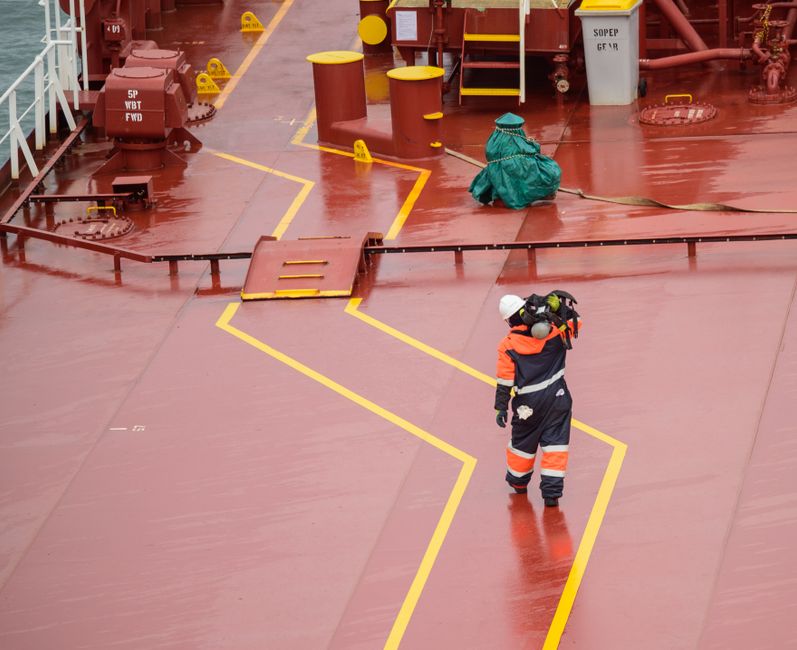
HD Hyundai Marine Solution stock closed at 221,000 won on Thursday, 27 August 2026, which puts the company at 9.9 trillion won, or roughly 7.18 billion US dollars. It listed on the KOSPI, the senior board of the Korea Exchange, in May 2024, and it does not build ships. It services ships that other yards already built: engine parts, overhauls, eco-conversions, vessel software, and marine fuel supply.
In March 2026 the company filed a value-up plan with the exchange. Two of its 2028 goals sit next to each other in that filing, and I spent most of my afternoon on what happens when you put them in the same equation.
What I did with this one, in three lines
1. The 2028 plan asks for a 20 percent consolidated operating margin and 20 percent compound growth in the core business. Both are the company’s own numbers.
2. Solve those two for the input the company left out, and you get a core-business margin near 28.5 percent by 2028.
3. The revenue-weighted core margin the company actually posted across the first half of 2026 was 28.45 percent.
Contents
What HD Hyundai Marine Solution stock costs and what the company discloses
I came to this name from the shipbuilders. Korea’s yards have been the loud part of the story for two years, and this company is the quiet adjacent business: the installed base rather than the order book. By its own count it can service 10,168 vessels as of the end of the second quarter of 2026, of which 857 carry dual-fuel engines. That second figure is 8.43 percent of the first, by my calculation.
Here is what the screen shows me at the 27 August 2026 close. Trailing price to earnings of 36.75 times, price to book of 12.01 times, return on equity of 33.7 percent, and an operating margin of 17.66 percent on the 2025 full year. Dividend per share for 2025 was 3,950 won, which against my closing price is a yield of 1.79 percent by my calculation. The vendor screen prints 2.0 percent for that yield and I was not able to reproduce it.
None of that is unusual for a Korean industrial that the market has decided is a compounder. What is unusual is how much the company breaks out voluntarily, and that is where this piece lives.
The two numbers the company did publish
In its second-quarter results on Monday, 27 July 2026, the company split its revenue in two. Core three businesses came to 356.7 billion won. Bunkering, the marine fuel supply line, came to 223.7 billion won. Consolidated revenue in the interim report was 580.4 billion won, so the split runs 61.46 percent to 38.54 percent by my calculation.
| Q2 2026 line | Revenue | Year on year | Share of consolidated revenue |
|---|---|---|---|
| Aftermarket parts and service | 275.0 bn won | plus 19.6 percent | 47.38 percent |
| Eco-conversion | 45.3 bn won | plus 38.1 percent | 7.80 percent |
| Digital solutions | 36.4 bn won | plus 65.5 percent | 6.27 percent |
| Core three, subtotal | 356.7 bn won | plus 25.2 percent | 61.46 percent |
| Bunkering | 223.7 bn won | plus 22.3 percent | 38.54 percent |
Alongside that split the company gave one margin: the core three businesses ran at 27.1 percent operating margin in the second quarter and 30.0 percent in the first. It did not give a bunkering margin, and it did not give a consolidated margin in the release, though the interim report supplies one. Operating profit for the quarter was 97.6 billion won on 580.4 billion won of revenue, which is 16.82 percent by my calculation.
Those two published numbers, 27.1 percent on 61.46 percent of revenue against 16.82 percent on all of it, imply a bunkering margin of 0.43 percent. I want to be careful about how much weight that carries. I read the 27.1 percent in Korean trade press covering the results release, not in a primary filing, and I never confirmed what the company puts above and below the line when it calls something a core-business margin. So I treat 0.43 percent as evidence that this line contributes very little operating profit, not as a figure precise to two decimals.
Meritz Securities analyst Bae Ki-yeon, writing on Thursday, 16 April 2026, described the bunkering business in Korean-language research as procured fuel carrying a thin markup, and noted that a higher oil price does not improve its profitability. That is a sell-side description of the same shape I solved for, arrived at independently.
Solving the 2028 goal for HD Hyundai Marine Solution stock
Now the plan. The value-up filing of Wednesday, 25 March 2026 asks for a consolidated operating margin of 20 percent in 2028, compound annual growth of 20 percent in the core three businesses, return on equity above 30 percent, a minimum dividend per share of 3,600 won, and four dividend payments a year in place of two.
A consolidated margin is the weighted average of the pieces underneath it. So a 20 percent consolidated margin is a statement about a mix and a set of piece-level margins, and the company published only some of those. Below I solve for the missing ones three ways. Every figure in this section is mine, not the company’s.
Condition one, if the mix never moves
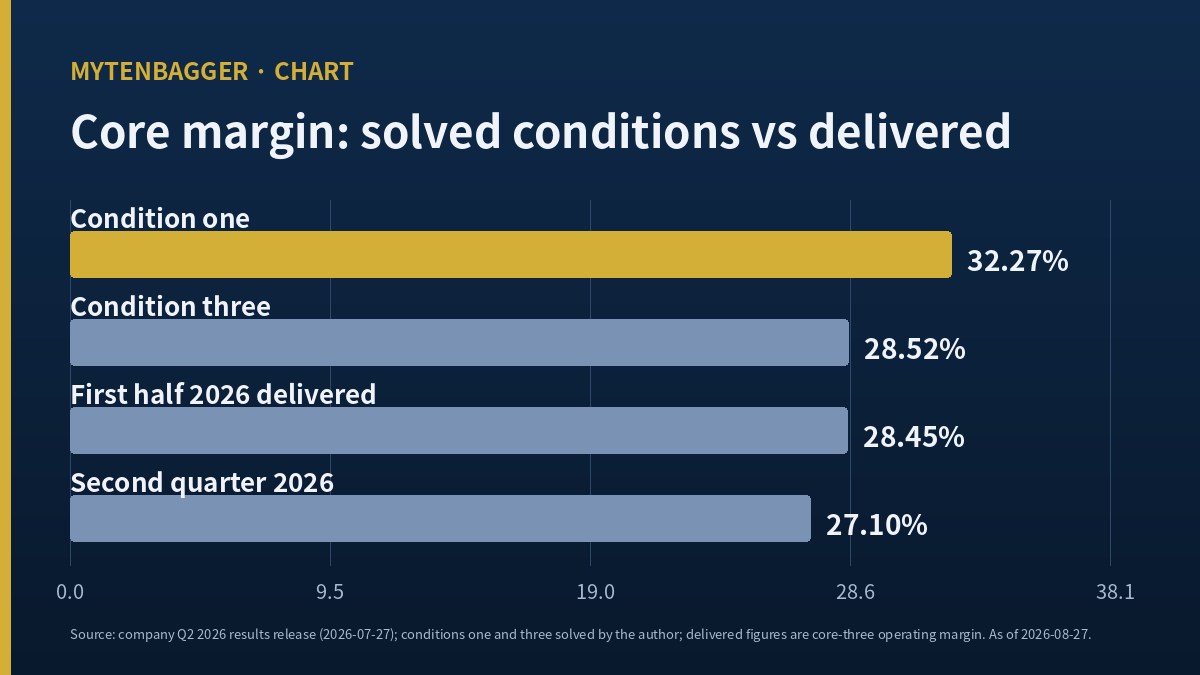
Hold the revenue split at 61.46 and 38.54, and hold the bunkering margin at the 0.43 percent I solved for. Then the core three businesses have to reach a 32.27 percent operating margin for the consolidated line to print 20 percent. That is 5.17 percentage points above the 27.1 percent just posted, and above the 30.0 percent of the first quarter. The company has published this margin for exactly two quarters and neither one is near that level.
Condition two, if the core margin never moves
Now flip it. Freeze the core margin at 27.1 percent and the bunkering margin at 0.43 percent, and ask what mix delivers 20 percent consolidated. The answer is that the core three have to reach 73.38 percent of revenue, with bunkering falling to 26.62 percent from 38.54 percent. Neither of these two conditions is what the company is guiding to. They are the corners of the space.
Condition three, which uses the company’s own growth number
This is the one that interests me. Take the company’s own goal of 20 percent compound growth in the core three, apply it for two years from the second quarter of 2026, and hold bunkering flat in absolute won. Core revenue goes from 356.7 billion won to 513.6 billion won in that quarter’s terms. Total becomes 737.3 billion won and the core share reaches 69.66 percent.
Solve that mix for a 20 percent consolidated margin and the core three need a 28.52 percent operating margin. Not 32.27 percent. A lift of 1.42 percentage points from where the second quarter landed.
Then I did the last step, which is the reason I wrote this piece. What core margin did the company actually deliver across the first half of 2026?
One input there is mine and I want it visible. The company broke out core and bunkering revenue for the second quarter only. For the first quarter I worked back from the two figures it did give, operating profit of 93.4 billion won and a core margin of 30.0 percent, which puts core revenue at 311.3 billion won and bunkering at 263.3 billion won. That derived bunkering figure sits 39.6 billion won above the second quarter’s, and the company’s second-quarter commentary described bunkering falling by roughly 40 billion won from the prior quarter. The two routes land 0.4 billion won apart, which is why I was willing to use the derived figure at all.
Weighting the first quarter’s 30.0 percent and the second quarter’s 27.1 percent by core revenue in each gives a half-year core margin of 28.45 percent. The plan needs 28.52 percent. The gap is 0.07 percentage points.
I do not think that is a coincidence, and I do not think it is a promise either. What it tells me is that the 2028 plan is not asking this company to become a different business. It is asking it to hold the margin it is already running while the core compounds and the low-margin supply line stays where it is. That is a very different proposition from the one I assumed when I first saw a 20 percent goal against a 16.82 percent actual.
The peer table I could actually build for HD Hyundai Marine Solution stock
Every peer table for this company that I have read compares it to marine equipment makers, and every one of them has the same problem: the comparison only works if the other company also sells service. So this time I used a single admission rule. A company gets a row only if it publishes what share of its revenue comes from service or aftermarket. That rule turned out to be brutal.
The three that disclose it
| Company | Listing | FY end | Revenue | Net income | Disclosed service share |
|---|---|---|---|---|---|
| Wartsila | Nasdaq Helsinki WRT1V | 31 Dec 2025 | 6,915 m euros | 626 m euros | 51.7 percent of net sales |
| Kongsberg Maritime | Euronext Oslo KMAR | 31 Dec 2025 | 26,922 m kroner | 3,780 m kroner | 50 percent, or 54 percent per the former parent |
| Alfa Laval | Nasdaq Stockholm ALFA | 31 Dec 2025 | 69,674 m kronor | 8,272 m kronor | 30.4 percent of net sales at group level |
| HD Hyundai Marine Solution | KRX 443060 | 31 Dec 2025 | 1,982,700 m won | 269,571 m won | 61.46 percent core three, Q2 2026 |
Four caveats before anyone leans on that table. Alfa Laval’s Marine division reports a 40 percent service figure, but that one is a share of orders, not of net sales, so it does not belong in the same column and I left it out. Kongsberg’s two official numbers for 2025 differ because the carve-out perimeters differ: the former parent reported 54 percent for the year while the newly listed subsidiary’s own first-quarter 2026 report puts 2025 at 50 percent, and I show both. That subsidiary only began trading on 23 April 2026, so its 2025 comparatives are carve-out figures and not audited standalone statements from a listed entity. And my own company’s 61.46 percent is a quarterly revenue share of a segment called core, which is not the same construct as an annual service share.
The dozen that do not, and the seven names that moved
Companies I looked at and could not admit under the rule, because I found no published service share: Rolls-Royce, Konecranes, Wabtec, Bureau Veritas, Mitsui E and S, which is the former Mitsui Engineering and Shipbuilding, Kawasaki Heavy Industries, Japan Engine Corporation, Daihatsu Infinearth, Weichai Power, China Yuchai, Hiab and Kalmar. Twelve names, none admitted.
Seven changes of name, code or listing status came out of that sweep and I am writing them down because printing a symbol that no longer trades is an error nobody catches in editing. Cargotec became Hiab, with the Helsinki code changing from CGCBV to HIAB on 1 April 2025, and Kalmar was demerged into its own listing on 30 June 2024 while MacGregor was sold to private owners on 31 July 2025. Kongsberg Gruppen demerged its maritime arm, which started trading separately on 23 April 2026. MAN Energy Solutions was renamed Everllence on 4 June 2025 and has never been separately listed, since Volkswagen owns it outright. Daihatsu Diesel became Daihatsu Infinearth in May 2025, keeping code 6023. Applus Services was delisted in Madrid on 30 October 2024 after a take-private.
What the rule tells me, in one sentence: the two listed companies that get anywhere near half their revenue from service both carry a large newbuild equipment book beside it, and Kongsberg Maritime’s own first-quarter 2026 report describes its aftermarket share moving down to 47 percent as newbuilding grows. The claim that no listed peer has this revenue shape therefore survives the check. It is not my claim originally: Lee Kyung-joo of Dealstory argued in Korean commentary in March 2026 that the peer set used to value this company was mismatched because none of its members is a pure service business, and noted that the company itself has said no comparable pure aftermarket company exists. I set out to check that and could not break it.
Where the forward numbers sit and when they were written
Three houses published full model tables that I could read, and I am putting the calculation date beside every one because that date does more work here than the figures.
| House and analyst | Calculated on | 2026 operating profit estimate | 2026 earnings per share estimate | Multiple at my close |
|---|---|---|---|---|
| Meritz, Bae Ki-yeon | 16 Apr 2026 | 416.6 bn won | 7,379 won | 29.95 times |
| SK Securities, Han Seung-han | 30 Apr 2026 | 439.0 bn won | 7,908 won | 27.95 times |
| KB Securities, Jung Dong-ik | 9 Jan 2026 | not obtained | 8,252 won | 26.78 times |
First-half operating profit was 191.0 billion won, so against the Meritz figure the company is 45.85 percent of the way through the year and against the SK figure 43.51 percent, both by my calculation. Consolidated revenue of 1,155.0 billion won against the company’s own 2,334.9 billion won revenue goal for 2026, given on Wednesday, 4 February 2026, is 49.47 percent. Half of a year has gone and the revenue line is 0.53 percentage points short of half the goal.
The harder fact is the two quarters themselves. Yuanta’s Kim Yong-min looked for 117.0 billion won of operating profit in the second quarter on Monday, 27 April 2026, and the company delivered 97.6 billion won, 16.56 percent below by my calculation. In the first quarter the company delivered 93.4 billion won, and reversing the two houses that published their own gap to consensus at the time gives a consensus somewhere around 101 to 104 billion won. Two quarters, both under. I weigh that more heavily than the half-year run rate.
I could not find a single piece of published research dated after the second-quarter release of 27 July 2026. Every figure I divided by in this section was calculated four months or more before the result it is being measured against.
Dividends, ownership and the block that finally cleared
The dividend record is short and it goes one way: 2,250 won for 2022, 2,500 for 2023, 3,150 for 2024, 3,950 for 2025. That last step is 25.40 percent by my calculation. From the first quarter of 2026 the company moved to quarterly payment, declaring 900 won a share for 40.4 billion won in total, with a record date of Monday, 11 May 2026 and payment on Friday, 5 June 2026. The share count used for that declaration was 44,833,460, while the vendor screen carries 44,833,484, a difference of 24 shares that I could not resolve.
On ownership, the thing I checked first was the private equity block. KKR put 653.4 billion won into the company in February 2021 for a 38 percent stake, sold down through the 2024 listing and three block trades to 4.99 percent by January 2026, and Korean press reported in July 2026 that it had cleared the rest and left the register. The exact settlement date and share count for that final sale were reported only in approximate terms, so I cannot pin them. The controlling holder is the group holding company HD Hyundai with 24,806,280 shares, or 55.34 percent as of a filing dated Friday, 27 March 2026, and not, as is often assumed, the shipbuilding intermediate holding company. Singapore’s GIC took 2,261,605 shares, 5.04 percent, at the end of June 2025 as a passive position.
I searched for bonus issues, rights issues, splits, buybacks and cancellations and found none reported. Not finding them is not the same as their absence, so I left treasury shares out of every per-share calculation in this piece.
How I hold HD Hyundai Marine Solution stock in my notes
Watching. I would rather say plainly what would make me put the file away.
My whole reading rests on one classification staying still. If the company changes what sits inside the core three businesses, or begins reporting a core margin on a different basis, then both of my solved conditions dissolve and the 28.52 percent I derived means nothing. That is the specific way this piece goes wrong, and it goes wrong quietly, because a reclassification looks like a footnote.
Beyond that, three things I am watching for in the third-quarter report, which is legally due on 15 November 2026, a Sunday, and therefore lands on Monday 16 November or later. First, whether the core margin holds at or above the 28.45 percent half-year level, because everything above depends on it. Second, whether bunkering’s share climbs back through 40 percent, which would push the consolidated line down even with the core unchanged. Third, whether a third consecutive quarter comes in under the published estimates, which would stop being a timing question and start being a seasonality question.
Readers who want a Korean industrial where the profit line and the cash line parted company can see SeAH Steel and US Tariffs: Cash Flow Went Negative, Profit Held. For a Korean marine business where the smallest quarter carried the best margin, there is Korea Line Earnings: Smallest Quarter, Best Operating Margin, and for a supplier into the same yards, Sungkwang Bend Capex Near Zero as Its Order Backlog Grew 33%.
Eight ways I could be wrong about HD Hyundai Marine Solution stock
Sharpest first.
One. The 27.1 percent core margin, which is the input to every solve above, reached me through Korean trade press covering a results release. I never opened a filing that defines it. If the company computes it on a different base, this entire piece is arithmetic on sand.
Two. Condition three assumes bunkering revenue stays flat in absolute won for two years. The company has never said that. Bunkering grew 22.3 percent year on year in the quarter I used as the base. If it keeps growing, the required core margin rises again.
Three. The 0.07 percentage point gap between what I solved for and what the company delivered is close enough that it invites over-reading. Two of the inputs to that gap are my own derivations. I would not rebuild it and expect the same figure from a different quarter’s base.
Four. KB Securities’ full-year operating profit line never reached me, so one row of the estimates table is blank and its multiple rests on an earnings-per-share figure I could read without the operating profit that produced it.
Five. No research at all after 27 July 2026. If the houses have already cut their 2026 numbers, my progress percentages are measured against full-year figures that no longer stand.
Six. The related-party concentration figures I found, 97 to 99 percent of aftermarket parts and 95 to 97 percent of service coming from within the group, date to March 2024, before the listing. The company has said it is expanding outside the group. I could not find an updated figure and I will not present a two-year-old one as current.
Seven. The screen’s dividend yield of 2.0 percent and its raw payout ratio field of 43.0 percent both failed to reproduce for me. The 65.7 percent payout ratio did reproduce, at 65.69 percent by my calculation from the declared dividend, the screen’s share count and the 2025 profit attributable to owners.
Eight. The shares traded at 268,500 won at the end of April 2026 and 221,000 won on 27 August 2026, a fall of 17.69 percent by my calculation, and I found nothing published that explains it. I am doing careful arithmetic on a price whose recent path I cannot account for.
Prices and multiples here reflect the close of Thursday, 27 August 2026 at 221,000 won, checked at the time of writing. Korean won is the reference currency throughout, and the single US dollar figure uses 1,380.9 won per dollar, the Seoul market close on the same date. The dollar rate is the 27 August 2026 Seoul close as reported by Korea JoongAng Daily, and the peer revenue and net income figures come from a single vendor, stockanalysis.com, checked on 27 August 2026.
- Hyundai Corporation Revenue Doubled on a Thin 3.81% Gross Margin
- Hanwha Engine Price to Book vs Wartsila: Where Equity Came From