Daesang Holdings Dividend Now Uses 96% of What It Receives
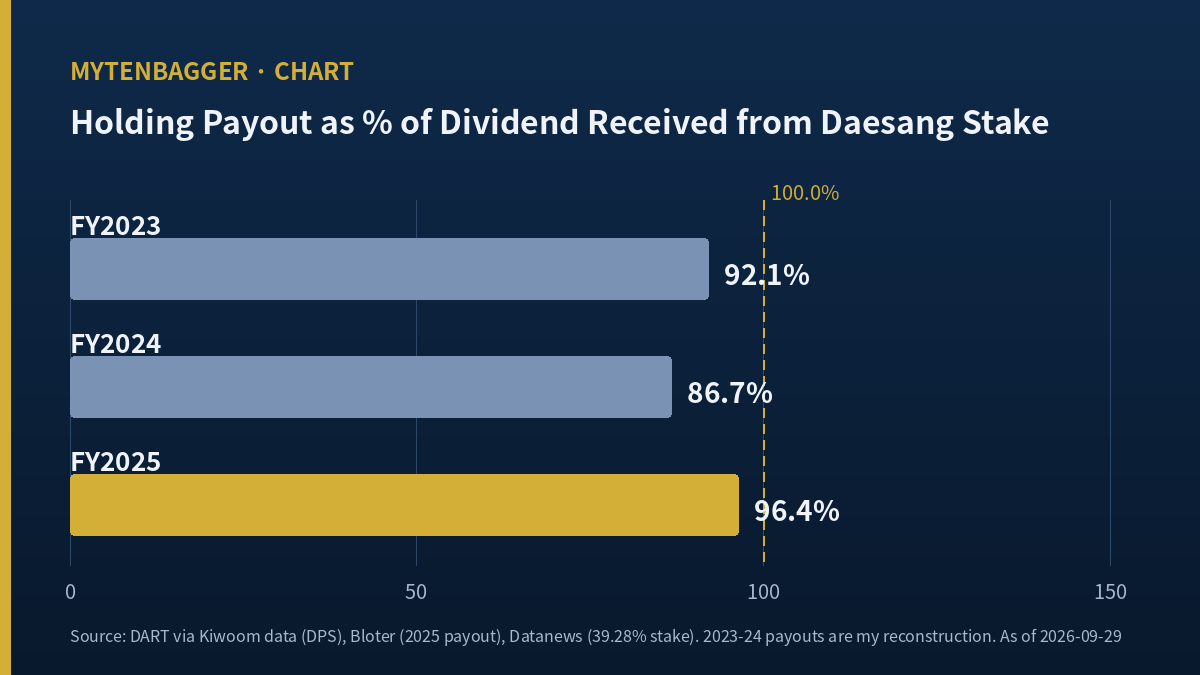
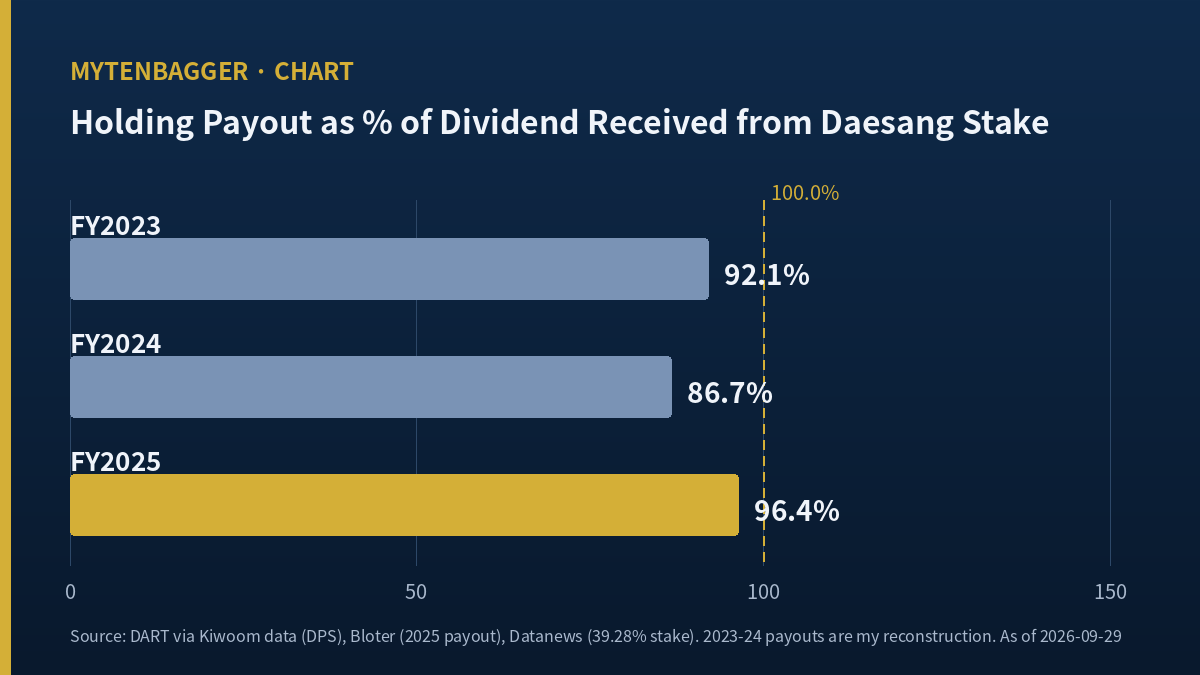
The Daesang Holdings dividend went up for 2025, to KRW 300 a common share from KRW 270. That made the total payout KRW 11.15 billion. The largest single source of cash behind it is the dividend the holding company collects on its stake in Daesang Corp. Daesang kept its own dividend at KRW 850 for the same year. On my calculation that stake paid the holding about KRW 11.57 billion. So the holding sent out roughly 96 cents for every won that one stake sent in. Two years earlier the same ratio was about 92%, and a year earlier about 87%. Daesang now owes a KRW 234.1 billion fine, due October 29, 2026. That fine is about eight times Daesang’s entire common dividend. I do not own the stock, and I am watching whether the KRW 850 survives the fine before I believe the KRW 300. The price I use is KRW 7,810, the September 28 close.
The Daesang Holdings dividend was raised for 2025 in a year when the group’s operating company was facing a KRW 234.1 billion fine, and that combination is what made me sit down with the numbers. Daesang Holdings (KOSPI: 084690) paid KRW 300 a common share, up 11.1% from KRW 270, for a total of KRW 11.15 billion. On my estimate, that is about 96% of the dividend the holding received on its Daesang shares for the same year.
KOSPI is Korea’s main board, roughly the country’s equivalent of the NYSE listing tier. Daesang Holdings is the listed parent of the Daesang food and ingredients group: seasonings, sauces, kimchi, starch and sweeteners, lysine and other fermentation products. It is controlled by the founding family through the holding company, which in turn controls Daesang Corp (KOSPI: 001680) with a stake just under 40%.
At KRW 7,810 on September 28, 2026, the holding’s 36,213,094 common shares are worth about KRW 282.8 billion, or roughly USD 207 million at the day’s KRW 1,365.1 per dollar close. The stock trades at about 5.72 dollars. At that price the KRW 300 payment works out to a trailing yield of about 3.84%. That yield is the reason most people look at this name at all, so I wanted to know where the KRW 300 comes from.
Contents
How the Daesang Holdings dividend is funded
A Korean holding company of this kind earns most of its own, parent-only income from two places: dividends from the companies it controls and brand royalties. The consolidated accounts hide both, because those payments move inside the group and cancel out. So the consolidated profit line tells me very little about whether the parent can keep paying. What matters is the flow of cash up to the parent and back out to its shareholders.
The consolidated balance sheet makes the same point from another angle. At June 30, 2026, total consolidated equity was about KRW 1,361.13 billion, and only about KRW 651.05 billion of it, roughly 48%, belonged to the holding’s own shareholders, per DART via Kiwoom data. The rest belongs to the outside shareholders of Daesang and the other subsidiaries. A reader who divides the dividend by consolidated profit, or compares it with consolidated equity, is mixing in money that the holding’s shareholders never see.
The biggest flow up is Daesang’s dividend. A March 2024 report in Datanews put the holding’s stake at 39.28% of Daesang’s common shares and noted that the holding had received about KRW 10.96 billion from Daesang for fiscal 2023 (Datanews, March 21, 2024). I use that 39.28% because it is the most recent stake figure I could pin to a named source. I did not open a later ownership report, and a small change would move my numbers slightly.
Daesang has 34,650,273 common shares. At 39.28%, the holding owns about 13.61 million of them, by my calculation. Daesang’s dividend per common share, per its DART filings as carried by Kiwoom data, was KRW 800 for 2021 through 2023 and KRW 850 for 2024 and 2025. Multiply through and the common-share dividend flowing up to the holding was about KRW 10.89 billion for 2023 and about KRW 11.57 billion for each of 2024 and 2025. I left Daesang preferred shares out of this estimate. The holding owns only a sliver of them, and the reported 2023 total of KRW 10.96 billion sits just above my common-only KRW 10.89 billion, which is the gap I would expect.
What went back out to shareholders
The flow out is easier to pin down. For 2025 the board approved KRW 300 per common share and KRW 310 per preferred share, with a March 31, 2026 record date and payment on April 24, 2026. Bloter reported the total at KRW 11.15 billion, of which KRW 0.28 billion went to preferred holders (Bloter, March 10, 2026).
The dates are worth a sentence for US readers. For years, Korean companies fixed the dividend record date at December 31 and announced the amount months later, so buyers did not know what they were getting. Under the newer practice many companies now use, the board announces the amount first and sets the record date afterward. Daesang Holdings did exactly that here: amount on March 10, record date on March 31. For a dividend-focused reader that is useful, because the next KRW figure will be public before anyone has to own the shares to receive it.
For the earlier years I rebuilt the payout myself from the same share numbers: KRW 270 on common and, as in 2025, ten won more on preferred. That gives about KRW 10.03 billion for each of 2023 and 2024. I have not checked those two totals against the company’s own dividend notices, so treat them as my estimates.
| Fiscal year | Daesang DPS (KRW) | In: from Daesang stake (KRW bn) | Holding DPS (KRW) | Out: holding payout (KRW bn) | Out as % of in |
|---|---|---|---|---|---|
| 2023 | 800 | 10.89 | 270 | 10.03 | 92.1% |
| 2024 | 850 | 11.57 | 270 | 10.03 | 86.7% |
| 2025 | 850 | 11.57 | 300 | 11.15 | 96.4% |
Sources: Daesang and Daesang Holdings DPS from DART via Kiwoom data; 2025 holding payout from Bloter; stake of 39.28% from Datanews (March 2024). “In” is my estimate on common shares only. The 2023 and 2024 holding payouts are my reconstruction from share numbers.
The pattern in that last column is what I did not expect. The holding kept its own dividend flat at KRW 270 while Daesang raised to KRW 850 for 2024, so the pass-through ratio fell to about 87%. Then for 2025, with Daesang’s dividend unchanged, the holding raised its own by 11.1%. The cushion between what comes in from this one stake and what goes out shrank from about KRW 1.54 billion to about KRW 0.42 billion.
Before I leaned on that 96%, I wanted to know whether it was unusual or just the top of a normal swing, so I pushed the same rebuild back to 2018 using the DART dividend series for both companies. I held share totals at today’s figures and the stake at 39.28%, which is a simplification: if the stake or the share totals moved in those years, the older rows move with it.
| Fiscal year | Daesang DPS (KRW) | In (KRW bn, est.) | Holding DPS (KRW) | Out (KRW bn, est.) | Out as % of in |
|---|---|---|---|---|---|
| 2018 | 550 | 7.49 | 190 | 7.06 | 94.4% |
| 2019 | 600 | 8.17 | 200 | 7.43 | 91.0% |
| 2020 | 700 | 9.53 | 220 | 8.18 | 85.8% |
| 2021 | 800 | 10.89 | 240 | 8.92 | 81.9% |
| 2022 | 800 | 10.89 | 270 | 10.03 | 92.1% |
Sources: DPS for both companies from DART via Kiwoom data. All KRW amounts are my estimates on constant share numbers; they are there to show direction and should not be quoted as reported totals.
Read together with the first table, eight years of ratios sit between about 82% and about 96%. The 2025 figure is the highest of the eight, but 2018 was close at about 94%, so I cannot call 2025 a break from history. What I can see is a rhythm. In the years when Daesang raised its dividend (2019, 2020, 2021 and 2024), the ratio fell, because the holding raised by less or not at all. In 2022 and 2025, when the holding raised and Daesang held flat, the ratio jumped. The holding follows Daesang up with about a one-year lag: Daesang went to KRW 800 for 2021 and the holding went to KRW 270 for 2022; Daesang went to KRW 850 for 2024 and the holding went to KRW 300 for 2025.
So the 2025 raise fits the old pattern, and that reassures me about intent. It worries me about timing. The holding has just caught up to an inflow level Daesang set before the fine. If Daesang resets lower after paying it, the catch-up will have been to a level that no longer exists, and the holding will be the one that has to move next.
There is also a plain reason the holding likes to pay. The same Datanews story listed two members of the founding family as owning 36.71% and 20.41% of the holding. If those stakes are still about the same, roughly 57% of the common payout, around KRW 6.2 billion for 2025 on my calculation, goes to two people. For a family-controlled group, the holding’s dividend is one of the few clean ways cash reaches the family. That gives the board a reason to keep it steady, and it also means the payout is not set purely with outside shareholders in mind.
I looked at the same problem from the other end in the GS Holdings piece, where the question was which of several equity figures a holding’s shareholders actually own. Here the question is narrower and about cash: which dividend actually pays mine. The subsidiary side of this story, including the fine and the provision Daesang set aside for it, is in the Daesang piece.
Why the Daesang Holdings dividend depends on one decision in Seoul
The holding does have other income. The group’s affiliate page lists Daesang Information Technology, Daesang Construction and several smaller food and trading companies, and I did not confirm which of them sit directly under the holding. Brand royalties also flow up. I was not able to open the holding’s parent-only accounts for 2025 this session, so I cannot tell you how large those other inflows are. That is the biggest hole in this piece and I would rather name it than paper over it.
What I can say is that Daesang is by far the largest company in the group. In the January to June 2026 consolidated accounts, Daesang’s own consolidated revenue of KRW 2.28 trillion was about 78% of the holding’s. When the biggest subsidiary pays a fixed KRW 850, the parent’s room to raise its own payout comes from somewhere else, and I do not yet know where.
To see how much room there is, I ran the 2026 inflow at three Daesang dividend levels and held the holding’s KRW 11.15 billion payout fixed. At KRW 850, the stake pays about KRW 11.57 billion and the payout uses about 96% of it, the same as now. At KRW 800, the level Daesang paid from 2021 to 2023, the inflow drops to about KRW 10.89 billion and the payout becomes about 102% of it, so the holding would be paying out more than this stake sends up. At KRW 700, the 2020 level, the inflow is about KRW 9.53 billion and the payout is about 117% of it.
None of these is a forecast. I do not know of any named brokerage that publishes a dividend estimate for Daesang Holdings, and I could not find a named 2026 or 2027 estimate for the holding at all in this session. I am showing the three levels because they are the three Daesang has actually paid in the last six years, which makes them the plausible places a board under pressure could settle.
That puts the next Daesang dividend decision, expected around March 2027, at the center of the Daesang Holdings dividend question. If Daesang holds KRW 850, the holding’s inflow from this stake stays around KRW 11.57 billion and the KRW 300 looks sustainable on this stake alone, barely. If Daesang trims, the holding either cuts or leans harder on those other inflows I could not see.
The fine that sits between Daesang and its KRW 850
On August 31, 2026, Daesang received the Korea Fair Trade Commission’s final written decision on a starch and starch-sugar price-fixing case. Its share is KRW 234.1 billion, payable by October 29, 2026, according to Edaily’s report of that day (Edaily, August 31, 2026). The accounting for that fine, including a 2025 provision that turned out larger than the final amount, is covered in my earlier Daesang piece linked above, and I am not reopening it here.
What matters for the dividend is scale. Daesang’s common dividend for 2025 cost about KRW 29.45 billion (KRW 850 times 34,650,273 shares, my calculation). The fine is about 7.9 times that. And Daesang’s own cash generation in January to June 2026 was thin: consolidated operating cash flow of about KRW 14.28 billion against capital spending of about KRW 92.80 billion, per DART via Kiwoom data. At the group level, the holding’s consolidated cash and cash equivalents already fell from KRW 674.35 billion at the end of 2025 to KRW 300.53 billion at the end of June 2026, per the balance sheet on Valueline (Valueline balance sheet). I have not traced where that cash went, so I do not tie it to the fine.
The borrowing side of the same balance sheet is heavier than the cash side. At June 30, 2026, consolidated short-term borrowings were about KRW 432.20 billion, the current portion of long-term debt about KRW 388.79 billion, bonds about KRW 698.46 billion and long-term borrowings about KRW 166.23 billion, per Valueline. That is roughly KRW 1.69 trillion of interest-bearing debt against KRW 300.53 billion of cash, before the fine is paid. Most of it sits inside Daesang and other operating companies, and the holding’s shareholders are not directly on the hook for all of it. Still, when a group carries that much debt, dividends upstream compete with debt service and capital spending for the same cash.
Put those together and my worry is simple. A board that has just written a KRW 234.1 billion check has a reason to hold its dividend flat, and a weaker reason to raise it. Daesang has not cut its dividend in any year from 2018 through 2025 on the DART series I have. The question is whether 2026 is the year that record meets its first real test.
A Japanese seasoning maker for scale
For a US reader who has never looked at Korean food stocks, the closest familiar name is Ajinomoto (TSE: 2802), the Japanese company that competes with Daesang in seasonings such as monosodium glutamate. I use it for one number only. Ajinomoto’s dividend page on Stock Analysis showed a trailing yield of 0.88% when I checked it on September 29, 2026 (Stock Analysis, Ajinomoto dividend).
Daesang Holdings at about 3.84% yields more than four times as much. I do not read that as a bargain signal. A yield that high on a controlling holding company usually tells me the market doubts the payout will grow, or marks down the fact that a family-controlled parent sets it. I am not comparing any other figure between the two, because Ajinomoto reports on an April to March fiscal year and I did not line up their accounts.
What could prove my read of the Daesang Holdings dividend wrong
Three arguments against my worry
- The holding raised the dividend knowing about the fine. The KRW 300 was decided on March 10, 2026, after Daesang had already recorded a provision for the case in its 2025 accounts. A board that raised the payout with the liability already on the table may simply expect to cover it from those other inflows I could not see.
- The stake is worth nearly the whole company. At Daesang’s September 28 close of KRW 18,300, 13.61 million shares are worth about KRW 249.1 billion, around 88% of the holding’s own market value. Per holding share that stake is worth about KRW 6,878, which leaves roughly KRW 932 of the KRW 7,810 price for everything else in the group. With that much value in one listed stake, the holding does not need to fund its dividend from the stake’s cash alone in any single year.
- Daesang’s operations improved this year. Daesang’s April to June operating profit came to about KRW 46.5 billion, up from a year earlier, according to Dealsite (Dealsite, August 14, 2026). A better operating year makes a flat KRW 850 easier to defend even after the fine.
Three things that would change my mind
- Daesang’s next dividend announcement, expected around March 2027. KRW 850 or more and I stop worrying about the stake inflow. Anything below KRW 800 and I expect the holding’s KRW 300 to be revisited.
- The holding’s parent-only accounts in its 2026 annual report, due in March 2027. If dividend and royalty income from companies other than Daesang covers at least a quarter of the payout, the 96% ratio above is less alarming than it looks.
- Daesang’s third-quarter report, due by November 16, 2026, which will show how the October 29 payment showed up in its cash and borrowings.
None of these depends on the share price, and I would rather wait for the first one than guess.
Where the Daesang Holdings dividend leaves me
I came into this expecting a boring answer: a holding that collects more than it pays and keeps the difference. What I found is a holding that now pays out almost everything its main stake sends up, in the year that stake’s company owes the regulator KRW 234.1 billion.
Where my first draft went too far
My first instinct was to judge this payout against the consolidated net loss for 2025, which made KRW 300 look reckless. That was the wrong line to use. Most of that loss came from Daesang’s provision for the fine, and the parent pays its shareholders from the cash it collects. A consolidated profit figure mixes in everyone else’s shareholders too. The lesson I am keeping is small and specific: for a holding company, I trace the cash up before I read the profit line.
So I am watching. I am not buying. The yield is real and the record is long, but the record was built in years without a KRW 234.1 billion bill. I want to see one dividend decision made after that bill is paid before I treat KRW 300 as a floor.
Prices and market values reflect the September 28, 2026 close (Daesang Holdings KRW 7,810 on both Valueline and Chickstock; a Kiwoom daily figure ten won higher was not used). Dollar amounts are approximate, at KRW 1,365.1 per dollar, the Seoul close on the same date as reported by Newsis. Dividend totals derived from share numbers and marked as my estimates are rounded.
Related reading