Lotte Chilsung Debt: Interest Takes Half of Operating Profit
Contents
Lotte Chilsung Stock: The Debt Fell and the Interest Did Not
Two numbers, one year apart, from the same company. Total consolidated liabilities fell by KRW 280.6 billion. Quarterly interest expense rose by KRW 28 million.
The first number is roughly $198 million and the second is roughly twenty thousand dollars. One of them is a balance and the other is a cost, so they do not sit in the same statement and they do not have to move together. I know that. I still spent most of an hour looking at the two of them side by side, because every piece of coverage I read about this company after its second-quarter print discussed revenue and operating profit, and none of them counted the line that has been taking the largest single bite out of this company’s profit for four consecutive years.
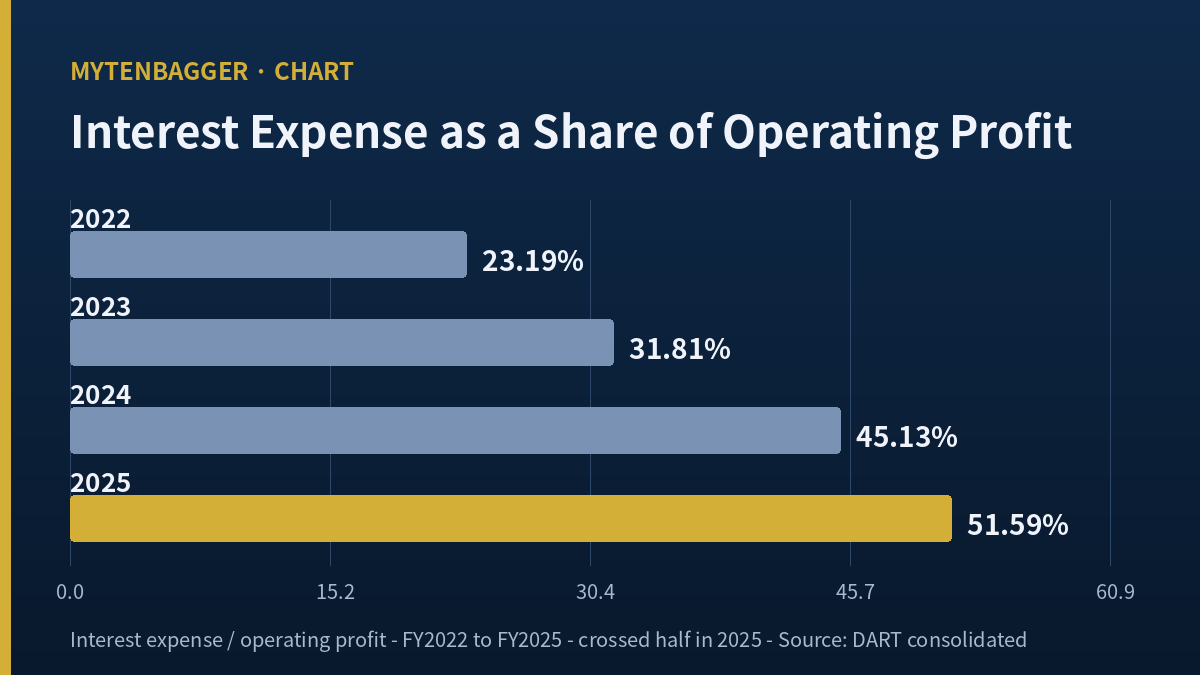
Interest expense as a share of operating profit
FY2022: 23.19% > FY2023: 31.81% > FY2024: 45.13% > FY2025: 51.59%
Consolidated filings with Korea’s Financial Supervisory Service. Interest expense divided by operating profit, my calculation. FY2025 is the first year above half.
Those four values are the whole piece. Everything below is me working out how they got there and what the first half of 2026 is doing to them.
Lotte Chilsung Beverage trades on the Korea Exchange main board under 005300. It is one of Korea’s largest beverage companies, it owns Chilsung Cider and the Cheoeum Cheoreom soju brand, and it has long bottled Pepsi and Del Monte in Korea under license. Market capitalization is KRW 950.2 billion, which is about $670 million, so by American standards this is a small cap running a top line just under four trillion won.
A Year Where Interest Took Half the Operating Profit
Start with fiscal 2025 on a consolidated basis. Revenue KRW 3,971.1 billion, operating profit KRW 167.2 billion, net income KRW 51.2 billion. That is an operating margin of 4.21 percent and a net margin of 1.29 percent. KRW 116.0 billion disappears between the operating line and the net line.
The largest single component of that gap is interest expense of KRW 86.2 billion, about $60.8 million. That equals 51.59 percent of operating profit and 1.68 times net income, both my calculation. In 2025 this company paid more to its lenders than it kept for its shareholders.
I do not treat that as a one-year accident, because the four-year series has a direction.
| Fiscal year | Revenue (KRW bn) | Operating profit (KRW bn) | Interest expense (KRW bn) | Interest / operating profit |
|---|---|---|---|---|
| 2022 | 2,841.7 | 222.9 | 51.7 | 23.19% |
| 2023 | 3,224.7 | 210.7 | 67.0 | 31.81% |
| 2024 | 4,024.5 | 184.9 | 83.5 | 45.13% |
| 2025 | 3,971.1 | 167.2 | 86.2 | 51.59% |
Source: consolidated statements filed with Korea’s DART electronic disclosure system. Ratios computed from unrounded figures.
Lotte Chilsung Stock and Four Years That Went Three Ways
Compare 2022 with 2025 directly and three items move in three directions.
- Revenue rose 39.74 percent, from KRW 2,841.7 billion to KRW 3,971.1 billion (my calculation).
- Operating profit fell 24.99 percent, from KRW 222.9 billion to KRW 167.2 billion (my calculation).
- Interest expense rose 66.86 percent, from KRW 51.7 billion to KRW 86.2 billion (my calculation).
Over the same stretch the operating margin slid from 7.84 percent to 4.21 percent and net income fell 60.95 percent, from KRW 131.1 billion to KRW 51.2 billion. My reading is that the cost of getting bigger outran the earnings that getting bigger produced.
One thing this table cannot settle: whether interest rose because the company borrowed more or because borrowing got more expensive. Total liabilities actually shrank slightly, from KRW 2,720.8 billion at the end of 2023 to KRW 2,684.4 billion at the end of 2025, while interest expense went from KRW 67.0 billion to KRW 86.2 billion. Dividing interest expense by the average of opening and closing total liabilities gives 2.68 percent for 2023, 3.03 percent for 2024 and 3.15 percent for 2025 (my calculation).
I will not call those three figures a cost of funds. Total liabilities include payables and other items that carry no interest, and I have not opened the borrowings schedule. So this is a rough sense of direction, and the direction is up.
First Quarter 2026: KRW 280.6 Billion Down, KRW 28 Million Up
The first quarter of 2026 was a good one by this company’s recent standards. Revenue KRW 952.5 billion (up 4.64 percent), operating profit KRW 47.8 billion (up 90.96 percent), net income KRW 25.3 billion (up 366.67 percent), all consolidated and all growth rates my calculation against the year-ago quarter. The operating margin went from 2.75 percent to 5.02 percent.
That is not the part I kept staring at.
| Consolidated | Q1 2025 | Q1 2026 | Change |
|---|---|---|---|
| Total liabilities | KRW 2,940.0bn | KRW 2,659.4bn | down KRW 280.6bn (9.54%) |
| Liabilities to equity | 189.78% | 165.14% | down 24.64pp |
| Total equity | KRW 1,549.2bn | KRW 1,610.4bn | up KRW 61.2bn |
| Interest expense (quarter) | KRW 19.827bn | KRW 19.855bn | up KRW 28m (0.14%) |
A 24.64 percentage point improvement in the liabilities-to-equity ratio is a real change, and it did not show up in the interest line. I treat that gap as the thing that decides this company’s next twelve months.
There is a friendlier way to hold the same data. Because interest stayed flat while operating profit grew 90.96 percent, interest as a share of operating profit went from 79.21 percent in Q1 2025 to 41.54 percent in Q1 2026 (my calculation). In the year-ago quarter, eight of every ten won of operating profit went to lenders. That is why net income in that quarter was only KRW 5.4 billion.
Annualize the Q1 2026 interest figure by simple multiplication and you get KRW 79.4 billion against KRW 86.2 billion for all of 2025, which is 7.90 percent lower (my calculation). If the remaining three quarters hold that pace, this company’s interest burden bends downward for the first time in four years. If.
Lotte Chilsung Stock After the Second-Quarter Numbers
Second-quarter results landed on Wednesday, August 5, 2026: revenue KRW 1,112.9 billion (up 2.4 percent), operating profit KRW 55.8 billion (down 10.4 percent), net income KRW 28.2 billion (up 1.8 percent), as reported by Korean press including Newspim and Herald Business.
First-half totals were revenue KRW 2,065.4 billion (up 3.4 percent) and operating profit KRW 103.6 billion (up 18.6 percent). I added the quarters myself: KRW 952.5 billion plus KRW 1,112.9 billion gives KRW 2,065.4 billion, and KRW 47.8 billion plus KRW 55.8 billion gives KRW 103.6 billion. Both close against what the company published.
On a parent-company basis the segments went in different directions. Beverages posted revenue of KRW 500.5 billion (up 1.7 percent) with operating profit of KRW 20.5 billion (down 13.2 percent). Liquor posted KRW 195.1 billion (up 3.2 percent) with operating profit of KRW 7.5 billion (up 156.6 percent). The global segment including overseas subsidiaries posted KRW 458.5 billion (up 3.4 percent) with operating profit of KRW 26.1 billion (down 27.0 percent). Management pointed to inflation, raw material prices and global logistics costs, and noted that ready-to-drink liquor products grew 143.3 percent on the Soonhari Jin line.
One separation is worth making here. The first-half operating margin improved from 4.37 percent to 5.02 percent, up 0.64 percentage points, but split by quarter that is plus 2.27 points in Q1 and minus 0.72 points in Q2 (my calculation). The entire half-year improvement came from the front quarter and the back quarter gave some of it away. I am not using that as this piece’s argument, since it sits at a different level of the income statement, but reading the half-year headline as “improving” hides an entire quarter.
And the second-quarter interest figure is not out yet. It appears in the semiannual report, and the filing deadline for that report is Friday, August 14, 2026. The number this piece rests on arrives on that exact date.
The Coverage Ratio on My Screen Is One Quarter, Not One Year
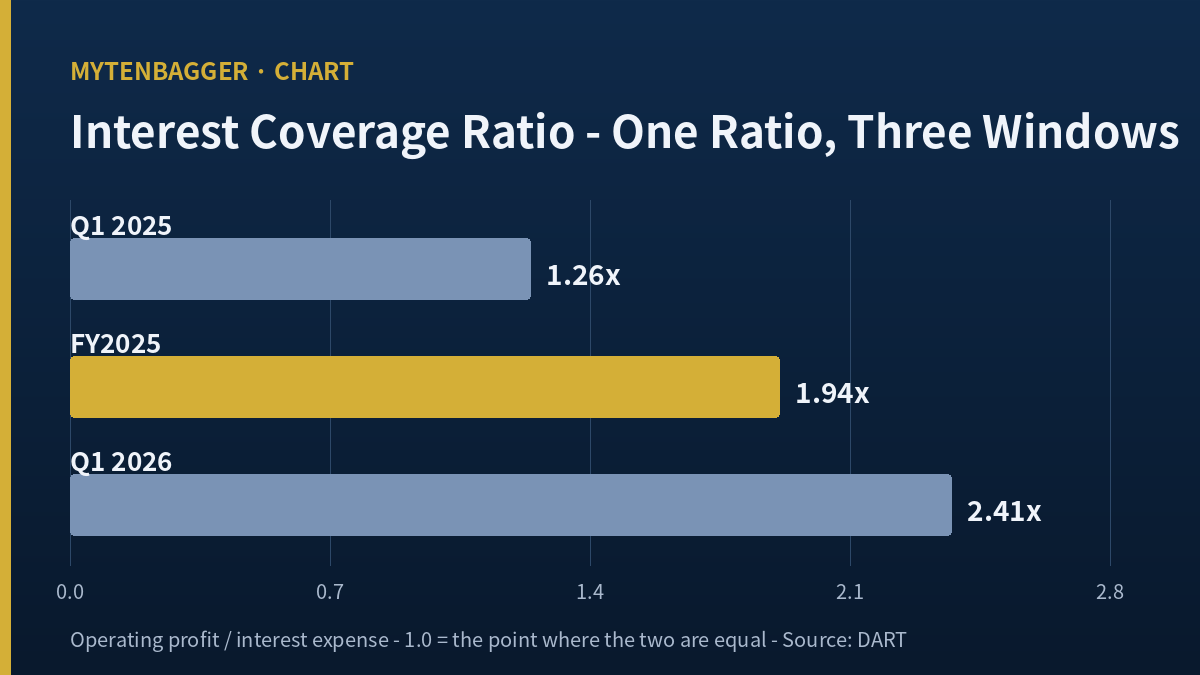
My data screen shows an interest coverage ratio of 2.41 for this company. Operating profit at 2.41 times interest expense. Thin, but survivable at a glance.
The screen does not say which period that covers, so I worked it out. Q1 2026 operating profit of KRW 47.8 billion divided by interest expense of KRW 19.855 billion equals 2.407. It reproduces to three decimals, which tells me the figure on my screen is a single quarter.
Recompute annually and the answer changes. Fiscal 2025 operating profit of KRW 167.2 billion divided by interest expense of KRW 86.2 billion equals 1.94. Take Q1 2025 alone and it is 1.26 (my calculation). The same named ratio ranges from 1.26 to 2.41 depending on the window.
I write this down because how comfortable or uncomfortable someone feels about this balance sheet can depend entirely on which window their screen happened to pick. I anchor on the annual 1.94 and I file 2.41 separately, as the best quarter this company has had recently.
Lotte Chilsung Stock Lost to the Index and Tied Its Sector
The price. KRW 102,400 at the Monday, August 10, 2026 close. Market capitalization of KRW 950.2 billion, which reproduces exactly against 9,279,297 shares outstanding at KRW 950,200,012,800. Trailing multiples are 21.8 times earnings, 0.68 times net asset value and 0.24 times sales, all on that same close.
Over the trailing year, from August 11, 2025 to August 10, 2026 across 243 trading sessions, this stock fell 18.79 percent. The KOSPI rose 96.45 percent over the same window. The stock trailed the index by 115.24 percentage points, which looks like a catastrophe if you stop reading there.
The beverage sector index fell 21.19 percent. Against its own sector this stock is ahead by 2.40 percentage points. Decomposing the excess return gives a sector contribution of minus 117.64 percentage points and a stock contribution of plus 2.40 points, so 98.0 percent of the explanation sits in the sector, not the company. Within that sector this name ranks fourth of twelve, against a median of minus 21.16 percent, beating eight peers.
The sector index here is an equal-weighted composite of the other eleven names with this stock excluded, so what I am comparing is this company against the rest of its own basket. My conclusion: over the past year this stock failed to keep up with the Korean market not because the business did something unusual, but because the whole basket sat still, and inside that basket this company did slightly better than average. Beta of 0.139 and correlation of 0.217 say it barely moves with the index in the first place.
The most recent twenty sessions run the other way and are worth flagging. Over that stretch this stock rose 1.59 percent while its sector fell 6.92 percent and the KOSPI fell 15.73 percent, a divergence of 8.5 percentage points that my screen flags as idiosyncratic and worth investigating. So the one-year picture and the one-month picture disagree about who is driving. I do not have an explanation for the recent twenty sessions and I am not going to invent one, but I note that the second-quarter release landed inside that window and the sell-side cuts followed it by one day.
On price position: KRW 102,400 sits at 66.15 percent of the 250-session intraday high of KRW 154,800, which is 33.85 percent below that high, and 9.05 percent above the 250-session intraday low of KRW 93,900. All three come off the same August 10 close. Measured on closing prices instead, the peak was KRW 148,200 on Monday, February 23, 2026 and the trough KRW 95,900 on Friday, June 26, 2026, putting the stock 30.90 percent below its closing peak. Intraday and closing bases give different answers, so I have not mixed them.
Lotte Chilsung Stock and CCEP: Two Bottlers in the Same Position
Comparing this company only against other Korean food and beverage names misses something structural. It sells its own brands, but it also takes other companies’ brands, puts them in bottles and sells them, Pepsi and Del Monte among them. So the useful comparison is a listed company standing at exactly the same point in the chain somewhere else in the world. Coca-Cola Europacific Partners (NASDAQ: CCEP) is that company.
| Metric | Lotte Chilsung | CCEP |
|---|---|---|
| Price to earnings | 21.8x | 20.85x |
| Net margin | 1.29% | 9.34% |
| Return on equity | 3.2% | 22.89% |
| Revenue growth | down 1.33% | up 2.2% |
The periods differ. Lotte Chilsung figures are fiscal 2025 consolidated results with multiples on the August 10, 2026 close. CCEP figures come from stockanalysis.com as displayed on the same date, with revenue and net income on a trailing twelve month basis and return on equity for fiscal 2025. The 9.34 percent net margin is my calculation from $24.42 billion of revenue and $2.28 billion of net income.
The two companies carry nearly identical earnings multiples and their net margins differ by 7.24 times (my calculation). Same business shape, comparable revenue growth, and one of them keeps 9.34 cents per dollar of sales while the other keeps 1.29. My working assumption is that a large part of that gap gets made below the operating line, which is why this piece began at the interest expense line. I have not verified CCEP’s own interest expense in absolute terms, so that sentence is my hypothesis and not a checked fact.
The last time I sorted companies by their balance sheets I was ranking three Korean cosmetics manufacturers by debt, and there the borrowing was producing a high return on equity. Here the same subject sits on the other statement and does the reverse, so I want to be careful not to carry the earlier conclusion across.
The reason I find a same-position comparison useful is narrow. Compare Korean bottlers only against Korean bottlers and everything looks normal by definition. Go outside and you find out whether a number is the shape of the industry or the shape of one company’s choices. Here the weight falls on the second, as I read it.
Lotte Chilsung Stock: What the Houses Did in August
Sell-side numbers came down after the second-quarter print. Shinhan Investment’s Cho Sang-hoon kept a buy rating on Thursday, August 6, 2026 while cutting KRW 15,000 off a KRW 160,000 valuation to reach KRW 145,000, as reported by Ajunews. The stated cause was prolonged cost pressure from raw materials and packaging, and the note observed that second-quarter operating profit came in 11 percent under consensus. The same day, Korea Investment and Securities’ Choi Go-woon moved from KRW 160,000 to KRW 150,000, per Newsway.
Earlier, on Wednesday, May 6, 2026, Kiwoom Securities’ Park Sang-jun held a buy rating and KRW 170,000 while modeling 2026 revenue of KRW 4,061.0 billion and operating profit of KRW 208.6 billion. The note said first-quarter operating profit of KRW 47.8 billion beat consensus while adding that can and PET input costs remained under pressure from Middle East conflict. Daol Investment expects overseas subsidiary input costs to ease in the second half if crude prices fall, per the Newsway report, where the analyst was not named.
Management’s own 2026 guidance is consolidated revenue of KRW 4,100 billion and operating profit of KRW 200 billion. First-half progress against that is 50.38 percent on revenue and 51.80 percent on operating profit (my calculation). The KRW 200 billion operating figure requires 19.65 percent growth on 2025’s KRW 167.2 billion, which means KRW 96.4 billion in the back half against KRW 79.8 billion in the second half of 2025, or 20.85 percent more, all my calculation.
For what it is worth, the other Korean drinks company I have written up recently, Hite Jinro with its low margin and high yield, presented a payout question, not a financing one. Two neighbors in the same aisle, two different problems.
I do not adopt any house’s number as my own. What I notice is that all three August moves cited input costs as the reason, and the line I am watching is not costs.
Lotte Chilsung Stock: Numbers I Did Not Use
Things that were on my screen and did not make it into the argument, listed so that the omissions are visible.
- Dividends. KRW 3,400 per share for a third consecutive year, a 3.31 percent yield. The payout ratio came back as 72.4 percent on one path and 40.3 percent on another, so I left the whole topic out.
- Return on equity decomposition. Splitting 3.2 percent into margin, asset turnover and financial leverage tells a different story than this one. I did not run it.
- EBITDA. The screen value equals the first-quarter operating profit exactly, which would imply zero depreciation, so it does not hold up. Dropped.
- Three-year revenue CAGR of 11.8 percent. I could not establish the basis, so I dropped it.
- Foreign ownership at 16.93 percent and margin balance at 0.24 percent. Unrelated to this argument.
- Total equity field. Blank on the screen, so I substituted the filed figure of KRW 1,610.4 billion at the end of the first quarter.
Where This Breaks: Five Conditions
- Total liabilities are not interest-bearing debt. The KRW 2,659.4 billion I compared includes payables and other non-interest items. Look at borrowings alone and the decline could be far smaller or absent, which would blur the whole contrast. This is the thinnest plank I am standing on.
- A period-end balance does not map onto a period cost. Putting a March 31 balance next to interest incurred across January to March is a convenience. When during the quarter something got repaid changes what an identical reduction does to the cost line.
- Sustained input cost pressure hits the operating line first. Shinhan wrote that prolonged cost pressure could take 8 percent off earnings estimates. Even with interest flat, a smaller number underneath pushes the ratio back up.
- The second-quarter segment numbers were already weak. Beverages down 13.2 percent and global down 27.0 percent on operating profit, parent basis. The signal that the first quarter did not continue is already published.
- I have not seen the second-quarter interest figure. This piece stands on one observation. One observation is a point, not a trend.
Is interest at half of operating profit a dangerous level?
Where anyone draws that line is personal. What I can state is the arithmetic: in 2025, KRW 86.2 billion of interest was 1.68 times the KRW 51.2 billion of net income, and annual coverage was 1.94 times. Operating profit at half its current level would not cover the interest. In the first quarter of 2026 that coverage figure came up to 2.41.
Why would liabilities fall without interest falling?
I do not know. Two candidates: what got repaid carried no interest, or the rate on what remains went up. The borrowings schedule in the semiannual report separates those. So this piece describes the phenomenon without asserting a cause.
Lotte Chilsung Stock: The Line I Look For on August 14
At KRW 950.2 billion of market capitalization it sits well outside the range where my default is anything other than watching, and nothing here changed that default.
What I did set is one checkpoint. When the semiannual report posts on Friday, August 14, 2026, the first thing I open it for is neither revenue nor operating profit. It is the first-half interest expense line. The comparable figure for the first half of 2025 was KRW 40.6 billion.
If that line comes in above KRW 40.6 billion, then the flat first quarter was one quarter of noise and this piece’s argument is wrong. If it comes in clearly below while total borrowings sit unchanged, then what fell was the rate and not the debt, and that is not something the company did. In that case I was right and the observation is worth half of what it looked like. There are two ways for me to be wrong here and one way to be right for the wrong reason. Writing those three down in advance is the most I can do with a single quarter of data.
Prices and multiples reflect the Monday, August 10, 2026 close as checked at the time of writing. This piece may post later, so figures can differ from live quotes. Financial statement figures are consolidated as filed in Korea, and the won is the base currency for everything here. Dollar amounts are approximate conversions at roughly KRW 1,418.40 per dollar, the Seoul market daytime close on that same date. Anything marked as my calculation is a value I derived, not one taken from a filing.
- Daesang Earnings: A Provision 60% Above the Final Regulatory Fine
- Lotte Chemical Price Target: Why Four Brokers Differ 2.13 Times
- Young Poong Earnings: Most Profit Comes From Outside Operations
- Korean Flex Circuit Maker BH Co: Profit Barely Covers Interest
- Samsung Electro-Mechanics at 174x Earnings: MLCC Upcycle Outlook
- Samsung Life Down 39%: Holding Discount, CSM and Capital