Ilshin Spinning Hyzen Stake Sale: 2.5 Million Shares Planned
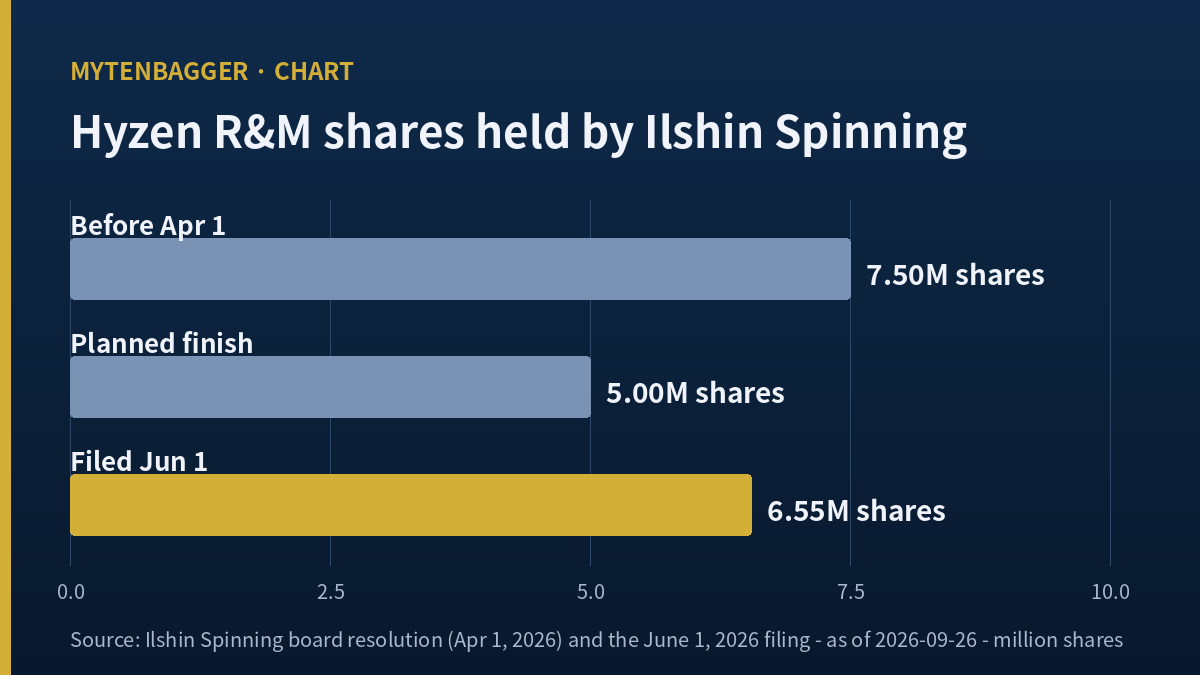
Ilshin Spinning stock closed at 11,100 won on September 23, 2026, which puts the whole company at about 254.9 billion won, or roughly $188 million. On April 1 the board voted to sell 2.5 million shares of Hyzen R&M, a KOSDAQ-listed motor maker in which it holds a large stake. The last filing I could trace, dated June 1, shows only 950,000 of those shares gone, and the 6.55 million that remain were worth 192.6 billion won at the same day’s close. That is about 75 percent of Ilshin’s own price tag sitting in one line of its balance sheet.
- Shares held before April 1
- 7.5 million (24.28 percent of Hyzen)
- Board decision, April 1
- sell 2.5 million for 81.06 billion won
- Planned finish
- 5.0 million shares, 16.19 percent
- Filed on June 1
- 6.55 million shares, 21.21 percent
- Shares traceably sold
- 950,000, or 38 percent of the plan (by my calculation)
- Hyzen close, September 23
- 29,400 won
- Value of the filed stake
- 192.57 billion won (about $141.8 million)
- Ilshin’s own market value
- 254.86 billion won (about $187.6 million)
- Stake as a share of Ilshin
- 75.56 percent
- Same ratio if the plan had finished
- 57.68 percent
- Where I stand
- no position, watching until a filing closes the 1.55 million-share gap
Contents
Ilshin Spinning stock and the filing I went looking for
I came to this company the way most people do, through its property. Ilshin Spinning is a KOSPI-listed cotton yarn and fabric maker, and nearly every Korean article about it starts with the Yeouido office tower, the Hannam-dong land and the old factory site in Gwangju. KOSPI is Korea’s main board, roughly the Korean equivalent of the NYSE for companies of this size. A Financial News piece from September 14 walked through all of that again, and I read it expecting another property story.
What held me was a smaller item near the end: a 21.2 percent stake in Hyzen R&M. Hyzen is a KOSDAQ-listed maker of industrial motors, servo drives and electrical control gear; KOSDAQ is Korea’s growth-company board, closer in spirit to the Nasdaq. A spinning mill owning a fifth of a motor company is odd enough. What made me open a spreadsheet was the date on the sale notice.
On April 1, 2026 (Wed), Ilshin’s board approved selling 2.5 million Hyzen shares for 81.06 billion won, as Digital Today reported that day. That works out to 32,425 won per share. The sale was scheduled for May 4 (Mon) through an after-hours block trade, with an off-exchange fallback if the block could not be done. The stated purpose was liquidity and money for new business investment. In dollars the planned sale was worth about $59.7 million, a sizable sum for a company whose whole market value is under $190 million. After the sale Ilshin would hold 5.0 million shares, or 16.19 percent. Bloter carried the same figures, plus the note that the deal equals 8.54 percent of Ilshin’s equity capital of 949.6 billion won.
So the plan was clear. I then went looking for the filing that says it happened.
What the June filing says about the Ilshin Spinning stock stake
The only later report I could find is a change-of-holding notice reported by Digital Today on June 1, 2026 (Mon). It says Ilshin sold 450,000 Hyzen shares in an after-hours trade on May 29 (Fri) and now holds 6.55 million shares, or 21.21 percent. Hyzen closed at 31,550 won on June 1, up 6.23 percent that day.
Put the two reports side by side and the arithmetic does not close. If 6.55 million shares remained after selling 450,000, Ilshin held 7.00 million on the morning of May 29. It started April with 7.5 million. By my calculation, then, 500,000 shares left the account somewhere between April 1 and May 28, and another 450,000 left on May 29. That is 950,000 shares in total, or 38 percent of the 2.5 million the board approved. The other 1.55 million shares have no sale I can point to.
I checked the percentages against Hyzen’s total share number before trusting any of it. Hyzen has 30.888 million shares outstanding according to KokStock. 7.5 million of those is 24.28 percent, 5.0 million is 16.19 percent and 6.55 million is 21.21 percent. All three match the reported figures to the second decimal, so the numbers are internally honest. They just describe two different endings.
The board approved selling 2.5 million shares. The filings I can see account for 950,000. The difference is worth about 45.6 billion won at today’s Hyzen price.
One more filing sits in the background. On September 7, 2026, Mirae Asset Asset Management reported that it had crossed 5 percent of Hyzen, holding 1,585,332 shares, or 5.13 percent, as of September 4, according to the disclosure page on ChickStock. The purpose was listed as simple investment. It does not tell me anything about Ilshin’s shares directly, but it does tell me that a large domestic fund was adding Hyzen through the summer, which is the kind of buyer a block seller would normally look for.
Three ways the gap could close
I can think of three explanations, and I cannot yet choose between them. The first is that more sales happened after June 1 and were reported in a filing I did not reach. Ilshin’s own IR page would not load for me, and the Korean disclosure system blocks the tools I use, so this is the likeliest reason the gap looks bigger than it is. The second is that the May 4 block trade failed or was cut short, and Ilshin chose to sell in pieces as the price allowed. The third is that the company changed its mind once Hyzen’s price moved; a decision to sell is permission, and a board can let permission lapse.
Each of these leads somewhere different. If the first is true, Ilshin now has a lot more cash than its June balance sheet shows. If the second or third is true, it still owns a stake worth three quarters of its own market value, carried in its accounts at a small fraction of that.
Pricing the remaining Hyzen shares against Ilshin Spinning stock
Hyzen closed at 29,400 won on September 23, 2026, up 2.1 percent, per KokStock’s quote page. That gives Hyzen a market value of about 908.1 billion won. On the same day Ilshin itself closed at 11,100 won, and KokStock lists 22.96 million Ilshin shares issued, for a market value of 254.86 billion won.
Now the two numbers that matter. At 6.55 million shares, Ilshin’s Hyzen stake was worth 192.57 billion won at that close, about $141.8 million at 1,358.4 won per dollar. That is 75.56 percent of Ilshin’s market value. Had the April plan run to the end, Ilshin would own 5.0 million shares worth 147.0 billion won, or 57.68 percent. Either way, a large piece of what a buyer pays for Ilshin today is a claim on a motor company it may or may not still be selling.
I want to be careful with that 75 percent. It is a market price multiplied by a share number, and nobody can sell 6.55 million shares of a KOSDAQ stock at the closing price. The April plan itself priced 2.5 million shares at 32,425 won, and even a block trade usually clears below the screen price. So I treat 192.57 billion won as an upper figure, and I will not quote it as a hidden value in any stronger sense than that.
Time has also had a price here. The April notice valued the shares at 32,425 won each. By September 23 Hyzen was at 29,400 won, 9.33 percent lower. If the 1.55 million shares I cannot trace are still in Ilshin’s hands, waiting has cost about 4.69 billion won against the April price, by my calculation, before any block price cut on either side. That is small next to a 192.57 billion won stake, but it is not nothing for a company whose whole January-to-June operating profit was 15.48 billion won. It is also the kind of cost nobody reports, because an unsold share never shows a realized loss until it is sold.
There is a comparison in this journal that I kept thinking about. My Kolon Industries entry on doubled aramid capacity was about a fiber company whose own plant expansion outran demand. Ilshin’s case runs the other way. The large number here sits outside the mill, in a company that makes motors, and the mill is the smaller business on the page.
What moved on the Ilshin Spinning stock balance sheet between December and June
If 2.5 million shares had been sold in May, the June 30 balance sheet should show it: an associate line that shrinks by roughly a third, and a jump in cash or short-term investments of around 81 billion won. So I pulled the balance sheet items from ValueLine’s balance sheet page for Ilshin and the cash lines from stockanalysis’ quarterly balance sheet.
| Item (KRW billion) | Dec 31, 2025 | Jun 30, 2026 | Change |
|---|---|---|---|
| Balance-sheet total | 1,120.71 | 1,169.68 | +48.97 |
| Investments in associates | 32.93 | 29.69 | −3.24 |
| Investment property | 272.06 | 268.95 | −3.11 |
| Cash plus short-term investments | 72.36 | 84.16 | +11.80 |
| Total liabilities | 171.06 | 190.05 | +18.99 |
Sources: ValueLine (total, associates, investment property, liabilities); stockanalysis (cash and short-term investments). Figures converted from hundred-million won to billion won.
None of these rows looks like an 81 billion won sale. The associate line fell by 3.24 billion won, or 9.84 percent. Cash plus short-term investments rose by 11.80 billion won. Liabilities went up, too, by 18.99 billion won, and stockanalysis shows total debt rising from 75.99 billion to 84.68 billion won over the same six months.
The investment property row deserves one sentence of its own. Ilshin carries it at 268.95 billion won. The Financial News article put the company’s real estate at roughly 1.32 trillion won, but it did not show who made that estimate or how, so I am not using it anywhere in my arithmetic. The carrying figure is the only one I can trace, and it barely moved in six months.
Two cautions before anyone leans on this. The associate line is not Hyzen alone. The Financial News article lists a 48.5 percent stake in Giordano Korea as well, so a 3.24 billion won drop mixes more than one company. And an associate is carried at cost plus its share of profits, which is why a stake worth nearly 200 billion won in the market can sit inside a line of under 30 billion. Even so, if a third of the Hyzen shares had left in May, I would expect that line and the cash line to move far more than they did. The June balance sheet fits the smaller number, 950,000 shares, better than it fits 2.5 million.
The June quarter’s profit line and where the extra came from
One more number points the same way. In the three months to June 30, stockanalysis shows Ilshin earning 29.96 billion won of net income against 12.49 billion won of operating profit. That leaves 17.47 billion won that came from outside the mill’s operations. A gain on the Hyzen shares sold in April and May is the obvious candidate. Whatever the carrying amount per Hyzen share is, it cannot be above roughly 4,500 won, because the whole associate line is 29.69 billion won and 6.55 million shares still sit inside it. Selling 950,000 shares at around 30,000 won would bring in something under 30 billion won, and a gain on that scale, less tax, fits a 17.47 billion won gap.
I have not seen the notes to the June report, so I cannot confirm that the 17.47 billion won is a disposal gain. It could include property income, fair-value changes on other investments or a tax item. What I can say is that the size fits a partial sale far better than a full one. A full 2.5 million-share sale at 32,425 won against a low carrying amount would have left a much larger mark on June’s profit.
The mill itself had a good year so far. Operating profit rose sharply from January to June, and a spinning business with that kind of spring does not need a Hyzen sale to look alive. That part of the story belongs to cotton prices, and I am leaving it out here on purpose, because this entry is about what Ilshin owns and what it said it would sell.
A US yarn maker for one comparison
For a peer I wanted a listed yarn producer whose balance sheet is public quarter by quarter, so I could see how much of its total a spinner normally ties up in inventory. Unifi (NYSE: UFI), the North Carolina maker of polyester and nylon yarns, fits. I am using exactly one ratio from it and nothing else: inventory divided by the balance-sheet total.
At March 29, 2026, Unifi reported $103.93 million of inventory against a total of $392.37 million, or 26.49 percent. Ilshin at June 30, 2026 carried 142.96 billion won of inventory against 1,169.69 billion won, or 12.22 percent. The dates differ by three months, and I did not try to align them. Unifi runs a fiscal year that ends in late June, so that March figure is its third quarter.
That single comparison says one thing clearly. Ilshin’s balance sheet is mostly not a mill. A yarn maker that runs only its plants holds roughly a quarter of everything in inventory; Ilshin holds about an eighth, because much of the rest is property, affiliates, cash and securities. I am writing no revenue, no earnings and no valuation multiple for Unifi, and I did not compare their debt either. The point of bringing it in was to see how thin the mill’s share of Ilshin really is, and that one ratio does the job.
For a broader look at how fragile Korean fiber-maker comparisons can be, my Hyosung TNC entry with a nine-company table showed one row moving a group median. That is a reason I kept this peer comparison to a single ratio.
What argues against my reading of Ilshin Spinning stock
- The simplest explanation is that the rest of the sale happened after June 1 and I missed the filing. I could not open Ilshin’s IR page or the Korean disclosure system from where I work. If later filings show Ilshin at 5.0 million shares or fewer, my central question is simply answered, and the gap was mine.
- The associate line includes Giordano Korea, so its small drop cannot be pinned on Hyzen alone. My inference that few Hyzen shares left in May rests partly on a line that mixes two companies.
- Hyzen’s price moves a lot. It closed at 31,550 won on June 1 and 29,400 won on September 23, a 6.81 percent fall. A stake that is 75 percent of Ilshin’s value makes Ilshin partly a bet on Hyzen’s chart, whether or not a holder of the spinning stock wants that.
- Market value is not sale value. Selling millions of KOSDAQ shares usually means a price below the close, and a sale also triggers tax. The realizable figure is lower than 192.57 billion won by an amount I cannot estimate.
- The 17.47 billion won gap between net income and operating profit in the June quarter may be one-off in part or in full. I should not treat June’s net income as a run rate.
- Revenue has been sliding for years. Annual sales fell from about 601.0 billion won in 2021 to 517.2 billion won in 2025, per Hankyung’s financial page. A strong January-to-June 2026 may be a cotton-price event and not a new trend.
- I found no named brokerage covering Ilshin. There are no forward estimates to lean on, so every number here is trailing, and the next quarter has no one else’s forecast to test against.
Two paths, and what would settle each
The sale finished without fanfare
A later filing, or the third-quarter report, shows Ilshin at 5.0 million Hyzen shares or fewer and cash well above 84.16 billion won. In that case the story becomes one about what the company does with the money. Some rough arithmetic: selling the remaining 1.55 million shares at the September 23 price would bring in about 45.57 billion won before tax and any block price cut, which would lift cash plus short-term investments from 84.16 billion won toward roughly 129.7 billion won. The company also doubled its dividend for 2025, from 200 won to 400 won per share according to Financial News, so the board has already shown it will hand some cash back. The April notice said new business investment. A spinning company with a lot of fresh cash and a stated plan to invest it outside its core is a very different holding from a spinning company with a large listed stake, and I would want to know the size and nature of that investment before doing anything.
The sale stopped near 950,000 shares
Ilshin keeps roughly 6.55 million Hyzen shares, and the associate line stays near 30 billion won. Then Ilshin remains, in market terms, three quarters Hyzen. That is fine in itself. It does mean the stock’s direction depends heavily on a motor company, and a reader who bought it for cotton or for property would be carrying something else.
The conditions I am watching on Ilshin Spinning stock
I own no Ilshin shares and I am not buying at 11,100 won. These are the points that would change that, or confirm it:
- A filing that states Ilshin’s Hyzen shareholding after June 1.
- Hyzen shares at or below 5.0 million in the third-quarter report, which would mean the April plan finished.
- Hyzen shares still near 6.55 million in that report, which would mean the plan stalled.
- Cash plus short-term investments at September 30 compared with 84.16 billion won at June 30.
- The associate line compared with 29.69 billion won.
- Any announcement of what the “new business investment” is, and how large.
- Total liabilities above 200 billion won without a matching rise in cash, which would suggest borrowing where a sale was expected.
- A third-quarter gap between net income and operating profit near zero, which would tell me June’s extra came from a one-time source.
The first answers could come any day, since a holding change of this size must be filed within days. The report itself is due by November 16, 2026 (Mon). If the filings show the sale finished, most of my caution goes away and a different question takes its place. If they show it stalled, I will treat Ilshin as a Hyzen holding with a mill attached, and value it that way.
What I got wrong on first reading
A disposal notice, to me, used to mean a finished sale. When I saw the April headline I wrote “sold 2.5 million Hyzen shares” in my notes and moved on. It took a second article two months later, and a subtraction that would not close, to show me that a board decision is a plan with a date on it. The June filing did not contradict the April one. It just told a smaller story, and I had filled the gap with an assumption.
So here is where this entry stops. I know the plan, I know one later filing, and I know the June balance sheet looks more like the smaller sale than the larger one. What I do not know is the current number of Hyzen shares Ilshin holds, and that single number decides whether Ilshin Spinning stock is a mill with property or a motor-company stake with a mill attached. The next filing that states it is where I pick this up.
Prices and market values reflect the September 23, 2026 close; Korean markets were shut on September 24 and 25 for the Chuseok holiday. Dollar figures are approximate, at about 1,358.4 won per dollar on the same date. Share arithmetic and percentages marked “by my calculation” are my own.
Related reading