Korea Aerospace Stock: The Multiple Rose While the Price Fell
On July 16 (Thursday), an analyst at Korea Investment & Securities cut his numbers ahead of the print. Jang Nam-hyun modelled second-quarter operating profit at ₩67.7bn (about $47m) for Korea Aerospace Industries, roughly 28.8% below where the market sat, and lowered his valuation on the stock to ₩200,000 (about $140), a 13% reduction. On July 29 (Wednesday) the company reported ₩48.4bn (about $34m). The bear who had already cut was still 28.5% too high, by my own arithmetic.
The next day, July 30 (Thursday), two things happened at once. Six of nine covering brokerages lowered their valuations on the stock. And at the company’s Sacheon campus, Korea’s Defense Acquisition Program Administration held a ceremony marking the formal completion of development for the KF-21 Boramae, the country’s first domestically developed supersonic fighter. The day a decade-long fighter programme officially finished and the day the market confirmed a 43% drop in quarterly operating profit were one day apart.
The share price gave way in between. From ₩158,000 ($110.50) at the July 24 (Friday) close to ₩117,100 ($81.90) on July 29, three sessions took 25.9% out of it by my calculation. The August 3 (Monday) close was ₩121,900, about $85.26. I pulled up my sheet on the back of that drawdown, rebuilt the table, and then put my hands in my pockets. What follows is why.
|
What I verified · Q2 revenue ₩1.168tn (+41.0%), operating profit ₩48.4bn (−43.1%), net profit ₩37.0bn (−35.2%) · A ₩38.0bn one-off litigation gain sat inside the year-ago quarter · Even after adjusting for it, the August 3 close prices the stock at 63.9x trailing and 75.9x first-half-annualised earnings · Order backlog ₩27.34tn; full-year company revenue goal ₩5.73tn |
What I could not verify · When LAH Mir-On deliveries restart. Neither the company nor the sell side puts a date on it · The substance of the reported 16-aircraft Indonesia proposal. Neither price nor terms came from the company · A trustworthy consensus forward earnings-per-share figure. The indicator database I use returns an empty field · Whether the fourth-quarter KF-21 deliveries actually convert to revenue inside the fourth quarter |
Contents
What Korea Aerospace reported, and why the market broke
A word on where this stock lives before the numbers. Korea Aerospace Industries trades on the KOSPI, the main board of the Korea Exchange in Seoul, under the ticker 047810. The KOSPI is the senior of Korea’s two boards, the junior one being the KOSDAQ, and it is where the country’s large industrial and defense names sit. The company is Korea’s national airframe manufacturer: it builds the FA-50 light combat aircraft, the KF-21 fighter, the LAH light armed helicopter branded Mir-On, and it makes structural components for Boeing and Airbus.
Second-quarter consolidated preliminary results were revenue of ₩1,167.9bn (about $817m), operating profit of ₩48.4bn, and net profit of ₩37.0bn. Revenue rose 41.0% year on year. Operating profit fell 43.1% and net profit fell 35.2%. The operating margin came in at 4.14% by my own division of the two figures, against 6.14% in the first quarter. Two percentage points of margin disappeared in a single quarter while the top line grew by more than a third.
The company gave two reasons. The first was a delay in deliveries of the LAH Mir-On helicopter. The second was a one-off gain inside the year-ago comparison, which I will come back to because it turned out to be the most useful thing in the entire release. Korean sell-side research added a third factor: a weaker won. Both the pre-print note and the post-print coverage describe the same mechanism, in which a softer won raises the cost side of the completed-aircraft export business faster than it lifts the revenue side. Seoul Economic Daily summarised the combination as a defense boom with clipped wings. I could not find a public breakdown of which specific cost lines moved, so I am leaving that at the level the sources support.
Adding the first quarter gives the half. Revenue of ₩1,092.7bn in Q1 plus ₩1,167.9bn in Q2 makes ₩2,260.6bn (about $1.58bn). Operating profit of ₩67.1bn plus ₩48.4bn makes ₩115.5bn. Net profit of ₩41.3bn plus ₩37.0bn makes ₩78.3bn. The first-half operating margin works out to 5.11%. That thin a margin on that fast a revenue ramp is the thing that snagged me, because it means the entire valuation case rests on one assumption: that the margin normalises.
Nearly half of that 43% drop was sitting in last year’s number
This is the part of the research that mattered most to me. Reporting from Seoul Economic Daily’s English edition relays the company’s explanation that the year-ago second quarter contained a ₩38.0bn one-time gain from a lawsuit settlement.
Run the arithmetic. If ₩48.4bn represents a 43.1% decline, the year-ago quarter earned roughly ₩85.1bn (₩48.4bn divided by 0.569, my calculation). Take the ₩38.0bn one-off out of that and ₩47.1bn is left. This year’s ₩48.4bn is about 3% above that adjusted base. On operating substance, the quarter was flat against the prior year. A large share of the headline decline is an artefact of a settlement that landed in last year’s income statement.
My first reaction was that the market had overreacted, and that the 18.1% single-session fall on July 29 was too much for what actually happened. I sat with that for a while and then turned it over. The adjustment cuts both ways. The moment you strip the one-off out to say the company matched last year, you have also said that revenue grew 41% and operating profit grew about 3%. Removing the illusion shrinks the earnings shock and worsens the quality of the growth at the same time. I ended up weighting the second reading more heavily, and everything downstream in this note follows from that choice.
Four consensus numbers, four different misses
Something else surfaced while I was reading the coverage. Every outlet reports how far the quarter fell short of consensus, and the percentages do not agree, because the denominators do not agree.
| Benchmark used | Whose number | Gap to ₩48.4bn |
|---|---|---|
| ₩88.9bn | Market consensus as printed by Seoul Economic Daily’s English edition | −45.6% |
| ₩95.1bn | Consensus cited in the July 16 Korea Investment & Securities note | −49.1% |
| ₩100.0bn | Consensus cited by Daishin Securities on July 30 | −51.6% |
| ₩67.7bn | Korea Investment & Securities’ own already-lowered estimate | −28.5% |
Every percentage in that table is mine, computed as ₩48.4bn divided by the benchmark, minus one. A 45.6% miss and a 51.6% miss are both accurate statements about the same quarter. When Daishin’s Choi Jung-hwan wrote that the result fell well short of a ₩100.0bn consensus, he was using a different number from the ₩88.9bn that appeared in the English-language report. Neither is wrong. The reader is the one who gets confused when the denominator goes unstated, which is why I put all four in a table rather than picking one.
The row I actually find useful is the bottom one. Korea Investment & Securities published a lowered estimate thirteen days before the print, having already identified the helicopter delay and the currency drag, and the reported number still came in 28.5% below that. When the party that saw the downside coming misses by that margin, the quarterly earnings of this business are not currently forecastable with any precision. Putting a high multiple on an earnings stream nobody can model is a combination I avoid.
I re-measured Korea Aerospace on first-half earnings alone
At the ₩121,900 close on August 3 and 97,475,344 shares outstanding, market capitalisation is roughly ₩11.88tn, about $8.31bn at the exchange rate stated in the footnote. The indicator database I use, sourced from Kiwoom and dated August 3, shows a trailing price-to-earnings ratio of 63.9x, a price-to-book ratio of 6.49x, and a return on equity of 10.5%. Against the intraday 250-day high of ₩215,500, the close sits 43.4% lower on my own calculation. The same database puts the stock 43.2% above its intraday 250-day low of ₩85,100 and up 33.22% over twelve months, which is worth holding alongside the drawdown figure. A 43% fall from the high and a 33% gain over the year describe the same tape, and quoting only the first one would flatter my case.
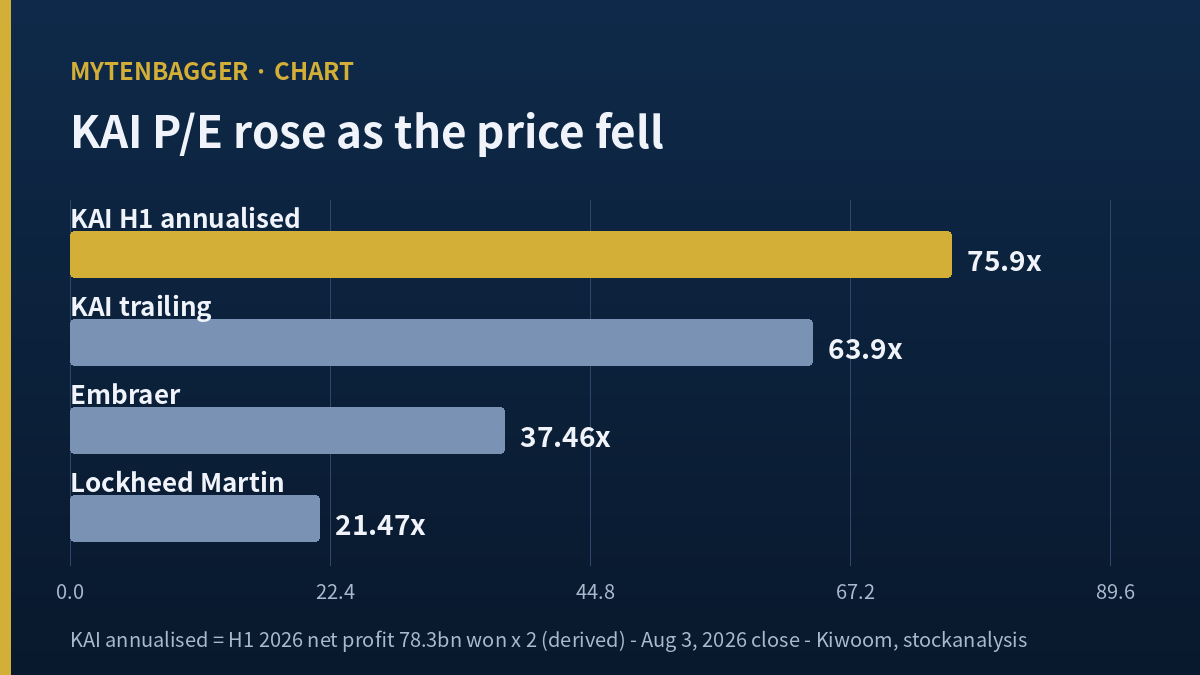
What I did next was simple. A trailing multiple divides by earnings that include quarters from before the margin cracked. So I redrew the scale using this year’s first half only. First-half net profit of ₩78.3bn, doubled to ₩156.6bn and divided by the share count, gives ₩1,607 per share (about $1.12). Divide ₩121,900 by that and the answer is 75.9x.
| Earnings basis | Earnings per share | Multiple at ₩121,900 |
|---|---|---|
| Trailing (Kiwoom data, August 3) | ₩1,906.89 | 63.9x |
| 2026 first half annualised (my calculation) | ₩1,607 | 75.9x |
While the price fell 43% from its high, the multiple went the other way, from 63.9x to 75.9x, because earnings fell faster than the share price did. For someone like me, who came to this name looking at the drawdown as a possible entry, that is a signal pointing in precisely the wrong direction. The annualisation does assume the second half looks like the first, and both the company and the sell side expect a much larger second half. I decided the honest thing was to quantify that assumption rather than wave at it, which is the next section.
Korea Aerospace next to Lockheed Martin and Embraer
Two global comparisons framed this for me. Lockheed Martin traded at 21.47x trailing and 18.85x forward earnings on August 3, with a market capitalisation of $133.70bn on $77.01bn of trailing revenue. Embraer traded at 37.46x trailing and 21.67x forward, at $12.16bn of market value on $8.25bn of trailing revenue. Embraer is the closer analogue: a mid-sized airframer from an emerging market that sells both defense and commercial platforms and depends on export campaigns for its growth.
Priced against sales rather than earnings, which sidesteps the one-off distortion entirely, KAI sits at 3.21x, Lockheed Martin at 1.74x, and Embraer at 1.47x. Those three are my own divisions of each company’s market value by its trailing twelve-month revenue. The Korean company carries more than double the sales multiple of the Brazilian one. Trailing revenue there is ₩3.70tn, about $2.59bn.
Now the guidance. UPI, reporting the KF-21 development milestone, carried the company’s 2026 targets of ₩5.73tn in revenue and ₩10.44tn in new orders, alongside an order backlog of ₩27.34tn. UPI converted that backlog to roughly $18.05bn using its own exchange rate; at the August 3 rate I use throughout this piece, the same won figure is closer to $19.1bn. I am flagging that because the gap between the two dollar figures is entirely currency, not a difference in the underlying number.
First-half revenue of ₩2,260.6bn is 39.45% of the annual goal. Closing the remaining ₩3,469.4bn (about $2.43bn) in the second half means running at 1.535 times the first-half rate. That is not an impossible ask in this business, where completed-aircraft revenue clusters around delivery dates. Daishin expects the KF-21 production schedule to hold with deliveries concentrated in the fourth quarter, taking domestic-programme revenue to ₩1.2tn. The same note, though, models full-year domestic revenue at ₩2.7tn against company guidance of ₩3.2tn. The sell side is not taking the company’s number at face value.
It is worth being specific about where that second-half revenue is supposed to come from, because for a reader outside Korea the programme names carry no intuition. Daishin’s note points at four sources. KF-21 domestic deliveries, concentrated in the fourth quarter. First-article FA-50 deliveries being prepared, with Poland in the near term and Malaysia in 2027. Rising revenue recognition from the Iraq contractor logistics support backlog, which is a sustainment contract rather than an airframe sale and therefore recognises more evenly. And a margin lift the analyst attributes to a steadier won. Three of those four are delivery events, which is the structural point: a company whose revenue recognises on handover has a lumpy income statement by construction, and lumpy is not the same as growing.
That lumpiness is why the fourth-quarter concentration matters more than it sounds. If the deliveries slip by even a few weeks across a year boundary, the revenue does not shrink, it moves, and the annual comparison that everyone is underwriting breaks anyway. The LAH Mir-On delay is the template: nothing about the order disappeared, the timing simply changed, and two quarters of reported profit changed with it. An investor buying the second-half recovery is underwriting a schedule, not a demand curve, and schedules in this industry have a documented habit of moving to the right.
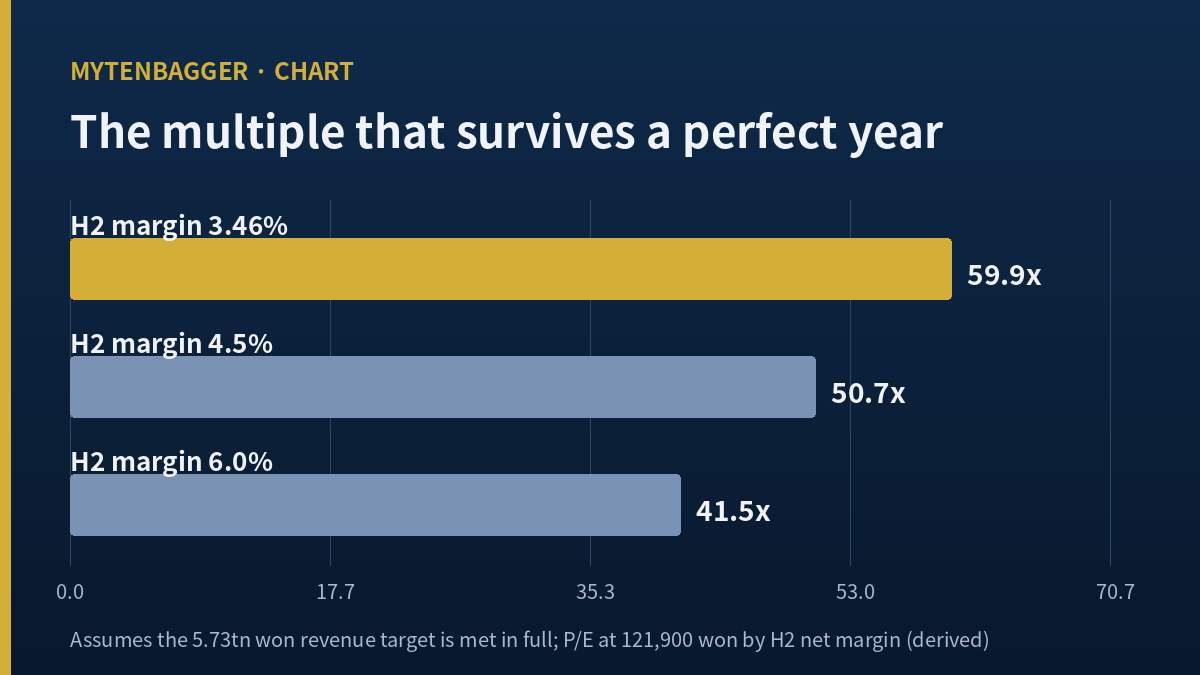
So I pushed the question further: if the company hits its revenue goal in full, where does the multiple land? First-half net margin was 3.46%, my division again. Applying three net-margin assumptions to the required ₩3,469.4bn of second-half revenue gives the following.
| Second-half net margin assumed | Full-year net profit (my calculation) | Multiple at ₩121,900 |
|---|---|---|
| 3.46%, unchanged from the first half | about ₩198.5bn | 59.9x |
| 4.5% | about ₩234.4bn | 50.7x |
| 6.0%, a full margin normalisation | about ₩286.5bn | 41.5x |
All three rows assume the company delivers 100% of its ₩5.73tn revenue goal. Stack that assumption on top of a full margin recovery to 6.0% and the result is still 41.5x, above Embraer’s 37.46x and close to double Lockheed Martin’s 21.47x. That is where I stopped. When the optimistic case, fully loaded, still clears the peer group’s current multiples, what I am looking at is not a discount created by the drawdown but a premium that has not finished deflating. The three margin figures are mine and arbitrary; had the indicator database carried a credible consensus forward earnings-per-share number I would have used it instead of guessing, and I would rather say that plainly than dress up my own assumptions as market expectations.
One more line on what an investor is paid to wait. The fiscal 2025 dividend was ₩500 per share, unchanged for three consecutive fiscal years since 2023, which is a 0.41% yield at the August 3 close by my calculation. The reported debt-to-equity ratio of 473.94% looks alarming until you remember that customer advance payments sit in liabilities in this industry, so the raw figure overstates financial risk; applied to total equity of ₩1,643.3bn it implies total liabilities in the region of ₩7,788.3bn. Foreign ownership stands at 24.25%. All of those come from the same Kiwoom-sourced database as of August 3. The practical conclusion is that this is not a name where a dividend pays you to be early, which is exactly why entry timing carries more weight for me here.
Korea Aerospace: my stance, and how long this note stays true
I do not own the stock and I did not buy it on this drawdown. That is not a judgement about the company. A completed indigenous fighter programme, a backlog above ₩27tn, and an export partner converting into an export customer add up to a more legible set of catalysts than most Korean defense names I have written up. The question is what price those catalysts already carry. At 43% off the high, first-half earnings still put the stock at 75.9x, and that is a different shape of decline from the ones I looked at in LIG Nex1, Doosan Enerbility, or LG Chem. In those, price fell faster than earnings. Here, earnings fell faster than price.
The other side deserves space, because on this one the entire sell side disagrees with me. The brokerages that cut did not abandon the direction. LS Securities lowered its valuation from ₩250,000 to ₩190,000 while maintaining that FA-50 and KF-21 export wins remain the investment case, and SK Securities moved from ₩230,000 to ₩190,000 while projecting continued growth once the Mir-On helicopter programme normalises and KF-21 and FA-50 delivery volumes expand. Daishin settled at ₩165,000 and Eugene Investment at ₩159,000 among the six that moved. Even the lowest of those, ₩159,000, sits about 30% above the August 3 close. Every covering analyst I found reads this drawdown as an overshoot. I am on the other side of that, and I would rather write it down than hide it.
The export story did move in the meantime. K-Defense News reported that Indonesia completed final payment on its KF-21 co-development contribution after the obligation was renegotiated from ₩1.6tn down to ₩600bn, a 62.5% reduction on my arithmetic, with the scope of technology transfer cut correspondingly and Jakarta’s status shifting from co-developer toward ordinary buyer. Separately, on July 28 (Tuesday), Korean press relayed a report from the overseas defense outlet Defense Express that KAI had proposed sixteen Block 2 aircraft for roughly $2.0bn. That figure did not come from the company. Whether it includes weapons, spare engines, pilot training, or sustainment is unconfirmed. The report’s own won conversion of about ₩2.7tn differs from the ₩2.86tn I get at the August 3 rate purely because of the exchange rate used. I treat this one as a thread to pull rather than as a number to build on.
Two things would make me recalculate. The first is third-quarter revenue clearly stepping up so the ₩5.73tn annual goal starts looking reachable on run-rate rather than on hope. The second is the LAH Mir-On delivery schedule, described by Daishin as still requiring further negotiation, turning into an actual date. If the fourth-quarter KF-21 deliveries land on schedule and Indonesia signs, my first-half annualisation becomes a useless yardstick overnight, and I do not think that outcome is unlikely. My position is that I can confirm it and still get a reasonable price, and that is a preference rather than a certainty.
A practical note for readers outside Korea, since this one only trades in Seoul. Korea’s daily price limit of plus or minus 30% applies, and fractional shares are not available on the KRX, so the ₩121,900 quote is also the minimum increment.
Finally, the shelf life. Every multiple above uses 2026 first-half earnings as its denominator, which means 63.9x and 75.9x both expire the moment third-quarter results are published. If Indonesia signs, the ₩27.34tn backlog and the ₩10.44tn new-order goal both need rewriting too. I am leaving this note here to reopen at those two moments. What I hold in this name right now is not a position but a habit of dividing the number one more time before deciding it is cheap.
Prices, market capitalisation and multiples reflect the August 3, 2026 (Monday) close of ₩121,900 as checked at the time of writing, with indicator data sourced from Kiwoom. The Korean won is the reference currency throughout; dollar figures are approximate conversions at ₩1,429.8 per dollar, the Seoul foreign exchange market level at 3:30pm on the same date. Figures described as my calculation do not appear in the source material and were derived by me. Second-quarter results are as reported by Hankyung on July 29, 2026, with the Korean-language sell-side commentary in this piece translated and paraphrased rather than quoted verbatim.
Related reading
- Nexen Tire Stock Has a 4.48x Multiple I Will Not Use
- TheBorn Korea Stock Raised Capex 3.4 Times as Revenue Fell