
Park Systems Stock: Buying the Q1 Earnings Dip
- Park Systems stock dropped after Q1 operating profit fell 84% year over year — and I used that dip to add to my position, not trim it.
- My reason is narrow on purpose: Park owns roughly 80% of the industrial semiconductor atomic force microscopy (AFM) niche, and its order backlog swelled to about $70M (₩97.8bn) by mid-May.
- The “global No. 1” headline, though, splits by which research house you read. If that industrial niche actually erodes under Bruker’s and Oxford’s large-sample push, my thesis is wrong.
Most people meet Park Systems stock through one line: “the world’s No. 1 in atomic force microscopy.” I did too. But the deeper I dug, the more that “No. 1” pointed at different numbers depending on who published the report — and the reason I actually put money here turned out to be a much smaller patch of ground than the headline suggests. When the Q1 profit collapse pushed the shares down, I checked whether that small patch had cracked. It hadn’t, so I added in tranches on the dip.
Quick context for readers who don’t trade Seoul directly: Park Systems trades on the KOSDAQ, Korea’s tech-heavy secondary board (think of it as Korea’s answer to a growth exchange, sitting beside the blue-chip KOSPI). All KRW figures below convert at roughly ₩1,400 per dollar.
Why a small Korean instrument maker should matter to a global reader: as the leading-edge foundries and memory makers wring yield out of 2nm logic and stacked HBM, the tools that measure what they build become a chokepoint of their own. Park Systems sits in one of those chokepoints. It’s small — a rounding error next to the equipment giants — but its position in production-line AFM gives it leverage on a trend (advanced-node and advanced-packaging metrology) that the whole AI-chip build-out depends on. That’s the frame I hold when I look at Park Systems stock.
Contents
Why I own Park Systems stock — it’s the 80% niche, not the “world No. 1”

My first reason: ~80% share of the industrial semiconductor AFM niche
What I weigh most heavily in Park Systems stock is not its rank in the whole AFM market, but its grip on one narrow lane: automated industrial AFM that goes into semiconductor production lines. A Korean brokerage, Shinhan Securities, frames Park as the pioneer that first commercialized non-contact AFM and put its share of industrial (semiconductor) AFM tools above 80%. That lane is the root of my bet.
Here is why that lane matters. As circuits shrink to the nanometer scale, optical microscopes can no longer see the surfaces engineers need to measure, and non-contact AFM — reading a surface atom by atom without touching it — fills that gap. As leading foundries push into 2nm yield competition and advanced packaging drives demand for large-sample inspection, the number of these tools per line climbs. I treat that structural demand, not the market-share trophy, as the real moat behind Park Systems stock.
The demand mechanism is worth spelling out, because it’s what convinces me the niche compounds rather than plateaus. Two of the most expensive problems in AI-chip manufacturing right now — 2nm-class gate-all-around transistors and the hybrid bonding used to stack HBM and chiplets — are precisely the places where sub-nanometer surface and step-height measurement stops being a research nicety and becomes a yield gate. You cannot bond two wafers reliably if you cannot measure their surface flatness at the atomic scale; you cannot chase 2nm yield without characterizing structures optical tools can’t resolve. Every extra layer of packaging complexity and every node shrink adds measurement points, and each measurement point is a place an AFM can be designed in. That’s the compounding I’m underwriting when I buy Park Systems stock: not the size of today’s market, but the number of new measurement steps the roadmap keeps creating.
There’s a reason the non-contact method earns its keep in production specifically. A probe that touches the surface risks scratching or deforming delicate structures; Park’s True Non-Contact mode captures high-resolution images without contact. On a production line you measure the same wafer repeatedly, automatically, so “no damage, repeatable, low operator dependence” becomes the selection criterion. And once an automated tool is qualified into a fab, that line rarely swaps it out. That switching cost is the substance of the moat I’m describing — and I’ll say plainly that Park’s “dominant position” holds inside this production-metrology box, not across the whole market.
My second reason: backlog grew from $62M to $70M
If you only look at the Q1 print, it’s scary: revenue of about $28M (₩39.4bn) and operating profit of about $1.5M (₩2.1bn). But I looked at the backlog first. By Kiwoom Securities’ tally, order backlog rose from roughly $62M (₩87.1bn) at quarter-end to about $70M (₩97.8bn) as of the annual-report filing date on May 14. The product didn’t disappear; the timing of shipment slid right. iM Securities added that new orders themselves also grew, to about $33M (₩45.6bn) in Q1 from ₩40.3bn the prior quarter. That’s not a business running dry — it’s one stacking up.
My third reason: new tools and M&A aim at the next cycle
Park Systems is pushing new tools built for advanced packaging and large samples — the NX-THS line for large-area inspection, a hybrid white-light interferometry system, and the FX large-sample series (including the FX300 for 300mm wafers and the FX200 IR / FX300 IR with infrared spectroscopy) shown at SEMICON Korea. It has also earmarked roughly $29M (₩40bn) for capacity expansion and about $43M (₩60bn) for R&D and external technology. Part of what’s pressing on margins right now is exactly that M&A and hiring spend — and I read it as pre-investment for the next cycle, not as leakage. Its industrial-AFM shipments to Taiwan’s leading foundry fit the same direction.
What I weigh most in this reason is the pieces bolted on through M&A. Park acquired Accurion of Germany (imaging spectroscopic ellipsometry) and Lyncée Tec of Switzerland (digital holographic microscopy). Stack those onto AFM and you get a multimodal nano-metrology bundle that measures surface, thickness, and shape in one flow. My long-held view is that the true moat in metrology tools isn’t a single patent but qualification history, installed base, and the cost of switching a line — and Park has layered that history on top of its distinctive non-contact method for over two decades.
There’s a strategic logic to the M&A that I don’t think the “AFM No. 1” framing captures. Bruker’s whole advantage is breadth — a giant portfolio of nanoanalysis tools sold and serviced through a deep network. A single-product AFM maker is structurally exposed to that breadth. By absorbing ellipsometry and holographic microscopy, Park is answering breadth with breadth on its own terms: it can now walk into a fab and offer a coordinated metrology stack rather than one instrument. That’s expensive today — the integration and headcount are part of why Q1 margins sagged — but it’s the move I’d want a niche leader to make while it still has the cash and the momentum. I read the current margin dip as the bill for that expansion, and I’m willing to pay it.
Its industrial-AFM shipments to Taiwan’s leading foundry fit the same direction — a reference win in the most demanding customer base there is.
Park Systems stock: the numbers I’m working from
| Metric | Q1 2026 (actual) | Q2 2026E (Kiwoom) | FY2026E (Kiwoom) | FY2026E (iM) |
|---|---|---|---|---|
| Revenue | $28M | $32M | $170M | $167M |
| Operating profit | $1.5M | $5.7M | $38M | $33M |
| Operating margin (derived) | 5.3% | 17.8% | 22.3% | 19.8% |
Sources: Q1 2026 figures from the company’s Park Systems IR quarterly report; Q2/FY estimates from Korean brokerages Kiwoom Securities and iM Securities. As of June 2026, USD at ₩1,400/$. Operating margin is derived from revenue and operating profit.
Set side by side, the shape is clear. A Q1 operating margin of 5.3% is genuinely low. But Kiwoom expects a Q2 rebound to about $32M (₩44.9bn) revenue and $5.7M (₩8.0bn) operating profit — roughly an 18% margin — and for the full year, Kiwoom models $170M revenue and $38M operating profit (up 16% and 26% year over year), while iM models $167M revenue and $33M operating profit (up 13% and 10%). Both see a back-half-loaded year.
The Q1 revenue mix is another thing I wrote down. Industrial tools were 64% of revenue and research tools 33%. By geography it ran China-region 34%, U.S. 32%, and domestic Korea 11%, with the U.S. share steadily rising on customer diversification. That mix matters to me because the earnings leverage in Park Systems stock comes from industrial-tool shipment volume. As long as the industrial slice stays thick, simply normalizing shipment timing snaps margins back up. When I laid the quarterly margins out in a spreadsheet, starting from that 5.3%, the curve wasn’t a smooth climb — it was saw-toothed, rising and falling with shipment clustering. The Q1 low is the bottom tooth, the way I read it.
On targets, I’ll note the numbers but keep them at arm’s length — they’re the brokerages’ figures, not mine. Kiwoom set ₩355,000 ($254), iM ₩334,000, and Shinhan ₩310,000; the six-month consensus average target sits near ₩320,000 ($229), up about 9% from the prior six-month average. The 52-week range ran ₩181,300–321,500 ($130–$230). Korean sell-side sentiment has clearly leaned optimistic. I don’t adopt any of those targets as my own — what I watch is the backlog and the niche grip underneath them, not the price tag.
A word on valuation, because it’s the obvious pushback. Park Systems stock does not trade cheap on any conventional multiple — a high-growth niche instrument maker priced for the roadmap rarely does, and a reader coming from U.S. semi-cap names should expect a richer tape here than the trailing earnings alone justify. That’s precisely why the Q1 print stings on the screen: when a stock carries a growth premium and prints a −84% profit quarter, the market’s first instinct is to question the premium. My read is the opposite — the premium is priced against the industrial-niche penetration and the multimodal expansion, both of which look intact on the company’s own disclosures, so a timing-driven quarter is a chance to add rather than a reason to exit. If the growth engine were actually the thing breaking, I’d treat the same price very differently.
Park Systems stock: the three scenarios I map
The path I think most likely (~55%)
Shipments normalize from Q2, and backlog converts to revenue. The 2nm transition and advanced-packaging capex lift industrial AFM demand, and operating margin recovers into the mid-teens-plus through the second half. The AFM market itself isn’t exploding — MarketsandMarkets sizes it at roughly $513.6M in 2024 growing to about $762.2M by 2030, a 7.1% CAGR. So I’m not betting on a market surge; I’m betting Park holds its industrial slice while widening its measurement scope through new tools and M&A. That’s my base case, and it lines up with the Korean brokerage estimates.
Where I’m wrong (~30%)
Backlog grew, but it converts to revenue slower than expected, and the M&A cost sits on margins longer than I think. Add a semiconductor-capex pause and the second-half rebound stays flat. This isn’t a stretch — I already saw that exact combination in Q1, and I’d be lying if I said the −84% didn’t make me re-check this branch harder than the base case.
The tails (~15%)
Best: a large customer adds meaningful large-sample or advanced-packaging orders within the year, backlog steps up again, and the multimodal bundle starts winning deals that a single AFM vendor couldn’t. Worst: the large-sample competition I discuss below eats into the niche faster than I expect, and the 80% figure I’m leaning on turns out to have been the peak rather than the floor. I keep both tails on the board precisely because a niche this concentrated is asymmetric — it holds until it doesn’t.
How I split apart the Park Systems “global No. 1” claim
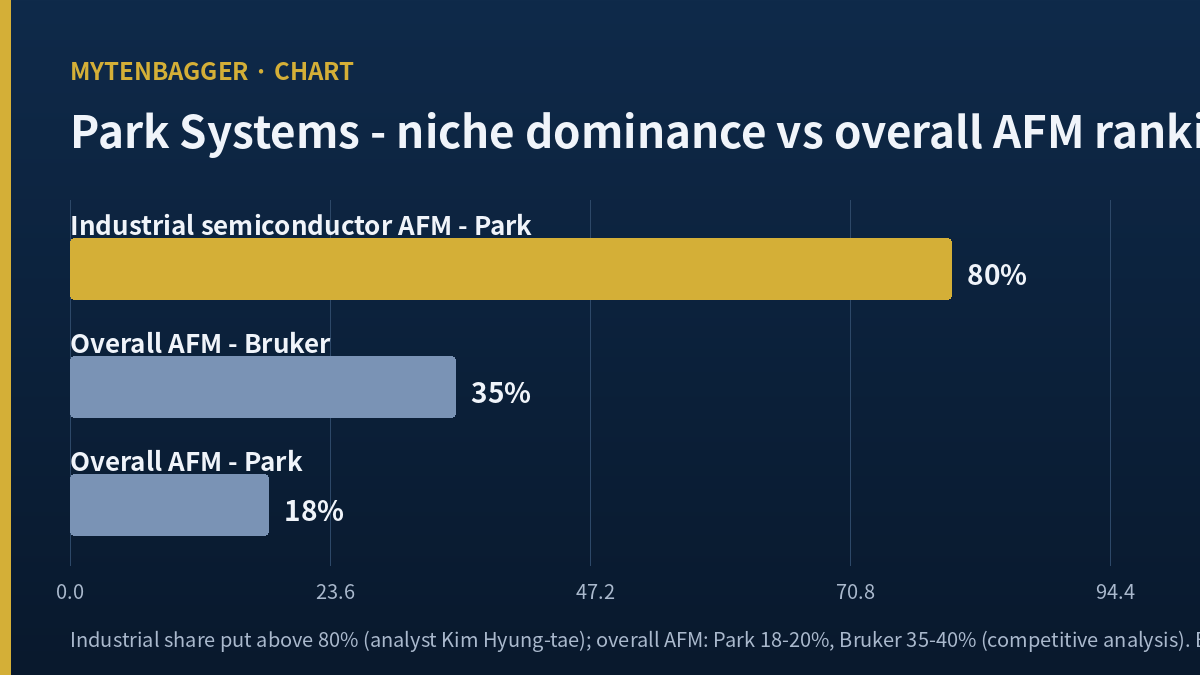
This is the part of the journal I most want to make. The market calls Park Systems “the world’s No. 1 in AFM.” But that No. 1 wears different faces depending on the report. The research Park cites — MarketsandMarkets and QY Research — puts Park first by AFM revenue, with about a 20% share as of 2023, and notes it overtook long-time leader Bruker on AFM revenue back in 2022. A separate competitive analysis, however, pegs Bruker at 35–40% as the undisputed leader and places Park second or third at 18–20%. That last source is lower down the reliability ladder, so I treat it as one view rather than settled fact — but it makes the point that “No. 1” wobbles with definition.
Why the split? Bruker’s AFM sits inside a huge nanoanalysis portfolio, so by total company revenue Bruker (NASDAQ: BRKR, a multi-billion-dollar business) is a different weight class from Park (about $118M / ₩165bn in 2024). “No. 1 in AFM-only revenue” and “No. 1 in AFM business scale” give different answers. My own conclusion: the overall AFM market is an oligopoly split among Park, Bruker, Keysight, and Oxford Instruments — not a Park monopoly. But narrow it to industrial semiconductor AFM and Park holds that 80%-plus. I bet on the narrow, deep patch, not the broad “world No. 1.”
The global-peer lens actually clarifies it. Per its own MarketsandMarkets profile, Bruker leads on scale, service network, and research-market brand, while Park leads on the non-contact method and industrial automation. I am not betting Park overtakes Bruker across the whole research market. My bet is whether Park keeps its share in the one lane of semiconductor production metrology. Sold wide, it’s a shaky story; drilled narrow, it’s a solid one. One more track-record note worth keeping: by the company’s own figures Park compounded revenue at roughly 26% a year from 2015 to 2025 — several times the ~7% the AFM market grew — and I read much of that gap as industrial-semiconductor penetration. Which cuts both ways: when that penetration stalls, the premium in Park Systems stock cools with it.
It’s also worth naming the full field, because “Park vs. Bruker” is too tidy. Keysight Technologies competes in both research and semiconductor metrology, Oxford Instruments and Hitachi High-Tech round out the majors, and the large-sample battleground specifically is heating up. The product calendar tells the story: Bruker launched its Dimension Nexus AFM in late 2024, Oxford launched a large-sample AFM (Jupiter Discovery) in 2025, and Park answered with its FX large-sample series at SEMICON Korea in early 2025. That clustering of launches around 300mm and advanced-packaging inspection is exactly where Park’s industrial premium either gets defended or gets chipped. I don’t dismiss it. It’s the single biggest reason my thesis carries a real kill-switch rather than a comfortable “buy and forget.”
Park Systems stock: what breaks my thesis
Let me write down, in advance, the signals that would force me to admit I’m wrong. First, when products like Bruker’s Dimension Nexus or Oxford’s large-sample AFM (Jupiter Discovery) actually start displacing Park’s large-sample and advanced-packaging lines in real orders. Second, when backlog burns down into revenue in the second half but new orders fail to refill it and the backlog rolls over. Third, when that 80%-plus industrial-AFM grip itself shows up eroding in the numbers — a visibly lower share in the next market survey, or a big buyer like Samsung or SK repeatedly qualifying a rival’s tool for large-sample inspection.
These signals arrive in an order. The fastest to answer is the quarterly backlog and new-order flow. If those keep stacking through Q2 and Q3, I can push the niche-share question to the back. If orders loosen for two straight quarters, I’ll weight the large-sample competition far more heavily and shift toward trimming. Checking the fastest verification point first is simply how I run this position.
Where I land right now
I’m holding Park Systems stock, accumulated in tranches on the dip. When the “operating profit −84%” headline pushed the shares down, I read it as a shipment-timing scar, not a sign the niche moat had cracked. Honestly, my hand paused for a beat when I first saw the print. It started moving again after I confirmed the $70M backlog.
Looking back, I too was briefly seduced by the “world No. 1” line, then learned that the No. 1 varies by research house and re-anchored my case on the industrial niche. Stripping out the broad narrative is exactly what kept me steady through this Q1 shock — had I still been holding on “global monopoly” alone, I’d probably have let go at −84%. The point is that I bought the 80% industrial niche, not the trophy. The moment that patch starts eroding under large-sample competition is my line; my next checkpoint is Q2 earnings and the backlog reading that comes with it. Until then, a shipment-timing quarter doesn’t move a thesis built on qualification lock-in and a rising order book. That’s how I see it. How deep do you think this niche runs?
→ Next in the moat series: TCK Stock Up 4x: Watching the SiC Ring Leader, Not Buying
→ Also in the moat series: Leeno Industrial Stock: Why I’m Starting to Buy the Pullback
→ Also in the moat series: EO Technics Stock Fell 45% While Estimates Rose: Why I Buy