Why LS Eco Energy Fell to Half Its May Peak After a Record Half
“First revenue in the first half of 2027.” That is a sentence about a factory that does not yet ship anything, and I am being asked to pay for it today. LS Eco Energy stock closed at ₩48,150 (about $33.92) on Thursday, August 13, 2026, and somewhere inside that quote sits a number attached to a rare earth metals plant in Vietnam that has never invoiced a customer, and I would be paying it if I bought.
I cannot tell you how large that number is. Neither, as far as I can find, can anyone else in print. That is the whole of what I have to report, and I think it matters more than a verdict would.
Two columns that do not overlap
| Already billing in H1 2026 | Not billing anything yet |
|---|---|
| Vietnamese cable and materials (LS-VINA, LSCV), extra high voltage cable and busduct included ₩635.75bn / about $447.9mn consolidated revenue |
Rare earth metals first revenue guided for H1 2027 in Korean press |
| All of it, on the one quarter where Korean press printed the mix (Q1 2026) | Submarine cable, reported as cooperation talks and framed for 2027 and beyond |
Half year revenue is my sum of the two quarterly disclosures (₩285.48bn plus ₩350.27bn) and is a consolidated figure. The only evidence I have that it all comes from the two Vietnamese entities is a Q1 2026 mix printed once by Korean press; I did not verify the half year mix. Timing for the unbilled work comes from Korean press quoting the company, and the company has filed no such date.
Contents
What LS Eco Energy stock did against its own index
The window first, because everything here depends on it. From August 13, 2025 through Tuesday, August 11, 2026, across 242 trading sessions, the shares returned 9.73%. The KOSPI returned 96.80% over the same 242 sessions. The electrical equipment group the company sits in, measured equal weight with the company itself excluded, returned 65.78%.
Divide 9.73 by 96.80 and you get 0.10052. For every hundred units the Korean market gained, this stock gained ten. Against the sector the gap is 56.05 percentage points. Inside a 30 name group the shares rank 18th, and the median name in that group returned 25.10%.
Now the company’s own figures over roughly the same stretch. Fiscal 2025 revenue was ₩960.06bn (about $676.4mn), operating profit ₩66.78bn (about $47.0mn), and net profit ₩48.48bn (about $34.2mn), per the consolidated filing accepted by Korea’s regulatory disclosure system on Monday, March 16, 2026. Operating margin came to 6.96%, up from 3.35% in 2022, 4.03% in 2023 and 5.15% in 2024. Laid out in order, those four annual figures rise without a step back: ₩27.45bn, ₩29.49bn, ₩44.77bn and ₩66.78bn. The 2025 figure is 2.4326 times the 2022 figure by my calculation.
A cheap conclusion is available here and I am declining it. The path was not a straight slide, and a straight slide is what the “market got it wrong” story requires.
The business that bills and the business that moves the price
Working backward from the endpoint, the window opened near ₩42,650: the August 11, 2026 close of ₩46,800 on the daily bars divided by 1.0973, my calculation. From there the close reached ₩93,400 (about $65.80) on Wednesday, May 13, 2026, which is 118.99% above that starting level. Then it fell to ₩34,050 (about $23.99) on Thursday, July 30, 2026, a drop of 63.54% from that peak close. On intraday values the 250 session high was ₩109,800 (about $77.36) and the low ₩32,000 (about $22.54), a ratio of 3.4312 times. Korean press places that intraday high on Thursday, May 14, 2026, and notes the shares were in the ₩45,000s in mid-April.
So the quote doubled and then gave back 63.54%, while the annual earnings series did what I described above and kept climbing. Something moved, and it was not the income statement.
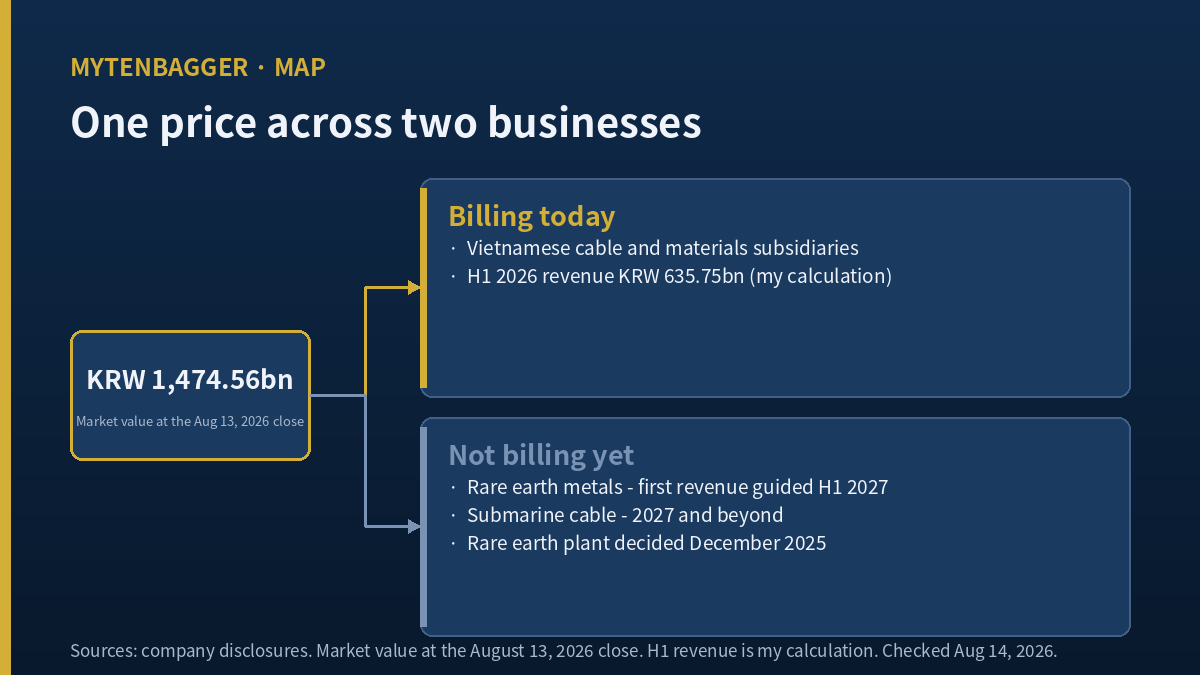
The revenue mix supplies half the answer. Korean press summarizing the Q1 2026 consolidated breakdown puts LS-VINA at 81% and LSCV at 19%. Both are Vietnamese production entities, and together they account for everything. Measured by revenue, this Korea listed company is two Vietnamese cable plants.
The news flow that moved the quote in 2026 was about neither of them. On December 17, 2025 the company said it had decided to invest roughly ₩28.5bn (about $20.1mn) to build a rare earth metals plant at its Vietnamese production entity LSCV. On Monday, July 27, 2026 it announced a reciprocal subscription of convertible bonds with Australia’s Lynas, ₩30.0bn (about $21.1mn) on each side. Korean sell-side notes carry rare earths and submarine cable in their headlines. First revenue recognition for the rare earth work is reported as expected in the first half of 2027, and the submarine side is framed as a 2027 and beyond story. Extra high voltage cable, unlike those two, bills today.
The income statement and the quote are describing different businesses. One of those businesses has not written a single line into the accounts.
A record half year and then LS Eco Energy stock at half its May peak
In a disclosure dated Wednesday, August 5, 2026 the company reported second quarter revenue of ₩350.27bn (about $246.8mn) and operating profit of ₩25.26bn (about $17.8mn). Summing the two quarters gives half year revenue of ₩635.75bn and operating profit of ₩45.36bn (about $32.0mn), both my calculation. Korean press called it a record half, and Newspim quoted chief executive Lee Sang-ho saying growth is running through high value products including extra high voltage cable and busduct. Extra high voltage cable, in other words, already bills today. What does not bill is the rare earth work and the submarine ambition.
Inside the record, one line went the other way
Second quarter operating margin works out to 7.2104% (₩25.26bn over ₩350.27bn, my calculation). The year ago quarter was 9.4287%. That is a decline of 2.2183 percentage points.
I did not discover this. Analyst Choi Min-ki at Shinhan Securities wrote on Thursday, August 6, 2026, as relayed by Korean press, that a heavier mix of lower margin materials revenue slowed the margin against the year ago quarter. My arithmetic and that sentence point the same way, which is the useful part.
The first quarter had gone the opposite direction: 7.0418% against 6.7163% a year earlier, an improvement of 0.3256 percentage points. Within one half year the two quarters moved in opposite directions on margin, and the half as a whole came in at 7.1347% against 8.1345% a year earlier. “Record” is a statement about won, and the ratio was moving the other way.
Two Korean desks took their numbers down after a beat
Everything below reached me through Korean press summaries of research notes. I opened no source note myself, and I am flagging that before the table.
| Number that desk put out | House | Date reported |
|---|---|---|
| ₩62,000 (about $43.68) | Daishin Securities, Park Kang-ho | Friday, April 17, 2026 |
| ₩80,000 (about $56.36) | BNK Investment Securities | Wednesday, April 22, 2026 |
| ₩105,000 (about $73.97) | Shinhan Securities | Monday, May 18, 2026 |
| ₩110,000 (about $77.50) | NH Investment and Securities | Thursday, May 21, 2026 |
| ₩76,000 (about $53.54) | IBK Investment Securities | Friday, June 19, 2026 |
| ₩80,000 (about $56.36) | NH Investment and Securities, Lee Min-jae | Thursday, August 6, 2026 |
| ₩72,000 (about $50.73) | Shinhan Securities, Choi Min-ki | Thursday, August 6, 2026 |
NH went from ₩110,000 on May 21 to ₩80,000 on August 6, a cut of 27.2727% across 77 days by my calculation. Shinhan went from ₩105,000 on May 18 to ₩72,000 on the same August 6, a cut of 31.4286% across 80 days. Inside those windows the company reported once, the second quarter on August 5, and that quarter’s operating profit rose 7.0442% against the year earlier period by my calculation. The first quarter report was filed on May 15, ahead of both notes.
The wording is what held me. Analyst Lee Min-jae at NH wrote in that same August 6 note, as relayed by Korean press, that second quarter revenue of ₩350.3bn and operating profit of ₩25.3bn came in above both the house estimate and consensus. A beat confirmed in one sentence and a lower number in the next.
The same quarter carried two growth rates in print
Newspim reported second quarter revenue growth of 32.8% against the year ago quarter on August 5. The next day the same outlet, relaying the NH note, said 40%. I ran it myself. Q2 2025 standalone revenue was ₩250.24bn, derived from the cumulative disclosures. Dividing ₩350.27bn by ₩250.24bn gives 1.39976, so 39.9763%. The NH figure holds.
Solving backward for the 32.8% version puts ₩263.76bn on the bottom of that division, and no quarter of this company shows that revenue. Half year cumulative does: ₩635.75bn over ₩478.58bn is 1.32842, which rounds to the same 32.8%. A half year rate appears to have landed in a quarterly slot.
This has no bearing on my thesis. I am recording it because one outlet, on consecutive days, printed growth rates 7.2 percentage points apart for one disclosure, and the lower figure was measuring a different period.
The distinction from the Hyundai E&C entry, where a 22 to 23% consensus beat was followed by three Korean houses cutting their numbers, is worth stating plainly. That piece asked why the numbers came down. This one does not ask why. It asks how the number that remains divides between two businesses, and no note I found answers that in won.
Prysmian already carries the same demand as signed money
I picked Italy’s Prysmian (Milan: PRY) for one reason, and it has nothing to do with size or multiples. Both companies are looking at the same submarine and extra high voltage demand, and for one of them that demand is already inside a half year income statement in euros while for the other it exists as a sentence about 2027.
Prysmian’s first half 2026 release shows revenue of €11,239mn and adjusted EBITDA of €1,331mn. The 14.8% margin the company prints alongside those figures rests on sales at standard metal prices, so it differs from the 11.84% that dividing the two amounts above produces (my calculation). Its Transmission segment, which houses the submarine work, reported half year revenue of €1,636mn and adjusted EBITDA of €325mn, with a company stated margin of 20.7%. The company put its group backlog at approximately €17bn with roughly €2bn of awarded projects not yet booked into that backlog, and raised full year adjusted EBITDA guidance to €2,800mn to €2,900mn from €2,625mn to €2,775mn.
I built no side by side margin or multiple table. The size gap is large, the reporting standards differ, and the segment definitions are not the same, so putting the two in one grid would suggest the figures measure a common thing. Recording that I chose against it seems more honest than the grid would have been.
One contrast is enough. Prysmian’s group backlog of €17bn is 10.39 times its half year Transmission revenue by my calculation. The top of that fraction covers the whole group while the bottom covers one segment over six months, so the ratio cannot be read as coverage for the segment. What I take from it is only that the demand exists as contracted money today. The Korean company’s rare earth work and its submarine ambition are guided to first bill in 2027, and carry no amount at all as of this writing. Euro figures are left in euros here, since converting them through won and then dollars would stack two conversions on one number. SKC sits a step earlier still, with ₩590 billion of committed glass substrate spending and no disclosed production, delivery or revenue date against it.
What the multiple on LS Eco Energy stock is a multiple of
The Thursday, August 13, 2026 close of ₩48,150 times 30,624,217 shares gives a market value of ₩1,474,556,048,550, which is ₩1,474.56bn or about $1,038.9mn. That ₩48,150 close divided by the vendor screen’s earnings per share of ₩1,373.67 is 35.0521 times, and divided by book value per share of ₩6,898 it is 6.9803 times. Market value over fiscal 2025 revenue of ₩960.06bn is 1.5359 times, and over half year operating profit of ₩45.36bn it is 32.5086 times. All four are my calculation.
Reading those is where I stop.
If 35.0521 times is the cable business, it is expensive. The 7.1347% half year operating margin is a consolidated figure, close to that business because revenue is effectively nothing else, though segment profit is not disclosed separately so it is not the cable margin as such. That consolidated figure slipped 2.2183 percentage points in the most recent quarter. If instead a meaningful slice of it belongs to rare earths and submarine cable, then knowing that slice is the only way to learn what I would be paying for the cable plants underneath.
I cannot produce that split. The company does not break out segment profit, and none of the notes I traced published a valuation broken into parts with won attached. The spread among those notes is itself the evidence: from ₩62,000 to ₩110,000 between mid-April and early August, a ratio of 1.7742 times on one company, though the April numbers predate both quarterly filings and so rest on different material.
This is a different question from the Hanwha Ocean entry, where a single procurement decision removed a $40bn program from the picture in one session. There, an expected item was deleted and I could watch what remained. Here nothing has been deleted. Something has simply never been added, and it is inside what anyone pays today.
Separating this from two entries it could be confused with
The LS Electric entry, on a record quarter followed by a 9.5% two day decline, covers the same corporate group and a similar looking setup. Its window is two sessions and its subject is reaction. My window here is 242 sessions and my subject is composition.
The Hyosung Heavy entry, where backlog and earnings carried the case through a give-back, is the counterexample I keep in view. There I could point at signed orders and name what the price was paying for. Here I cannot, and the difference between those two situations is why one earned a positive read and this one, size rule aside, could not.
My position on LS Eco Energy stock and what would change it
At a market value near ₩1,474.56bn the company sits outside Korea’s largest hundred by size, and my standing practice is to keep names in that range as observations.
My thesis: the market value here is split between a business that bills and a business that does not, and I cannot draw the line between them in won. While that line is undrawn, 35.0521 times is a number and not a judgment, because what sits underneath it has not been settled.
None of this says the shares are dear or cheap. It says one input to the calculation is missing. I found plenty to be enthusiastic about: four annual profit figures that rise in order, return on equity of 21.4712% on the consolidated basis by my calculation, a debt to equity ratio down from 242.76% in Q1 2022 to 112.89% in Q1 2026, and a reciprocal investment with a producer widely ranked second globally in rare earths. Connecting that enthusiasm to today’s quote requires splitting an amount, and I am short one of the two numbers.
Three markers I am watching:
- A filing that reports segment profit separately. The moment rare earth revenue lands in its own segment, the two amounts separate and the multiple can be rebuilt.
- Actual recognition of first rare earth revenue. When the reported H1 2027 expectation becomes a booked figure, that amount can be tested against what today’s quote implies.
- Direction of the consolidated margin. If the operating margin that fell 2.2183 percentage points in Q2 stays below its year ago comparison for three consecutive quarters, the business that actually bills needs work before any split matters.
What would kill this thesis. If any house publishes a valuation broken into cable and new business with won attached, and a second house’s breakdown broadly agrees with it, my premise disappears: the split I called impossible would have been done in public. I would retire this entry and start again from that breakdown.
Seventeen ways this read could be wrong
- What I labeled impossible to split may simply not need splitting. Markets value a company as one asset and do not sum its segments. If so, my demand is the wrong demand and this entry waits on a document nobody owes me. I hold no basis for excluding that.
- Segment profit disclosure happens when a company chooses it. The filing I named as a marker may never arrive, in which case I wait indefinitely.
- The Prysmian contrast strains under the size difference, and a 10.39 times backlog ratio compares businesses built differently.
- The 81 and 19 mix is a Q1 figure from a press summary. On a half year basis it could differ, and I did not open the underlying filing.
- Book value per share of ₩6,898 times the share count gives ₩211.25bn, while the consolidated equity in the filing is ₩225.77bn. The ₩14.52bn gap looks like a minority interest but I did not confirm it, and my price to book carries that uncertainty.
- A December 2025 treasury share disposal moved 297,303 shares to LS Cable. The float structure differs before and after, and I did not confirm the remaining treasury balance.
- The ₩30.0bn reciprocal issue with Lynas is in convertible form and can affect the future share count. I could not confirm the conversion price, the maturity or the resulting share count, and the per share figures here ignore it.
- First revenue timing for rare earths and submarine work comes from press quoting the company and appears in no filing. It could arrive earlier or later.
- A beta of 0.936 with correlation of 0.586 means much of this security’s movement is unrelated to the index, which is itself evidence that company specific factors are at work.
- Ranking 18th of 30 with a group median of 25.10% places these shares mid pack within their sector, well short of an extreme.
- A KOSPI up 96.80% is an unusually strong comparison. I did not count how many Korean names beat it over this window.
- The 9.73% return depends entirely on the start date, and August 13, 2025 is a boundary the tool set automatically.
- The cuts at NH and Shinhan may reflect a broad de-rating of market multiples more than any deletion of new business value.
- The spread among published numbers may owe more to the price level on each note’s date than to differing assumptions about new businesses. April and August were very different tape.
- The Q2 margin decline follows from a heavier weighting of lower margin materials revenue, which is a mix effect of growth and may not indicate weaker earning power.
- The company has posted a record half. Four fiscal years without a decline in operating profit is a real foundation for some multiple, even if not this one.
- Paying today for a business that starts billing later is what growth valuation does. Refusing on the grounds that I cannot split it may mean refusing every growth name forever.
The one document that restarts arithmetic on LS Eco Energy stock
I have contradicted nothing about this company. Operating profit did not fall in any of four fiscal years, margin climbed from 3.35% to 6.96%, leverage came down by more than half, and the rare earth partner is a producer widely ranked second globally. There is nothing in that paragraph I want to argue with.
My single failure is arithmetic. Of ₩1,474.56bn today, I cannot write down how much is Vietnamese cable and how much is 2027. Without that division, 35.0521 times stays a figure on a screen and never becomes a judgment.
So instead of a verdict I am naming a document: the first report in which rare earth revenue appears as its own segment. That single filing performs the split I could not perform, and on the day it appears I start this calculation over from the beginning. If the reported expectation holds, it arrives sometime in 2027. Until then the name stays on my watch list.
Prices and multiples reflect the Thursday, August 13, 2026 close of ₩48,150 as checked at the time of writing. This entry publishes on a delay, so live quotes will differ. Financial figures are consolidated as filed with Korea’s regulatory disclosure system, and anything marked as my calculation was derived by dividing or subtracting two published values. Dollar conversions are approximate, at roughly ₩1,419.4 per dollar on the same date, and Euro figures for Prysmian are left unconverted. The benchmark window ends Tuesday, August 11, 2026, two days before the price date, so reading the two as one moment introduces error.
Sources: Korea’s regulatory disclosure system (DART) · Newspim on the second quarter result · Newspim summary of the NH Investment note · Infostock Daily summary of the Shinhan note · Industry Journal on the rare earth investment · Daily Invest on the revenue mix and price path · Goodkyung on the medium term pipeline · Bloter on the Lynas reciprocal subscription · Prysmian first half 2026 results release · Hankyung on the Daishin Securities note · MarketScreener on Prysmian’s half year