
EO Technics Stock Fell 45% While Estimates Rose: Why I Buy
- I started accumulating EO Technics stock in the ₩340,000 zone, down roughly 45% from its June high, in tranches.
- My reason isn’t a cheap monopoly — it’s a company using a paid-for front-end laser moat to widen cracks in DISCO’s back-end dicing turf, right as estimates keep climbing.
- If the August Q2 print stalls, Samsung’s P4/P5 annealing orders slip past this year, and the back-end reference wins don’t come, I stop adding. That’s my breakpoint.
Two facts landed on my screen in the same week and refused to sit together. EO Technics stock had fallen about 45% from a June peak near ₩620,000 into the ₩340,000 area — a genuine drawdown, not a wobble. And in the same stretch, a sell-side analyst was raising the 2026 operating-profit estimate on the name by roughly two-thirds. Price collapsing, forward numbers rising. When those two move in opposite directions, one of them is usually wrong, and I want to know which. That question is why I opened a position, and this is my journal on EO Technics stock, the fifth entry in the semiconductor supply-chain moat series I’ve been keeping.
I’ll say the uncomfortable part first: I am not buying a bargain. On trailing earnings this is an expensive stock. What I’m buying is the gap between a correction driven by supply and flows, and a business whose structural story got better, not worse, while the price fell. I’m just writing down mine.
I should admit I ignored this name for a long time. When I first looked at it, the pitch I heard was “the company that laser-etches serial codes onto chips,” and I filed it under boring — a commodity marker vendor. That was lazy of me, and I missed a good run because of it. What changed my read wasn’t the marking business at all; it was realizing the same laser competency had quietly walked into annealing and then into back-end dicing, two places where the memory roadmap actually needs it. The stock I dismissed as a code-stamper turned out to be a laser-process platform. I’d rather admit that miss than pretend I called it early.
Contents
Why I’m Buying EO Technics Stock — Three Reasons in the Correction
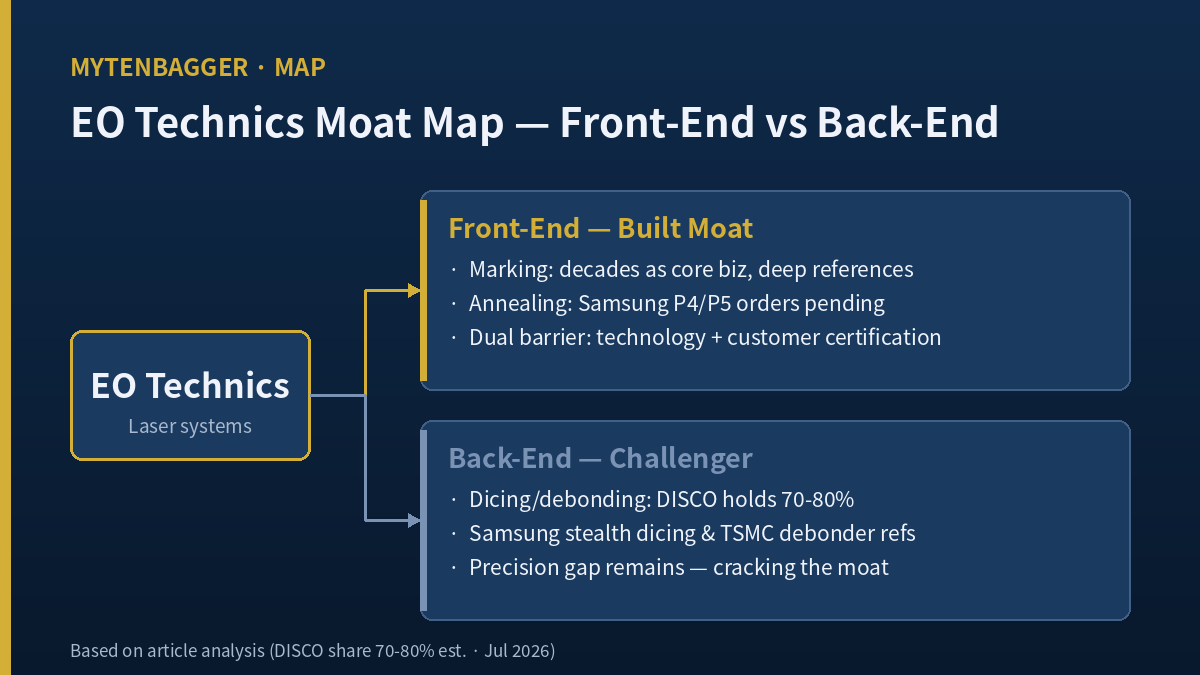
The bull case for EO Technics stock rests on one idea: this is two companies wearing one ticker. One half is a built, defended moat. The other half is a challenger prying open a Japanese monopoly. The market prices the first and mostly ignores the second. Here are my three reasons, in the order they matter to me.
My first reason: the front-end laser moat is already paid for
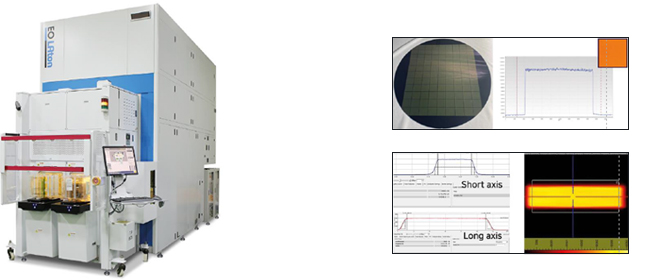
EO Technics has been etching identification codes onto chips for decades. The chip-scale marker business isn’t glamorous, but it sits inside qualified production lines with years of accumulated IP behind it — exactly the kind of thing a customer doesn’t rip out casually. Founder Sung Kyu-dong started the company in 1989 and still runs it with a 28% stake; Forbes reported in March 2026 that the memory-chip boom had pushed his net worth past a billion dollars. That’s not why I bought — but a founder-operator who has compounded one narrow laser competency for 35 years is the kind of continuity I look for.
The part of the front-end I actually care about is laser annealing. As chipmakers pile on layers and shrink features, thermal processing gets harder, and laser-based dopant activation becomes the tool of choice. This is the segment Samsung leans on for new capacity, and it’s the one an analyst pointed to when the growth story got upgraded. It’s a real moat: hard to qualify, sticky once installed, and levered to the exact roadmap the whole memory industry is racing down.
My second reason: the back-end challenge to DISCO is the free option
Here’s the half nobody pays for. In back-end processing — dicing, grooving, debonding the wafer after it’s built — the dominant name is Japan’s DISCO Corporation, whose Stealth Dicing method holds an estimated 70-80% of the market. EO Technics is not replacing DISCO. I want to be precise about that, because overstating it would be the fastest way to be wrong: EO’s laser dicing still trails DISCO on some precision metrics. What it is doing is widening a crack, winning validation slots at Samsung and TSMC where a laser-based method fits.
Why now? Because the roadmap is doing EO’s selling for it. TrendForce’s June 2026 look at the 400-layer NAND race lays out the mechanics: taller stacks mean thinner wafers to cut and far more heat to manage. Thinner wafers push demand toward gentler laser cutting; more heat pushes demand toward precision laser annealing. Both arrows point at EO’s toolset. iM Securities framed the same thing in its March note — the laser-equipment benefit accelerates from 2027, pulled by NVIDIA’s advanced marking needs and next-generation memory formats. The back-end challenge is an option I’m not paying much for, on a trend I can actually see.
There’s a mechanical reason I weight this more than a normal share-gain story. As NAND climbs past 300 layers toward 400 and beyond, the wafer being diced gets thin and fragile enough that mechanical blade dicing starts to chip and stress the die — the exact failure mode a laser stealth method avoids by working from inside the wafer rather than grinding through it. That’s not EO marketing; it’s the physics DISCO itself built its stealth process around, and it’s why the whole industry is drifting toward laser-based back-end steps as stacks get taller. When the direction of travel favors your method, you don’t need to beat the incumbent on today’s precision — you need to be good enough on the nodes where the incumbent’s older method starts to strain. That’s the narrow door I think EO is walking through, and it’s why I treat the back-end as a real option rather than a slide-deck fantasy.
My third reason: the numbers got better while the price got worse
This is the one that actually moved me. Through the 45% drawdown, the estimate revisions went the other way. In March 2026, iM Securities lifted its target on the stock from ₩300,000 to ₩485,000, and in April, Sangsangin Securities set ₩570,000 — both maintaining a buy stance, both citing the NAND-stacking tailwind. I don’t adopt anyone’s target as my own, but a correction where named brokers are raising numbers, not cutting them, is a supply-and-flow drawdown, not a thesis break. That’s the kind of dislocation I try to buy.
EO Technics Stock by the Numbers — 2025 Results and 2026 Estimates
Numbers first, interpretation second. All conversions use ₩1,380/$ unless stated; DISCO’s yen figures use ¥150/$. The 2025 actuals come from company results as reported by Forbes; the 2026 estimates are iM Securities’ March 19, 2026 figures, not company guidance.
| Metric | 2025 Actual | 2026E (iM Sec.) |
|---|---|---|
| Revenue | ₩381B ($276M) | ₩488B ($354M) |
| Operating profit | ~₩81B ($59M) | ₩133B ($96M) |
| Operating margin | ~21% | 27.3% |
| Revenue growth (YoY) | +19% | +28% |
| Operating-profit growth (YoY) | — | +65% |
Sources: 2025 actuals per Forbes (company results); 2026E per iM Securities, March 19, 2026 report | USD at ₩1,380/$. 2025 operating profit is derived from reported ~21% margin on ₩381B revenue (derived figure).
What the table says to me: this is a business compounding in the 20-30% range with margins expanding toward the high-20s, not a broken cyclical. A stock can fall 45% and still be expensive — and both can be true at once here. EO Technics stock isn’t cheap on trailing earnings. It’s reasonably valued only if you believe the 2026 estimates, and cheap only if the back-end option pays off on top.
Here’s how I frame the valuation without pretending I have a target. On trailing earnings the multiple is steep — the kind of number that only makes sense for something growing fast with a long runway. On the 2026 estimate, with operating profit estimated up about 65% year over year by iM Securities, that same price compresses to a forward multiple in the high-40s. So the question I’m actually underwriting isn’t “is this cheap” — it plainly isn’t — but “does the 2026 estimate hold, and is there a second leg the estimate doesn’t capture?” The front-end annealing cycle answers the first. The back-end DISCO challenge is the second leg, and it’s the part no consensus number is really paying for yet. That’s the whole trade in one sentence: I’m paying a fair-to-full price for the growth I can see, and getting the option on the growth I can’t yet prove.
One honest gap: I’m not anchoring on a single quarter’s growth rate. The Q1 2026 print showed strong year-over-year operating-profit growth, but the exact figures I’ve seen quoted don’t agree across sources, so I’m leaning on the full-year actuals and the sell-side 2026 estimate instead of a number I can’t pin down. If the August Q2 print confirms the margin path, that gap closes on its own.
EO Technics Stock vs DISCO — The Peer Gap the Market Is Missing
This is the comparison that made me open a position rather than just watch. A US reader can’t size EO Technics stock in a vacuum — so put it next to the incumbent it’s challenging. DISCO Corporation (Tokyo: 6146) is the giant: a market cap around ¥8.7 trillion (roughly $58B) on about ¥437B ($2.9B) of trailing revenue, trading near 64x trailing and 48x forward earnings.
Now hold that next to EO Technics: a roughly $4 billion (mid-single-digit-trillion-won) equipment maker trading around the high-40s on forward earnings — in the same neighborhood as DISCO’s forward multiple. Sit with that for a second. The dominant back-end monopoly and the small challenger trade at a similar forward multiple. If EO were merely a smaller version of DISCO, that’d be a stretch. But EO isn’t paying up for DISCO’s turf — it’s the one trying to take a sliver of it, while also owning a front-end annealing moat DISCO doesn’t have. Same multiple, asymmetric setups. The alpha, the way I see it, is the re-rating room if EO’s laser-method back-end wins actually expand — a challenger doesn’t get a monopoly multiple until the market believes it’s cracking the monopoly.
The scale gap is the other half of the point. DISCO turns roughly ¥437B — call it $2.9 billion — of trailing revenue; EO’s entire 2026 estimated revenue is about $354 million, something like one-eighth the size. In most industries the tiny challenger trades at a discount to the giant precisely because it’s small and unproven. Here they’re at a similar forward multiple, which tells me the market is already paying EO for growth — but paying it as a memory-capex proxy, not as a back-end share-taker. If EO stays a one-eighth-scale supplier, today’s multiple is full. If it becomes the name that laser methods route through as stacks get too tall for blades, the growth rate that justifies the multiple is understated. That asymmetry — full price for the base business, unpriced option on the disruption — is exactly the shape of setup this series exists to find, and it’s why I’d rather own the challenger here than the incumbent.
The market is pricing EO Technics stock as a memory-capex cyclical. I think the mispriced part is the back-end option on DISCO’s turf.
I’ll flag my own bias here — I’ve been building this semiconductor moat series for months, so I’m primed to see moats and challengers everywhere. Writing this, part of me wonders if I’m too in love with the DISCO framing. But every time I try to talk myself out of it, the roadmap math pulls me back: taller NAND needs exactly what EO sells.
Where My EO Technics Stock Thesis Breaks
A journal without a breakpoint is just cheerleading, so here’s where I’d stop adding to EO Technics stock — and I’m watching these in the order they answer, not as a single trigger.
The fastest verification is the August Q2 2026 print. This is the first place the margin-expansion story either shows up or doesn’t. If operating-profit growth materially decelerates versus the setup the 2026 estimates imply, my “numbers got better while price fell” premise is the thing that’s wrong, and I’d pause.
The second, slower signal is Samsung’s P4/P5 annealing order timing. My front-end reason leans on those orders landing in the back half of this year. Push them into 2027 and the near-term earnings bridge stretches; the thesis isn’t dead, but its timing is, and I’d want to re-underwrite before adding more.
The third is the one that would actually break the story rather than delay it: the back-end option going nowhere. If the DISCO precision gap stays fixed and the Samsung/TSMC reference wins don’t broaden over the next few quarters, then I was wrong about the free option — I’d be left holding a very expensive front-end supplier, and I’d size the position accordingly. When those three point the same direction, that’s not noise; that’s my exit.
How I See EO Technics Stock Playing Out — My Scenarios
These probabilities are my personal read, not math — markers for how I’m weighting the paths, and where responsibility sits if I’m wrong.
The path I see as most likely (~50%)
The 2026 estimates land roughly in the consensus band, margins push into the high-20s, and the front-end annealing cycle carries earnings while the back-end story stays an unpriced call option. In that world the correction was a flush, and the named-broker targets — iM at ₩485,000, Sangsangin at ₩570,000 — mark the zone the market drifts back toward. That’s the base case, and the data supports it most strongly.
Where I could be wrong (~30%)
Capex timing slips — Samsung pushes orders, a memory air-pocket appears — and 2026 comes in soft against the estimate. This isn’t an unreasonable read; memory is cyclical and the whole complex is running a cautious, split HBM4 strategy into 2026. In that path the stock churns lower before the roadmap reasserts, and I’d be glad I bought in tranches rather than all at once.
The tails (~20%)
Best case (~12%): HBM4 and 400-layer NAND accelerate together, the laser back-end lands real repeatable volume, and the challenger starts earning a re-rating toward the incumbent’s respect. Worst case (~8%): a genuine memory downturn arrives and the laser-dicing precision gap proves durable — then this is an expensive supplier in a down cycle, and the ₩340,000 area wasn’t the bottom.
My take, and yours
To recap where I stand: I’ve been buying EO Technics stock in the ₩340,000 zone, in tranches, treating the 45% drawdown as a supply-and-flow correction rather than a thesis break. My conviction rests on a paid-for front-end laser moat, a back-end challenge to DISCO that I’m getting as a near-free option, and estimates that rose while the price fell. My next real checkpoint is the August Q2 print, then the timing of Samsung’s annealing orders. If both disappoint and the back-end wins don’t come, I was wrong, and I’ve written down exactly how I’ll know.
That’s my bet, laid out with the numbers I could verify and the ones I couldn’t. If you see a variable I’m underweighting — especially on how fast that DISCO precision gap is really closing — I’d like to hear it. Follow it, watch it, or skip it; that part’s up to you.
This post is the fifth entry in my semiconductor supply-chain moat series – earlier entries cover HPSP, Park Systems, TCK, and Leeno Industrial.