Intops Valuation: Shares Trade Below Its Cash and Real Estate
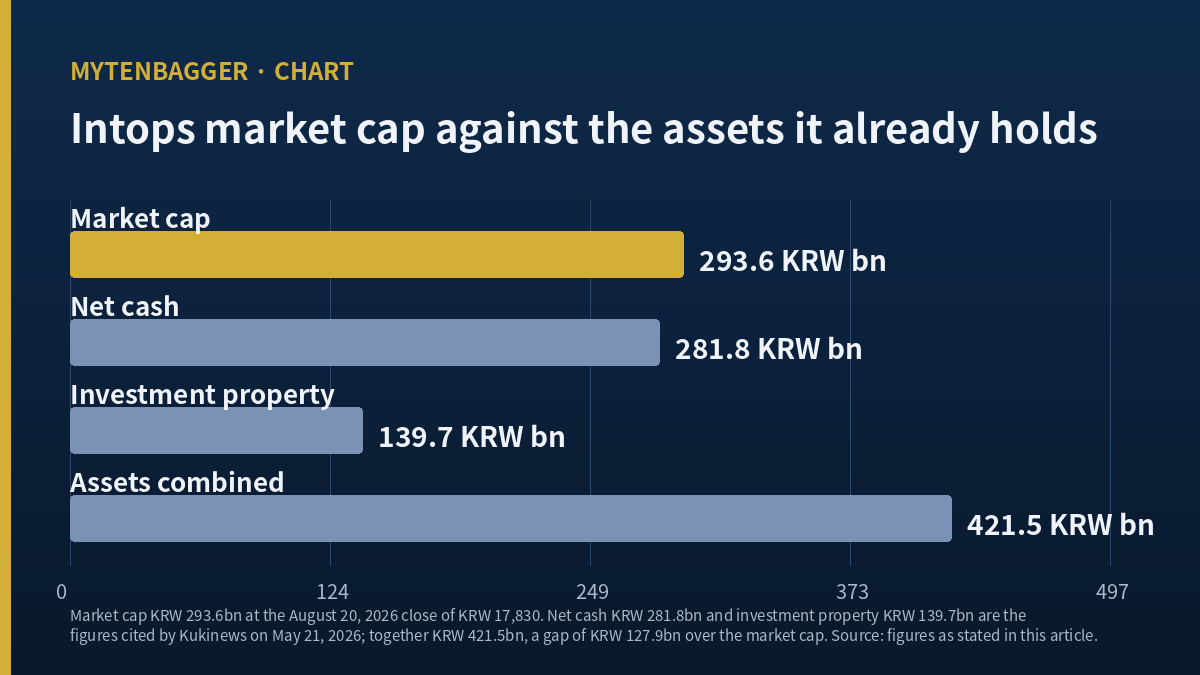
I keep tripping on the same habit when I open Intops stock: I want to price the whole company off its operating profit, and this one does not let me. At the August 20, 2026 (Thursday) close of KRW 17,830, market capitalization is KRW 293.6 billion (approximately USD 208 million). The company’s own cash plus investment property, as summarized by Kukinews on May 21, 2026, was KRW 421.5 billion (~USD 298 million). That figure is larger than the market cap. I have not seen this kind of imbalance often enough to trust my usual sequence — earnings, then multiple, then price. Here I have to start with the balance sheet.
The three sentences I am carrying through this piece
- Market cap KRW 293.6 billion. Reported net cash plus investment property KRW 421.5 billion. Gap KRW 127.9 billion, or 43.6 percent of market cap.
- FY2025 operating income was −KRW 11.3 billion. Owner-share net income was +KRW 16.2 billion. Something outside the operating line paid the bills that year.
- LS Securities has posted a KRW 30,000 target valuation (May 19, 2026, Analyst Jung Hong-sik) while the Hankyung consensus average sits at KRW 27,333. Neither figure explicitly credits the asset gap.
Contents
Why I set the earnings multiple aside on this Intops stock
The Kiwoom quote screen shows the name at a trailing PER of 18.92, a PBR of 0.44, and a return on equity of 2.4 percent. Read only through the PER, this looks expensive. Read only through the PBR, it looks like a company changing hands for less than half of its stated book value. When two multiples pull in opposite directions like this, the stock usually sits somewhere between a value trap and a genuine asset play. I read Intops as tilted toward the asset side.
Three reasons hold that read up. First, a large share of book equity is real cash and revenue-producing property; intangibles and goodwill make up little of it. Second, that asset base produced income even in a year when the core business lost money — the same shape I found in the Teuksu Construction piece, where the payout did not come out of operations. Third, the KRW 30,000 valuation on the sell side prices in a recovery in the operating line and treats the balance sheet as background. I want to walk through each of these before I try to say whether any of them changes what I do.
What KRW 421.5 billion actually consists of for Intops stock
The Kukinews piece quoted net cash of approximately KRW 281.8 billion and investment property of approximately KRW 139.7 billion, both as of the first quarter of 2026. Together the two amount to KRW 421.5 billion. In the article’s own words, that sum already exceeded the market capitalization at the time of writing. Six months later, the market cap has drifted down to KRW 293.6 billion, so the gap has widened rather than closed.
I did not open the half-year filing (DART receipt number 20260814000607, submitted August 14, 2026) at the account level to reconfirm either figure. The vendor summary I do have shows total assets of KRW 898.9 billion, total liabilities of KRW 119.6 billion, and total equity of KRW 779.3 billion at the end of Q2 2026 (owner-share equity KRW 684.4 billion), which is consistent with a lightly-levered balance sheet dominated by cash and long-lived real estate (see the Investing.com summary of the first-quarter disclosure). What I cannot verify without the footnotes is the precise split as of June 30, 2026.
| Line | KRW billion | Basis |
|---|---|---|
| Net cash | 281.8 | Kukinews May 21, 2026; Q1 2026 basis |
| Investment property | 139.7 | Kukinews May 21, 2026; Q1 2026 basis |
| Sum | 421.5 | Simple addition of the two lines above |
| Market capitalization | 293.6 | Aug 20, 2026 close KRW 17,830 × 16,466,629 shares (by my calculation) |
| Gap | 127.9 | 43.58 percent of market cap (by my calculation) |
The nature of the property matters as much as the size. Investment real estate is carried on the books at cost and is only marked to market at disposal, so the KRW 139.7 billion is a conservative number for what an active market might pay. It also throws off rental income that runs through the operating statement year after year. That rental line is a big part of the answer to the next question.
The year Intops stock’s operating line was red and owner-share income was black
FY2025 (DART receipt 20260317000896) closed with consolidated revenue of KRW 590.8 billion, an operating loss of KRW 11.3 billion, and owner-share net income of KRW 16.2 billion. Revenue was down 3.89 percent year over year (KRW 590.8 billion measured against FY2024 KRW 614.7 billion) and the operating margin was −1.91 percent. Yet the bottom line for the parent’s owners was clearly positive. That gap of roughly KRW 27.5 billion between operating income and owner-share net income came from somewhere below the operating line.
Interest income, rental income, equity-method gains, investment revaluation and disposal gains all live in that region of the statement. I did not open the footnotes for the account-level breakdown in this session. But even a rough scenario is instructive: net cash of KRW 281.8 billion earning 3 percent in deposits and money market instruments would produce KRW 8.5 billion; at 4 percent it would produce KRW 11.3 billion. Investment property of KRW 139.7 billion at a modest 5 percent rental yield would add KRW 7 billion. Those two lines alone are enough to absorb the operating loss of KRW 11.3 billion with room to spare, without asking anything of equity-method or disposal accounts. This is a rough outline of the mechanism; the audited breakdown is a separate task.
The Q1 turn — yields and Intops Vietnam
The operating story also improved in the first quarter of 2026. Quarterly revenue was KRW 163.1 billion, operating income KRW 6.4 billion, and net income KRW 11.8 billion — the first operating profit in five quarters (see the Bloter report carried by Daum). Through the end of Q2, cumulative revenue was KRW 318.1 billion, operating income KRW 8.3 billion, and owner-share net income KRW 14.0 billion (DART receipt 20260814000607).
Two things drove the swing. First, injection-molding yields, which had suffered when Samsung Electronics tightened quality standards on a new smartphone generation in late 2024, returned to normal by the first quarter of 2026. Second, the Intops Vietnam affiliate — which handles smartphone case assembly and component supply and accounts for close to 70 percent of consolidated revenue — moved from a KRW 3.3 billion net loss to a KRW 3.9 billion net profit in the quarter.
The home appliance side of the group went the other way. Platel Vina (television and appliance components) posted revenue of KRW 88.2 billion in 2023, KRW 80.7 billion in 2024, and KRW 69.1 billion in 2025. That is three consecutive years of contraction. How long the smartphone recovery can offset that appliance decline is a separate question this piece does not try to answer.
The sell-side gap — KRW 30,000 versus KRW 27,333
LS Securities analyst Jung Hong-sik published a May 19, 2026 note carrying a Buy rating and a KRW 30,000 target valuation (see the Newspim summary of the report). The rationale had two legs: the first operating profit in five quarters from the IT Device segment, and the expansion of robot and drone EMS work with a widening customer list. The scale of the move was itself an event — Money Today had already noted an 87.5 percent target uplift earlier in the year.
The Hankyung consensus screen as of August 19, 2026 shows an average target of KRW 27,333 and an expected EPS of KRW 1,268 (see the Hankyung consensus page). That places the LS number at the upper end of the range, with a gap of KRW 2,667 (about 9.8 percent) to the average. The implied upside from today’s KRW 17,830 is 68.3 percent to the LS valuation and 53.3 percent to the consensus. What neither figure does explicitly is credit the KRW 127.9 billion balance sheet gap. Both approach the price by placing a multiple on operating recovery, treating the balance sheet as scenery.
Why Intops stock keeps sliding out of the low-PBR rerating conversation
A 0.44 PBR is close to the bottom of the entire Korean market. Whenever the Value-Up program comes up in policy discussions, this class of stock gets named as a rerating candidate. Intops does not linger in that conversation. Three overlapping frictions are pressing back.
The first is short-selling pressure. On May 13, 2026, Intops was designated a short-squeeze warning stock and trading was suspended for a day. Before and after that event, the stock loan balance held above 800,000 shares and short-sale volume exceeded 10 percent of session turnover on some days. Convertible-bond hedging is one common explanation for the persistence of that overhang, but I did not open the CB terms in this session to confirm the mechanics.
The second friction is a governance overhang. In June 2026, second-generation owner Kim Geun-ha stepped down from the CEO role as what press reports characterized as a preemptive response to an investigation risk (I reached this through Finance Scope coverage of the robotics tie-ups, having lost robots.txt access to the primary source at TheBell). Kim’s personal stake is 17.24 percent (2,964,489 shares) and founder-chairman Kim Jae-kyung holds 14.31 percent (2,461,322 shares). A related party called Platel, more than ninety percent owned by Kim, has been reported buying stock in the market. It is difficult to talk about a rerating while the succession direction is unsettled.
The third friction is treasury shares whose fate has not been set. The company announced a KRW 13 billion buyback in June 2026 and holds 1,366,185 treasury shares (7.94 percent of the total). An additional block of about 630,792 shares linked to a convertible bond sits within that treasury count. A buyback announcement, by itself, is a stabilizing signal. Without a cancellation resolution to follow, the rerating case only has half of what the textbook Value-Up sequence requires.
The Intops robot EMS optic — Botfit, Bear Robotics, Wirobotics
The freshest label on this name is “robot EMS.” Samsung’s wearable Botfit awaiting mass production, exclusive assembly of LG’s newly acquired Bear Robotics service robots, and a memorandum of understanding with wearable-robot startup Wirobotics were the headlines through the first half of 2026. Coverage in Robot Newspaper summarized the pivot from smartphone-case maker to robot turnkey EMS work.
I did not use these items as a valuation lever, for two reasons. First, the robot EMS revenue share has not yet been broken out in disclosure. Management’s own language on the Wirobotics tie-up is that discussions aim to move to production in the second half. Second, even if Botfit and Bear Robotics orders arrive at meaningful scale, Intops is the contract manufacturer while the brand sits elsewhere. Full end-product multiples are not automatically available to an EMS. Any multiple expansion here needs a starting point — a number for the robot revenue share — that the company has not yet published. I am recording what I have and refusing to guess at what I do not.
Why there is no peer table in this piece
Domestic Korean smartphone component makers such as KH Vatec (060720) and UIL (049520) sometimes get grouped with Intops. The businesses differ: hinges, mechanical parts and antennas versus injection-molded cases and modules. The size ratios and the balance-sheet structures do not line up either. What is unusual about Intops is the pairing of injection molding, a large net-cash and investment-property base, and an EMS-style extension into robots inside one small-cap. I could not find a listed peer holding all three at once.
A comparison against global EMS names — Foxconn, Jabil, Flex — is even more awkward. Those companies are one hundred times larger by revenue and run on entirely different margin structures. Placing multiples side by side would erase the asset-base story that carries this piece. So I did not build the peer table and I am noting here that I did not, which is the fifteenth consecutive piece where I have skipped a peer table for a reason I could name in prose.
The other side — nine ways the Intops stock axis can break
- The KRW 421.5 billion is a first-quarter number lifted from a press summary. I did not reconfirm it against the half-year footnotes. The specific split between cash equivalents and property could have moved.
- If the investigation around Kim Geun-ha widens from a personal legal issue into a corporate legal issue (fraud, accounting violation, or a trading suspension trigger), the balance sheet value stops protecting the stock.
- The short-squeeze warning and 800,000-share loan balance describe a market that is actively betting on a further decline. Even if the CB hedge story is the correct reading, the pressure keeps compounding.
- Thin investor relations and low daily turnover narrow the path from asset value to share price. Without index inclusion or a major news catalyst, rerating takes years.
- Until the 7.94 percent treasury block is put up for cancellation, the shareholder-return commitment is a promise without a due date. EPS and BPS mechanics stay theoretical.
- Continued Platel buying inside the market can be read as succession-related accumulation. Minority-shareholder returns from the asset base then sit further down the priority list.
- Platel Vina’s appliance-parts revenue has now declined three years in a row (KRW 88.2 billion, KRW 80.7 billion, KRW 69.1 billion). Nobody has drawn a floor under that segment yet.
- LS Securities at KRW 30,000 is a single-firm high-conviction view. A 9.8 percent gap to the KRW 27,333 average shows the rest of the sell-side unwilling to sign the same number.
- The Samsung Electronics smartphone customer concentration that drives the operating recovery is also a single-customer exposure. Any weak Galaxy cycle presses margins back down.
Things I looked at and did not use for Intops stock
The 630,792-share convertible-bond block inside the treasury count
Press coverage says a block of about 630,792 shares tied to a convertible bond sits inside the total 1,366,185-share treasury holding. The CB indenture — coupon, put date, conversion price and remaining balance — was not something I opened this session. That block’s real character affects the effective public float and I left it out of any float-based calculation.
The vendor ebitda field of KRW 6.4 billion
The vendor summary’s Q1 2026 EBITDA field is KRW 6.4 billion, exactly identical to the same quarter’s operating income at the won level. That is what happens when a system returns operating income unchanged when the depreciation add-back was missing. I did not use the field.
Interest coverage of 2.54 and debt ratio of 15.35 percent
The 2.54 interest coverage number appears in the vendor screen, but the exact interest reference figure is not documented, so I did not lean on it. The 15.35 percent debt ratio is genuinely low for a Korean industrial name but sits outside the axis this piece is running, so it only shows up in this list.
One check I did run, and it held — the par value arithmetic
Par value KRW 500 × 17,200,000 shares = KRW 8.6 billion of paid-in capital, which matches the DART figure. That is a small check but it confirms the outstanding-share count I used in the market-cap calculation.
Basis, currency and margin of error
Prices and multiples in this piece reflect the August 20, 2026 (Thursday) close of KRW 17,830 as checked in the early hours of August 21, 2026 (Friday) before market open. Because publication may follow with a lag under editorial scheduling, live quotes may differ. The Korean won is the reference currency throughout; USD conversions are approximate, at roughly KRW 1,413 per dollar on the same date, and the piece’s argument closes in won without leaning on the dollar figures. That means KRW 293.6 billion is approximately USD 208 million, KRW 421.5 billion is approximately USD 298 million, and the KRW 127.9 billion gap is approximately USD 91 million.
The KRW 281.8 billion net cash, KRW 139.7 billion investment property, the convertible-bond linked treasury block, and the interest-coverage reference are all still ahead of a footnote-level reconciliation I did not run this session. I used each of them only for scale and kept them out of any multiple calculation. When the half-year footnotes are opened, the first paragraph of this piece is the one I would revisit.
Axis and the three conditions that break it
In one sentence: Intops has a KRW 293.6 billion market capitalization sitting under KRW 421.5 billion of reported net cash and investment property, and the KRW 127.9 billion gap explains why owner-share net income was positive in a year the operating line was negative. Neither the LS Securities KRW 30,000 valuation nor the KRW 27,333 consensus explicitly credits the gap. Owner-succession risk and a short-selling overhang are pressing on it from two sides.
Three concrete conditions would end this axis:
- The Q3 2026 half-year figures (due by November 15, 2026) show that the reported KRW 421.5 billion of net cash plus investment property has fallen by 20 percent or more (for example through a property sale, a large dividend, or a heavy capital-spend cycle). What a year of capital spending outrunning operating profit looks like is in the Asia Cement piece.
- The Kim Geun-ha investigation widens into corporate legal risk — an embezzlement, accounting-violation, or trading-suspension trigger. The balance-sheet cushion stops mattering.
- The KRW 13 billion of new buybacks plus the standing 7.94 percent treasury block go six months without any cancellation resolution. The Value-Up case then loses half of its base, and if the accumulation is confirmed as succession-related the axis is no longer live.
Any single one of those events sends me back to rewrite this piece. I am watching; whether the axis holds depends on the November filing and whatever governance news arrives between now and then.
- Korea Ratings Valuation: 4.3 Times Sales Against Moody’s
- Why Hanwha Systems Shares Fell 66% as Operating Profit Tripled
- Why Doosan Corp Hit Limit-Up: The SK Siltron Wafer Deal