Sebang Battery Earnings: Lead-Acid Margins Fund a Lithium Push
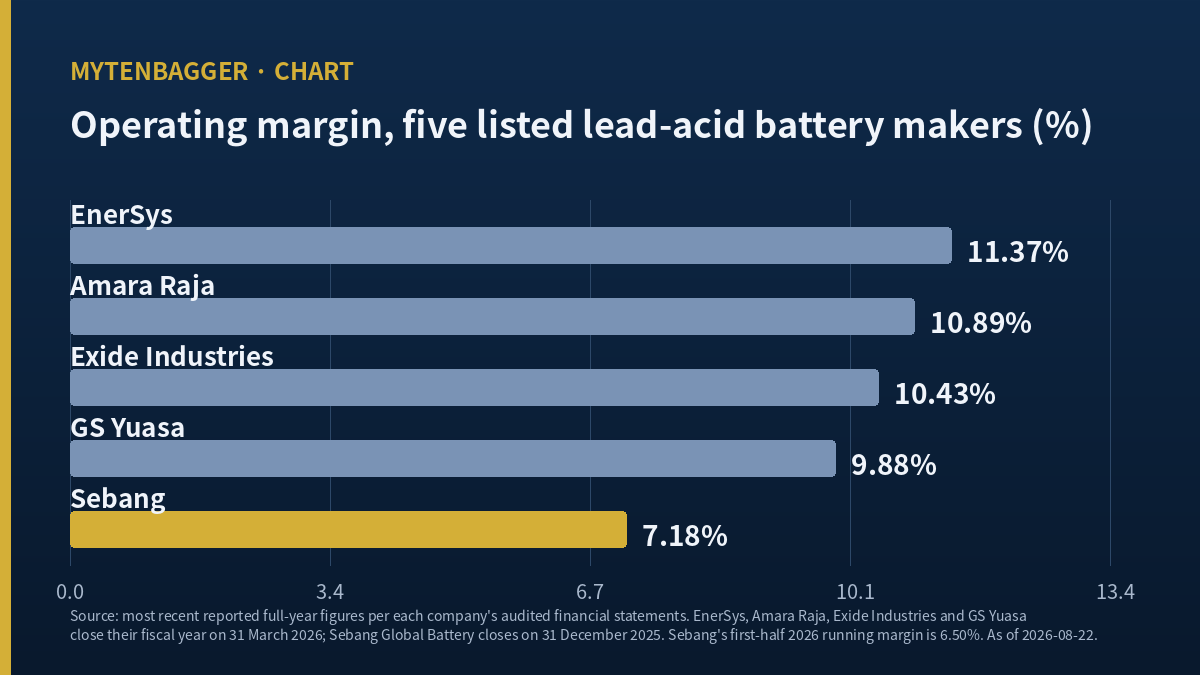
Five companies build lead-acid batteries at industrial scale and publish an operating margin I can read. I put the five numbers on one page, and Sebang Battery stock sits at the bottom of that page by a clear gap. EnerSys reported 11.37 percent for the year to 31 March 2026. Amara Raja reported 10.89. Exide Industries reported 10.43. GS Yuasa reported 9.88. Sebang Global Battery reported 7.18 percent for the year to 31 December 2025, and 6.50 percent for the first half of 2026.
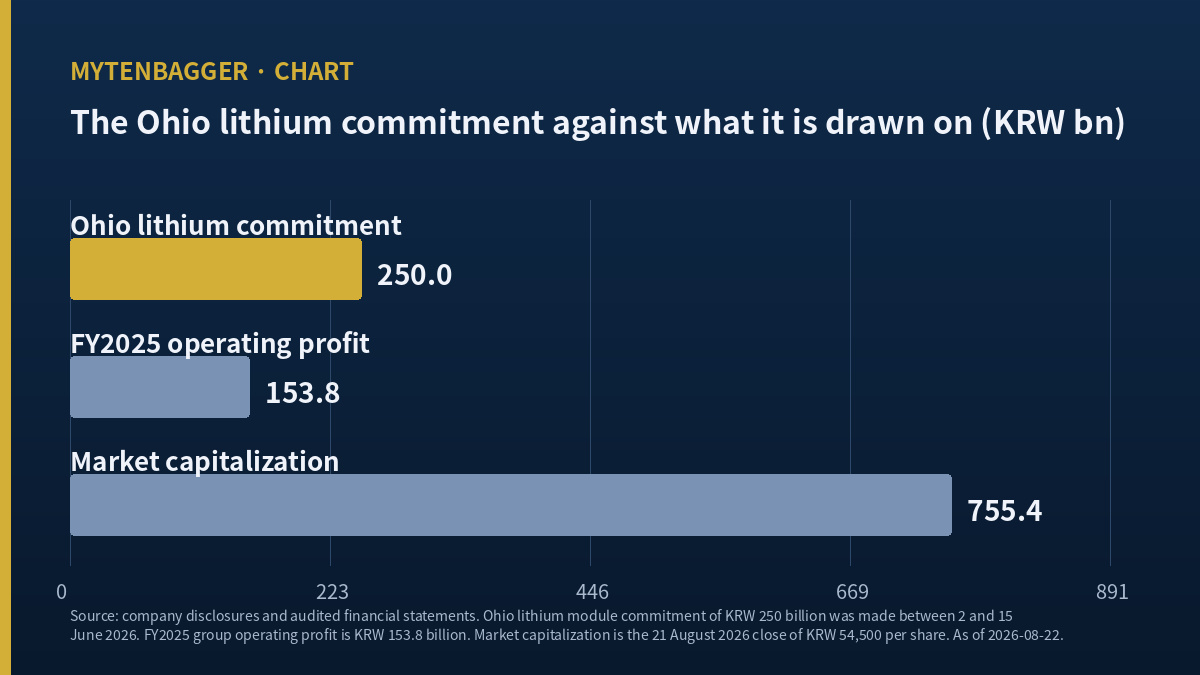
That is the whole starting position of this piece. What interests me is not the ranking itself, which is a small and slightly unfair thing to build an argument on, but what the company has decided to do while sitting there. Between 2 June and 15 June 2026 Sebang committed roughly KRW 250 billion to a lithium module business in Ohio. Its market capitalization on Friday 21 August 2026 was KRW 755.4 billion. The company is funding a third of its own market value into a new product line out of the thinnest margin in its industry.
Contents
Five makers, five margins, and Sebang Battery stock at the bottom
The spread is 4.19 points wide
From 11.37 percent down to 7.18 percent is 4.19 percentage points. On Sebang’s FY2025 revenue of KRW 2,142.1 billion, closing that gap entirely would be worth roughly KRW 89.8 billion of operating profit, against the KRW 153.8 billion the company actually reported. In other words the distance to the top of this small ladder is more than half of what the company earns.
I want to be careful about what that does and does not mean. It does not mean four foreign management teams are better operators. Product mix differs, aftermarket exposure differs, and two of these companies sell into markets where replacement demand is structurally younger. What it does mean is that a 7 percent line is not the normal state of this industry, so the question of why Sebang runs below the group is a real question, unrhetorically meant.
Two names that are not on the ladder
The largest lead-acid maker in the world is not there. Clarios, the former Johnson Controls power solutions arm now owned by Brookfield, is private. It filed for a listing in 2021 and withdrew that filing on 6 January 2025, and the ticker never traded. Third-party aggregators put its trailing revenue near USD 8.19 billion with a net loss of about USD 181 million, which I treat as unaudited and indicative. On 3 March 2025 it announced a USD 6 billion American manufacturing strategy, funded with debt, with no equity raised against it.
The second absence is instructive in a different way. Exide Technologies, the old American operator, filed Chapter 11 in 2020 for the third time. Its Americas assets went to Atlas Holdings and relaunched on 25 August 2020 as Stryten. Its European and Asia-Pacific business separated on 27 October 2020 as an independent Exide Group. So the industry I am ranking has already had one large listed participant fail outright, and my ladder is built from survivors.
Sebang Battery stock’s margin is not thin because the product is bad
Lead is close to two-fifths of revenue
Korean trade press reporting from August 2024 put lead at 41 percent of Sebang’s revenue, which is a striking way to state a raw material burden. Lead itself has been kind lately. The London Metal Exchange price sat at about USD 1,901.88 per tonne on 21 August 2026, down roughly 4.7 percent so far in 2026, and Fastmarkets published a view in late 2025 that lead would hold near USD 2,000 per tonne into 2027 on a broadly balanced refined market.
So the largest single input has moved the company’s way, and the margin still fell. That mismatch is where the interesting part of this business lives, and it is not unique to Korea. On Exide Industries’ fourth-quarter call on 6 May 2026 management said softer LME lead had been offset by a rupee depreciation of about 10 percent, and separately that sulfur feedstock costs had risen roughly fivefold year on year, from INR 15 per kilogram to INR 74 or 75, which they sized at about INR 150 crore a quarter. Their answer was four aftermarket price increases between 1 January and 1 April 2026 adding up to something like 5 or 6 percent. Pass-through works in this industry, and it works one to two quarters late. A recovered top line sitting above a halved operating profit is the same lag read from the other end, which is what SeAH Steel showed.
The won cuts both ways
Korean sell-side has said this openly in both directions. NH Investment & Securities cited a weaker won and softer lead as profit drivers in February 2025. Hana Securities, six months later, listed a stronger won as the first cause of margin damage, noting the move from about KRW 1,474 to the dollar at the end of March 2025 down to about KRW 1,354 by the end of that June. Both statements are correct, because the currency is a swing factor with a sign that changes.
The sign right now is unhelpful. On Friday 21 August 2026 the won closed at 1,386.5 to the dollar in Seoul daytime trading, about four-tenths of a percent firmer on the day and at its strongest level in about eleven months. For an exporter, a firm home currency is a headwind that shows up in the same quarter it happens.
Sebang Battery stock now carries a lithium bill
KRW 100 billion into a subsidiary, KRW 150 billion into a plant
On Tuesday 2 June 2026 the subsidiary Sebang Lithium Battery resolved a KRW 100 billion rights issue and set up an operating entity in Ohio, with new shares to be paid in on Wednesday 1 July 2026. Sebang holds 92.07 percent of that subsidiary, and Korean press reported that its board approved putting in roughly KRW 92.1 billion of cash on Friday 12 June 2026. A further KRW 150 billion of capital expenditure for the North American build was reported alongside the contract news.
Then the order arrived
On Monday 15 June 2026 the same trade outlet reported that Sebang Lithium Battery would supply grid-scale energy storage modules in North America to LG Energy Solution, cumulatively worth about KRW 1.8 trillion through 2028. Revenue is expected to begin in the fourth quarter of 2026, with an annual run rate near KRW 800 billion once the lines are stabilized.
Set that KRW 800 billion ambition against a company whose entire FY2025 revenue was KRW 2,142.1 billion and whose market value is KRW 755.4 billion, and the ambition is obvious. So is the exposure. I am not in a position to judge whether that number is achievable, and I have no independent view on ESS module pricing. What I can do is look at the one place where a lead-acid company’s lithium ambition has already shown up in an income statement.
Further up the same supply chain, Chunbo shows what that bill looks like when the capacity is built ahead of the demand. Its annual revenue fell 59.30 percent between 2022 and 2025 while the plant it was building stayed short of the revenue line. Capacity is a cost long before it is a product.
India already ran the experiment Sebang Battery stock is starting
Two profit lines from the same company
Exide Industries closed its year to 31 March 2026 with standalone profit after tax of INR 1,111 crore and consolidated net profit of INR 860 crore. The difference is INR 251 crore, or 22.6 percent of the standalone figure, and the gap is where the lithium cell subsidiary sits. The lead-acid business earned the first number. The consolidated shareholder received the second.
I find this the single most useful comparison available on Sebang right now, because it is the same shape of decision taken by a company of similar scale in the same product, roughly one investment cycle earlier. It does not prove the Korean version will do the same thing. It does establish that a lead-acid balance sheet paying for a lithium plant produces a visible subtraction at the consolidated line for some number of years before it produces anything else.
The Korean subtraction has already started
Korean commodity trade press reported that in the first quarter of 2026 Sebang Lithium Battery turned over KRW 75.0 billion and recorded a net loss of KRW 8.9 billion. That was before the Ohio entity existed, before the KRW 100 billion rights issue, and before any of the KRW 150 billion capital budget was spent. Whatever the drag becomes, the first quarter of 2026 is the smallest version of it that shareholders will see.
This is the reason I am not treating the 7.18 percent margin as simply a problem to be fixed. It is also the funding source for something else. A management team that wanted the margin to look like its peers’ would have an easier path available, which is to stop spending on the thing that is not yet earning. Korean battery-materials names carry the same question in a different shape — see Foosung.
What Sebang Battery stock is priced at, and what those multiples divide
Sebang Global Battery trades on the KOSPI, the senior board of the Korea Exchange, which lists the country’s larger and longer-established industrial companies and is distinct from the KOSDAQ venture board. On Friday 21 August 2026 the shares closed at KRW 54,500, which is about USD 39.31, giving a market capitalization of KRW 755.4 billion or roughly USD 544.8 million. That is a small company by American standards and a mid-tier industrial by Korean ones.
A price-to-earnings ratio of 5.41 against a year that has already turned
The trailing price-to-earnings ratio is 5.41 and price-to-book is 0.46. The declared dividend for FY2025 was KRW 2,650 per share, about USD 1.91, which on the 21 August close is a yield of 4.86 percent and is 2.41 times the prior year’s KRW 1,100. All four of those numbers are backward-looking and describe a year that ended eight months ago. Sebang’s first-half 2026 operating profit of KRW 68.6 billion was 20.96 percent below the first half of 2025, so the earnings figure sitting under that 5.41 has not yet absorbed what the company has already reported.
A comparison I did not make: I looked for a peer multiple table and decided against building one. EnerSys trades near 20.75 times trailing earnings, GS Yuasa near 14.79, Exide Industries near 41.6, Amara Raja somewhere between 17.64 and 23.0 depending on which aggregator and which basis. That last range is the problem. Two sources disagreed by more than five turns on the same company and I could not establish which was standalone and which consolidated. A table where one row is uncertain by that much is not a table, so I left it out. A cheap-looking multiple settles nothing on its own, which is the lesson I took from a company trading below the cash and real estate it owns.
The market Sebang Battery stock sits in, and nobody agrees on its size
Two research houses, two scopes
Grand View Research, in an update published in June 2026, sized the global lead-acid battery market at USD 44.9 billion for 2025, growing to USD 62.1 billion by 2033 at a compound rate of 4.0 percent, with Asia-Pacific at 57.0 percent of the total. Stratview Research, updated on 21 August 2026, sized the automotive lead-acid market alone at USD 30.77 billion for 2025, reaching USD 38.88 billion by 2032 at 3.4 percent compound. The roughly USD 14 billion difference comes from scope. The first count includes industrial and standby applications; the second stops at vehicles. I am reporting both and combining neither.
The 12-volt question, which I could not settle
The long-standing bull argument for lead-acid is that every vehicle, electric ones included, still carries a low-voltage auxiliary battery. The counter-argument is that the chemistry in that slot is changing. ResearchInChina, in a report published in February 2026, records that BYD moved its entire DM-i hybrid range to lithium iron phosphate 12-volt starter batteries from May 2024, and that only Tesla has volume-produced a 48-volt low-voltage architecture. I could not obtain a penetration percentage or a growth rate for that transition, because the share data sits behind a paywall, so I have not used this as evidence in either direction.
European regulation, where my sources contradict each other
Some Korean technical outlets have written for several years that the European Union will bar lead-acid batteries from new vehicles after 2030. Batteries International reported on 18 August 2026 that the exemption for lead batteries holds through 2030 and that no review is due before then, with any eventual review obliged to weigh economic and social impact. I cannot reconcile those two accounts and I am not going to pick one. Both are on the record.
Eight ways this reading fails
One. Every margin on my ladder was measured over a year ending 31 March. Sebang’s was measured over a year ending 31 December. I compared five numbers taken from five different twelve-month windows and then called the lowest of them lowest. If the two windows that matter most had been aligned, the ordering might survive, but I have not shown that it does, and the whole page rests on an ordering.
Two. The world’s largest producer is not on the ladder at all, because Clarios is private and publishes nothing comparable. I ranked survivors who file, which is a selection that disclosure rules made for me.
Three. The 41 percent lead-to-revenue figure comes from a 2024 trade article and I could not verify it against a filing. If the true ratio today is materially lower, my account of what moves this margin is weaker than I have made it sound.
Four. I have leaned on Exide Industries as a precedent for what a lithium subsidiary does to a consolidated line. Indian battery economics, Indian tax, and Indian aftermarket pricing are all different, and one company is not a pattern.
Five. KRW 8.9 billion of quarterly loss at the lithium unit is small against a group that earned KRW 153.8 billion of operating profit in 2025. Calling it the beginning of something requires the something to actually happen.
Six. The KRW 1.8 trillion figure is a cumulative supply arrangement through 2028 reported by trade press, and I have inspected no firm order book behind it. Cumulative multi-year contract values are among the least reliable numbers in industrial reporting.
Seven. A global peer is Sebang’s second-largest shareholder at 16.16 percent. That means one of the companies I placed above it on the ladder is also an owner of it, which makes the comparison something other than arm’s length, and I have not worked out what that ownership does to product overlap or to transfer pricing.
Eight. The strongest version of the bear case against me is simple. If the Ohio build is a well-priced entry into a market growing far faster than lead-acid, then paying for it out of a 7 percent margin is exactly what a management team should do, and the thin margin is a choice and no longer a symptom. I do not have the information to reject that reading.
What would end this piece
If Sebang reports full-year 2026 consolidated operating profit above KRW 153.8 billion, the figure it posted for 2025, then the drag I have described here is not a drag and this piece is wrong. That threshold is not a round number I chose for effect. It is the company’s own prior-year result, and reaching it now requires KRW 85.2 billion in the second half against KRW 68.6 billion in the first, while the lithium unit is still loss-making and the won is at an eleven-month high.
Prices and multiples reflect the Friday 21 August 2026 close as checked at the time of writing. Korean won is the base currency throughout; the two dollar conversions above use approximately KRW 1,386.5 per dollar on that same date and are rounded. Peer figures appear in each company’s own reporting currency and were not converted. Margins, gaps and ratios described as my own are arithmetic I performed on published line items.
Sources consulted: EnerSys investor relations, GS Yuasa investor relations, Exide Industries financials, Amara Raja financials, Clarios, Stryten launch announcement, Exide Group, LME lead, Fastmarkets, Grand View Research, Stratview Research, ResearchInChina, Batteries International, Korean trade press on the LG Energy Solution supply arrangement, Korean commodity press on the lithium subsidiary