Why Kumho Petrochemical Shares Fell After a Q2 Profit Jump
Kumho Petrochemical reported a 419.9 percent jump in second quarter operating profit on August 7, 2026, and nine trading days later Kumho Petrochemical stock closed below where it sat the day before that report. The stock touched KRW 139,000 intraday on announcement day, finished that session at KRW 129,600, and closed at KRW 117,200 on Friday, August 21, 2026. That last figure is 3.70 percent below the KRW 121,700 close of August 6.
At the August 21 rate of KRW 1,386.5 per dollar, the closing price works out to USD 84.53 and the whole company to about USD 2.13 billion. Every won figure in this piece converts at that single rate, which was the Seoul daytime close that Friday.
I looked at this sequence and wanted to settle one thing before anything else. If a company posts a quarter that large and the shares end up cheaper than they were before the news, the market has already decided not to stretch that quarter across a year. To judge whether that decision is right, I had to run the multiplication myself and then find out why it does not hold. This piece is that record.
The four calculations I actually ran, and what I did with each
| Calculation | Result | How I treated it |
|---|---|---|
| Q2 2026 operating profit KRW 338.998 billion times four | KRW 1,355.99 billion, about USD 977.9 million | Never used as evidence |
| First half actual KRW 398.401 billion plus Hana Securities Q3 estimate KRW 68.3 billion | Nine month total KRW 466.701 billion | Flagged as a mixed figure, kept out of the judgment |
| Q1 2022 operating profit KRW 449.068 billion times four | KRW 1,796.27 billion | That year came in at KRW 1,147.745 billion |
| Fiscal 2025 as filed | Operating profit KRW 271.828 billion, about USD 196.1 million | The earnings base under the screen multiple |
Annual figures come from the audited filings on Korea’s electronic disclosure system, and single quarters are cumulative filings minus the prior cumulative period.
Contents
Kumho Petrochemical Stock Fell Below Its Pre-Announcement Close
The company trades on the KOSPI, the senior board of the Korea Exchange, under the ticker 011780. The KOSPI carries Korea’s larger listings while the KOSDAQ hosts smaller and growth names, and this one sits on the senior board.
Price first. The August 21, 2026 close was KRW 117,200. Multiply that by 25,156,997 shares outstanding and the market value comes to KRW 2,948.4 billion, which matches the vendor screen down to the last won. As a second check on the share count, paid in capital of KRW 152.3 billion divided by the KRW 5,000 par value gives 30,460,000 shares. That larger number reflects the total before cancellations, since Korean buyback cancellations funded from distributable earnings do not reduce paid in capital.
The seven sessions around the report went like this. August 6 closed at KRW 121,700. Announcement day, August 7, closed at KRW 129,600 after an intraday high of KRW 139,000, which means the session gave back 6.76 percent from its own high. August 14, the day the semiannual filing was accepted, closed at KRW 130,600. Then August 18 at KRW 126,500, August 19 at KRW 123,600, August 20 at KRW 120,000, and August 21 at KRW 117,200. From the August 14 high close, that is a 10.26 percent decline over four sessions.
Volume on announcement day was 398,495 shares against 58,461 the prior session, a factor of 6.82. I do not read that day as applause. I read it as one set of buyers doing the multiplication in the morning and another set undoing it in the afternoon.
Over a longer window the August 21 close sits at 72.2 percent of the 250 session high of KRW 162,300 and 14.0 percent above the low of KRW 102,800. It trades below the 20 session average of KRW 121,270, the 60 session average of KRW 121,733, and the 120 session average of KRW 127,377. Twelve month performance is positive 4.92 percent while six month performance is negative 20.27 percent.
The Arithmetic That Invited a Multiplication
Here is the number that started this. Working from the semiannual filing accepted on August 14, 2026, and subtracting cumulative periods to isolate single quarters, the last six quarters look like this.
Six single quarters of operating profit
| Quarter | Revenue (KRW bn) | Operating profit (KRW bn) | Operating margin |
|---|---|---|---|
| Q1 2025 | 1,908.23 | 120.61 | 6.32% |
| Q2 2025 | 1,773.37 | 65.23 | 3.68% |
| Q3 2025 | 1,643.81 | 84.43 | 5.14% |
| Q4 2025 | 1,589.74 | 1.56 | 0.10% |
| Q1 2026 | 1,779.96 | 59.40 | 3.34% |
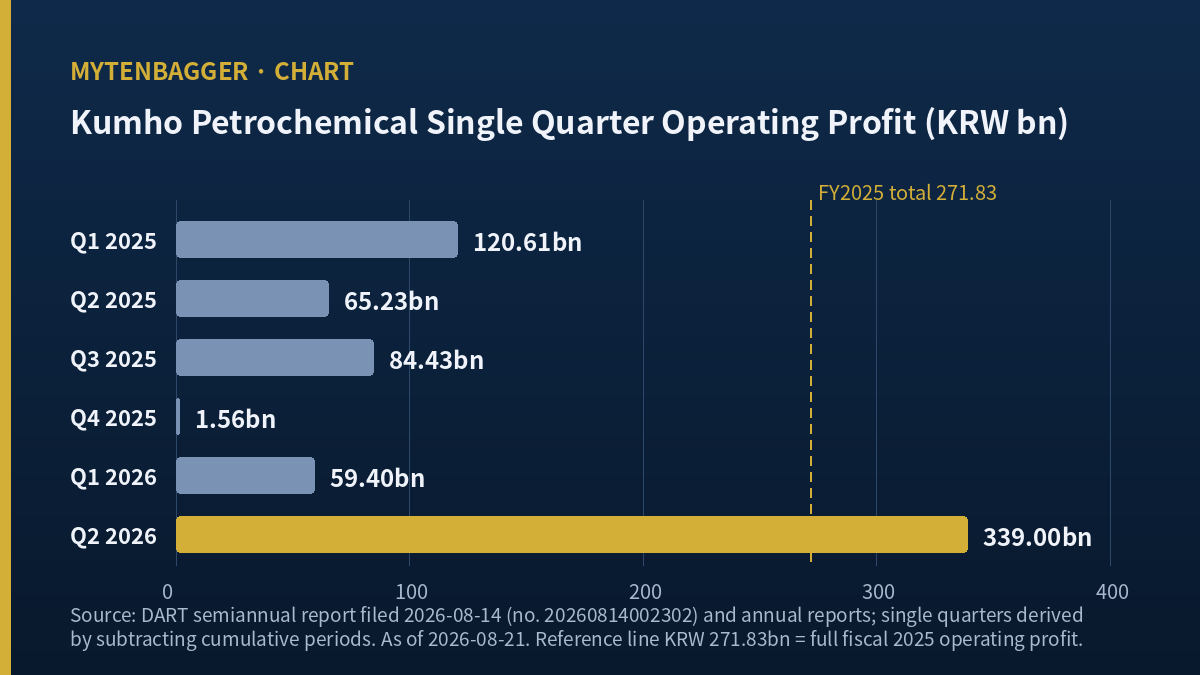
| Q2 2026 | 2,268.15 | 338.998 | 14.95% |
The line I stared at longest is not the last one but the fourth. In the fourth quarter of 2025 this company sold KRW 1,589.74 billion of product and kept KRW 1.56 billion of it, an operating margin of 0.10 percent. Two quarters later it sold KRW 2,268.15 billion and kept KRW 338.998 billion. Revenue rose 42.67 percent while operating profit multiplied 217.7 times.
That Q2 2026 operating profit of KRW 338.998 billion exceeds the entire fiscal 2025 operating profit of KRW 271.828 billion by 24.71 percent. One quarter beat a full prior year. Widen to the first half and the figure is KRW 398.401 billion, which is 146.56 percent of all of fiscal 2025. Against the same half of 2025, revenue rose 9.96 percent, from KRW 3,681.60 billion to KRW 4,048.11 billion, and operating profit rose 114.38 percent, from KRW 185.837 billion to KRW 398.401 billion.
Numbers like that move your hand before your head. Four times KRW 338.998 billion is KRW 1,355.99 billion, and that would exceed the KRW 1,147.745 billion this company earned at the peak of its pandemic cycle in 2022 by 18.14 percent. Divide the KRW 2,948.4 billion market value by it and you get 2.17 times earnings. I have not used that 2.17 anywhere in this piece as evidence, and the next section is why.
Three Reasons I Left Kumho Petrochemical Stock Unannualized
One, the company wrote the warning into the same release
The Korean outlet Newspim published its earnings piece at 15:21 on August 7, 2026, and carried the company’s own guidance in it. In my translation, the company expected third quarter profitability to soften somewhat on weaker raw material prices, the seasonal low period, and soft downstream demand. A company that had just posted a 419.9 percent jump used the same material to warn about the next quarter. Tires are the largest single destination for that synthetic rubber, and I have already written down why I would not use the 4.48 times multiple on a Korean tire maker. I think that sentence accounts for a good share of why the intraday KRW 139,000 became a KRW 129,600 close.
Two, the sell-side number attached to Q3 is very small
Yoon Jae-sung, senior research director at Hana Securities, estimated third quarter operating profit at KRW 68.3 billion in an August 8, 2026 note. That is 79.85 percent below the KRW 339.0 billion the company just posted. The same note projected synthetic rubber operating profit falling 91 percent quarter over quarter and expected the synthetic resin and phenol derivative units to swing to losses in the third quarter. The mechanism given was reverse lagging, meaning that raw material costs passed through to customers in the second quarter arrive as expensive inputs in the third.
Take that estimate at face value and the nine month operating profit becomes KRW 466.701 billion, which is the KRW 398.401 billion actually filed plus KRW 68.3 billion someone else projected. The two halves of that sum have different standing, so I record it once here and keep it out of the judgment.
Three, the divisional figures do not add up to the consolidated ones
The same Newspim article gave second quarter divisional results of KRW 987.1 billion revenue and KRW 189.8 billion operating profit for synthetic rubber, an operating margin of 19.2 percent, then KRW 375.4 billion and KRW 37.4 billion for synthetic resins, KRW 492.8 billion and KRW 55.1 billion for phenol derivatives, and KRW 227.1 billion and KRW 47.4 billion for EPDM and TPV. Those four revenue lines sum to KRW 2,082.4 billion against KRW 2,268.15 billion consolidated, a gap of KRW 185.75 billion. The four profit lines sum to KRW 329.7 billion against KRW 338.998 billion, leaving KRW 9.30 billion. The energy segment and consolidation entries probably sit inside those gaps, but I did not confirm the breakdown, so I have not used divisional figures to judge the company as a whole.
Seven Arguments That Cut Against Me
I want the case against my own reading standing up before the rest of the piece. If all seven of these hold, I am wrong.
One. Hwang Kyu-won at Yuanta Securities Korea projected in a November 18, 2025 note that NB latex utilization climbs from 54 percent in 2025 to 65 percent in 2026 and 75 percent in 2027. A business climbing a utilization curve tends to deliver quarterly profit as a staircase. The oscillation I am describing would be the wrong picture for that.
Two. The same note traced margin expansion to naphtha cracker rationalization across Asia. That is a multi-year change in supply structure and it does not expire after one quarter.
Three. Hana Securities projected the collapse in the third quarter and kept a buy rating anyway, citing improved spot margins across key products and the end of the 2021 through 2025 global capacity build. The house forecasting the weak quarter is the same house calling the recovery.
Four. Capital spending really has come down, from KRW 436.19 billion in 2024 to KRW 194.40 billion in 2025, a decline of 55.43 percent, with KRW 52.88 billion in the first half of 2026. Yuanta assumed roughly KRW 250 billion for 2026. Profit at a company past its build cycle recovers faster than its revenue does.
Five. The balance sheet can wait out a cycle. The debt to equity ratio was 34.4 percent at the end of June 2026, and first half operating profit divided by first half interest expense of KRW 32.441 billion gives interest coverage of 12.28 times, which matches the vendor screen to two decimal places.
Six. My second reason above leans on a Hana Securities estimate, and the sell-side has already been badly wrong about this exact quarter. Hwang Sung-hyun at Eugene Investment carried a Q2 2026 operating profit estimate of KRW 114.5 billion in a May 11, 2026 note. The company posted KRW 339.0 billion, which is 196.07 percent above that estimate. A house that misses one quarter of this business by nearly three times is a thin foundation for my confidence about the next one, and that cuts my reasoning as much as it cuts theirs.
Seven, and this one costs me the most. I could not verify a raw material price series that would let me judge whether a 14.95 percent operating margin is repeatable. I failed to source butadiene and propylene prices as of my reference date from a filing or a trade press outlet I would call reliable. So the reverse lagging story in this piece rests entirely on statements from the company and from Hana Securities. Half my argument is borrowed.
What Kumho Petrochemical Stock Did After Its Last Peak Quarter
This company has already shown what happens when a single quarter gets stretched across a year. First quarter 2022 operating profit was KRW 449.068 billion at a 20.42 percent operating margin. Four times that is KRW 1,796.27 billion. The full year came in at KRW 1,147.745 billion, which is 63.9 percent of the multiplication. The following year, 2023, operating profit fell to KRW 358.961 billion, down 68.72 percent from 2022.
The path since then is worth having in one place. Operating profit was KRW 358.961 billion in 2023, KRW 272.804 billion in 2024, and KRW 271.828 billion in 2025. Revenue fell from KRW 7,975.63 billion in 2022 to KRW 6,915.15 billion in 2025, a three year compound change of negative 4.64 percent, which again matches the vendor screen.
The 2022 peak and the 2026 second quarter do not share a cause. The earlier one came from pandemic era NB latex demand arriving all at once. What the company and its analysts describe for this one is pass-through of higher input costs into selling prices. Different causes can produce different endings. What I take from this company’s own record is narrower than that. In its history, four times a single quarter has never once been the right answer.
Kumho Petrochemical Stock Against an American Maker of the Same Market Value
Olin Corporation trades on the New York Stock Exchange under OLN and makes chlorine, caustic soda, and epoxy. The product overlap with this Korean company is partial, since epoxy sits downstream of the bisphenol A that comes out of a phenol derivatives business, while synthetic rubber has no Olin equivalent at all. Because the mix differs I have limited the comparison to size, profitability, and whether an earnings multiple exists.
| Measure | Kumho Petrochemical | Olin Corporation |
|---|---|---|
| Market value | USD 2.13 billion | USD 2.09 billion |
| Revenue | USD 4.99 billion, fiscal 2025 | USD 6.70 billion, trailing twelve months |
| Net income | USD 209.8 million, owners’ share | Loss of USD 196.9 million |
| Net margin | 4.21% | Negative 2.94% |
| Trailing earnings multiple | 10.13 times, my own division | None, the company is loss making |
Two chemical companies of almost the same market value, one of which earned USD 209.8 million over its last reported year while the other lost USD 196.9 million over its last twelve months. The Olin figures come from a stockanalysis.com quote stamped August 21, 2026 at 3:13 PM EDT with the market open, so that price of USD 18.38 is an intraday print, which is not a close. I checked it against the share count: 18.38 times 113.98 million shares gives USD 2,094.9 million, which reproduces the displayed market value. The displayed trailing loss per share of USD 1.73 also reproduces, since dividing USD 196.9 million by 113.98 million shares gives USD 1.7275, a difference of 0.14 percent.
What I find useful is not the ranking but the divergence in response. Olin is pursuing a merger with Huntsman Corporation, which cleared its Securities and Exchange Commission review in July 2026. The Korean company spent its downcycle canceling its own shares. Both are answers to a weak chemical cycle and they point in opposite directions, one toward consolidating capacity and the other toward shrinking the share count while capacity stays put. I have no way to score which answer is better, and I am not pretending the two businesses face the same end markets.
Which Earnings Base Does Kumho Petrochemical Stock Trade On
The vendor screen shows a price to earnings ratio of 11.91 times. That is the KRW 117,200 close divided by precise earnings per share of KRW 9,840.47, and it reproduces to two decimals. The problem is that the earnings per share sits on fiscal 2025 owners’ net income of KRW 290.936 billion. The displayed 3.93 percent operating margin, 4.7 percent return on equity, and KRW 6,915.15 billion revenue all come from fiscal 2025 too. The multiple stands on a year the company has already left behind.
Here is what I got dividing for myself. The KRW 2,948.4 billion market value over fiscal 2025 owners’ net income of KRW 290.936 billion is 10.13 times. Over the four quarters from the third of 2025 through the second of 2026, which sum to KRW 504.934 billion of owners’ net income, it is 5.84 times. I added those four quarters from the filings myself. Which earnings base a chemical name trades on is the same fork I hit when I priced Lotte Chemical twice and got two answers. The 6 times multiple Hana Securities cited on August 8 is close to the second one, and the 0.5 times book multiple in the same note is below the 0.54 the screen shows.
Three vendor items I excluded
Three fields failed to reproduce, so they are out of this piece. Book value per share of KRW 215,808 times the share count gives KRW 5,429.08 billion against fiscal 2025 owners’ equity of KRW 6,245.29 billion, a discrepancy of 13.07 percent. The raw payout ratio field of 58.4 reproduces on no path I tried. The field labeled EBITDA reads KRW 59.403 billion, which equals first quarter 2026 single quarter operating profit to the won and therefore carries no add back of depreciation at all.
Earnings per share is only partly settled as well. Dividing fiscal 2025 owners’ net income by the precise earnings per share implies 29,565,255 shares, which is 4,408,258 more than the 25,156,997 common shares outstanding. Preferred shares and the timing of cancellations probably explain it, but I did not confirm that, which is why I put the screen multiple and my own division side by side above.
The fields that did reproduce I used as they stand. Return on equity of 4.7 percent equals fiscal 2025 owners’ net income over the average of end 2024 and end 2025 owners’ equity, at 4.7372 percent. The payout ratio of 17.3 equals the KRW 1,700 dividend over precise earnings per share, at 17.2756 percent. The dividend yield of 1.45 equals KRW 1,700 over the reference close, at 1.4505 percent. Free cash flow yield of 1.2 equals first half free cash flow of KRW 35.247 billion over market value, at 1.1955 percent.

My Stance on Kumho Petrochemical Stock and What Would Break It
The vendor checklist scores five of seven at 71 points, and the two failures are the 3.93 percent operating margin and the 4.7 percent return on equity, both of them fiscal 2025 figures. I did not use that score, because the fiscal year it rests on is the whole subject of this piece.
The buyback history matters for the same reason any share count does. The board resolved on March 6, 2024 to cancel 2,624,417 shares, half of the treasury holding, in installments through 2026. Newsis reported the first installment of 875,000 shares on March 20, 2024, and Bloter reported 874,417 shares worth KRW 106.5 billion canceled on March 20, 2026. I confirmed the first and last installments in press reports and never found the share count for the middle one. Adding 874,417 to the current 25,156,997 gives 26,031,414, which tells me the vendor share count already reflects the March 2026 cancellation, and that is why the market value reconciled to the won.
Dividends went the other way. The declared dividend per share fell from KRW 10,000 for 2021 to KRW 5,400, KRW 2,900, KRW 2,200, and KRW 1,700 for 2025, four consecutive annual reductions. At the reference close that last figure yields 1.45 percent.
The one calculation I refused to make is four times KRW 338.998 billion. Here are the conditions under which I will concede that calculation was right.
Condition one. If third quarter 2026 single quarter operating profit exceeds KRW 150 billion, it clears twice the Hana Securities estimate of KRW 68.3 billion and the reverse lagging account is simply wrong. Every sentence in this piece resting on that account goes.
Condition two. If third quarter single quarter operating profit comes in below KRW 68.3 billion, the sell-side was the optimistic party and the second quarter was an isolated event. In that case I stop watching this name.
Condition three. If third quarter operating margin falls below 4.41 percent, the median of the six quarters in the table above, then the 14.95 percent posted in the second quarter was one pass-through and nothing more. Sorted from low to high those six margins run 0.10, 3.34, 3.68, 5.14, 6.32, and 14.95, and the average of the middle two is 4.41 percent.
Condition four. Separate from the three above, if the company does not restore its dividend out of 2026 earnings once the cancellation program has ended, then shareholder return stops being a live subject at this name for a while.
All four get settled by the third quarter report. The statutory deadline is November 15, 2026, and because that date falls on a Sunday the filing itself lands on the following business day or later. Korea Exchange preliminary results sometimes run two to three weeks ahead of the formal report, so the practical read starts in late October.
A year ago I stood in front of a 37 percent monthly move at SK Innovation and did not chase it, and what I was waiting on there was whether the profit driving the move came from inventory revaluation or from structure. At Hyundai Steel the assets that earned the second quarter were not the assets supposed to lift the third. Here the thing that earned the second quarter is pass-through, and the thing said to cut the third is the other side of that same pass-through. When one mechanism shows up in consecutive quarters with opposite signs, isolating a single quarter and multiplying it was never a valid operation to begin with.
What grew for me after this earnings report is not conviction about this company. What grew is the number of things I have to check. I wrote down four conditions where the multiplication would have gone, and from November onward those four lines get to grade me.
Sources
- Korea’s Financial Supervisory Service electronic disclosure system, semiannual report accepted August 14, 2026 (receipt 20260814002302) and annual reports for fiscal 2022 through 2025, consolidated statements. Single quarters derived by subtracting prior cumulative periods.
- Newspim, August 7, 2026, 15:21, divisional results and company guidance, in my own translation from the Korean original
- News1, August 7, 2026, second quarter results
- Point Economy, August 8, 2026, citing the Hana Securities note by Yoon Jae-sung
- Newspim, May 11, 2026, Eugene Investment note by Hwang Sung-hyun
- S-Journal, citing the Yuanta Securities Korea note of November 18, 2025 by Hwang Kyu-won
- Newsis, March 6, 2024, board resolution on treasury share cancellation
- Bloter, cancellation of 874,417 treasury shares
- Money Today, August 21, 2026, 16:29, won dollar rate
- stockanalysis.com quote for Olin Corporation, August 21, 2026, 3:13 PM EDT
- Price and ratio fields from Kiwoom data as of the August 21, 2026 close, screen updated 17:07 that day. Market value cross checked by multiplying close by shares outstanding.