Korean Refiner S-Oil: A 9.26 Trillion Won Plant Not Yet Earning
The plant is built. It is not running. That is the sentence I keep returning to whenever I look at S-Oil, the South Korean refiner listed in Seoul under the code 010950, and it is the reason I am only watching the shares even after a twelve month gain of 130.39 percent.
The company has committed 9.26 trillion won to a single petrochemical complex. In the quarter that ended on June 30, 2026, petrochemicals was the only one of its three segments that lost money. I want to walk through both of those facts with the numbers attached, because they point in opposite directions and I have not yet decided which one wins.
My price reference is the close of 141,000 won on Wednesday, August 26, 2026, the last trading session before I wrote this. Multiplied by 112,582,979 common shares, that is a market value of 15.87 trillion won, or roughly 11.46 billion dollars at 1,384.80 won to the dollar, the Seoul closing rate on the same date.
Six dated steps from target to startup
1. End of May 2026: original mechanical completion target for the complex.
2. Friday, June 26, 2026: a fatal accident on the Ulsan construction site, followed by a government stop work order on that zone.
3. Tuesday, June 30, 2026: the contractor submits its mechanical completion documentation.
4. Monday, August 3, 2026: the company says it is still verifying equipment performance and the submitted files.
5. Fourth quarter of 2026: startup to be completed, per company guidance.
6. Early 2027: commercial operation, a schedule the company said on August 3 had not changed.
Contents
The plant is finished and it is not earning
The Shaheen project is a petrochemical complex the company puts at 9.258 trillion won of total investment in its own materials. It is designed for 1.8 million tons of ethylene a year, 770,000 tons of propylene and 1.32 million tons of polyethylene, and it uses a process the company calls TC2C, which converts crude directly into chemical feedstock instead of routing it through naphtha (Newspim, Thursday, June 25, 2026).
The offtake side is contracted. On Monday, February 9, 2026, the company announced a polyethylene export agreement with SABIC worth roughly 5.5 trillion won over five years (Edaily, Monday, February 9, 2026). A contract is not a running cracker, though, and the gap between the two is where this quarter sits.
The timeline in the box above comes from Korean business press reporting on the company’s second quarter call (Bloter, Monday, August 3, 2026). What I take from it is narrow. As of early August the company had not declared mechanical completion; it had received the contractor’s paperwork and was checking it. Commercial operation is a 2027 event on the company’s own schedule.
What the South Korean refiner spent, and what each part of it earns
Adding the investing outflows reported in each year’s cash flow statement, this company spent 10.79 trillion won on plant and equipment from 2022 through the first half of 2026. Over the same stretch its operating profit added up to 7.61 trillion won. Both figures are my own sums from the consolidated statements filed with Korea’s Financial Supervisory Service, and I am labeling them as such.
The balance sheet carries the difference. Consolidated debt to equity moved from 131.19 percent at the end of 2022 to 199.85 percent at June 30, 2026. Operating cash flow for the first half of 2026 was negative 566.96 billion won, which is a combination I have written about before in a Korean utility where reported profit and reported cash pointed opposite ways for four straight quarters; here the cause is inventory and capital spending rather than collection timing. Inventory grew from 4.16 trillion won at the end of 2025 to 6.61 trillion won at the end of June, an increase of 2.45 trillion won. On the second quarter call, management put its target debt to equity ratio at 80 to 100 percent (Etoday, Monday, August 3, 2026), which is about half of where the ratio sits now.
Interest is the line I watch on a balance sheet like this. Interest expense in the first half of 2026 was 512.82 billion won against first half operating profit of 2,196.09 billion won, which is coverage of 4.28 times by my own division. In a strong half that is comfortable. The point of writing it down is that the denominator stays roughly where it is when the profit line thins out.
Three segments behaving like three different companies
In the June 2026 quarter the company reported refining revenue of 9,029.3 billion won with operating profit of 532.4 billion won, lubricants revenue of 1,301.7 billion won with operating profit of 477.4 billion won, and petrochemicals revenue of 1,012.5 billion won with an operating loss of 44.8 billion won (Ajunews, Monday, August 3, 2026). The three revenue lines sum to the reported quarterly total of 11,343.5 billion won and the three profit lines sum to the reported 965.0 billion won. I added both columns myself before using them.
| Segment, June 2026 quarter | Revenue (bn won) | Operating profit (bn won) | Margin, my own division of the two figures in this row |
|---|---|---|---|
| Refining | 9,029.3 | 532.4 | 5.90% |
| Lubricants | 1,301.7 | 477.4 | 36.68% |
| Petrochemicals | 1,012.5 | 44.8 loss | 4.42% loss |
Lubricants produced 49.47 percent of segment operating profit on 11.48 percent of segment revenue, both by my own division. Management attributed that to base oil spreads at record levels, helped by supply disruption in the Middle East and shipping delays around the Strait of Hormuz. Petrochemicals lost money on higher feedstock costs. So the money went into the weakest of the three, on the argument that a new process changes what that segment is.
One number in the June quarter that Korean readers already know
There is a companion piece to this one on my Korean site, and its subject is the first quarter, not the second. The company disclosed 643.4 billion won of inventory related valuation gains inside its March quarter operating profit of 1,231.1 billion won, broken out as 524.8 billion in refining, 87.1 billion in petrochemicals and 31.5 billion in lubricants (ZDNet Korea, Monday, May 11, 2026). That is 52.26 percent of the quarter by my own division. The company did not put a number on the equivalent line for the June quarter. I read the two quarters together and I would not annualize either one, which is the same discipline I applied when I declined to annualize a Korean chemical maker’s outlier quarter earlier this month.
Four fiscal years of margin going one way, then a half year that went the other
The segment picture above is a single quarter. Stretched across four reported years, the consolidated numbers show something a foreign reader should see before assigning any multiple to this company.
| Fiscal year | Revenue (bn won) | Operating profit (bn won) | Margin, my own division of the two figures in this row |
|---|---|---|---|
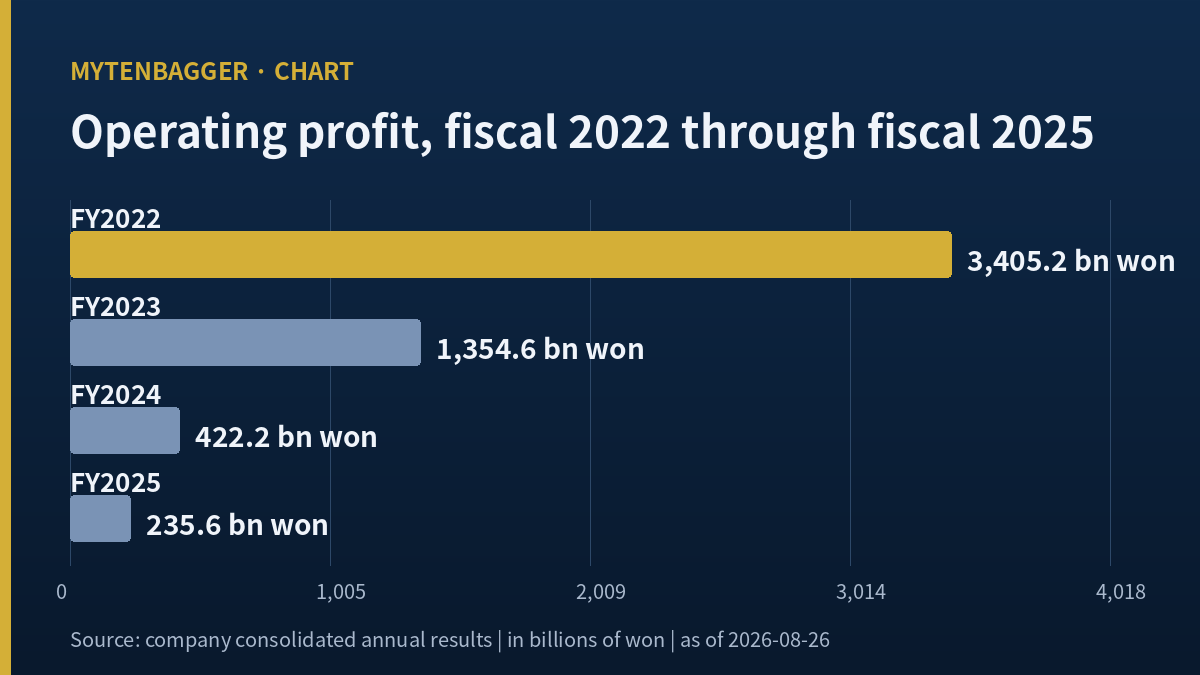
| 2022 | 42,446.0 | 3,405.2 | 8.02% |
| 2023 | 35,726.7 | 1,354.6 | 3.79% |
| 2024 | 36,637.0 | 422.2 | 1.15% |
| 2025 | 34,247.0 | 235.6 | 0.69% |
| First half of 2026 | 20,286.2 | 2,196.1 | 10.83% |
Four consecutive years of a shrinking operating margin, from 8.02 percent down to 0.69 percent, and then a half year at 10.83 percent that on its own is 9.32 times the whole of fiscal 2025 in profit terms. Every one of those figures is a consolidated reported number and every percentage is mine. A business whose margin can travel that distance in eighteen months is not a business I am willing to value off one good half.
How this South Korean refiner lines up against thirteen listed peers
Comparing refiners across countries has one trap that outranks all the others, and it is not currency. It is the fiscal calendar. Refining margins moved violently in the first half of 2026, so a company whose year ended in March 2026 is reporting a partly different world from one whose year ended in December 2025. The right hand column below says, for each row, whether that reported year contains the January to March 2026 quarter. Five of the fourteen rows do. Nine do not.
| Company | Listing | Fiscal year ended | Revenue, reporting currency | Operating profit, reporting currency | Contains Jan to Mar 2026? |
|---|---|---|---|---|---|
| Marathon Petroleum | NYSE MPC | 2025-12-31 | 133,174m USD | 6,220m USD | No |
| Phillips 66 | NYSE PSX | 2025-12-31 | 132,376m USD | 4,385m USD | No |
| Valero Energy | NYSE VLO | 2025-12-31 | 115,939m USD | 4,741m USD | No |
| PBF Energy | NYSE PBF | 2025-12-31 | 29,332m USD | 747.3m USD loss | No |
| HF Sinclair | NYSE DINO | 2025-12-31 | 26,869m USD | 927m USD | No |
| S-Oil | KRX 010950 | 2025-12-31 | 34,246,957m KRW | 235,631m KRW | No |
| Sinopec | HKEX 386 | 2025-12-31 | 2,783,583m CNY | 54,977m CNY | No |
| Formosa Petrochemical | TWSE 6505 | 2025-12-31 | 626,159m TWD | 10,852m TWD | No |
| Thai Oil | SET TOP | 2025-12-31 | 330,943m THB | 10,165m THB | No |
| Reliance Industries | NSE RELIANCE | 2026-03-31 | 10,572,190m INR | 1,212,610m INR | Yes |
| Indian Oil | NSE IOC | 2026-03-31 | 7,844,154m INR | 676,323m INR | Yes |
| Bharat Petroleum | NSE BPCL | 2026-03-31 | 4,552,280m INR | 349,921m INR | Yes |
| ENEOS Holdings | TSE 5020 | 2026-03-31 | 11,765,470m JPY | 348,852m JPY | Yes |
| Idemitsu Kosan | TSE 5019 | 2026-03-31 | 8,105,891m JPY | 212,205m JPY | Yes |
What I did not do with that table
I did not convert any of those currencies, and I did not rank the rows. Six reporting currencies in one table means six exchange rates, and this piece uses one. I also want to be honest about sourcing: thirteen of the fourteen rows come from a single financial data site and I did not check them against the original filings. The S-Oil row is the one I pulled from the regulatory filing itself. On HF Sinclair the same data site showed 919 and 927 on two of its own pages, so I re-read the income statement page twice, took 927, and I am flagging the discrepancy here instead of hiding it.
What this South Korean refiner actually is
The shares trade on the Korea Exchange, the main board that hosts the KOSPI index, in Korean won, and settlement follows Korean market rules.
Ownership matters more here than in most Korean large caps. Reporting in Korean media puts Aramco Overseas Company at 63.41 percent of the common shares, though the article I found did not state the record date, so I have kept that figure out of my argument and am mentioning it only as context. What is dated is the credit action that followed: NICE Investors Service raised the corporate bond rating to AA+ on Monday, February 9, 2026, and Korea Ratings Investors Service followed on Wednesday, March 25, 2026 (Asiae, Thursday, March 26, 2026). Both agencies cited the parent’s capacity to support the balance sheet through the petrochemical build.
One more piece of country context belongs here, because it has no US analogue. Korean prosecutors moved against the domestic refining industry on Monday, July 6, 2026 over fuel pricing, and the reporting on who exactly was charged does not agree with itself. One account describes all four refiners as indicted (Money Today, Monday, July 6, 2026); another says only two were charged on price fixing while this company was included on a separate count concerning dealings with independent stations. I could not settle which version is right, so it stays out of my argument and sits here as a disclosed uncertainty. Separately, brokers on both sides of the valuation range have flagged the domestic maximum price mechanism as a live constraint on what a Korean refiner can keep from a strong margin environment.
The margin that paid for the June quarter came from outages elsewhere
The International Energy Agency put global refinery throughput for July 2026 at 80.9 million barrels a day, about 5 million barrels a day below the same month a year earlier, and described Atlantic Basin refining margins as reaching all time highs in July (IEA Oil Market Report, August 2026). Russian throughput in July ran at 3.6 million barrels a day, the lowest since May 2002, according to Bloomberg figures carried by The Moscow Times on Monday, August 3, 2026. China left its first batch of 2026 refined product export quotas flat at 19 million tons. None of that is something this company did, and none of it is under its control. That is exactly why I keep the multiple I am willing to pay for it low, the same reason I sat out a 37 percent month in another Korean energy name in July.
Where I stand on this South Korean refiner
I am watching. The company is large enough that size alone would not keep me watching, but three things do.
First, the earnings mix. Half of the March quarter was an inventory valuation gain the company itself named, and the equivalent figure for the June quarter was never disclosed, so I cannot yet separate the repeating part from the part that arrived with the oil price. Second, the 9.26 trillion won asset is still in commissioning, and the segment it will feed lost money last quarter. Third, the cash return while I wait is thin: the fiscal 2025 dividend was 330 won a share, and the interim dividend declared on Monday, August 10, 2026 was 800 won a share, a total of 93.14 billion won, with a record date of Tuesday, August 25 and payment scheduled for Tuesday the fifteenth of September (Financial News, Monday, August 10, 2026).
There is one thing I want to flag about screen multiples before anyone quotes one back at me. The price to earnings figure my data screen shows, 92.91 times, is built on the fiscal 2025 result. Summing the four quarters from the September 2025 quarter through the June 2026 quarter gives net income of 1,523.9 billion won, and on that base the same price is 10.42 times by my own division. Same company, same close, and a multiple that moves by a factor of 8.92 depending on which four quarters sit beneath it. A Korean chemical maker gave me the same lesson earlier this month when two defensible ways of pricing one company produced two different answers.
Korean brokers disagree about one quarter by a factor of 12.72
On Tuesday, August 4, 2026, the day after the results, Korean brokerages lifted their valuations together. Hana Securities analyst Yoon Jae sung went to 220,000 won from 200,000. NH Investment and Securities analyst Choi Young kwang went to 165,000 from 150,000, Samsung Securities to the same 165,000 from 150,000, and Eugene Investment to 148,000 from 126,000 (Hankyung, Tuesday, August 4, 2026). The compiled consensus figure that day was 164,412 won. Against that consensus, the Hana number sits 33.81 percent higher and the Eugene number 9.98 percent lower, both by my own division. Add KB Securities analyst Jeon Woo je, who held 167,000 won in a note dated Monday, May 11, 2026, and four of the five cluster inside a narrow band while one sits well above it. I am not adopting any of those numbers as mine. What I take from them is where informed readers of the same filings part company.
They part company far more violently one line down, on the September quarter itself. An NH note dated Monday, June 29, 2026 modeled roughly 85.0 billion won of operating profit for that quarter, citing lagging feedstock costs and inventory valuation losses. The Hana note of August 4 modeled 1,081.4 billion won. The second is 12.72 times the first by my own division. Two months and one earnings release separate the two documents, so timing explains much of the gap, and I still find the size of it instructive: this is a business where two competent desks can look at the same quarter and be an order of magnitude apart. Consensus for the full year steps down from there anyway, at 4.27 trillion won for 2026, 3.14 trillion for 2027 and 2.79 trillion for 2028 as compiled in Korean press (Etoday). The market is already treating this year as the peak.
My checkpoint and the four ways this piece breaks
My checkpoint is the third quarter report. Korea’s statutory filing deadline falls on Sunday, November 15, 2026, so the filing itself lands on Monday, November 16 or later. Two things in it decide whether I move: whether the company puts a figure on inventory related gains again, and whether petrochemicals is still in loss while the new complex runs its startup sequence.
Now the ways I could be wrong. One, and this is the one that would hurt most, I am valuing an idle asset as an asset that earns nothing, while the market may already be discounting 2027 output into today’s price; if so I am describing the past and the price is describing the future. Two, the segment boundaries are the company’s, and I did not verify which products sit in which line. Three, my 10.79 trillion won capital spending total is my own addition of cash flow statement lines and I could not isolate how much of it belongs to this one project. Four, forward consensus for 2026 operating profit appears in Korean press at 4.27 trillion won in one report and about 3.27 trillion won in another, neither of which states its compilation date, so I did not build anything on either figure.