SK Hynix Stock Fell 25% After Its Record Nasdaq Debut
- I’ve been adding to SK Hynix stock through this pullback — the shares sit roughly a quarter below their late-June high even after the biggest foreign listing in Nasdaq history.
- My core reason is boring and mechanical: the US listing finally lets American money price this against Micron, and the higher-share player trades at the cheaper forward multiple.
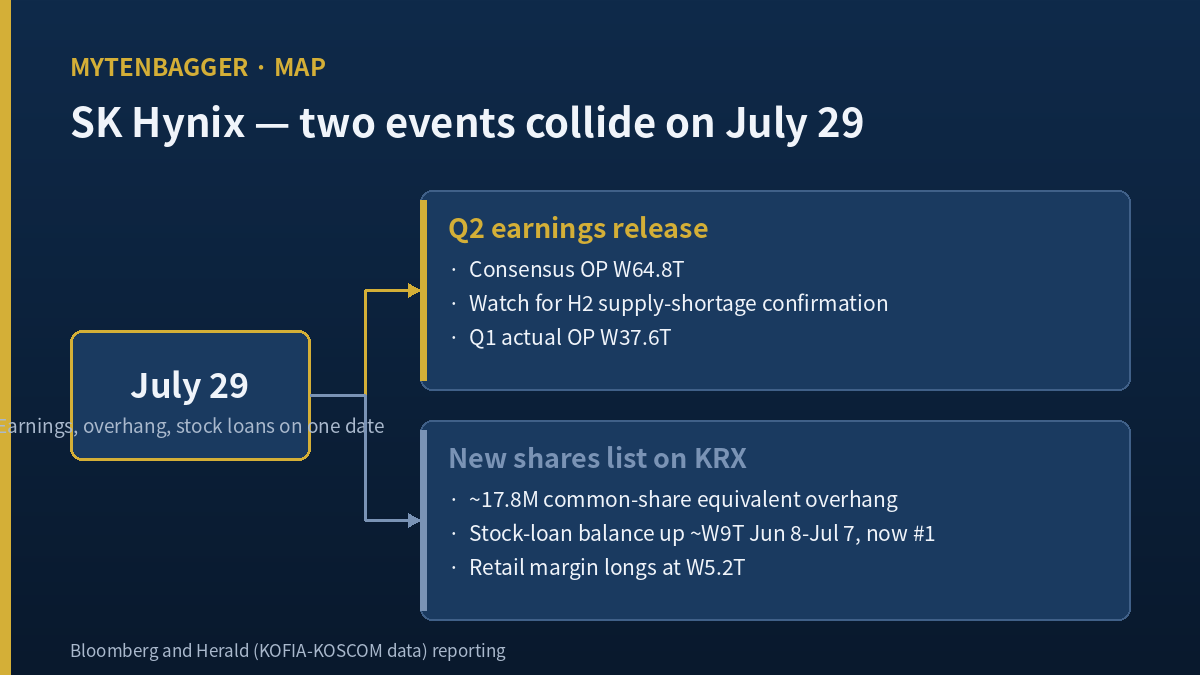
- Where I’d be wrong: July 29 brings Q2 earnings and the KOSPI listing of the ADR-underlying shares on the same day, and Samsung’s HBM4 qualification is the crack I’m watching. That’s my checkpoint.
On Friday I did something I almost never do — I sat and watched an opening bell. SK Hynix rang in its American Depositary Receipts on the Nasdaq at 9:30 a.m. Eastern on July 10, and my first thought wasn’t the record-book number scrolling across the ticker. It was the valuation gap underneath it. A company that just pulled off the largest US share sale ever completed by a foreign issuer was, that same morning, trading at a lower forward multiple than Micron — the American memory maker it outsells more than two-to-one in HBM. That gap is the whole reason I’ve kept buying the shares into weakness, and this journal entry is me writing down why, and where the trade falls apart.
Two quick notes for anyone reading this from outside Korea. That changed with the ADR. And to keep this honest, I’m converting at about ₩1,400 to the dollar throughout; where I give a Korean-won figure I’ll put the dollar next to it.
Contents
Why I Added to My SK Hynix Stock Position After the Debut
My first reason: the listing itself is the re-rating catalyst
Here is the part the “record IPO” headlines skipped past. The ADR sale priced at $149 per receipt and raised $26.5 billion. SK Hynix had signaled a raise of up to roughly $29 billion when it set the deal in motion in late June; the final pricing, as reported via Yahoo Finance, ranks as the largest US share sale ever completed by a foreign company, edging past Alibaba’s $25 billion in 2014. The book was reportedly covered about seven times over. The stock trades under the permanent ticker SKHY.
The mechanics matter for the thesis, so here they are. The sale comprised 177.9 million ADRs, and demand ran hot enough that this wasn’t a deal that scraped to get done. What I care about more is where the cash goes: SK Hynix has said it will use the proceeds to expand manufacturing in South Korea and buy equipment. That cuts both ways, and I’d rather name it than bury it. New fab capacity is exactly what feeds the HBM ramp I’m buying — and capacity is also the exact thing that, industry-wide, turns a shortage into a glut. I’m holding a company that just raised a record sum to build more of the product whose price cycle is my single biggest risk. Both of those sentences are true at once.
But the money raised isn’t my thesis — the audience it unlocks is. For years SK Hynix carried a version of the “Korea discount,” the persistent gap where Korean champions trade below global peers partly because foreign capital had to jump through hoops to own them. With ADRs on the Nasdaq, a US investor can now price the shares in the same brokerage window, in the same currency, on the same screen as Micron. According to Seoul Economic Daily on July 2, SK Hynix was trading at roughly 6.0 times its 12-month forward earnings, against Micron at 7.9 times and SanDisk at 12.6 times. Sit with that. The company with the biggest HBM share on earth carried the lowest forward multiple of the three.
What I’m buying, then, isn’t a catalyst that’s coming. It’s one that arrived Friday. When the marginal buyer changes from “Korean institutions and a handful of foreigners” to “every US desk that benchmarks against Micron,” the multiple that gap implies has room to travel. I don’t need a miracle. I need the discount to keep narrowing.
I mention it because access friction was part of what created the discount in the first place. Take the friction away, and the reason for the discount starts to erode on its own.
My second reason: the moat is two moats, not one
People talk about SK Hynix’s “HBM lead” as if it’s a single wall. When I model it, I see two separate moats stacked on top of each other, and that’s what gives me the conviction to add rather than trim.
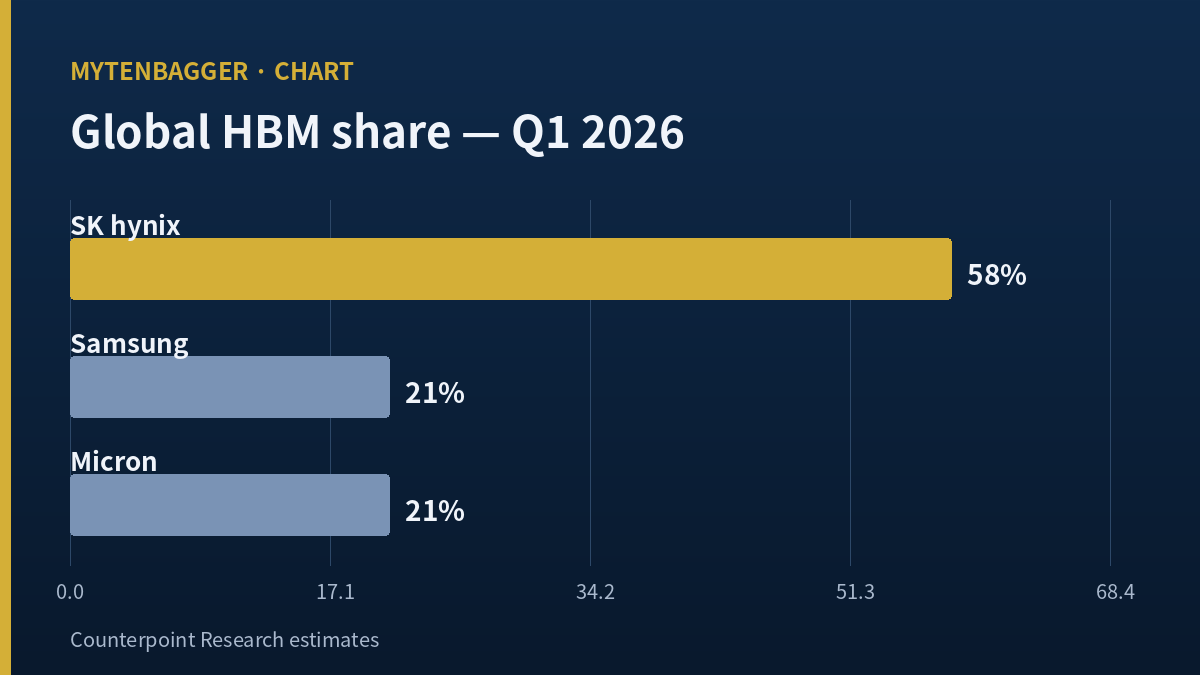
The first is technical scale. IDC data cited inside SK Hynix’s own SEC filing put its share of global HBM revenue at 56.4% in the first quarter of 2026; other trackers such as TrendForce have run the number closer to 62% depending on the metric. Either way it is a commanding lead in the exact memory that AI accelerators are starving for. The second moat is quieter and, to me, harder to copy: the customer relationship. Per TrendForce, relaying Yonhap reporting, Nvidia is expected to route roughly two-thirds — understood to be close to 70% — of its HBM4 demand for the Vera Rubin platform to SK Hynix, credited to years of proven yields at scale. Market share you can chart. A design-in relationship where the world’s most important chip customer trusts your yields is the kind of thing that doesn’t reprice in a quarter.
I’ll be honest that I first held this name mostly for the raw share number, and only later did the customer-lock piece become the part I actually care about. Share can erode at the edges. A qualified, high-yield supply position on the flagship AI platform is the piece I’d want to own through a cycle.
My third reason: the trailing multiple is lying to me
If you screen the shares on trailing numbers, it looks expensive — a mid-30s trailing P/E and a double-digit price-to-book. That’s the memory-cycle optical illusion: you’re dividing today’s price by yesterday’s depressed earnings. The forward picture is why the sell-side is where it is. Seoul Economic Daily cited brokerage estimates for a second-quarter revenue jump of about 50% quarter-over-quarter, to roughly ₩79 trillion (~$56B), and noted the company was on track for an 11th straight quarter of beating forecasts since late 2023. The demand driver they point to is the shift to agentic AI, which chews through vastly more tokens — and therefore more DRAM and NAND — than the generative workloads before it.
I’m not adopting anyone’s target as my own, but for context on where professional money sits: on July 2, IBK Investment & Securities lifted its target to ₩4.0 million from ₩1.8 million with a buy rating, and NH Investment & Securities moved to ₩4.1 million from ₩3.2 million, both per Seoul Economic Daily. Those are their numbers, not mine — I cite them the way I’d note the weather. What I take from them is simpler: the people paid to model this see the forward earnings, not the trailing ratio, as the real anchor. So do I. (I keep a small spreadsheet of the two names’ forward multiples side by side; the week SK Hynix’s dropped under Micron’s was the week I stopped debating with myself and started adding in earnest.)
SK Hynix Stock — The Numbers I’m Actually Looking At
Here’s the snapshot on my screen this week. USD is primary, Korean won in parentheses, converted at about ₩1,400/$.
| Metric | SK Hynix | Micron |
|---|---|---|
| 12-mo forward P/E | ~6.0x | ~7.9x |
| HBM revenue share, Q1’26 | 56.4% | ~20-25% |
| Nasdaq instrument | ADR: SKHY ($149) | Common: MU |
| Seoul share price | ~₩2.18M (~$1,560) | — |
| Off late-June high | ~ -25% | — |
| Sell-side targets (cited) | ₩4.0M IBK / ₩4.1M NH | — |
Sources: SK Hynix SEC filing (IDC HBM data); Seoul Economic Daily, July 2, 2026 (forward P/E, targets, price); CNBC and Yahoo Finance (ADR price/size). HBM share for Micron is an approximate range. As of July 10-11, 2026. USD at ₩1,400/$.
The Seoul shares peaked near ₩2.99 million (~$2,134) on June 26, per Seoul Economic Daily, and had slid to the ₩2.3 million area by July 2 before drifting toward ₩2.18 million (~$1,560) around the listing. So the “25% off the high” I keep saying is real, and it happened into the single biggest positive event this company has ever staged. That combination — a violent pullback landing right on top of a structural catalyst — is exactly the setup I like to add into.
One caution on the multiples: the ~6.0x versus ~7.9x gap is a forward estimate, and forward memory earnings are the most cyclical number in tech. Treat it as a directional read, not a precise coordinate. What matters to me is the sign of the gap, not the second decimal.
One more thing the table doesn’t show. A memory name can carry a mid-30s trailing P/E and still screen cheap on forward numbers only because the “E” is moving faster than almost anything else in large-cap tech — the sell-side’s roughly 50% quarter-on-quarter revenue estimate for Q2 is a small-cap-sized jump on a company this large. That’s the whole memory-cycle trick, and it’s the reason I anchor on the forward line and treat the trailing one as scenery. It’s also why a name like this can look “expensive” and “cheap” in the same afternoon depending on which number you divide by.
How I See SK Hynix Stock Playing Out From Here
The path I think is most likely (~55%)
US demand for the ADR keeps the discount to Micron closing rather than widening, Q2 confirms the earnings ramp the sell-side is modeling, and the HBM4 ramp into Nvidia’s next platform does most of the heavy lifting through 2026 into 2027. In this world I keep the position and let it compound. I don’t need the stock to hit anyone’s ₩4 million print. I need the forward multiple to stop apologizing for the balance sheet.
The mechanism I’ll actually be watching for is unglamorous: index and mandate inclusion. A Nasdaq-listed ADR with this much float becomes eligible for US products and benchmarks that a Seoul-only line never touched, and that shows up as a slow, structural bid rather than a headline. Slow bids are the ones I like, because they don’t depend on me being right about any single quarter — they just accrue. That’s the quiet half of the re-rating case, and it’s the half that survives a bad print.
Where I could be wrong (~30%)
The bear case isn’t stupid, and I’d be lying if I pretended otherwise. Goldman Sachs has argued the industry’s fat gross margins are a peak rather than a floor, with synchronized capacity additions from all three makers threatening to compress pricing into 2027-2028. That’s the memory-cycle ghost that has burned every holder who mistook the top for a new plateau. Layer on a US price-fixing suit naming Samsung, SK Hynix and Micron, and short selling having returned to the Korean market on March 31 — a name that has run this far draws sellers. If the cycle rolls before the re-rating completes, the discount I’m buying can stay a discount for a long time.
The tail scenarios (~15%)
Best case: HBM4 pricing holds above the reported $600-plus for 12-layer stacks, Samsung’s ramp slips, and SK Hynix keeps its near-70% Nvidia allocation intact — the multiple re-rates hard and fast. Worst case: a genuine demand air-pocket in AI capex plus a Samsung share grab hits at once, and memory does what memory does. I size for the middle and leave room to be surprised in both directions.
The Detail Most Coverage Missed on SK Hynix Stock
Here’s the piece I keep coming back to, and it’s the counter-view I’d flag if a friend asked. The market treats the Nasdaq listing as a trophy — a status upgrade for a Korean champion. I think that framing undersells it and oversells it at the same time.
It undersells it because the listing is a mechanical re-rating lever, not a ceremony. When you compare SK Hynix to Micron directly — higher HBM share, lower forward multiple — the only clean explanation for the inversion was access friction, and Friday removed a chunk of that friction. That’s Pattern-4 peer math: same industry, and the lower-share player was priced richer purely because Americans could reach it more easily. That’s not a moat; that’s plumbing, and plumbing gets fixed.
You can see how unsettled the memory debate still is just by looking at where the Street sits on Micron itself. Sell-side coverage compiled by IndMoney runs from roughly $400 at the bearish end (Goldman Sachs) to the $1,500s at the bullish end (Bank of America) — the bulls arguing memory now eats a large slice of cloud AI capex, the bears calling the fat gross margins a peak rather than a floor. That is a roughly four-fold spread on the same US-listed peer; the market genuinely does not agree on whether we’re mid-cycle or late-cycle. I don’t pretend to settle that argument. I lean on the relative call instead of the absolute one: whatever the cycle does, it does to Micron and SK Hynix together, and I would rather own the higher-share, lower-multiple side of that pair than try to time the top tick.
But it oversells it too, because a listing doesn’t touch the one variable that actually decides this trade: whether Samsung finally breaks SK Hynix’s HBM4 grip. Per TrendForce relaying Hankyung, Samsung completed final HBM4 qualification and was poised to begin shipments to customers including Nvidia and AMD, using 1c-class DRAM and a 4nm-class logic die. There’s a detail inside that I think the market is under-weighting: per TrendForce relaying Dealsite, SK Hynix and Samsung are set to supply HBM4 to Nvidia at comparable prices, with 12-layer stacks reportedly clearing $600 apiece. Read that carefully. If the two leaders are priced roughly the same, then price isn’t where this fight gets settled — allocation is. Nvidia doesn’t win by playing them off on cost; it wins by having a credible second source. So the number I actually care about isn’t the HBM4 sticker. It’s what fraction of Vera Rubin volume ships from SK Hynix versus Samsung once both are qualified. So the real contest isn’t SK Hynix versus its own share price. It’s SK Hynix’s near-70% Nvidia allocation versus a Samsung that has, on paper, just caught up. The listing is loud. The qualification race is quiet. The quiet one is the one I’m actually watching.
Where My SK Hynix Stock Thesis Breaks
I keep my breakpoints as events, not price lines, because a price line just tells me I’ve lost money — an event tells me the story changed. Three of them, in the order they’ll answer.
The first answers soonest: July 29. On a single day, Korea time, SK Hynix reports Q2 earnings and lists the new ADR-underlying common shares on the KOSPI. If the print undershoots the ~50% quarter-on-quarter revenue ramp the sell-side is carrying, the “trailing multiple is lying” argument I leaned on gets weaker fast, and the fresh share supply hitting Seoul the same day is a real digestion test. The second is slower and heavier: the Samsung HBM4 ramp. If Samsung’s qualification turns into an actual reallocation of Nvidia volume away from SK Hynix — not a press release, but shipped share — the customer-lock moat I called my best reason is cracking. The third is the cycle itself: if HBM and DRAM pricing rolls over ahead of the 2027-2028 capacity wave Goldman is worried about, the forward earnings that make this cheap stop being forward earnings.
I weight them unevenly. The July 29 print I can survive being ugly — one quarter in a supercycle is noise. A confirmed Samsung share capture is the one that would actually move me to trim, because it attacks the moat, not the mood. Until I see shipped volume shift, I read Samsung’s qualification as a threat, not yet a fact.
My Take
So that’s where I land. I’ve been adding to SK Hynix stock through a drawdown of roughly a quarter, into the same week it staged the biggest foreign listing Nasdaq has ever seen, because the listing is the mechanism that lets US money price a memory leader against Micron and find it cheaper. The moat I’m paying for is the Nvidia HBM4 lock, and the moat I’m afraid of losing is that same lock if Samsung’s qualification becomes real share. My checkpoint is July 29, and my one non-negotiable is shipped HBM4 volume.
I wrote about holding this name into the Nasdaq re-rating the day before it listed, and I think the setup only got more interesting once the shares sold off after the event. If you want the other half of my memory-cycle thinking, I laid out why I bought Samsung on its own record-quarter drop a few days earlier. This is my journal, not your order ticket. How are you reading the July 29 setup?