Samsung Electro-Mechanics Stock: The Trigger Sits in Kyoto
I think the MLCC upcycle behind Samsung Electro-Mechanics stock is real, not a story. The shortage shows up in contracts, in utilization, in customer behaviour. And I still own zero shares. The reason is narrow: the company that decides when MLCC prices go up is not this company. My entry conditions are written at the bottom.
Up 756% in the first half of the year. Down roughly a third in five trading sessions. Trading at a trailing P/E of about 174. Those three numbers are the whole reason anyone types Samsung Electro-Mechanics stock into a search bar this month.
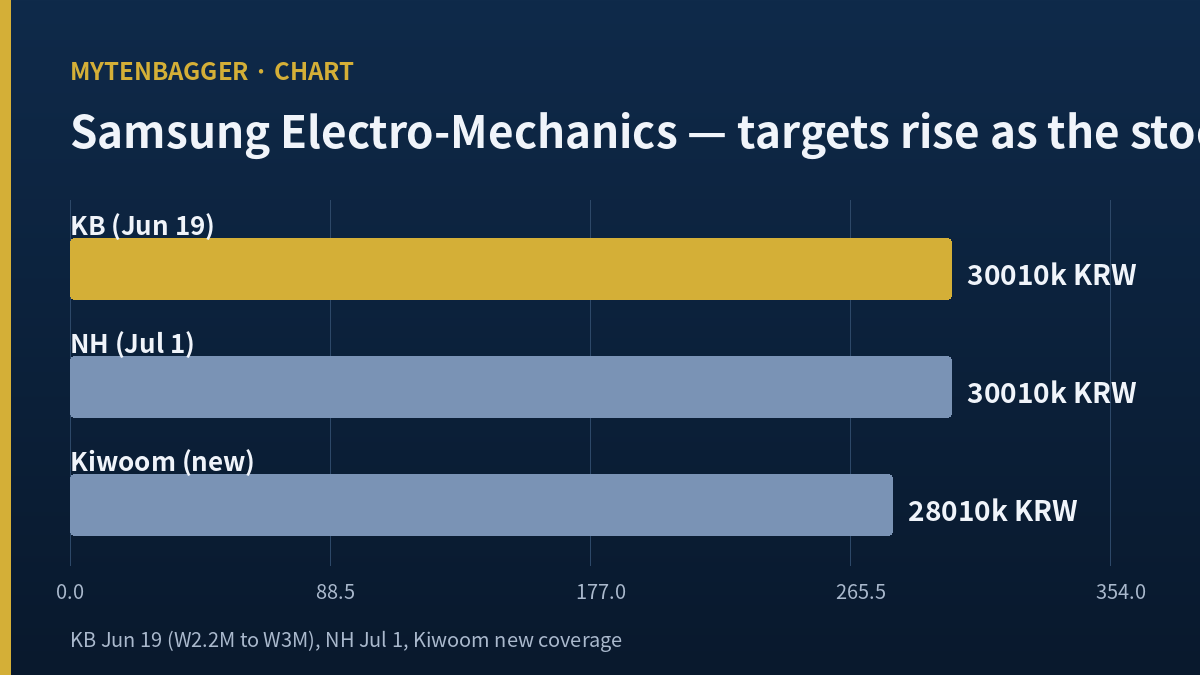
Normally that combination is the sound of a bubble letting go. What makes this one strange is what happened on the other side of the tape. While the shares were being cut down, Korean brokers were raising their numbers, not cutting them. KB Securities lifted its valuation call to ₩3.0 million on June 19. NH Investment did the same on July 1. Kiwoom opened coverage at ₩2.8 million. The price went one way and the sell-side went the other.
I spent an evening on that gap. I came out of it without buying — and not because the multiple scared me. What stopped me was pricing power.
A note on units before I go further. This company reports in Korean won, its contracts are disclosed in won, and the dollar conversions floating around the English-language press disagree with each other because they use different FX assumptions. So I quote won as the source unit and give the dollar figure only where the source itself supplied one. I would rather be usable than tidy.
Contents
What the Samsung Electro-Mechanics stock rally is actually pricing in
The shortage is showing up in contracts, not just commentary
Here is the piece of news that I think matters more than any broker note. On June 30 the company disclosed a long-term MLCC supply agreement with an unnamed global big-tech customer. TrendForce, citing Global Economic News, put it at roughly ₩450 billion — about $330 million on their conversion — running for one year from January 1 to December 31, 2027.
Read the shape of that, not the size. In MLCCs, short orders are the norm; multi-quarter lock-ins are not. A customer signing for 2027 volume in mid-2026 is a customer that has decided it might not be able to get the parts later. That is the behaviour of someone who is frightened of a shortage, and it is worth more than any analyst adjective.
It was not an isolated signature either. The same TrendForce piece notes an earlier agreement — a two-year silicon capacitor supply deal reported at ₩1.5 trillion, running from January 2027 through December 2028. Two long-term lock-ins inside two months tells me the customers are moving before the price does.
The physical demand math is genuinely absurd
I like this part because it does not require me to trust anyone’s model. AI servers consume more than ten times the MLCC count of a conventional server, per ZDNet as relayed by TrendForce. A single GPU can carry over 20,000 of these things. A full rack can run to 600,000. Korean press covering Nvidia’s VR200 NVL72 platform put its MLCC content around 600,000 units, more than 30% above the GB300 generation.
So every step up in accelerator specification mechanically drags more capacitors into the box, and the ones it drags in are the hard ones — higher capacitance, smaller package, higher temperature tolerance. That is a content story layered on top of a unit story, and content stories are what move average selling prices.
Murata’s own president, Norio Nakajima, told Bloomberg that he expects cloud-driven data centre investment to run for another three to five years, and that customer inquiries for Murata’s MLCCs are coming in at roughly twice the company’s available supply. When the market leader says demand is double his capacity, I take that as the most honest supply signal available.
The moat here is qualification, not cost
Whenever I look at a company I force myself to name the kind of moat before I decide whether it matters. For this one I would not call it a cost moat and I would definitely not call it a pricing moat. I call it a switching-cost moat built on qualification.
An AI accelerator board needs high-temperature, high-capacitance, high-layer-count MLCCs and it needs a large, many-layered flip-chip substrate. Both parts have to pass the customer’s qualification before they are allowed onto the board, and once they are designed in they tend to stay until the board itself is redesigned. Samsung Electro-Mechanics is unusual in making both parts in-house — the capacitor and the substrate — which is exactly the combination the AI board wants. Korea’s trade ministry has also designated ultra-high-capacitance MLCC design and process technology a national core technology, which is a bureaucratic way of saying the entry barrier is real.
The moat answers “are you allowed on the board?” It does not answer “what can you charge once you are there?” That distinction is the spine of this entire journal entry.
Samsung Electro-Mechanics stock and the numbers behind it
Everything below is dated, and I have tagged who produced each figure, because a company guide, a broker estimate and a consensus print are three different animals and I have been burned before by mixing them.
| Item | Figure | Whose number |
|---|---|---|
| FY2025 revenue / operating profit | ₩11.3tn / ₩913bn | Reported result (+23.3% YoY) |
| Q1 2026 revenue / operating profit | ₩3.0tn / ₩281bn | Reported result (+40% YoY, first ₩3tn quarter) |
| Component division utilization | 99% | As of Q3 2025 (+13pp YoY) |
| Q2 2026 operating profit | ₩400bn | NH Investment estimate (Jul 1); consensus ₩382bn |
| FY2026 operating profit | ₩1.71tn | Hana Securities estimate (Korean sell-side) |
| Trailing P/E / P/B / ROE | 174x / 12.7x / 7.7% | Trailing, on the July 10 close |
| Global MLCC share | ~25% | Global Economic News, via TrendForce |
| AI-server MLCC share | 40%+ | Global Economic News, via TrendForce |
Sources: company disclosures, TrendForce, NH Investment, Hana Securities, Korean market data | As of July 10, 2026
A trailing P/E of 174 tells you nothing here, and I want to be blunt about that rather than hide behind it. You are dividing today’s price by last year’s ₩913 billion of operating profit. Of course the answer is silly. The price in front of you contains 2027, not 2025.
The first piece of 2027’s evidence has already landed, though. Q1 2026 was the first ₩3 trillion revenue quarter in the company’s history, with operating profit up about 40% year on year. On the call, management said usage of dedicated high-temperature, high-capacitance MLCCs for AI servers was climbing sharply and that supply-demand in the AI and server segment would be tighter than last year. That is the company talking about its own order book, not a broker extrapolating. I weight it accordingly.
Utilization says the same thing from another direction. The component division that houses MLCC was running at 99% as of the end of Q3 2025, up 13 percentage points year on year. The lines are full. When lines are full there are exactly two ways to grow revenue: raise the price, or build more lines. Every argument about this company for the next two years collapses into that one sentence.
And here is where I keep my honesty. The upgraded 2026 and 2027 numbers are estimates, not results. Hana’s ₩1.71 trillion of operating profit for this year would be roughly a doubling of last year. Between a trailing 174x and that estimate sits a gap filled entirely with belief. I do not put size into a gap filled with belief.
Why I stopped short of buying Samsung Electro-Mechanics stock
The trigger is pulled in Kyoto
This is the part that took me from interested to sidelined.
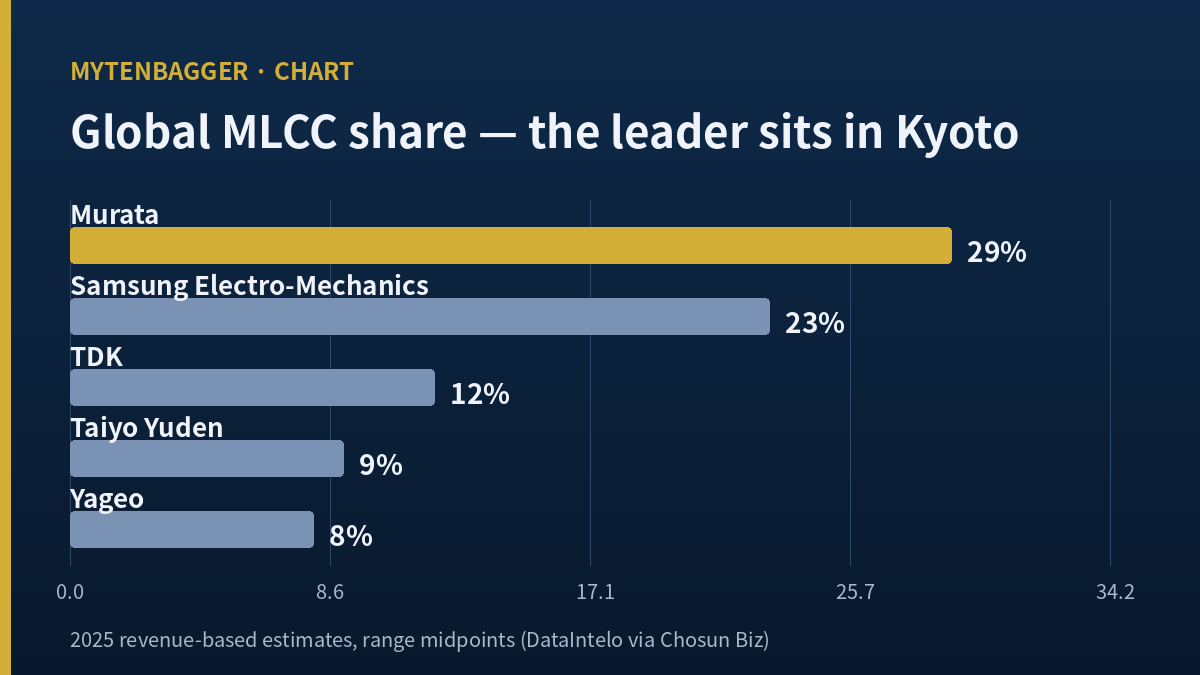
Korean industry reporting through the spring described the sequence plainly: Murata, the market leader, signals a price increase; the rest of the industry watches customer reaction; then Samsung Electro-Mechanics follows. The reason is not timidity. It is memory. In the 2017–2018 upcycle this company moved first on price, lost part of its customer base to rivals, and spent years — Korean press puts it at three to five — clawing the share back. Having paid that tuition once, it now waits.
I do not think that is a management error. I think it is a scar, and scars are rational. But look at what the scar costs. If Murata has to raise before Samsung Electro-Mechanics can raise, then this company’s earnings upgrade is not a decision it makes. It is a derivative of a decision made in Kyoto. Every ₩3 million valuation call I have read rests on the premise that prices go up — and the finger on that trigger belongs to somebody else.
The export mix hardens the point. Korean filings show the overwhelming majority of this company’s MLCC revenue is exported — the mid-90s percent range. Its price is not set at home. It is set inside a global pricing order, and the first mover in that order is the share leader.
The share numbers do not agree with the headlines
You will see this company described as the world’s number one component maker. The share tables do not say that. Global Economic News, via TrendForce, puts its global MLCC share around 25%. Murata is ahead. The company’s genuine crown is narrower: above 40% of the AI-server MLCC segment, a segment where technical difficulty keeps the field small.
That narrow crown is a real asset and I do not want to talk myself out of it. But being co-leader of the profitable slice is a different proposition from leading the market, and only one of those two facts gives you the pen when the price list is written.
There is also a genuine disagreement in the data that I think most write-ups paper over. TrendForce’s own read is that while high-end lines run near capacity, overall MLCC utilization and inventories remain soft because consumer demand is weak — a polarized market, not a broad shortage — and that leading suppliers have been prioritizing price stability over aggressive across-the-board hikes. Goldman Sachs, as of the spring, had lifted its 2026 MLCC price forecast only from flat to up 0–5%. Meanwhile Korean industry chatter has Murata notifying customers of increases in the 15–35% range, and other desks talk about hikes of 30% or more into 2027.
Those are not small differences of opinion. That is a spread wide enough to drive a truck through, and the entire bull case sits inside it. When the range of credible forecasts is that wide, the honest position is that nobody knows yet — which is precisely why I want to see one printed quarter before I commit capital.
And my own book is already long this trade
Full disclosure of the unflattering kind. More than half of my equity book already sits in Samsung Electronics and SK Hynix, with AI semiconductor ETFs and a handful of Korean equipment names stacked on top. That book is currently down by a double-digit percentage.
Buying this name would not be adding a position. It would be buying the same bet a second time. If AI server capex wobbles, I am already hurt; I do not need another door into the same room. So I am passing — not because I dislike the company, but because there is no room for it in the portfolio I actually own. That is a statement about me, not about the business, and nobody should copy it.
Three paths for Samsung Electro-Mechanics stock
My base case (55%) — the drawdown was froth, not the top
The increases Murata is reported to have notified stick, customers absorb them, and Samsung Electro-Mechanics follows within a quarter. Q2 lands near NH’s ₩400 billion, the second half builds from there, and the trailing multiple melts as earnings arrive underneath it. In this path the 33% air pocket in early July is remembered as a valuation reset inside an intact cycle, and the shares spend the rest of the year re-rating on delivered numbers rather than promised ones.
Where I am wrong (30%) — the hike does not stick, or demand cools first
Customers push back on price, and the whole edifice wobbles, because every upgraded estimate assumes ASP does the heavy lifting. TrendForce’s polarized-market read is the warning label here: strength in high-end, softness underneath, and suppliers more interested in defending price stability than starting a broad hike. On the demand side, the tape has already shown how thin the ice is. On July 1 the Philadelphia semiconductor index fell 6.27% after reports that Meta might turn spare AI compute into a cloud business; the following session in Seoul, this stock opened down more than 9%. A stock that loses 9% to somebody else’s news headline is a stock carrying a great deal of expectation.
The tails (15%)
Best case (10%): the increases spread from high-end into commodity grades and the ASP lift runs well beyond what the cautious desks penciled in, with the FC-BGA substrate business compounding on top. Worst case (5%): 2018 repeats. The industry breaks ground at the top of the cycle and the new lines light up exactly as AI capex flattens. I read passive components as more dangerous than memory in this respect, not less — the capacity lead time is shorter, which sounds like an advantage right up until everyone uses it at once.
That worst case is not hypothetical. This company is already spending on Vietnamese substrate capacity — Korean trade press reported an investment in the ₩1.8 trillion range — and management has said it will keep expanding capacity around AI servers and automotive while funding future growth. Murata is doing its own arithmetic. Everyone breaking ground at 99% utilization is how every component cycle in history has ended. I watch capacity announcements more nervously than I watch price-hike headlines.
What would make me start buying Samsung Electro-Mechanics stock
I write entry conditions for names I do not own. If I skip that step, I end up buying them later on adrenaline instead of evidence.
1. Did component ASP actually rise in the Q2 print? If the number comes in materially below NH’s ₩400 billion, then “price increases” are still a hope rather than a line item. This is the condition that resolves first, and it resolves soon.
2. Can this company raise alongside Murata rather than behind it? If the lag between Murata’s move and Samsung Electro-Mechanics’ response compresses, the company stops being a derivative and starts being a principal. That, to me, would be the real re-rating event — more than any single quarter’s beat.
3. How much capacity does Murata add? If the leader expands aggressively, the length of this cycle shortens, and every price forecast above gets marked down. Prices have always broken on capacity, eventually.
These resolve in sequence rather than together. The first answers itself at the Q2 print. The second reveals itself over the following couple of quarters. The third is the slowest and the most consequential. I will work down that list in order, and if the first gate opens cleanly I will stop using a trailing multiple as an excuse.
Where I land today
I think this is a good company. It sits behind a qualification wall, it makes both of the parts the AI board is short of, and its narrow crown in AI-server capacitors is genuinely hard to attack. But a good company and a stock I should own today are two different sentences. As long as the trigger on pricing sits in Kyoto, I keep this one on the watchlist and wait for the Q2 numbers.
If somebody reads this and buys it anyway, that is their call. I have laid out the evidence I trust, the disagreement inside that evidence, and the fact that my own book is already leaning hard in the same direction. The materials are all on the table.
TrendForce — the ₩450bn AI-server MLCC supply agreement · TrendForce — the polarized MLCC market and Murata’s stance · TradingKey — MLCC peer map, ADRs and Vishay · DigiTimes — the 5–10% price hike deliberation · BigGo Finance — Korean brokers lift their valuation calls · Samsung Electro-Mechanics — investor relations
Related reading
- Hanwha Systems Stock: Profit Tripled, Price Down 66%. My Check
- Samsung Electronics Lost the Crown the Day It Posted a Record Profit