LG Energy Solution Stock: The Q2 Profit Washington Paid For
- LG Energy Solution stock (KOSPI: 373220) trades near ₩326,000 (about $216), roughly 38% under its 52-week high of ₩527,000. It just swung back to an operating profit after three losing quarters, and I do not take that profit at face value.
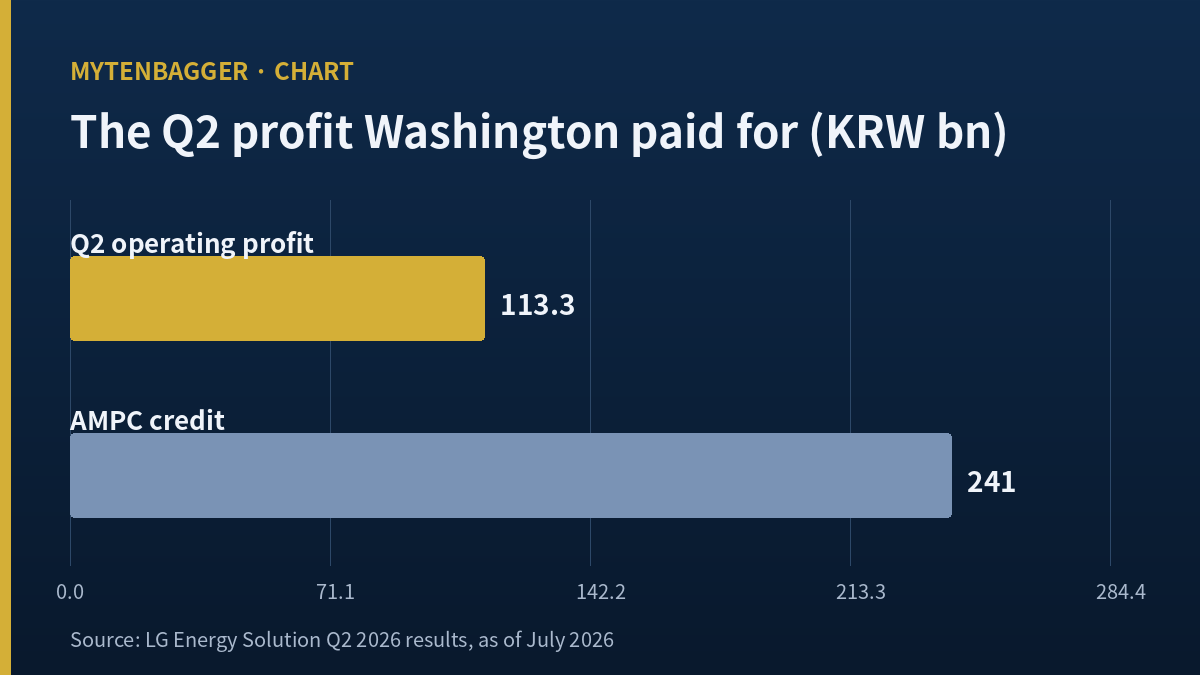
- The ₩113.3 billion (about $75 million) Q2 operating profit was more than covered by ₩241 billion (about $160 million) in US AMPC production credits. Strip the subsidy out and the operating margin is still minus 1.7%. The author of the profit is the US Treasury, not the company.
- I am genuinely bullish on the energy-storage (ESS) pivot. But I keep watching — not buying — until the ex-AMPC line turns positive on its own.
LG Energy Solution (LGES) posted a ₩113.3 billion operating profit in the second quarter of 2026, ending three straight quarters of losses (The Korea Times). The first thing I did when I saw that headline was not celebrate. I went looking for the author of the profit. Did the company earn it, or did someone else write the check?
The answer was already in the earnings table. In the same quarter, LGES booked ₩241 billion (about $160 million) in AMPC — the Advanced Manufacturing Production Credit, the US Inflation Reduction Act’s 45X subsidy for making battery cells on American soil. That credit is more than double the reported operating profit. Take it out, and the quarter is still in the red, with an ex-AMPC operating margin of minus 1.7%. That is why, even with LG Energy Solution stock down 38% from its 52-week high, I have not bought a share. I am watching. Below is what I am watching for, and what would change my mind.
Contents
Why I’m watching LG Energy Solution stock, not buying it
Most people searching this name want one of two things: reassurance that the bottom is in so they can buy, or a reason to keep holding a position that is underwater. I understand both impulses. But with my own money on the line, LGES has three gates to clear before I step in.
Gate one: the company did not make the profit
I said it above and I will keep saying it, because it is the whole thesis. The ₩113.3 billion operating profit does not exist without the ₩241 billion AMPC credit. Management’s own ex-AMPC operating margin was minus 1.7%, with roughly ₩100 billion in customs-refund costs and early ESS fixed costs still weighing on the core business (The Elec).
And even this subsidy-lifted profit came in light. The market consensus was about ₩188 billion, and LGES landed nearly 40% below it, which is why the shares slipped on the print (Bloomberg). A profit is a profit, but a profit that misses its own lowered bar made me pause a second time.
What actually lifted revenue was Tesla-bound cylindrical cell shipments and rising ESS volume, which offset the impact of a production slowdown at the Ultium Cells joint venture with GM (The Elec). I read that mix two ways. The good part is that LGES is no longer a one-customer EV story. The bad part is that the diversification has not yet shown up as margin.
There is a way to size how load-bearing the subsidy is. The ₩241 billion AMPC was earned on roughly 4.6 GWh of qualifying US output (Korean press estimate), which works out to about $35 per kWh — and that lines up almost exactly with the 45X cell-level credit rate of $35/kWh (Center for Climate and Energy Solutions). In other words, the credit is not a rounding item; it is a per-kWh stream large enough to be the difference between red and black ink every quarter. When a single line that Congress controls is the swing factor between profit and loss, I treat the equity as much as a policy position as an industrial one.
The direction is real — the ex-AMPC line has improved for three quarters, and I give the company credit for that. But “an improving loss” and “a self-sustaining profit” are different animals. Until the second one shows up, I do not count this as a profit.
I ran into the mirror image of this at Doosan Bobcat. There, second-quarter operating profit jumped 42.9% — and the beat rested on an $81 million US tariff refund, so on a dollar basis excluding it the line runs about minus 22% (my read on that quarter). One company’s profit is written by a subsidy it collects; the other’s by a refund it gets back. The direction differs, the question does not: take out the line a government controls, and what is left standing?
Gate two: a US demand cliff starts hitting in the second half
Policy worries me more than the income statement. The One Big Beautiful Bill Act (OBBBA) ended the US consumer EV credit (30D, up to $7,500 per vehicle) on September 30, 2025 — seven years earlier than its original 2032 sunset (Center for Climate and Energy Solutions). When the consumer subsidy disappears, US EV demand softens; analysts flagged a post-September dip well before the deadline (Thomson Reuters). North American EV supply is a large slice of LGES revenue, so that cliff shows up in the numbers from Q3 onward. I do not pull the trigger before I see how deep it cuts.
I will be honest about my own record here. I misread the battery cycle once before. Early in the EV chasm I waved off the correction as almost over, and I badly underestimated how long the sector would keep bleeding. Since then I have gotten much stingier with the word “turnaround.” So this time I read the line under the headline first.
Gate three: the valuation is ahead of the loss
The numbers give me pause too. On a trailing basis LGES still shows a negative annual operating result (about minus ₩300 billion) and a return on equity of minus 5.2% (trading indicators, as of July 10). Yet the stock carries a price-to-book of about 3.77. That is nearly four times book value on a company that is not yet earning money. You can call it a growth premium, but when a premium runs this far ahead of results, I have usually chosen to wait.
Cash flow is heavy as well. Trailing operating cash flow is negative (about minus ₩316 billion) and the debt-to-equity ratio is around 140% (trading indicators, July 10). Some of that is fair for a company mid-expansion, but while the core business is not generating cash, a high multiple keeps me patient. It is not a question of good or bad; it is a question of sequence.
OBBBA’s two blades: 45X stays, 30D is gone
Here is the distinction the market keeps blurring. OBBBA swung two blades at the battery industry, and they point in opposite directions. Mix them up and you misread LGES.
The consumer credit (30D) is gone; the production credit (45X / AMPC) stays. LGES lost its demand-side support and now leans harder on its supply-side support.
The first blade, 30D, ended early, as noted. The second blade, 45X — the manufacturing credit worth $35/kWh at the cell level, among other tiers — was not repealed; it phases down over time and is scheduled to end in 2032 (Center for Climate and Energy Solutions). So the AMPC that LGES currently leans on for its profit does not vanish tomorrow. The problem is that it is on a clock. If the core business cannot stand on its own before the credit thins out, the prop under the profit is slowly pulled away as 2032 approaches. To me that reads less as “support is cut” and more as “the countdown on that support has already started.”
One counter-point belongs here too. The same policy shift raised US tariffs on Chinese batteries sharply (toward 40.9% in 2025 and 58.4% in 2026, per Korean trade press), which hands US-based producers like LGES a tailwind on the ESS side (Benchmark Mineral Intelligence). So this policy is a headwind for EV and a tailwind for ESS at the same time — crosswinds, not one clean gust.
Where ESS makes me genuinely bullish on LG Energy Solution stock
This is the part where, honestly, my expectations run high. I think LGES’s next cycle key is not the electric car but ESS — energy storage systems — and I want to bet fairly hard on that direction.
In late May, LGES signed a $1.6 billion (about ₩2.4 trillion), roughly 6-GWh ESS supply deal with DTE Energy, a large US utility (Yahoo Finance). It runs about two years, is built on LFP chemistry out of the Holland, Michigan plant, and is tied to surging AI data-center power demand within the Oracle/OpenAI buildout (Korea JoongAng Daily). When batteries start selling as power-infrastructure components rather than car parts, that is a structural shift, and I expect a lot from it. Data centers need firm, dispatchable power on a timeline that new generation cannot always meet, and grid-scale storage is one of the few things that can be deployed fast enough to bridge that gap — which is exactly the demand LGES is now positioned to serve from US soil.
But I tie my expectation to data. The ESS pivot is a substitute for EV demand in the chasm; it is not EV demand coming back. And in this very quarter, early ESS fixed costs actually pressed on core profitability. Revenue is climbing — Q2 revenue was about ₩7.56 trillion, up 24.8% year on year (The Korea Times) — but that revenue is not yet dropping through as thick profit. My expectation is large; my rule is to confirm it lands on the income statement before I step in.
There is a genuine moat forming here, though. LGES is widening its ESS portfolio by converting lines to LFP (at Ultium’s Tennessee site, among others), and in a market where the US is stacking tariffs on Chinese cells, the list of players that can mass-produce LFP ESS inside the United States is short. That scarcity is close to a real competitive edge. On ESS alone, I am fairly optimistic.
One cold caveat, though. The market cheered the “$1.6 billion ESS deal” as a big catalyst, but I also watch the pace at which that backlog converts to revenue. It ships over roughly two years, and fixed costs lead early. There is a lag between the number in the order announcement and the number that lands in quarterly profit. Ignore that lag and you start believing “backlog equals profit.”
LG Energy Solution stock by the numbers
These are the figures I lay out on a table and stare at before I risk any capital. The line my eyes kept returning to was the gap between “operating profit” and “ex-AMPC.”
| Metric | Q1 2026 | Q2 2026 | Note |
|---|---|---|---|
| Revenue | ~₩6.6T | ₩7.56T ($5.0B) | +24.8% YoY |
| Operating result | -₩207.8B | +₩113.3B ($75M) | first profit in 3 quarters |
| AMPC credit | — | ₩241B ($160M) | +27% QoQ |
| Ex-AMPC op. margin | negative | -1.7% | core still in the red |
| P/B · ROE | 3.77x · -5.2% | BPS ₩86,391 | |
| Price vs high | -38% from 52-wk high | -18% in 3 months | |
Sources: Q2 results via The Korea Times / The Elec / Bloomberg (2026-07-07 preliminary); valuation and price position from trading indicators (as of 2026-07-10). Q1 revenue is approximate; USD conversions at roughly ₩1,510/$.
How does the sell-side see it? NH Investment & Securities set a price objective of ₩580,000 (about $384) on June 25 with a buy call, describing the weak patch as “aftershocks felt while passing through the bottom” — though the same note trimmed its figure from a prior ₩610,000. In May, Daol pegged ₩550,000 and Hana ₩530,000; in early June, LS Securities was as cautious as ₩397,000 (each per Korean sell-side reports). The fact that the band runs from ₩397,000 to ₩580,000 tells me the market itself has not agreed on where the bottom is. I read that spread as a lack of conviction. These figures are each brokerage’s own view; I do not adopt any of them as mine.
Widening the lens does not make me rush either. China’s CATL — the world’s number-one cell maker, listed in China — stays profitable while gaining share, even as the three Korean makers lose global share (per industry share trackers). A number-one that holds a downcycle on real profit is a different animal from an LGES whose profit is subsidy-made. CATL is also pushing sodium-ion cells, adding pressure on both price and technology, and the general industry view is that Korea cannot beat China head-on on cost. So I see LGES’s real battleground not as “make it cheaper” but as “the right to make it inside the United States” — the fence that tariffs and credits built. The catch is that half of that fence, the demand-side subsidy, has already come down.
The rest of the peer field says the same thing in a different way. Japan’s Panasonic, Tesla’s other major cell partner, faces the same US EV soft patch but on a narrower customer base. BYD, vertically integrated and selling its own cars, turns battery scale into finished-vehicle margin in a way a pure cell supplier like LGES simply cannot. Measured against that field, LGES’s edge is neither cost nor integration — it is location. It can make cells and LFP storage inside the US tariff wall. That is a real asset, but it is a policy-made one, and policy-made moats can be re-legislated. I keep that at the back of my mind every time the ESS headlines get loud.
Three paths I see for LG Energy Solution stock
The path I weight most (about 50%)
ESS orders keep stacking, the EV cliff offsets them, and the ex-AMPC line hovers near zero for a few more quarters. The stock holds its current wide range. This is the picture the data explains best to me, and on this path I stay on the sidelines.
The path where I start buying (about 30%)
In the Q3 or Q4 print, operating profit turns positive even after backing out AMPC, and ESS revenue margin is confirmed to clear its early fixed costs. That flips “subsidy profit” into “self-made profit,” and I start scaling in from that quarter. I will admit it — I would be glad to see this one arrive. What would make me lean in earlier is a second large ESS award at a disclosed margin, because that would tell me the DTE deal was a template rather than a one-off, and that the data-center demand is deep enough to reprice the whole ESS line.
The path where I walk away (about 20%)
The 30D expiry pulls North American EV volume down more than expected, and Chinese LFP price pressure eats into ESS margin too. The ex-AMPC loss then deepens again. This is not a stretch; it only needs two trends that are already in motion to overlap.
Laying these three over the sell-side band sharpens the picture. Today’s ₩326,000-ish price sits below even the most cautious call, LS Securities’ ₩397,000. That tells me the market has already priced in some shadow of the third path. So I read this level not as “cheap” or “expensive” but as “an unresolved range,” and the resolution comes on one page: the next income statement.
The levels that would break my thesis on LG Energy Solution stock
My watch has an order to it. The first answer arrives with quarterly earnings. If the Q3 print shows a positive ex-AMPC operating result, I take that as the profit’s author changing to the company, and I end this watch. That is my first checkpoint.
Next comes the measured policy impact. How much the early 30D expiry actually shaved off North American deliveries shows up in Q3–Q4 revenue. If the hit is smaller than feared, that means the ESS tailwind is already offsetting the EV headwind, and my weight shifts toward the second path. If the hit is large, I take the third path more seriously.
Last is core stamina. As long as AMPC is on a clock, the one thing I want to confirm is whether the core margin thickens faster than the subsidy thins. If that inequality flips the right way, the story gets a spine; if it does not, I keep watching. This journal is valid only through the Q3 release — once those numbers land, I have to rewrite it.
Where I stand on LG Energy Solution stock
To sum up: I have not bought LGES, and I keep watching despite the return-to-profit headline. The reason narrows to one line. The ₩113.3 billion Q2 profit was made not by the company but by ₩241 billion of US AMPC credit, and once the subsidy is out, the core is still negative. At first I felt the pull — “three quarters and it’s profitable again, isn’t that the bottom?” — but after tearing through the table twice, checking the author of the profit came first.
That does not make me a bear. The picture of batteries selling as power infrastructure is one I expect a lot from. What I am waiting for is a single line — profit that survives without AMPC. When the quarter that prints it arrives, I end this watch and scale in. Until then I keep watching. Until that quarter prints, this stays a watch and not a position.
Related reading
- Korean Patriotic Stocks: Why I Cheer the Crab Stick, Not the Shares
- Samsung C&T Stock: 29% Drop, Stakes Worth Twice the Cap
- LG Chem Stock: Why I Trust the Credit Cut Over the Cheap Math