Korean Value-Up Stocks: Shinyoung and Bookook Brokerages
- Behind the headline Korean value-up stocks, I found something more interesting: two small, family-controlled brokers that hoarded treasury shares for decades — Shinyoung and Bookook — both turning shareholder-friendly at once.
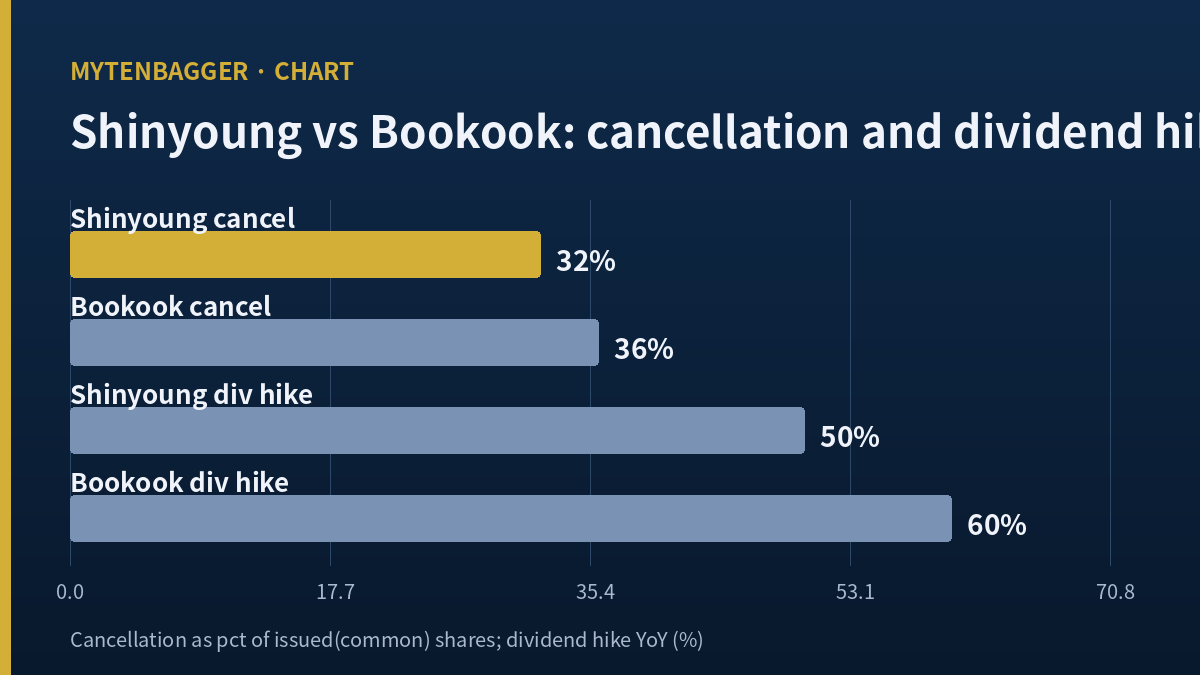
- Shinyoung had its shareholders approve cancelling 32% of issued shares (5.26M) and lifted its dividend to ₩7,500 (+50%). Bookook approved cancelling 36% of common shares (3.73M, worth roughly half its market cap) and raised its dividend to ₩2,400 (+60%).
- I am watching both, not buying either. I hold three counter-views to the “high-yield broker equals safe” reflex, and those counter-views are my breakpoints.
Korean value-up stocks have been the loudest story in Seoul this year, but the coverage clusters around the giants — Mirae Asset, Samsung Securities, Kiwoom. I kept looking behind them and landed on a different picture. The real test of the value-up program isn’t the large, already-efficient brokers. It’s the companies that sat for years on mountains of their own treasury stock, controlled by founding families, and left trading below what their books say they are worth. If the value-up pressure has any real force, it eventually has to move those names. (For non-Korean readers: KOSPI is Korea’s main stock exchange, roughly analogous to the NYSE and the S&P 500 for the US market. All figures below are in US dollars first, with Korean won in parentheses, converted at about ₩1,380 to the dollar.)
Two brokers landed squarely on that test in the first half of 2026: Shinyoung Securities and Bookook Securities. Both announced expanded shareholder returns around their spring and early-summer meetings, and then the market went quiet on them. That quiet is exactly why I wanted to look. This is my record of how I read the two names, and why I decided to watch rather than buy.
Contents
Korean value-up stocks: what I actually saw at Shinyoung and Bookook
Shinyoung Securities — the treasury hoarder that finally turned
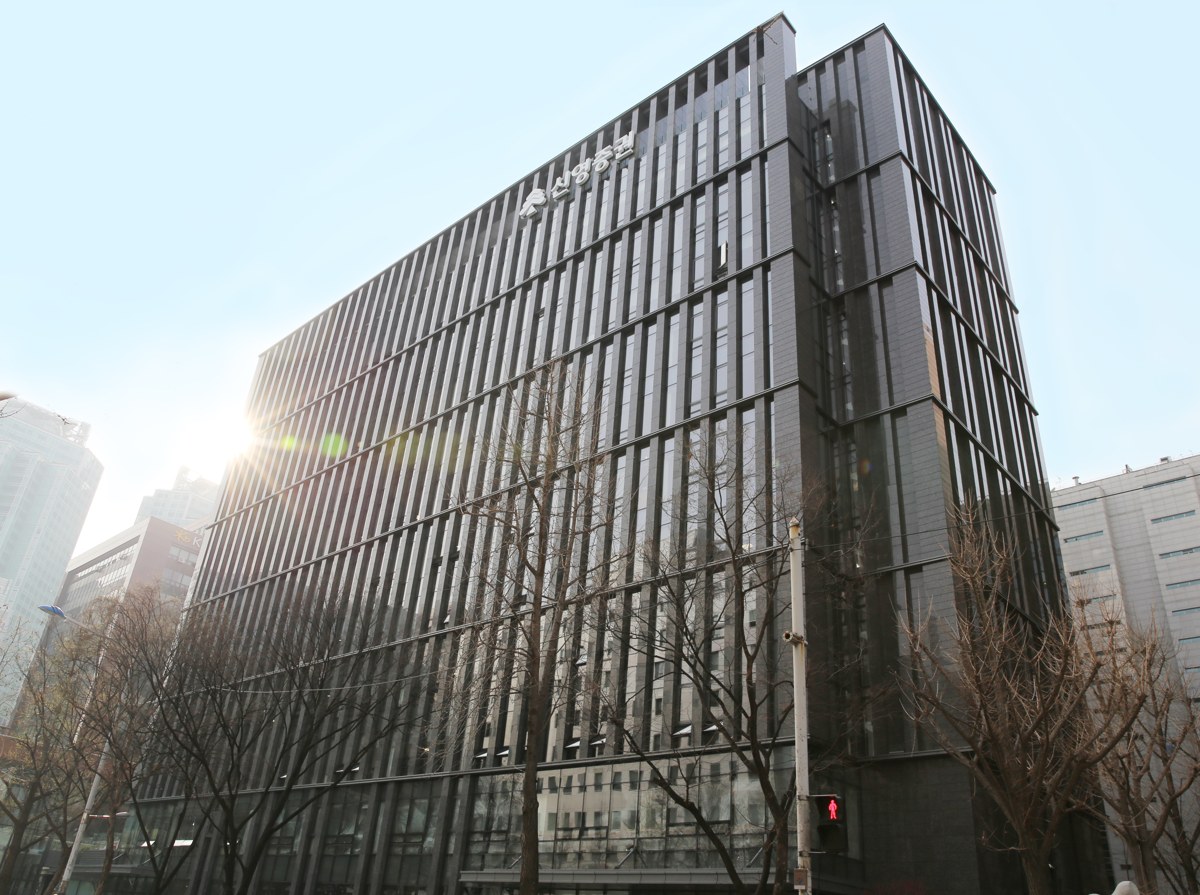
Anyone who has followed Shinyoung knows the nickname: the treasury-share hoarder. It held more than half of its own issued shares in treasury — the highest ratio among Korean brokers — and the market treated that as a discount. Stock a company buys back but never retires sits in a strange limbo: it can later be used to reinforce family control or deployed for other purposes, and that optionality is precisely what minority holders don’t like. Korean financial press noted Shinyoung’s largest shareholder and related parties held only about 20% directly, meaning the >50% treasury block had effectively served as a control buffer.
That changed. At its 72nd annual meeting on June 19, shareholders approved cancelling 5.26 million shares — 32.01% of issued stock, and roughly 62% of the treasury pile. English-language coverage from Seoul Economic Daily reported the same package: a 32% cancellation alongside the dividend increase (see Seoul Economic Daily, and its earlier tally of broker treasury ratios here). Korea’s amended Commercial Act sets a statutory cancellation deadline of September 2027; Shinyoung locked in the size at this meeting, though Korean sell-side reporting frames it as a company taking the deadline at a measured pace rather than racing ahead. I read the size commitment itself as the signal. A firm that stacked treasury stock for thirty years agreeing to erase a third of it is trying to lift the discount that the hoard created.
The dividend moved too. Shinyoung raised its common dividend to ₩7,500 ($5.40) from ₩5,000, a 50% increase, taking the total payout to about $44 million (₩60.1B) from roughly $29 million (₩40.1B) a year earlier. Shareholders also struck the clause excluding cumulative voting, so from the first director-election meeting after September 10, cumulative voting applies — a governance lever for minority holders. Cancellation, dividend, and board mechanics all moved at once.
On the numbers, Shinyoung can afford this. Shareholders’ equity is around $1.25 billion (₩1.73T), close to its own market capitalization of about $1.9 billion (₩2.58T), and its operating margin runs near 47%. The one thing I flag is the top line: revenue of about $299 million (₩412.2B) was down roughly 11% year over year. The margin is high, but the business is shrinking. For the cancellation-and-dividend story to last several years, revenue and profit ultimately have to hold. I keep that “shrinking top line, expanding returns” combination in mind whenever I look at Shinyoung.
Bookook Securities — below book value, and cancelling 36% on top
Bookook is a different animal. Founded in 1954, it is light on retail brokerage and leans on fixed-income and derivatives trading plus real-estate-linked IB. It was also the second-biggest treasury hoarder among brokers, at about 43%. What caught my eye first was valuation. The stock trades near $41 (₩56,300) against book value per share of about $48 (₩66,693). It trades below the net asset value on its own books — a 0.84 price-to-book multiple, a classic deep-value setup even by brokerage standards.
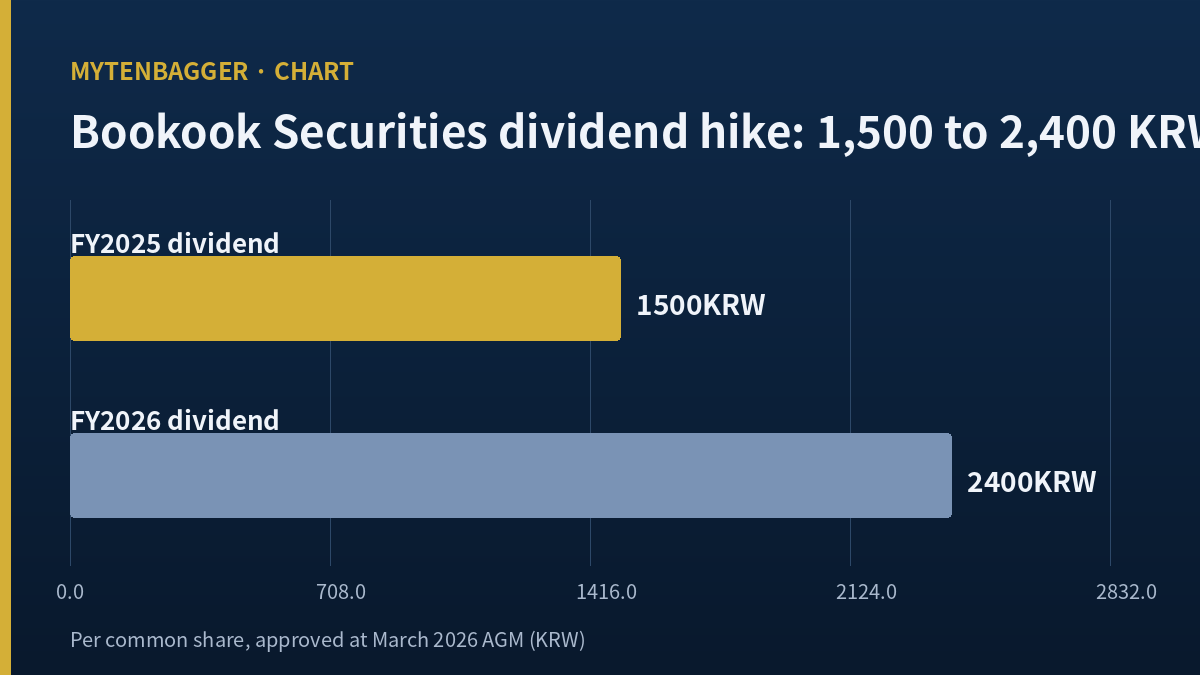
Then that company pulled two levers at once. First, at its 72nd shareholder meeting on March 27 it approved cancelling 3.73 million common shares — 35.98% of common stock. Korean disclosure filings put the size at roughly $220 million (₩304.1B) at the prior day’s close, more than half of Bookook’s entire market capitalization, with the retirement running through July 2027 (about 700,000 shares earmarked for employee ownership and compensation are excluded). Independent English coverage from Smartkarma’s Douglas Kim flagged the same 36% common-share cancellation and noted Bookook’s large net-cash position (see Smartkarma). Second, Bookook raised its dividend to ₩2,400 ($1.70) from ₩1,500, a 60% increase, for a yield around 4.3% and a payout ratio in the 70s. A company trading below book is retiring a third of its stock while pushing out most of its earnings as dividends. That is the same “treasury hoarder cancels big and hikes the dividend” pattern as Shinyoung — happening below net asset value.
Bookook’s balance sheet is not fragile. Equity sits around $548 million (₩756.1B), and a Korean credit-rating agency’s assessment describes its loss-absorbing capacity as better than the sector average. Its revenue trajectory also runs opposite to Shinyoung’s: the top line of about $130 million (₩179.7B) grew roughly 24% year over year, with an operating margin near 32%. Where Shinyoung is “high margin, shrinking,” Bookook is “low ROE, but growing.” It also owns an asset-management subsidiary, giving it a fee stream alongside the trading and real-estate IB book. The money behind a 60% dividend hike and a one-third share cancellation isn’t coming from nowhere.
There is one more number that reframes how cheap Bookook is. Independent coverage from Smartkarma’s Douglas Kim put Bookook’s net cash at about ₩1.2 trillion as of the third quarter of 2025 — a figure it pegged at roughly 133% of the company’s market capitalization at the time. Read that literally: the cash on the balance sheet, net of debt, was worth more than the entire equity value the market was assigning the business. Even allowing for the share-price moves since, that is the profile of a company where the operating franchise is being handed to you for close to free once you back out the cash. It is also why a 36%-of-common-shares cancellation is credible here — Bookook has the liquidity to retire that much stock without straining the business. I treat that net-cash cushion as the single most important item in the deep-value case, and also as the thing most likely to be quietly deployed in ways minority holders don’t control.
The two catalysts that pushed both at once
Why did two different companies move in the same window? I see two policy drivers behind it. The first is the amended Commercial Act. Its third revision this year mandates that treasury shares acquired before the law took effect be cancelled — or managed under a shareholder-approved plan — within 18 months of the effective date (September 2027 for Shinyoung’s timeline). As AMRO and AllianceBernstein both note, the mandatory-cancellation rule is aimed squarely at controlling families that used treasury stock to entrench themselves. Shinyoung and Bookook, the two biggest broker hoarders, sat at the center of that pressure. The mechanics matter for shareholders: as the Korea Herald explains, cancelling shares cuts the count outstanding, which lifts earnings and dividends per share even if total profit and payout are unchanged (see The Korea Herald).
The second driver is dividend-tax reform. Korea’s National Assembly moved to cut the tax rate on dividend income sharply — from a top rate near 45% toward the 14–30% range — for higher-payout companies, with the benefit tied to firms that maintain strong payout ratios (a payout above 40% is the headline threshold) or meaningfully raise dividends (see Janus Henderson and Asian Century Stocks). Both Shinyoung (+50% dividend) and Bookook (70%-plus payout, +60% dividend) clear those bars. Policy is pushing from both the treasury-cancellation side and the dividend side, and the more deeply discounted the company, the more a single cancellation-plus-dividend signal can re-rate the multiple. Foreign inflows into Korean equities have picked up since mid-2025 as these reforms took hold, and activist funds have increasingly targeted exactly this profile — heavy treasury holdings, low price-to-book, and low founder ownership. That is the frame that made me look at these small Korean value-up stocks in the first place.
Korean value-up stocks side by side — Shinyoung vs Bookook
Laid out in numbers, the two companies’ personalities separate cleanly. Figures are as of July 10, 2026 (USD converted at ~₩1,380/$1).
| Metric | Shinyoung (001720) | Bookook (001270) |
|---|---|---|
| Share price | $114 (₩156,900) | $41 (₩56,300) |
| Market cap | ~$1.9B (₩2.58T) | ~$423M (₩583.8B) |
| P/B | 1.21x | 0.84x |
| P/E | 17.3x | 16.5x |
| ROE | 8.0% | 5.7% |
| Operating margin | ~47.5% | ~31.6% |
| Revenue (YoY) | ~$299M (−11%) | ~$130M (+24%) |
| Shareholders’ equity | ~$1.25B (₩1.73T) | ~$548M (₩756.1B) |
| Dividend / share (latest FY) | ₩7,500 (+50%) | ₩2,400 (+60%) |
| Dividend yield | 3.69% (company) | 4.26% (filings) |
| Share cancellation (of issued) | 32.01% (5.26M, Jun AGM) | 35.98% (3.73M, Mar AGM) |
| Foreign ownership | 6.0% | 1.0% |
| 3-month price change | ~−24% | ~−27% |
Here is how I read the table. Shinyoung trades above book at 1.21x; Bookook trades below book at 0.84x. But the shareholder-return structure is strikingly similar — both are retiring roughly a third of their shares and both raised dividends hard. If anything, the below-book name (Bookook) is the more aggressive one, with a cancellation worth over half its market cap and the bigger dividend hike (+60%). The common thread is low ROE — 8.0% for Shinyoung, 5.7% for Bookook. Neither earns a high return on the capital it runs. So these are not “buy them for growth” stocks; they are “share count shrinks and the discount closes” stocks. Both have fallen more than 20% over three months, which only lowers the entry multiple further.
The reason the cancellations matter so much here is arithmetic. Because both companies hoarded such a large treasury block, retiring a third of the share count has an outsized effect: earnings and book value per share rise mechanically even if total profit and total equity don’t move. Shinyoung erasing 32% of issued stock and Bookook 36% of common shares means the same net asset base and the same dividend pool get divided across far fewer shares. For a below-book name like Bookook, that math is the whole thesis — if the ₩756B of equity ends up spread over roughly a third fewer shares, book value per share jumps and the 0.84x multiple looks even more stretched at today’s price. For Shinyoung, the cancellation plus the 50% dividend hike is what turns a decades-long treasury overhang into a per-share tailwind. This is the lever value-up is really pulling at these two, and it’s why I care more about execution than about any single quarter’s revenue line.
Low ROE, heavy dividends, and a one-third share cancellation — this is a de-rating-reversal story, not a growth story. So I watch whether the returns are sustained, not how fast the price moves.
Korean value-up stocks re-rating — the path I see
The path I think is most likely (~55%)
My base case: the push from the Commercial Act and the dividend-tax change is a multi-year structure, not a one-off. Shinyoung has fixed the cancellation size, the dividend, and cumulative voting in one motion, and the disposal path for its remaining treasury block is the next thing to watch. Bookook’s approved 36% common-share cancellation, if it actually executes through July 2027, lifts EPS and book value per share materially and narrows the below-book gap. On this path both names become slow re-rating stories — you collect the dividend while the shrinking share count pulls per-share value up — not momentum trades. The market backdrop helps: Korean brokerage daily turnover ran around $85 billion (₩118T) in the second quarter and reportedly reached roughly $99 billion (₩137T) in June, per a sector “overweight” note.
For US-based readers, one practical note fits here. Neither Shinyoung nor Bookook has a US-listed ADR, and both are thinly traded small caps. Korea is also moving to require English-language disclosures for KOSPI companies from 2027 and to extend won trading hours, which should slowly ease the access friction for foreign investors.
Where I could be wrong (~30%)
I weight the other side heavily. Bookook’s biggest risk is real-estate finance. It carries real-estate-linked exposure of roughly 21% of equity (about $116 million / ₩160B), and within that, logistics-center bridge loans are a large slice — around 60%. If the property cycle worsens, additional credit costs can surface, and that pressures the dividend and cancellation runway. Shinyoung’s risk is different: an 8% ROE means weak capital efficiency, and the single largest cash beneficiary of this round of returns is the founding family. On this scenario, the returns don’t translate into a re-rating — you just collect a dividend and wait.
The other paths (~15%)
If the broad market corrects, small, illiquid brokers tend to overshoot on the downside. Both are already off more than 20% in three months, and off roughly 42% (Shinyoung) and 46% (Bookook) from their 12-month highs; a further market shake could push them deeper below book. The mirror case: if the government ships stronger follow-on value-up policy, deep-discount, below-book names can pop again. Low probability on each, but I keep both open.
The other side of the high yield — the counter-views I hold
This is the real reason I keep this as an observation journal. There is a market reflex that “high-yield brokers are safe.” I hold three counter-views against it.
First, at Shinyoung the largest cash beneficiary of the returns is the owner, not the minority holder. The founding Won family’s share of this dividend round is estimated at roughly $17 million (₩22.9B) pre-tax. The return itself is a good direction, but whether it feeds back into minority value or reinforces family control is a separate question. If the remaining ~19% treasury stake tilts toward employee compensation or in-kind distribution rather than outright cancellation, I can’t read it as pure shareholder return.
Second, Bookook’s 70%-plus payout ratio is a double-edged sword. It’s reassuring when earnings rise, but if real-estate credit costs bend profit down, the dividend is the first line to get cut. A high headline yield inflated partly by a falling share price is the textbook yield trap. Entering on the yield number alone is dangerous here.
Third — and cutting the other way — Bookook has a buffer that doesn’t show up cleanly on the surface. A Korean credit assessment notes that the equities inside its risk assets are not volatile holdings but quality stakes such as the Korea Exchange and Korea Securities Finance, and that provisioning against watch-list bridge loans runs above 70%, with 90%-plus coverage on substandard-and-below exposures. On top of that, independent coverage flagged a large net-cash position relative to its market cap. On the surface it’s a deep-discount micro-broker; underneath, the asset quality is sturdier than the multiple implies. That hidden value explains part of the 0.84x discount, in my read. The counter-view and the buffer coexist — that is Bookook’s real face.
For a global frame, this rhymes with Japan more than the US. Japan’s earlier governance push re-rated a market whose price-to-book had hovered near 1x; Korea’s benchmark sits below that, and hundreds of small names trade at single-digit multiples. The Korea Value-Up Index has climbed well over 100% since its September 2024 launch and the KOSPI has pushed past the 5,500 level, yet the average price-to-book of the benchmark has still hovered around 1x, with more than 60% of Korean firms posting ROE below the long-term average — the exact discount the reforms are trying to close. Activist capital has noticed the setup: proxy-advisory data shows treasury-stock cancellations among Korean firms jumping sharply as campaigns and government signals converged (see Glass Lewis). Bookook, cancelling a third of its stock while sitting on net cash worth more than its market cap and trading below book, looks less like a US growth compounder and more like a Japanese cash-rich micro-cap in the early innings of a value-up re-rate. That is the lens I hold it through — and it’s a lens that only works if the cancellation and the payout actually stick.
Where my thesis breaks
So I hold neither name today; I watch. I write the breakpoints down in advance, ordered by which one answers first.
Bookook answers first. It reports real-estate-finance health metrics each quarter. If logistics-center bridge loans throw off additional credit costs, or the dividend base looks shaky, one leg of the “cheap plus high-yield” picture gives way. I also watch whether the approved 36% common-share cancellation actually executes on schedule through July 2027 — an approved-but-delayed retirement would undercut the per-share-value story. Conversely, if the credit costs settle, the cancellation runs on plan, and the payout holds, the below-book price becomes a re-rating candidate. That is what I check on Bookook first.
Shinyoung comes after September. How cumulative voting actually works through board composition, and whether the residual ~19% treasury stake goes to cancellation or to compensation, is the fork. Cancellation would be evidence the turn is real; another use would mean the old hoarder habit lingers. And if ROE slips below 8%, the capacity to keep funding returns thins out. When those signals point the same way, I re-set my read on Shinyoung.
To sum up, across this whole Korean value-up stocks move I’m in observation on both Shinyoung and Bookook, not holding. The wave reaching small, family-controlled brokers — both retiring about a third of their shares and lifting dividends — looks real to me. But Shinyoung carries owner skew and low ROE, and Bookook carries real-estate PF and the sustainability of both its dividend and its cancellation. Both have sold off hard, so the expected-return setup has improved; I’m keeping Bookook’s next-quarter credit prints and cancellation execution, and Shinyoung’s post-September governance and residual-treasury decision, as my checkpoints. I’ll update this entry when those checkpoints land.
Related reading