Mirae Asset Securities Stock: The One I Don’t Treat as a Brokerage
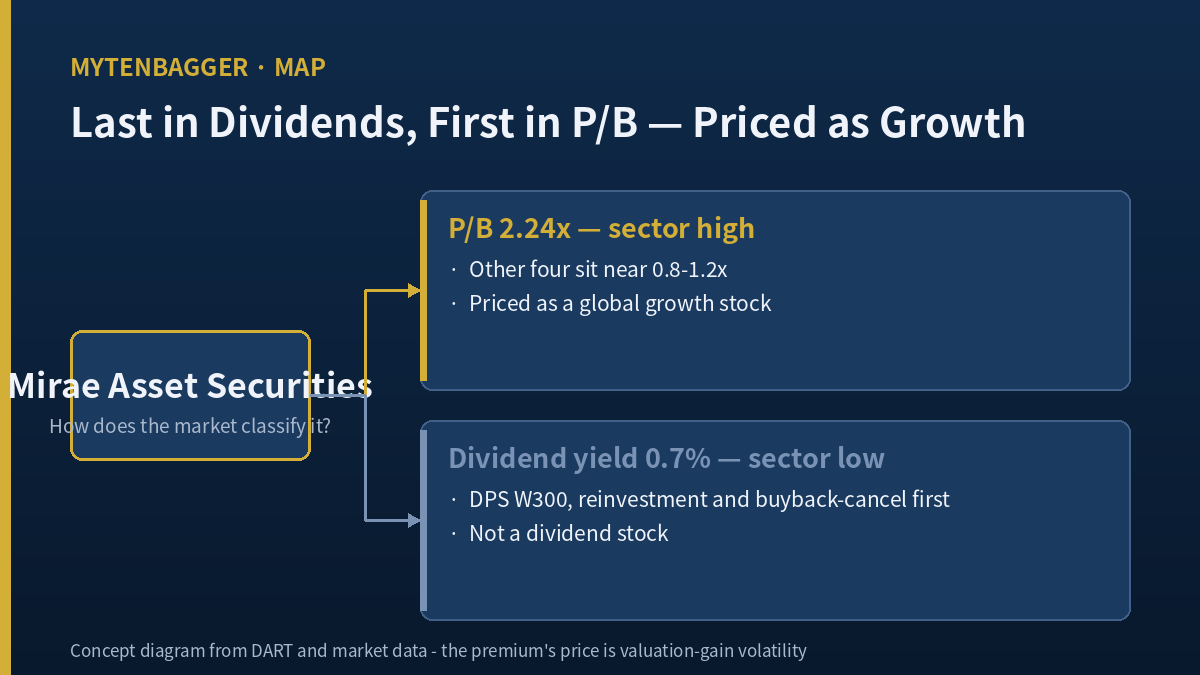
Mirae Asset Securities has the lowest dividend yield of the five names in this series — about 0.7%. Yet its price-to-book is 2.24x, the highest of the group. The dividend is dead last, but the stock carries more than double its book value. I think that contradiction is the whole identity of this name. The market does not price Mirae Asset as “a brokerage that pays a dividend.” It prices it as a global asset manager that compounds profit overseas and returns capital through buybacks rather than payouts. So I don’t measure this one with a dividend yardstick. I still haven’t bought it — because of that premium, and because of the volatility of the earnings underneath it.
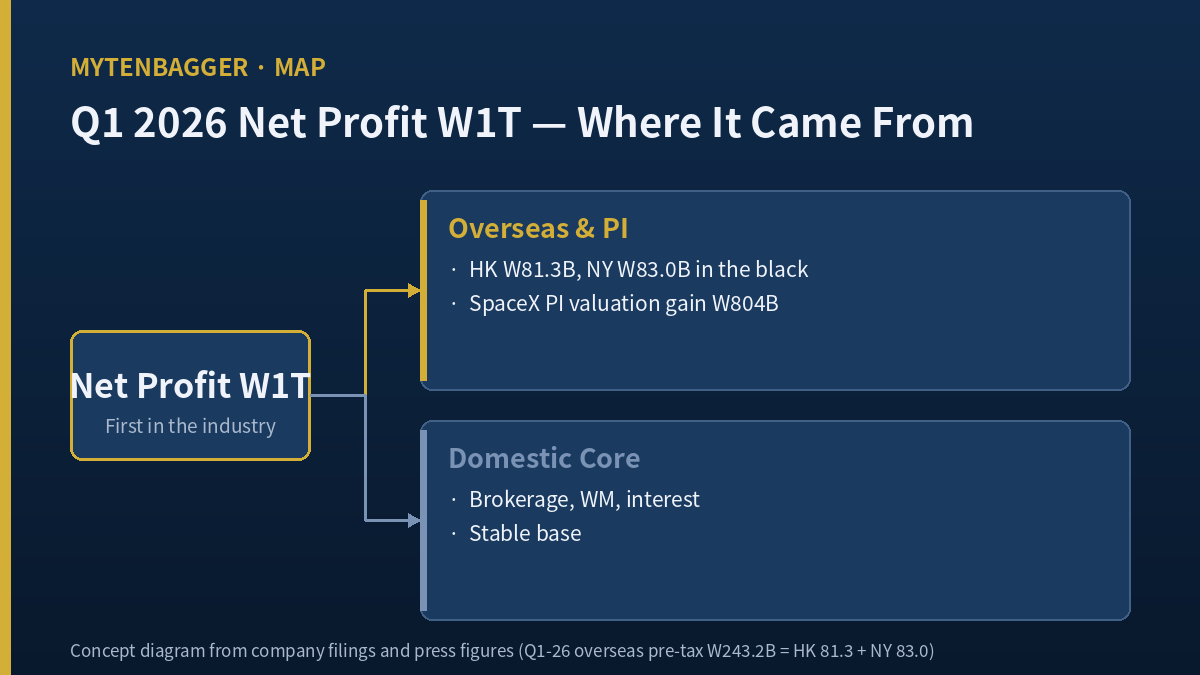
No Korean brokerage had ever earned more than ₩1 trillion of net profit in a single quarter. Mirae Asset Securities cleared that wall for the first time in the first quarter of 2026: net profit of ₩1,001.9 billion (about $727 million) and operating profit of ₩1,375 billion (about $996 million), up 297% year over year (Korean outlet Infostock Daily, May 2026). Usually a number like that makes “so buy it” the automatic next thought. For me it did the opposite — my hand stopped. Because when you open up where that profit came from, this is not the earnings of the brokerage we think we know. This is the last stock in my Korean brokerage series, and I put it at the very back on purpose, because it forces the question the whole series has been circling: what is a brokerage stock, really? For readers outside Korea, Mirae Asset trades on the KOSPI, the main board of the Korea Exchange — think of it as the Seoul equivalent of the NYSE.
Contents
Mirae Asset Securities: the contradiction of a 0.7% yield and 2.24x book
Start with the contradiction in the numbers. Mirae Asset’s per-share dividend for 2025 was ₩300 (about $0.22), a yield of roughly 0.7% (DART filing). In this series NH yields in the mid-4% range, with Samsung, Korea Investment, and Kiwoom in between — and Mirae Asset alone comes in under 1%. Yet its price-to-book is 2.24x. The other four sit somewhere near 0.8-1.2x; Mirae Asset stands alone above two. Lowest dividend in the sector, highest valuation in the sector. Those two facts living in one stock mean the market sees this company as something other than the rest.
Here’s how I read it. The yield is low not because the company is stingy, but because it plows earnings back into overseas expansion and new businesses and returns capital through buybacks instead of cash dividends. The book multiple is high because the market has put a premium on the result of that reinvestment — overseas profit and growth optionality. Put simply, Mirae Asset is priced on growth, not on payout. Across the previous four entries I applied a different yardstick to each name — dividend, wealth management, trading volume, low P/E — and none of them fits Mirae Asset cleanly. That’s exactly why I don’t treat this one as a brokerage stock.
Three reasons Mirae Asset Securities is on my watch list
1. The only Korean brokerage that actually earns money abroad
Korean brokerages have talked about going “global” for a long time, but few of them earn meaningful profit from overseas subsidiaries. Mirae Asset is the exception. In the first quarter of 2026 its overseas pretax profit was ₩243.2 billion (about $176 million), of which the Hong Kong unit made a record ₩81.3 billion ($59 million) and the New York unit ₩83.0 billion ($60 million) (Infostock Daily, May 2026). Overseas wealth-management client assets stand at ₩78 trillion (about $56 billion). I regard this as the core of the story. Unlike peers whose revenue is bolted entirely to the domestic trading-volume cycle, a large share of Mirae Asset’s profit is earned outside Korea’s borders. That means when KOSPI turnover slows, Hong Kong and New York can keep the lights on. That is the first reason this name is on my watch list. There is also a wrinkle that most US readers miss entirely, and I’ll come back to it — the “Global X” ETF brand many Americans hold is a Mirae Asset company.
2. A record-sized buyback and cancellation
A low dividend does not mean weak capital return. On June 17, 2026, Mirae Asset’s board approved a ₩300 billion (about $217 million) share buyback with full cancellation (Korean outlet Financial News, June 2026). That is roughly three times the previous record of ₩103 billion — the largest capital return in the company’s history. The composition is ₩200 billion of common shares, ₩10 billion of first-preferred, and ₩90 billion of second-preferred, and it marks the first time the company has included preferred shares in a buyback. I paid attention to this. Unlike a dividend, cancelling shares shrinks the share count itself and lifts per-share value. If you file this stock under “doesn’t return capital” on the basis of a 0.7% yield, you miss the entire ₩300 billion. The key to reading Mirae Asset is that its capital return runs through cancellation, not dividends.
The decision to buy back preferred shares for the first time is not a throwaway detail either. The company said the aim was “to narrow the price gap between common and preferred shares and raise the effect of shareholder return” (Financial News, June 2026). Preferred shares are thinly traded and usually change hands at a steep discount to the common; when the company itself buys and cancels them, that discount narrows. I take that kind of detail as a sign the company approaches capital return by design rather than for show. Choosing to shrink the share count and fix the preferred discount, instead of the easy route of hiking the dividend, tells me this firm’s return philosophy sits on “raise per-share value,” not “hand out cash.” Read the low yield without that lens and you misread the stock.
3. A price that has already halved off its high
Mirae Asset shares more than doubled over the past year (up 118% over twelve months) and then fell hard. Down 41% over three months, down 16.6% over one. From a 52-week high of ₩87,800 (about $64) the stock now sits in the ₩42,000s (about $31) — nearly a halving. When I look at a richly valued growth stock, I weigh that drawdown heavily. A name that had a lot of expectation priced in and then gave back half of it has, by definition, already bled off much of the premium it once carried. The sell-side targets are split but sit above the current price: iM Securities at ₩65,000 (about $47), Meritz at ₩79,000 (about $57), and Kiwoom at ₩90,000 (about $65) (each brokerage’s report, May 2026). I don’t adopt those targets as my own. But the fact that several houses raised their eye level after the results is worth logging as market information.

Mirae Asset Securities: the numbers that matter
Here are Mirae Asset’s earnings, valuation, and capital-return figures. Dividends are per DART year-end filings, first-quarter results and targets per sell-side reports, and valuation per recent financial data. Every cell was checked against its source. Won-to-dollar conversions use roughly ₩1,380 per USD.
| Metric | Value | Note |
|---|---|---|
| Price / market cap | ₩42,200 / ₩23.6tn | ~$31 / ~$17.1B; largest in sector |
| P/E · P/B | 19.6x · 2.24x | P/B highest in sector |
| Dividend yield / DPS | 0.7% / ₩300 | lowest in sector (DART 2025) |
| Q1 2026 net profit | ₩1.002tn (~$727M) | industry’s first ₩1tn quarter |
| Q1 2026 overseas pretax | ₩243B (~$176M) | HK ₩81B (record) · NY ₩83B |
| Buyback + cancellation | ₩300B (~$217M) | record (prev. ₩103B), full cancel |
Sources: dividend = DART FY2025 filing | Q1 2026 results & overseas = Infostock Daily 2026-05 | buyback = Financial News 2026-06 (board) | targets = iM / Meritz / Kiwoom reports 2026-05 | valuation = recent financial data | as of July 2026. FX ~₩1,380/$.
One more line on the tape: Mirae Asset is the most volatile name in this series. It rose the most over twelve months (+118%) and fell the most over three (−41%). That is the polar opposite of a dividend defensive. I don’t think that wide swing is an accident — it comes straight from the character of the earnings. Which is the next section.
There is a policy tailwind worth naming here, because it explains part of why the buyback landed when it did. Mirae Asset’s record cancellation sits inside Korea’s Korea Exchange “Value-up” program, the government-backed effort to lift the chronically low valuations of Korean companies through stronger capital return. For most of the sector, Value-up shows up as bigger dividends. Mirae Asset’s version is different — it leans on cancellation, which suits a company that would rather compound cash overseas than pay it out. I read that as consistent, not contradictory: the firm is returning capital in the form that least constrains its reinvestment. That is a coherent policy for a growth-priced stock, and it’s another reason I file this name under growth rather than yield.
What the market misses on Mirae Asset Securities — half of the ₩1tn is a mark-to-market gain
This is the part I most want to make. Everyone reads “₩1 trillion quarterly profit” as operating performance, but open it up and you find two different kinds of earnings mixed together. One is the recurring operating profit from brokerage, wealth management, and the overseas units. The other is the mark-to-market gain on investments the firm runs with its own capital. In its principal-investment (PI) book, Mirae Asset booked roughly ₩804 billion (about $583 million) of valuation gains from stakes in overseas innovation companies such as SpaceX (Infostock Daily, May 2026). In other words, a substantial slice of that ₩1 trillion came from this valuation gain.
Why does that matter? A mark-to-market gain is unrealized, book-only profit. If SpaceX goes public or its valuation rises further, it turns into real money; if the valuation rolls over, it comes back as a mark-to-market loss by exactly that much. In my NH entry I asked “what funds the dividend?” — with Mirae Asset you have to ask the same question of the entire profit line. Of this ₩1 trillion, how much is operating income that repeats every quarter, and how much is the result of an asset like SpaceX simply being marked up? If recurring operating profit is large, this is a stable global growth stock; if it leans on valuation gains, it’s a volatile stock that lurches quarter to quarter. I think today’s Mirae Asset sits somewhere in the middle, and the 2.24x book the market assigns is priced closer to the former.
So I read Mirae Asset not as “a brokerage earning ₩1 trillion a quarter” but as “a growth stock holding a fistful of overseas growth options.” The ₩804 billion SpaceX-led valuation gain is this name’s attraction and its risk at once. It’s a growth option that can dramatically lift earnings, and simultaneously a source of volatility that can drag earnings down just as hard if valuations wobble. You have to hold both sides to judge whether 2.24x book is cheap or expensive.
The global-peer lens sharpens the character of this stock. Japan’s Nomura spent years trying to expand abroad, and after its post-Lehman push it repeatedly lost money overseas — leaving a lasting impression that “offshore is hard” for an Asian brokerage, a story wire services such as Reuters have tracked for years. Mirae Asset is close to the counter-example. Its Hong Kong and New York units actually turn a profit, and overseas wealth assets have compounded to ₩78 trillion. When I look at Korean brokerages I usually compare them to domestic rivals, but Mirae Asset is the one name I think is better measured against Asian brokerages that went abroad, like Nomura. On that yardstick its overseas record is a clear differentiator. If you own a Global X ETF, you are, indirectly, already a customer of this Korean company — that reach into the US retail market is part of what the growth premium is paying for. But as Nomura’s history shows, offshore earnings swing wider in the good times and the bad than domestic ones do, and I keep that in mind too.
Mirae Asset Securities: the two paths I see
The path I weight higher — overseas and buybacks defend the premium
My base case runs like this. If the Hong Kong and New York units keep stacking profits, if PI assets like SpaceX move toward realization through listings or re-ratings, and if the ₩300 billion cancellation actually shrinks the share count, then Mirae Asset’s 2.24x book gets re-read not as “an expensive brokerage” but as “a normal global growth stock.” The stock, already down nearly half, then re-rates as it recovers the growth premium. I lean somewhat toward this path. The real value of this name is not domestic trading volume but its ability to compound earnings overseas, and that ability is already showing up in ₩243 billion of first-quarter overseas pretax profit. If growth keeps confirming, the low dividend reads not as a flaw but as evidence of reinvestment. In fact, the ₩78 trillion of overseas wealth assets is a base that throws off fees every year — I treat that as a compounding income source, not a one-off, because the more assets stack up, the larger the recurring revenue that sits on top of them.
The path where I’m wrong — if the mark-to-market cracks, so does the premium
Now I write the other side heavily. Because Mirae Asset’s earnings lean so much on PI valuation gains, a wobble in those asset values can sink profit fast. If the valuation of an unlisted asset like SpaceX is marked down, or if global risk assets freeze, the ₩804 billion that was a gain this quarter can flip to a mark-to-market loss the next. And when that happens, the 2.24x book premium is the first thing to break. The sell-siders with hold ratings make exactly this point: “expectations are substantially pre-reflected in the valuation, and earnings volatility from investment mark-to-market is high” (Infostock Daily, May 2026). A valuation roughly twice that of peers is justified while growth confirms, but it unwinds hardest the moment the growth narrative wobbles. It’s that volatility — not the ₩1 trillion headline — that has kept me from buying.
My line in the sand — the conditions to buy this growth stock
I haven’t bought Mirae Asset Securities yet. All the good ingredients are on the table — a ₩1 trillion quarter, real overseas profit, a record buyback — and I still haven’t. The reason is singular: I haven’t yet seen how repeatable this profit is. The conditions under which I’d start accumulating are three.
The first thing I watch is the quality of earnings. In the second- and third-quarter results, how much recurring operating profit is left once you strip out the PI valuation gains, and does it show up consistently? The second is the durability of the overseas units — whether the Hong Kong and New York profits are a one-quarter flash or a trend. The third is execution of the cancellation: whether the ₩300 billion buyback is actually carried out, the share count actually falls, and this becomes a routine part of capital return rather than a one-off. If earnings quality, overseas durability, and a routine cancellation all confirm in the same direction, I’ll enter this name — not as a dividend stock but as a growth stock — in tranches on a pullback. If instead the valuation gains drain out and recurring operating profit alone leaves earnings sharply lower, I read that as a sign the premium was never justified, and I step back.
That closes out all five brokerages. Korea Investment for its low-P/E earnings quality, Kiwoom for retail market share, Samsung for its client-asset defense, NH for the durability of its dividend, and Mirae Asset for the repeatability of overseas growth. One question ran through all five from the start: what are this company’s earnings tethered to, and does that keep coming? Put that question to Mirae Asset and the answer is not domestic trading volume — it’s beyond Korea’s borders. Would you price this 0.7%-yield stock on a brokerage yardstick, or a global growth yardstick?
New to this series? Start with the opener on Korea’s brokerage re-rating.