
Classys Stock: A Fifth More Revenue, Slightly Less Profit
Classys stock closed at 31,350 won on September 8, 2026 (Tue), which puts the market capitalization at 20,451 hundred million won, or roughly US$1.52 billion at that day’s exchange rate. The 52-week range on the same screen runs from 31,000 won to 77,600 won. The company is listed on KOSDAQ, the junior board of the Korea Exchange, where Korea’s smaller technology and healthcare names trade alongside the larger KOSPI board.
I do not own it and I have no order in. What follows is a note I keep for myself about a company whose revenue grew by about a fifth in the first half of 2026 while its operating profit came in a shade below the same half of 2025. The income statement tells you that happened. It does not tell you why. For that I went to the balance sheet, and I think the balance sheet answers it.
Contents
Classys stock and the two share counts on one screen
Before anything else I had to settle which share count I was using, because the screen gave me two. The annual financial page lists 65,505,659 shares outstanding at the end of 2025. The quote page lists 65,235,659 listed shares. The gap is exactly 270,000.
That is not a rounding artifact and it is not two vendors disagreeing. On February 19, 2026 (Thu) the company disclosed the cancellation of 270,000 treasury shares, about 17.1 billion won worth at the February 2026 closing price cited in the filing, with the cancellation set for February 27, 2026 (Fri). Subtract, and the two numbers agree. So the annual page is showing me the year-end count and the quote page is showing me the count after the retirement.
The retirement is 0.412% of the pre-cancellation count, by my calculation. That is small. I mention it anyway for two reasons. The first is mechanical: every per-share figure in this note has to sit on one of these two counts and not drift between them, and I checked that the market capitalization the screen prints reconciles to the smaller count. The second is that a company doing buybacks and cancellations while its margin is compressing is telling you something about where management thinks it is in the cycle, and I would rather write that down now than reconstruct it later.
The paid-in capital check, which held
Par value is 100 won. Multiply by the year-end count of 65,505,659 and you get 6,550,565,900 won, which rounds to the 66 hundred million won of paid-in capital the screen shows. No preference shares, no split flagged. This is a small check and it passed, and I note it because on the last two companies I looked at, the paid-in capital line was simply missing from the same screen and I could not run it at all.
What the balance sheet did when the distributor arrived
In March 2026 the company completed the purchase of a controlling interest in its Brazilian distributor and switched to selling direct in that market. Brazil is, by the company’s own framing, one of the larger aesthetic device markets in the world. Buying the distributor means the distributor’s sales and the distributor’s costs both arrive on the consolidated statements at the same moment.
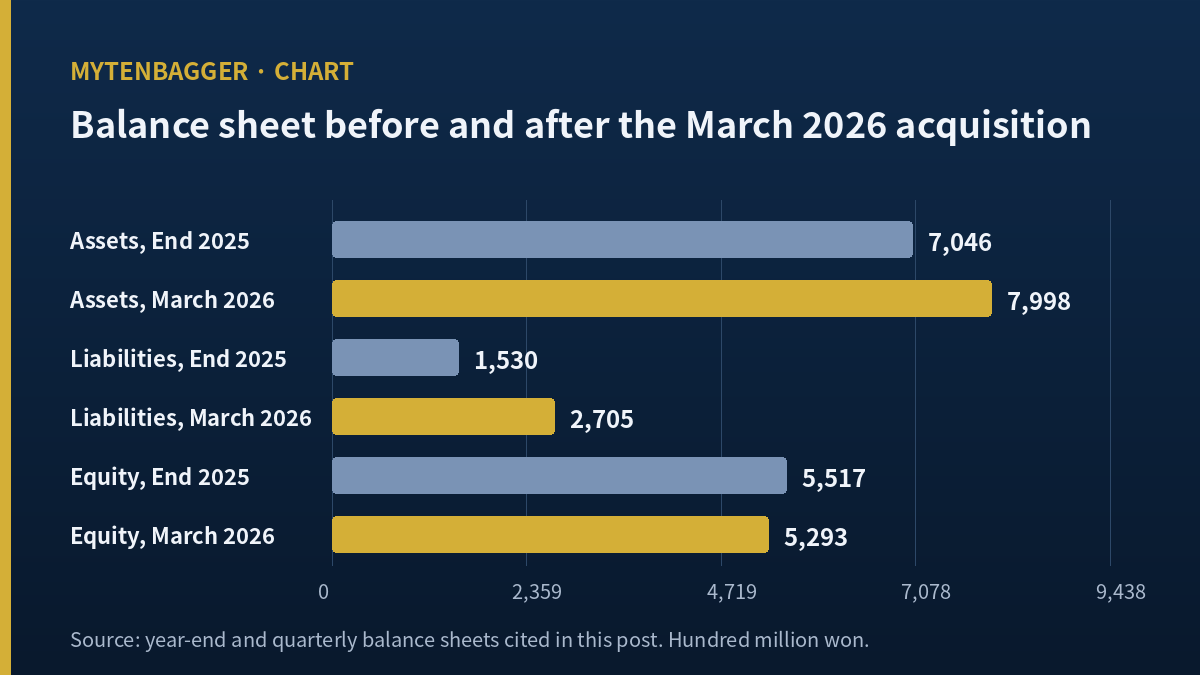
Here is what the four year-end balance sheets look like, with the two 2026 quarters after them. All figures in hundred million won, from the same financial screen.
| Period | Assets | Liabilities | Equity | Debt to equity | Return on equity |
|---|---|---|---|---|---|
| End 2022 | 3,314 | 1,019 | 2,296 | 44.37% | 38.33% |
| End 2023 | 3,754 | 919 | 2,835 | 32.43% | 28.94% |
| End 2024 | 6,084 | 1,557 | 4,526 | 34.41% | 26.54% |
| End 2025 | 7,046 | 1,530 | 5,517 | 27.73% | 26.20% |
| March 2026 | 7,998 | 2,705 | 5,293 | 51.12% | 27.42% |
| June 2026 | 7,747 | 2,196 | 5,551 | 39.57% | 26.32% |
The March quarter is where the acquisition lands. Assets rose 952, liabilities rose 1,175, and equity fell 224, all in hundred million won and all taken as differences from the row above. Liabilities plus the equity move come to 951, which is one unit away from the 952 on the asset side, and that unit is rounding in the source figures. The debt to equity ratio went from 27.73% to 51.12% in a single quarter, which is the largest single move between any two rows in that table.
By June it had come back to 39.57%. Assets fell 251, liabilities fell 509, equity rose 258, again as differences from the row above. So the second quarter paid down a chunk of what the first quarter brought in.
This is the part I find useful. If you only had the income statement you would see revenue up and margin down, and you would have to guess whether the market softened or the mix changed or costs ran away. The balance sheet says something narrower and more checkable: the company took on a set of assets and a larger set of liabilities in one quarter, and the thing it bought was the step that used to sit between its factory and its Brazilian customers.
Return on equity held, which surprised me
Look at the last column. Return on equity was 26.20% at the end of 2025 and 26.32% in June 2026. It did not fall. The operating margin fell by close to nine percentage points over the same half, and return on equity was flat.
Those two facts are compatible because return on equity is a ratio of profit to equity, and equity barely moved across the half while the profit pool held up in absolute terms even as it thinned relative to a bigger revenue base. But I would not want a reader to see the flat return on equity and conclude nothing happened. Something did happen, and it happened in a line the return on equity ratio does not look at.
Classys stock against a peer that lost the same margin
The natural US-listed comparison is InMode Ltd. (NASDAQ: INMD), an Israeli maker of energy-based aesthetic platforms sold to the same kind of clinic. I want to be careful about what this comparison is for. It is not a valuation argument and I am not ranking the two as investments. What I want to know is whether margin compression in this product category during 2026 looks like a company problem or a category problem.
| Company | Operating margin, second quarter | What revenue did in the same quarter |
|---|---|---|
| InMode Ltd. (NASDAQ: INMD) | 24% in 2025 to 13% in 2026 (GAAP, company release) | Flat at US$95.6 million, the same as the year before |
| Classys (KOSDAQ: 214150) | Fell by roughly ten points across the same comparison | Grew by more than a quarter year on year |
The two lost a similar amount of margin. They did it in opposite revenue conditions. InMode’s gross margin went from 80% to 75% and its GAAP operating income went from US$22.9 million to US$12.3 million on identical revenue, which is what cost pressure looks like when there is no growth to absorb it. Net income came in at US$17.1 million, down by roughly a third from the prior-year quarter, and diluted GAAP earnings per share at US$0.29 against US$0.42. For the full year InMode guides to revenue of US$365 million to US$375 million, non-GAAP income from operations of US$68 million to US$73 million, and non-GAAP diluted earnings per share of US$1.29 to US$1.34.
One more line from the InMode release is worth putting next to the Korean company. Consumables and service were US$22.3 million in the quarter, up from US$19.8 million, which takes them to 23% of revenue from 21%. Both of these companies describe themselves as businesses where the recurring half matters more than the box. InMode publishes the split every quarter in a single line. That is the kind of disclosure I wish I had on the Korean side in the same form.
Why no valuation multiple went into that table
Because the two companies do not report the same things. One reports in dollars under US GAAP with a segment split I can lift straight from a press release. The other reports in won under Korean IFRS with a product split that reaches me through Korean trade press quoting company briefings. Putting a multiple in the same row would suggest I had reconciled the underlying accounting, and I have not. The margin direction survives that mismatch. A multiple would not.
Where I was wrong in the first draft of this note
My first pass at the peer section said, in effect, that the Korean company was winning: its revenue was growing and InMode’s was flat, so whatever was squeezing the category was hurting the Israeli company more. I had written two paragraphs on that before I actually subtracted the margins.
When I did, the two compressions were close to the same size. Roughly eleven points for InMode and roughly ten for Classys, in the same quarter of the same year, in the same product category. The growth difference is real and it matters, but it is a separate fact from the margin difference, and I had let the one I liked stand in for the other. I deleted the paragraphs.
What I take from that is narrow and I want to keep it narrow. When two companies move the same direction on one line and opposite directions on another, the temptation is to let the line where my company looks better decide the sentence. The fix is boring: subtract both lines before writing either.
Classys stock, sixteen estimates, and a date I cannot see
Sixteen houses cover the name, according to the consensus screen I use. Their pooled 2026 earnings per share estimate is 2,355 won, their pooled valuation is 61,312 won, and their pooled rating comes out at 4.00 on the screen’s five-point scale. The pooled valuation sits well above where the shares trade.
I am quoting those as facts about what analysts have published. I am not adopting any of them as my own view. And there is a limit to what the pooled number tells me, which is the point I actually want to record. The screen gives me the average and the count. It does not give me the date each of the sixteen last revised. A consensus built from four notes written last week and twelve written in February is a different object from one built from sixteen notes written last week, and on this screen the two look identical.
I have one dated data point to anchor against. On July 23, 2026 (Thu) one Korean brokerage cut its published valuation for the name and trimmed its operating profit estimates for 2026 and 2027, citing weakness in the domestic consumables business. That cut reached me through Korean press coverage, and I never opened the note itself. I am saying so plainly so nobody reads this paragraph as a summary of an original document. What it tells me is that at least some of the sixteen were still marking down in late July, after the first quarter was out and before the second quarter landed.
What KOSDAQ means for a US reader holding Classys stock
There is no American depositary receipt for this company, so a US-based reader cannot get exposure through an ADR line. I did not verify inclusion either way and I am not going to guess.
The ownership structure a foreign reader should know about
Foreign investors hold 68.40% of the shares, which is unusually high for a KOSDAQ company of this size. The largest holder is a private equity vehicle with 49.08%, and Korean trade press has reported on and off since 2025 that the sponsor has been looking at ways to monetize that position. Several Korean aesthetic device makers owned by financial sponsors have been taken private in recent years. I am not predicting anything here. I am recording that the ownership register introduces a timeline that has nothing to do with quarterly margins, and a reader who only models the operating business will not see it coming.
Twenty-two arguments against Classys stock
- The debt to equity ratio nearly doubled in one quarter, from 27.73% to 51.12%, and even after the June improvement to 39.57% it is well above every year-end figure since 2022.
- Equity fell in the March quarter by 224 hundred million won even as assets rose. Acquisitions that consume equity while adding liabilities deserve a second look.
- Return on equity of 26.32% in June is below the 38.33% of 2022 and has declined at every year-end since.
- Buying a distributor converts a variable, low-commitment channel into fixed cost. That is irreversible in the short run.
- I cannot separate acquisition dilution from underlying weakness in the same half, which is the central weakness of my own working idea.
- The cancellation of 270,000 shares removes 0.412% of the count. That is not enough to change any per-share figure meaningfully.
- A company retiring shares while its margin compresses may be defending a price, and defending a price is a different activity from allocating capital.
- Sixteen estimates pooled into one valuation tells me nothing about the dispersion behind it, and the screen does not publish the spread.
- At least one house was still cutting its numbers in late July 2026, after the first quarter was known.
- The peer comparison shows a category-wide margin problem, which means the recovery is not entirely in this company’s hands.
- InMode’s guidance implies a full-year operating margin far below what it earned two years ago, and it sells into overlapping clinics.
- Foreign ownership at 68.40% concentrates the selling risk if sentiment on Korean small caps turns.
- A financial sponsor holding 49.08% has an exit clock that is invisible in the financial statements.
- Several comparable Korean device makers under sponsor ownership have left the public market. Minority holders were not the party deciding.
- The shares sit close to the bottom of their 52-week range, which means the market has had time to price everything I have written here.
- The financial screen I use mislabeled two quarterly columns on this company, and I rebuilt my quarter map from company announcements and residuals instead. Anyone using the same screen without checking would get a different history.
- I did not read a single original brokerage note for this company. Everything on the estimate side reached me through secondary reporting.
- I could not verify inclusion in either of the two Korea funds I named, so a US reader’s practical access remains an open question.
- The product mix disclosure on the Korean side arrives through press quoting company briefings; there is no published segment line I can pull myself each quarter.
- Second-quarter net profit came in well below second-quarter operating profit, and I did not identify the items between them.
- Operating cash flow in the quarterly screen is a small fraction of first-half operating profit, and I could not confirm whether that column is quarterly or cumulative.
- Every price figure in this note is a September 8, 2026 (Tue) close. By the time anyone reads it there is a different number on the screen.
Related reading: ranking three Korean cosmetics manufacturers by their liabilities instead of their reporte, a Korean aesthetic medicine company whose profit growth fell behind its revenue growth for
Two figures I left out of the argument
I want to name the numbers I looked at and then declined to lean on, because leaving them unmentioned would make this note look tidier than the work was.
The first is the forward multiple. Divide the September 8, 2026 (Tue) close of 31,350 won by the pooled 2026 estimate of 2,355 won and you get 13.31, by my calculation. That is a real number and it is not a hard one to compute. I did not build anything on it because of the vintage problem described earlier: the estimate underneath it is an average across sixteen houses whose revision dates I cannot see, so the multiple inherits an unknown staleness. Quoting it as if it were a clean forward reading would be borrowing precision the input does not have.
The second is foreign ownership. When I first opened the quote screen it printed 68.48%, and when I opened it again the next session it printed 68.40%. That is eight hundredths of a percentage point. I have seen notes treat a move that size as a flow signal, and I do not think it is one. Two observations a day apart, on a field the vendor updates on its own cadence, cannot support a sentence about what foreign investors are doing. I am recording both values and drawing nothing from the difference.
What would change my mind about Classys stock
Two things, both in the third-quarter report due after November 16, 2026 (Mon).
The first is the debt to equity ratio. It went 27.73%, then 51.12%, then 39.57%. If the September reading continues down toward the high twenties, the acquisition was a one-quarter balance sheet event that the company is working off at the pace I would expect. If it stalls near 40% or turns back up, then what arrived in March is heavier than I have assumed and my working idea about a clean structural step is wrong.
The second is whether the gap between operating profit and net profit narrows. In the June quarter net profit sat well below operating profit and I could not name the items in between. If the same gap shows up in September, it is not a one-off and I should have treated it as a recurring feature instead of writing it off as noise I could not identify.
Both of those get settled by a document the company files. What that document will not settle is the thing I actually keep coming back to. A business that sells a machine once and sells what goes into it forever is two businesses wearing one income statement, and the reported margin is a weighted blend of them. When that blend moves, the blend itself does not tell you which of the two moved. This company will publish a consolidated margin in November and I will read it, and I will still not know which half moved unless something else in the filing tells me. I would rather write that limitation down while the question is open than pretend in three months that I had it settled all along.

Prices and ratios here reflect the September 8, 2026 (Tue) close as checked at the time of writing. The Korean won is the reference currency throughout; the single dollar figure in the opening paragraph is approximate, converted at about 1,344 won per dollar on that same date, and it is the only conversion I made. InMode’s figures are in US dollars as the company reported them and I have not converted them. Amounts written as hundred million won follow the Korean convention used in the source statements. Figures I describe as differences or as my own calculation are not printed in any source; I derived them from two numbers that are.
Sources: InMode second-quarter 2026 results release · Korean press on the 270,000-share cancellation, February 2026 · Korean press on the second-quarter 2026 results, August 12, 2026 · Korean press on the first-quarter 2026 results and the Brazilian consolidation · Korean press on the July 2026 brokerage estimate cut · Korean press on financial sponsors in the aesthetic device sector · Company summary and financial statement screens, retrieved September 9, 2026