Vivien Stock Trades at 15% of Book Value: Why I Pass
Vivien stock hit its daily ceiling on a patriotic buying wave. At roughly $5.9 (₩8,170) it changes hands for about 15% of its book value per share, so it looks cheap. I did not buy it. That book value is being eaten away — a 2025 net loss near ₩12.6 billion ($9.1 million) shrinks it every year — and the controlling shareholder happens to sit inside the troubled Ssangbangwool group. My watch turns into interest only when a return to operating profit and a durable move back above the delisting line point the same way.
Yesterday Vivien locked limit-up on the Korea Exchange, closing 29.89% higher. For readers outside Korea: KOSPI is the main board of the Korea Exchange (KOSDAQ is the smaller, tech-heavy board), and Korean stocks move inside a daily price band of plus or minus 30%, so “limit-up” means the shares gained the maximum the exchange allows in one session. Every headline framed it the same way — a patriotic “buycott” (a buy-to-support campaign) to keep a beloved 60-plus-year underwear brand from being delisted. I know that warmth; I have now watched the same scene three times with Hansung Enterprise, Monami and Enex. But the number that stopped my eye on Vivien stock was not the gain. It was the gap: book value above ₩55,000 ($40) a share against a price in the ₩8,000s. While everyone stared at the ceiling, I sat with that gap for a long while. My conclusion was that this is not cheap-and-attractive; it is cheap-for-a-reason, and the reason is what worries me.
This is not a buy write-up. I do not buy companies worth less than $15 million. But I understand the person typing “is it too late to get in” into a search box, and I would rather hand that person the answer I actually dug for. This is my fourth buycott watch journal.
Contents
What Pushed Vivien Stock Up Was the Delisting Line, Not Earnings
Start with the real driver, because it is easy to misread. Vivien did not rise because it got better. It rose because it is cornered. The Korea Exchange is sharply raising the market-capitalization floor a company must clear to keep its KOSPI listing. Under the reform, the main-board market-cap requirement climbs from ₩5 billion toward ₩20 billion in 2026, ₩30 billion in 2027 and ₩50 billion in 2028. Then the timetable was pulled forward: as Korean financial press reported, the exchange accelerated the schedule and the ₩30 billion ($22 million) threshold took effect from July 1, 2026, with a minority-shareholder group protesting the compressed rollout. The reform itself comes from the Financial Services Commission.
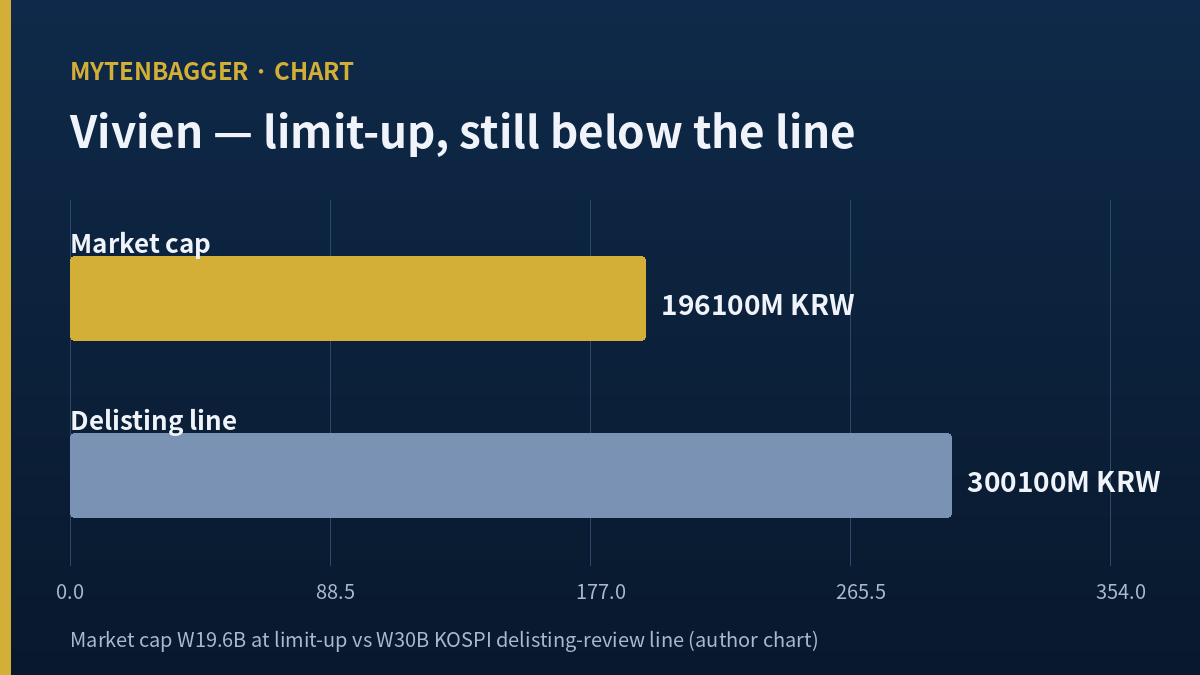
Vivien’s market cap is about ₩19.6 billion ($14 million). That leaves it more than $7 million short of the freshly raised line. So retail investors, hating to see a heritage brand pushed out, poured money in — and that is what sent Vivien stock up nearly 30% in a single day. I do not sneer at the impulse. As The Korea Herald documented, the same wave lifted Hansung and Monami before it. There is an irony in the backdrop worth noting: this purge is landing while the KOSPI itself trades near record highs, above the 5,500 level. The headline index and its smallest constituents are moving in opposite directions — big, liquid names carry the benchmark up while sub-₩30 billion companies are being swept toward the exit. A patriotic bid can briefly interrupt that sweep for one name, but it does not reverse the tide the regulator has deliberately set in motion. I simply refuse to treat it as a reason to buy. A buycott aimed at the delisting line does not change earnings; it nudges the market cap for a while.
The four buycott names, lined up against the same line
Carrying this series to a fourth entry has given me one useful picture: the same “patriotic limit-up” sits at very different distances from the delisting line. Hansung Enterprise, the crab-stick maker, was pushed by its buycott back above the threshold and bought itself breathing room. Monami, the national ballpoint-pen brand, sits around ₩50 billion ($36 million) — already above the ₩30 billion floor. Enex, the household-furniture name, is at roughly ₩19.3 billion, and Vivien at ₩19.6 billion; both remain below the new line. Put plainly, Vivien’s ceiling is not “a cheer for escaping the danger zone” so much as “a shout still raised from beneath the line.” I use that sense of distance as my first filter between buying and merely watching. A name that has cleared the line and one still more than $7 million short of it do not deserve the same temperature. Vivien is squarely in the second bucket, and being cheap on book does not move it into the first.
The Brand Is Real — I Grant That
It would be unfair to list only the negatives. Vivien is not a nobody. It started in 1957, made Korea’s first stockings the following year, changed names several times and became “Vivien” in its current form in 2020. It has been listed since 1976 — half a century on the exchange. During the 2019 boycott of Japanese goods it was tagged as a patriotic domestic-underwear name. Brand recognition, a distribution network, five decades of history — a startup cannot manufacture that in a few years. And revenue still flows. The problem is not the brand; it is that the brand no longer makes money.
Vivien Stock Versus Book Value — What the Deep-Value Case Really Looks Like
Here is why I sat with this one. On surface metrics Vivien looks like a classic asset play. The market prices it at a price-to-book (PBR, the Korean shorthand for price-to-book ratio) of about 0.15 — 15% of the net assets the company carries on its books. Book value per share is above ₩55,000 ($40) while the stock sits in the ₩8,000s, so arithmetically “liquidate today and shareholders get six times the price.” A deep-value hunter would salivate. But I read the table below vertically, not horizontally.
| Item (₩ / approx US$) | 2023 | 2024 | 2025 |
|---|---|---|---|
| Revenue | ₩217bn ($157m) | ₩235bn ($170m) | ₩222bn ($161m) |
| Operating profit | +₩4.9bn | +₩1.7bn | −₩5.0bn |
| Net income | −₩7.9bn | −₩3.8bn | −₩12.6bn |
| Debt-to-equity | 116% | 114% | 145% |
Source: Korean press financial summary (FnGuide data) | Basis: FY2025 preliminary. USD figures approximate at about ₩1,380/$.
Read down the columns and the story flips. Operating profit thinned from ₩4.9 billion in 2023 to ₩1.7 billion in 2024, then turned to an operating loss of about ₩5.0 billion in 2025. Net income was negative all three years, and the 2025 loss widened to roughly ₩12.6 billion. Debt-to-equity climbed from 116% to 145%. Revenue holds in the ₩220 billion range, but the structure leaks below the top line. That is where I dropped the “it’s cheap” first impression.
Go one layer deeper. If the 2025 loss were a one-off charge, I would read it differently. But revenue slipping from ₩235 billion (2024) to ₩222 billion (2025) alongside profit bending negative points to the core margin thinning, not a stray item. Innerwear carries dense input, labor and distribution costs, so operating leverage runs in reverse when sales dip even slightly. Selling a brand and profiting from a brand are entirely different problems. I watch the direction of that margin, not the size of revenue — and the direction is down.
Vivien Stock Is Not Cheap — Its Book Value Is Melting
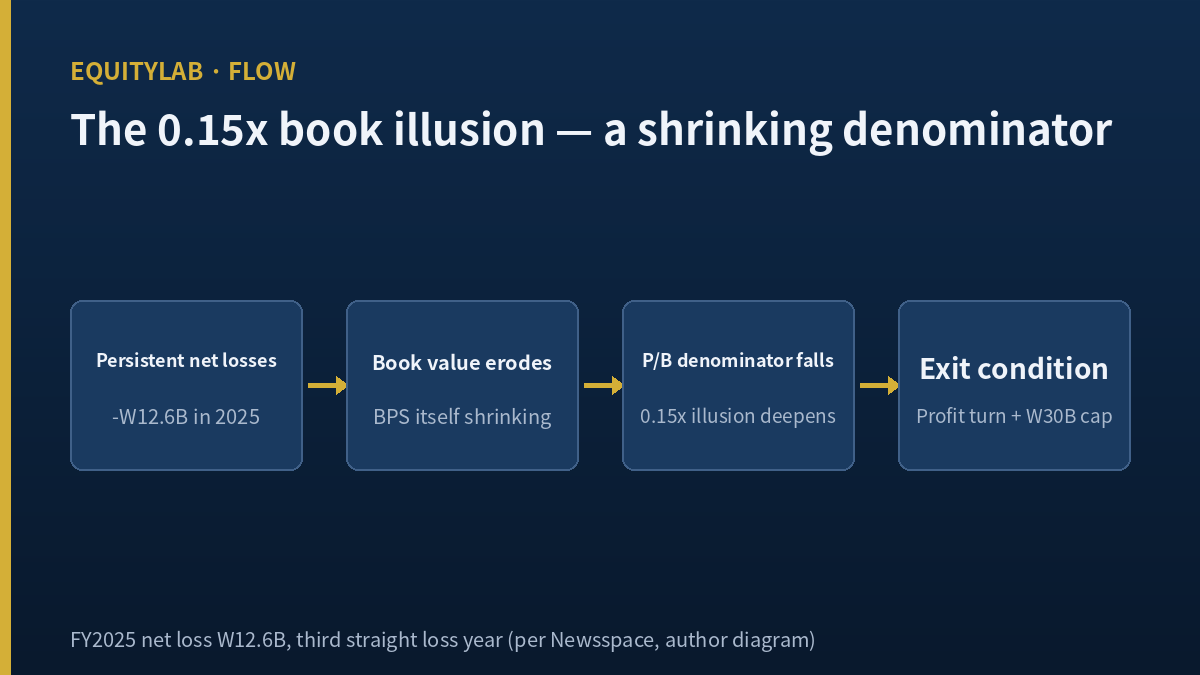
This is the point I most want to make. PBR 0.15 reads two ways. One is “the market oversold it.” The other is “the market does not believe this book value.” I take the second. The evidence is the bottom row of the table. A net loss is a reduction of equity. The 2025 net loss of roughly ₩12.6 billion pulled that much out of shareholders’ equity, and book value per share shrinks with it. In other words, the very denominator that makes the ratio look cheap is being carved down year after year. Today’s “15% of book” carries no guarantee it will be 15% next year. When equity melts faster than the price falls, cheap becomes a reason to get cheaper.
The company did try. As Korean business press laid out, Vivien raised about ₩43 billion ($31 million) via a rights offering plus convertible bonds and pushed it into new ventures — masks, athleisure, equity stakes. It put roughly ₩30 billion into masks, but a ₩20.4 billion supply deal with Medytox was terminated amid competition; it put about ₩57.5 billion into an Infinity NT stake, which came back as impairment charges. Burning capital to buy growth, it mostly just burned capital. I do not score that history as a catalyst for the discount to close. I score it as a reason to distrust the book value.
There is a second-order effect I keep in view. Those rescue rounds — the rights offering, the convertible bonds — did not just fail to build growth; they expanded the share count and thinned each existing share’s claim on the company. That is the quiet arithmetic of a distressed listing: even if book value per share looks generous today, every survival financing that follows divides the same equity across more shares. So when I look at “15% of book,” I do not see a fixed backstop. I see a number that both the losses and the next capital raise can keep pushing down. A margin of safety is only a margin if the company is not the one consuming it, and here the company has been the main consumer.
Widening the lens does not calm me either. US innerwear giant Hanesbrands and Japan’s Wacoal both grind through slow growth for demographic and consumption reasons — underwear was never an explosive category. So Vivien’s real problem is not “because it’s underwear.” In the same low-growth space, both of those peers are many times Vivien’s size and neither is fighting for its listing, while Vivien has been buying time by tearing into its own capital rather than earning. Separate the industry’s limits from this company’s limits. The discount on Vivien stock owes more to the company than to the sector — that is my read.
Vivien Stock: The Three Paths I See
Even so, the odds split. I am not buying this, but not-buying and not-watching are different things. Here are the three branches I keep in my head.
The path I weight most (I keep watching)
The buycott cools, turnover drains, and the price drifts back toward where it sat before the ceiling. As long as earnings stay put, the market cap oscillates below the ₩30 billion line again, and listing-survival cards — rights offerings, capital reductions, asset sales — get floated over and over. Existing holders get diluted in the process. My reason for keeping my hands off shows up again right here.
The path where I am wrong (the rebound is real)
I cannot dismiss this one. If a core-business restructuring bites and operating profit returns, or if the company actually monetizes real estate or brand assets and settles the market cap above ₩30 billion, the story changes. Then PBR 0.15 was genuine value, not an illusion. I do not rule this out. I simply have no basis in the current numbers to bank on it, so I watch.
The path I least want (a qualitative review)
If losses deepen and capital impairment becomes real, the issue moves past a market-cap shortfall into a separate gate — an exchange listing-eligibility review. Persistent net losses eating into equity can touch the criteria for “administrative issue” designation, and from there, regardless of brand value, the risk of a trading halt and liquidation trading rises. I put the probability low, but not at zero. And this is where retail investors learn the hardest lesson: the cards a company plays to stay listed — rights offerings, capital reductions, asset sales — usually dilute or impair existing shareholders. “I bought it cheap and it got cheaper” is born right here. A PBR of 0.15 may look like a margin of safety, but if the company is spending that margin itself, it is not safe.
The Controlling Shareholder Happens to Be Gwangrim
The financials alone already put me in watch mode; the ownership structure hardened it. Vivien was acquired in 2019 by Gwangrim, an affiliate of the Ssangbangwool group. The trouble is the group’s recent record. English-language Korean coverage is blunt about it: as The Korea Times reported, former Ssangbangwool chairman Kim Seong-tae was sentenced over an illicit North Korea remittance scandal. Korean press has further reported additional indictments tied to Gwangrim and Vivien, a group that by 2025 was effectively unwinding, with the affiliate Gwangrim itself heading into delisting in 2026. I do not wave owner risk away as a soft deduction. At a company sitting on the delisting line, the controlling shareholder’s credibility feeds directly into whether a rights offering succeeds, whether asset sales are fair, and whether minority holders are protected. I cheer the brand; I have no basis to cheer the hands holding it. That an affiliate under the same roof has already been pushed out of the market reads to me as a precedent in front of my eyes, not a vague worry.
The checkpoints that would end my watch
So my checkpoints are an order of facts, not a price. First is earnings: does the operating line turn back to profit in the half-year or full-year report? If that clears, second, does the market cap hold above the ₩30 billion line for weeks rather than days? Last, do owner-driven risks — fresh litigation, aggressive dilutive raises, fire-sale asset disposals — quiet down? When those three begin to point the same way, I fold the watch and sit back down. If instead none of them moves and only the price jumps, that is noise to me, not signal. I will check the Korea Exchange delisting and investment-caution disclosures and the interim report in exactly that order.
Vivien Stock Is a Different Calculation From Loving the Brand
Before the practical note, one caveat on access, since most readers here are outside Korea. Vivien (ticker 002070) is a KOSPI-listed Korean stock with no US ADR.
I will be honest: writing this was not comfortable. A half-century-old domestic brand pinned on the delisting line, surviving a day on the goodwill of small investors — that tugs at me beyond the numbers. I grew up with the Vivien name. That is exactly why I worked to keep feeling and judgment apart. Cheering a brand and buying its shares are two decisions. A buycott is beautiful in the realm of consumption, but the force that clears a delisting line comes from earnings and capital.
When I started this series I assumed a buycott ceiling was a one-day event. Then I watched Hansung climb two sessions in a row and admitted I was half wrong; the firepower of patriotic buying ran hotter and longer than I expected. So with Vivien I dropped the “it cools tomorrow” certainty. What only hardened across three watches is that the firepower does not change the earnings. The price can run a few more days; the direction of melting capital does not turn in those days.
I also want to be fair about my own blind spot here. Value investors I respect would look at the same 0.15 multiple and see a genuine cigar-butt: buy a dollar of assets for fifteen cents, take whatever puff is left. That framework has made money in Korea before, especially in asset-rich holding companies trading far below their real-estate value. If Vivien turns out to sit on land or brand rights worth more than the market assumes, and if the controlling shareholder actually surfaces that value cleanly, the deep-value crowd will be right and I will have been too cautious. I hold that possibility open honestly. My hesitation is not that the assets cannot be real; it is that between me and those assets stand recurring losses and an owner whose recent track record does not earn my trust. For my own capital, that distance is too wide to cross on a brand I feel fond of.
To put it plainly: I did not buy Vivien, and I am still on the sidelines watching, unowned. I read PBR 0.15 not as appeal but as the market refusing to believe the book value, and the 2025 swing to losses plus Gwangrim–Ssangbangwool owner risk justify that disbelief in my eyes. Until a return to profit and a durable reclaim of the ₩30 billion market cap show up together, my wallet stays shut. My next checkpoints are H1 earnings and any delisting-related filing, and of those, whether the core business prints a profit signal again is the first variable that could shake my watch. I’ll reopen this one when that signal shows up in a quarter. I am leaving my own view here, exactly as I saw it, so that a year from now I can come back and check whether the melting stopped or I was simply too fond to notice the floor giving way.