KEPCO Stock at 2.5x Earnings: The Market Prices Only Tariffs
KEPCO stock (Korea Electric Power, NYSE ADR: KEP; KOSPI: 015760) trades around $22.5 (₩33,800), pinned to a 52-week low near ₩33,200, down roughly 39% over six months. Yet the company held an operating profit of ₩3.78 trillion (~$2.5 billion) in Q1 2026, as Korean financial outlet Infostock Daily reported. All USD figures here use roughly ₩1,500 per dollar.
The market sells it for one reason: on June 22 the Q3 fuel-cost adjustment was frozen, and Seoul signaled it would keep public utility rates flat through the second half. The tariff — which is KEPCO’s margin — sits in the government’s hands.
I have not bought it. But I split this name into two axes: margin (the tariff) and volume (kilowatt-hours sold). I can’t time the margin. The volume is real. Here is how I read it, and the levels that would change my mind.
Anyone typing KEPCO stock into a screener sees two numbers that shouldn’t coexist: a price-to-earnings ratio of about 2.5x, and a red arrow at a 52-week low. I wanted to understand why both sit on the same ticker, so I went back through the filings and the Korean sell-side. The market’s story is a single line — “they can’t raise tariffs, so earnings won’t grow.” That line is not wrong. My view is that it explains only half of this company, and I’ll spend this journal on the other half.
One framing note for readers outside Korea. KEPCO is Korea Electric Power, the national electricity utility, majority-owned by the Korean government. It lists on the KOSPI (Korea’s main board, the large-cap equivalent of the NYSE; the smaller, tech-heavy board is the KOSDAQ). One practical note for US holders: Korean dividends carry a withholding tax (15% under the US-Korea treaty), which matters more now that the payout is back, and the KEP ADR’s daily liquidity is a fraction of the Seoul line, so the local shares through a broker usually give tighter fills for size. I look at the Seoul line, but everything below applies to the ADR too.
Contents
KEPCO Stock at a 52-Week Low While Q1 Stayed Profitable
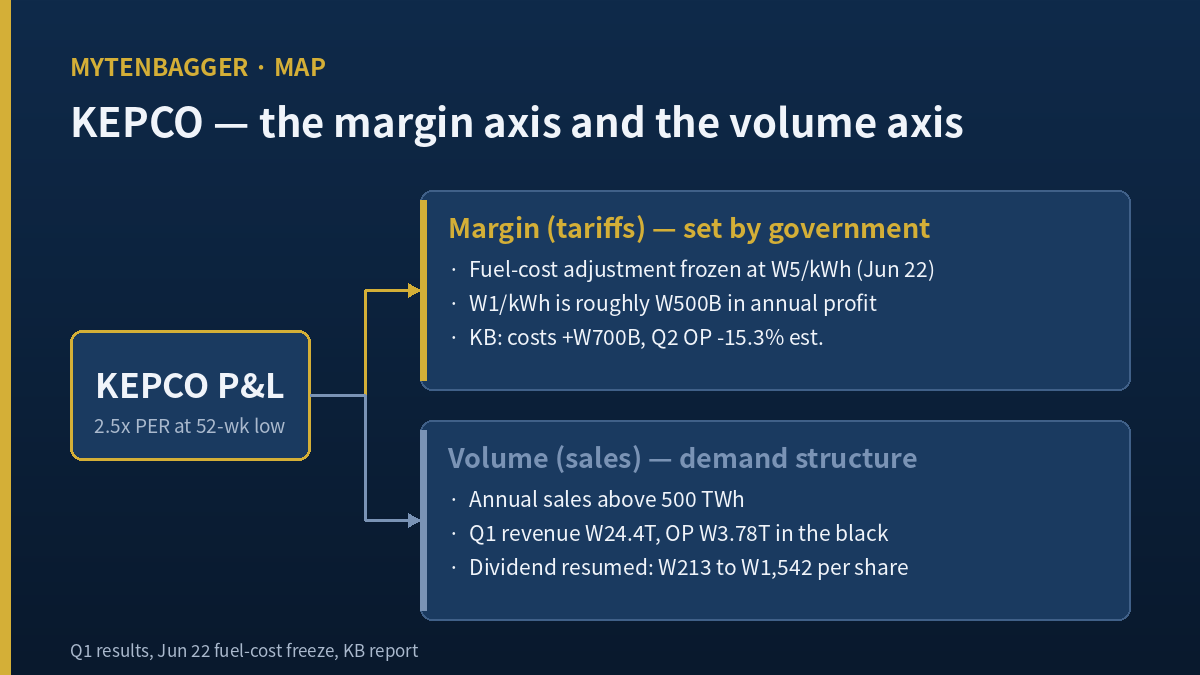
Let me set the numbers first. KEPCO’s Q1 2026 revenue was ₩24.4 trillion (~$16.3 billion) and operating profit was ₩3.78 trillion (~$2.5 billion), roughly ₩30 billion above the prior-year quarter, per Infostock Daily’s results coverage carried on Investing.com. Korea’s Eugene Investment credited the quarter to “lower purchased-power costs” in a May 14 note. Zoom out to the full year and this is a company already out of its deep-loss tunnel: trailing operating profit runs into double-digit trillions of won and net income is positive on the financial data I track. The dividend came back, too. Per Korea’s DART regulatory filings, the dividend per share went from ₩213 in 2024 to ₩1,542 (~$1.03) for 2025. I won’t call that “steadily rising” — it was cut to near zero in the loss years and then restored, which is a recovery, not a compounding streak. Keeping that distinction straight is my rule for this journal.
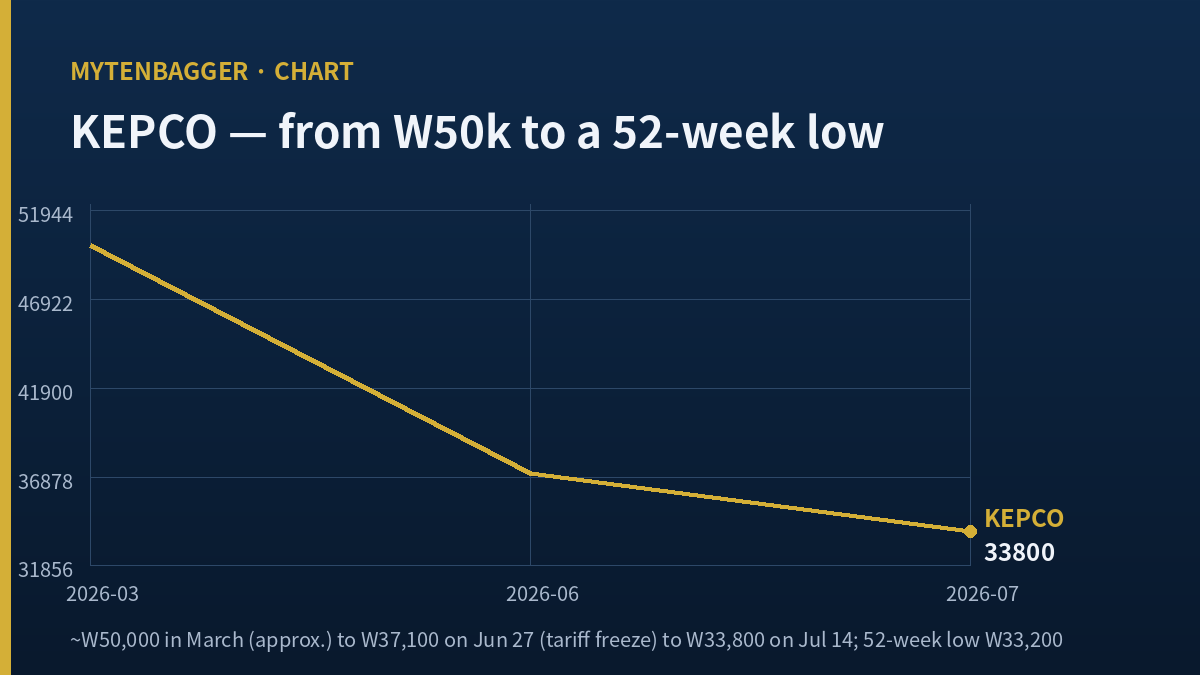
The price did the opposite. Around ₩50,000 (~$33) in March, KEPCO stock slid to ₩33,800 by July 14, cutting below its 20-, 60-, and 120-day moving averages (₩37,456 / ₩39,698 / ₩45,716). A profitable company, one that just restored a dividend, trading at 2.5x earnings and 0.45x book, is sitting at a 52-week low. That contradiction is my starting point. I don’t jump to “the market is wrong.” The market isn’t ignoring these numbers — it just doesn’t believe they’ll hold.
The Margin Axis Pressing KEPCO Stock: Seoul Sets the Price
The reason the market discounts that profit is clean. KEPCO’s earnings are essentially one spread: the cost of buying power (purchased-power cost) versus the price of selling it (the electricity tariff). And KEPCO does not set the selling price — the government does. On June 22, KEPCO kept the Q3 fuel-cost adjustment unchanged at ₩5 per kilowatt-hour, as Korea’s Seoul Economic Daily reported, and the finance ministry signaled that electricity and gas rates would stay frozen through the second half. On that news, KEPCO stock fell 4.38% in a single session to ₩37,100 on June 27.
A cost-side problem landed on top of it. Korea’s KB Securities estimated that a delayed pass-through of higher global energy prices pushed procurement costs up by about ₩700 billion (~$470 million) while the tariff stays frozen, making an earnings decline “unavoidable,” and cut its objective for the shares from ₩63,000 to ₩54,000. The same note put Q2 operating profit near ₩1.8 trillion (~$1.2 billion), down 15.3% year over year. Sell-side commentary aggregated by Investing.com pointed to the same squeeze — high oil, a weak won, and an inflation-control stance limiting rate hikes — with Middle East-driven oil spikes hitting from Q2. So on the margin axis, KEPCO is pressed from both sides: the government caps what it charges, while oil and FX lift what it pays.
That is my first reason for not owning KEPCO on cheapness alone. A 2.5x multiple is the market pricing the odds of margin normalization at close to zero. I think that’s overdone — but the trigger that would fix it (tariff normalization) isn’t in my hands or the company’s. It’s in the government’s, and I dislike outsourcing the timing of my capital to a variable I can’t control. Debt makes the clock worse: Q1 borrowings were reported around ₩128 trillion (~$85 billion), with daily interest near ₩11.4 billion (~$7.6 million) and a debt-to-equity ratio in the 400% range. With margins pinned and that interest running every day, cheap valuation doesn’t mean time is on the company’s side.
I’ll add the other edge of that blade, because it cuts both ways. A pinned margin snaps back fast when it releases, precisely because the volume KEPCO sells is enormous. Korea’s annual electricity sales run above roughly 500 billion kWh, so arithmetically a ₩1-per-kWh tariff change is on the order of ₩500 billion (~$333 million) a year in revenue and profit (a back-of-envelope figure, sales × price). A few won of cost-reflective normalization moves trillions of won of earnings. That is why 2.5x is dangerous and attractive at once: a company with margin crushed toward zero shows explosive earnings-growth optics on even a small recovery. Knowing that reverse leverage is exactly why I can’t delete KEPCO — and knowing the government holds the trigger is why I stand in front of it without pulling.
What the Volume Axis Adds to KEPCO Stock
If that were the whole story, I’d simply watch and move on. But there is a second axis the market currently assigns almost no value to: volume. Margin is “how much I keep per kWh”; volume is “how many kWh I sell.” If the quantity sold structurally grows even while the tariff is frozen, that is growth independent of the tariff.
What’s driving that volume is the same force reshaping power markets worldwide: AI data-center demand. Korea’s Electronic Times (ETNews) reported on June 1 that domestic data-center power demand could exceed 1.5 GW within three years. Data centers are 24-hour base load. If that demand actually connects, the kilowatt-hours KEPCO sells rise regardless of the tariff. There’s a nuance in that volume story I keep honest about. Base-load demand from data centers is structural in a way retail or industrial demand isn’t — a hyperscale facility runs flat-out around the clock and doesn’t switch off in a downturn, so the kilowatt-hours are stickier than a normal load. But the bottleneck usually shows up before the generation does: transmission lines, substations, and interconnection queues gate how fast that demand actually reaches the meter. So the volume axis is real but slow, measured in years of grid build-out rather than quarters. That timing gap — real demand, delayed delivery — is precisely why I treat volume as a reason to keep watching rather than a reason to buy today. This, to me, is the part the market has erased from the stock entirely — it threw the tariff-frozen margin bad news and the tariff-independent volume growth out together.
The second piece is nuclear. When Korea’s Eugene Investment kept its ₩92,000 objective on the shares (per Newspim’s report of the note), the core of its case was progress in US-Korea nuclear cooperation. KEPCO is both the domestic electricity seller and an operator that builds and runs nuclear plants abroad; that export and operations business is a cash flow outside domestic tariff regulation. Eugene also flagged that an SMP price cap in the second half could actually cap the downside to earnings, plus post-election policy momentum. I do not adopt that ₩92,000 figure as my own — it is Eugene’s number, not mine. What matters to me is that its logic stands on the volume-and-structure side, not the margin side, which is the axis I’m watching. Viewed from the design subsidiary instead, the same nuclear expectation carries the opposite price. KEPCO Engineering trades at 45.89x, and more than half of the net income sitting under that multiple came from a single building. One nuclear axis, 2.5x on this side and 45x on that one.
The value-up angle deserves a fair mention, then a caveat. Korea’s 2024-2025 “corporate value-up” push lifted low price-to-book names, and at 0.45x book KEPCO looks like it belongs at the front of that line. But I’m careful applying the value-up frame here. Its engine is shareholder return — buybacks and bigger dividends — and KEPCO is a government-controlled utility that must first steer a large share of profit into cutting debt. The restored dividend is a real improvement, but this is not a company positioned to hand surplus cash aggressively back to minority holders the way a private firm can. So I don’t file KEPCO under “low P/B, therefore value-up winner.” Its re-rating comes from tariff policy, not payout policy — and that is what separates it from other cheap-on-book names.
How KEPCO Stock Looks Next to Global Regulated Utilities
I understand KEPCO best by setting US and European regulated utilities beside it. NextEra Energy, Duke Energy, and Southern Company also can’t raise rates at will — they’re regulated too. But one thing is decisive. Their tariffs are set by independent regulators through a rate-case process that grants an allowed return on invested capital: when costs rise, the tariff follows with a lag. That is why these names have long commanded double-digit earnings multiples for dividend stability and growth, and why the AI data-center wave is re-rating them upward right now.
The mechanism gap is worth spelling out, because it’s the whole game. A US regulated utility typically carries a fuel adjustment clause that passes fuel-cost swings through to customer bills on a near-automatic monthly or quarterly cadence, plus periodic rate cases that reset an allowed return on the capital it sinks into the grid. The utility still can’t gouge, but it is structurally made whole for cost and capital. Korea has the same idea on paper — a fuel-cost linkage system introduced in 2021 — but in practice it has been repeatedly suspended whenever it collided with consumer-price politics, which is exactly what the June freeze was. So the difference between KEPCO and its global peers isn’t asset quality or demand; it’s whether the cost pass-through is a rule the regulator honors or a lever the government can switch off. When I value a regulated utility, that single distinction drives most of the multiple, and it’s why I refuse to read a 2.5x number as simply “too cheap.”
KEPCO stands in front of the same AI power demand and de-rates instead. The hand setting its tariff isn’t an independent regulator but a government that also has to weigh inflation and politics. To me this is a textbook case of the so-called “Korea discount”: the assets are there, the demand is there, the profit is there, yet the stock is trapped near a 2.5x multiple because pricing power lives outside the company. So against global peers, the variable that actually matters for KEPCO stock isn’t the earnings line — it’s the institutional question of how far the tariff is allowed to track cost. That doesn’t show up on a chart; it shows up in policy headlines. Which is why I file KEPCO as a policy stock, not an earnings stock.
Analyst Targets, Institutional Flows, and How I Access KEPCO Stock
The spread of sell-side objectives tells you exactly what kind of stock this is. The high end is Korea’s Eugene Investment at ₩92,000 (~$61); IBK Investment cited room for dividend expansion at ₩77,000 in a February 27 note. The low end holds SK Securities at ₩40,000 and Kyobo and Shinhan Investment at ₩43,000. Eugene cited a trailing six-month consensus average of ₩64,412 (~$43). These are each firm’s numbers, and I take none of them as my own destination. But the fact that ₩40,000 and ₩92,000 attach to the same stock at once is itself information. It isn’t a disagreement about “what’s fair” — it’s the market assigning different probabilities to a single fork: does the tariff release or not. The current ₩33,800 quote sits below even that consensus floor.
A line on flows. On the supply-demand indicators I follow, KEPCO showed institutions net-buying for 5 to 7 straight sessions in early July — accumulating into the very slide that took the price toward its low. I don’t read that as “institutions are right”; institutions are wrong plenty. But a specific cohort steadily absorbing shares at the low tells me there is real money treating this level as a floor. I use that as an input to my trigger thinking, not as a signal to follow anyone in.
Three pictures sit in my head. My base case: the tariff freeze runs through the second half, oil doesn’t cooperate, Q2 earnings fall year over year, and KEPCO stock grinds in the low ₩30,000s. My bull case: the Q4 tariff decision takes one cost-reflective step, oil calms, and the pinned margin snaps back through the reverse leverage above — at which point a 2.5x multiple flips into “cheap with the reason for cheapness gone.” My bear case: oil climbs further, the tariff stays locked, and interest on ₩128 trillion of debt eats into profit and even the restored dividend. I currently weight the base case most heavily, which is why I watch rather than own.
Why I Haven’t Bought — My Triggers
To pull it together, here is how I hold this name. The margin axis I don’t trust: the tariff is in the government’s hands, oil and FX push costs up, and the interest on ₩128 trillion of debt runs daily. The volume axis I do trust: data-center demand and nuclear exports grow the quantity sold regardless of the tariff. The problem is that of the two, the one moving the stock today is margin. Volume arrives slowly over three years; margin can change a quarter’s earnings with a single tariff decision. So I believe the volume and still don’t buy — a good company and a good entry are different questions, and I won’t hand my timing to a government calendar.
I’ll be honest: I’ve been burned on policy stocks before. Years ago I went early into another quasi-public, tariff-and-regulation name on the logic that “this cheap, it has to normalize eventually,” and normalization came more than a year later than I expected while I paid the opportunity cost the whole way. What I learned is simple: when the reason a stock is cheap sits in policy rather than performance, cheapness means nothing if I can’t time when the policy turns. KEPCO keeps reminding me of that, so this time I keep my hands out until the trigger is visible.
The conditions that break my watch stance are three, in time order. First, a Q4 tariff decision that actually lets the fuel-cost pass-through work, or signals a cost-based direction — that’s the key to the margin axis. Second, oil and the won/dollar stabilizing so purchased-power cost verifiably falls in a reported quarter. Third, data-center power contracts or nuclear orders showing up as hard numbers, moving the volume axis from “forecast” to “results.” If the first or second arrives, I’d treat it as the start of margin recovery and scale in gradually. If only the third comes, that lengthens my horizon rather than justifying a buy today. And I’d size it as what it is — a policy option, not a core position. If the first trigger fires, my plan is a starter tranche, then adds only as each subsequent quarter confirms the pass-through is real rather than a one-off gesture, because a single cost-reflective step that gets reversed at the next inflation scare would trap me exactly where today’s holders sit. Cheap gives me a margin of safety on price; it does not give me one on timing, and on this name timing is the whole risk.
And the signal that my volume thesis is wrong, so I don’t only mark the bull path: if data-center demand jams against transmission and substation bottlenecks and never converts to actual sales, or the nuclear cooperation drifts on a political calendar, I re-file KEPCO as “cheap but going nowhere” and push it down my watchlist. Right now I haven’t bought KEPCO stock, but I haven’t deleted it either. I’m tracking two separate axes — tariff headlines and data-center contracts — one at a time. On this name, the half the market sells is right and the half it erases is early. That’s my one-line entry for today.
Related reading