Samsung SDI Stock: Why I Watch Q2, Not the 66% ESS Win
On July 13, Samsung SDI stock jumped 9.21% in a single Seoul session, and I did something I do more often than I’d like to admit: I opened the order ticket, stared at it, and closed it. The catalyst was real — the company had just swept roughly two-thirds of the battery volume in the Korean government’s first AI-operated grid ESS program. The question wrote itself: does this lock in the second-half turnaround everyone keeps talking about? The answer felt too clean, and answers that arrive too clean make me suspicious. This is a company that has now posted six consecutive quarterly operating losses. Within three sessions, the stock had handed back essentially the entire pop.
So this entry isn’t about chasing a spike. It’s me sitting down after the spike cooled and re-underwriting the whole company — a KOSPI large cap worth about ₩35 trillion (roughly $23 billion at ₩1,520 per dollar, the rate Trading Economics shows, which I use for every conversion below). For readers new to the ticker: Samsung SDI (006400) trades on the KOSPI, the main board of the Korea Exchange, where Korea’s flagship industrials list. I had never given this name a full write-up before, mostly because I don’t enjoy underwriting losses. This time I did the work.
Where I stand: no position, watching. The company that just took 65.6% of Korea’s first AI grid-ESS battery volume is also a company six quarters into operating losses. I want that gap closed by numbers, not narrative — my first trigger is whether the Q2 battery division prints at or near breakeven.
Contents
Samsung SDI Stock Jumped 9% on a Government ESS Sweep — Here’s the Anatomy
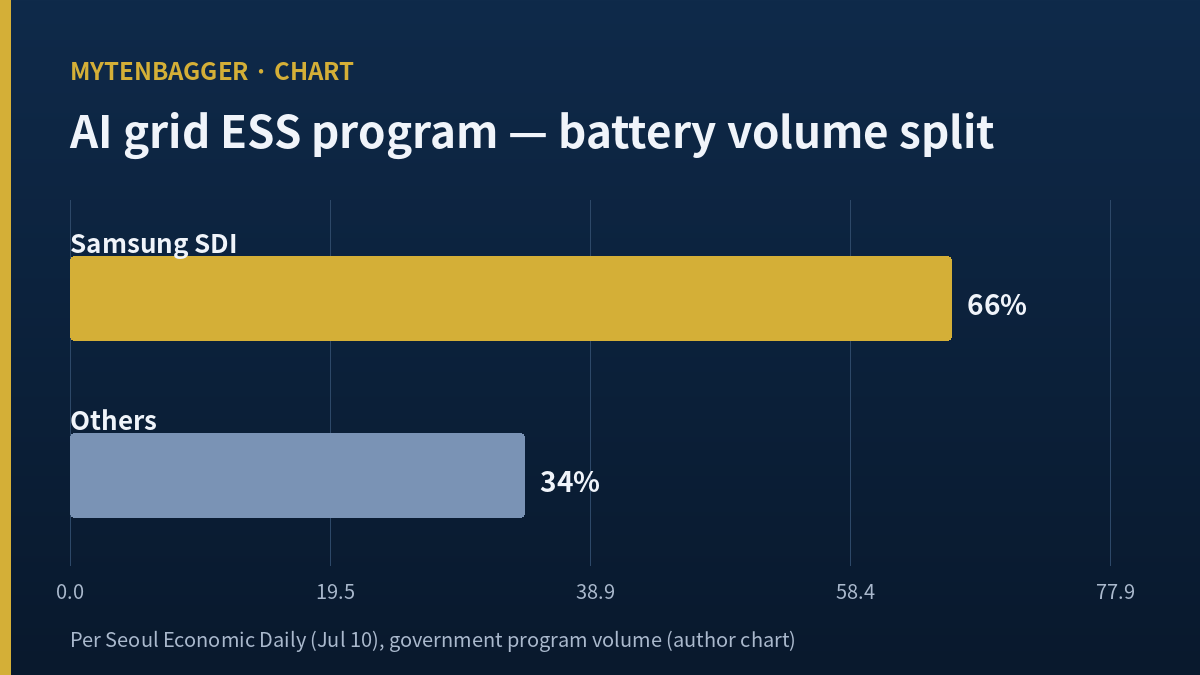
Start with what actually happened. According to Seoul Economic Daily, a major Korean business daily (July 10 — this and all Korean-language sources below are my translations), the Ministry of Climate, Energy and Environment awarded its “AI-utilized ESS deployment support program”: 32 distribution-grid lines, 20MWh of batteries per line, 640MWh in total. Nine consortiums won operator slots, and six of the nine picked Samsung SDI cells. Counted by grid lines, that’s 21 of 32 — 65.6% of the volume. LG Energy Solution supplied 7 lines (21.9%) and SK On took 4 (12.6%). The winning product was the SBB 1.5, Samsung SDI’s containerized system built on high-nickel NCA prismatic cells.
Two layers of winning — cells versus operations
One nuance I found worth the dig: this wasn’t a simple loss for the competition, because the game had two layers. The consortium list Seoul Economic Daily printed includes LG Energy Solution itself as one of the nine operators. So LGES placed only one win in the cell-selection layer but secured a seat in the layer that runs the projects, while Samsung SDI dominated the layer where operators choose whose cells to buy. Both get called a “win” in headlines; the cash flows through different doors. My read is that the cell-supply scoreboard is the cleaner signal of a battery maker’s core competitiveness — it’s nine independent operators voting with their procurement budgets.
Still, let me keep the size honest. Twenty-one lines times 20MWh is 420MWh (my arithmetic), and 420MWh does not move the P&L of a company that sell-side models put near $10 billion in annual revenue. What I actually took from the award is two things. First, reference-account value: this is the Korean government’s first AI grid-ESS program, the opening track of a state-level buildout of storage on the distribution grid, and Samsung SDI took two-thirds of it. Second, it’s an entrance, not an exit — the same report flags a third central-contract ESS market auction coming around September. Whether the 66% share survives that auction is the real test of this catalyst.
A word on that market for readers who don’t follow Korean power policy: the central-contract ESS market, as the Korean coverage describes it, is a government-run auction system through which grid storage capacity is procured under long-term contracts — Korea’s institutional answer to the question of who pays for batteries on the grid. The September round would be the third. For a cell maker, recurring auctions mean the scoreboard resets every round; a 66% share is a photograph, not a franchise. That cuts both ways, and I’d rather own the company being photographed at 66% than at 22% — but I want at least two photographs before I trust the pattern.
The U.S. roadmap — NCA shipping now, LFP by Q4
If the Korean program is the symbol, the profit engine is supposed to be America. A KB Securities note (February 25, the one that raised its price objective 39% to ₩530,000, about $349) laid out the sequence as the analysts there estimate it: U.S. production of ESS-grade NCA batteries started back in Q4 2025, and ESS-grade LFP production is slated for Q4 2026. The same note estimated Q1 ESS revenue would hold near the record level of Q4 2025 and named AI-driven power demand as the engine, lifting its 2026–2030 average operating-margin assumption from 4.1% to 6.0%. I’ll flag plainly that every number in this paragraph is sell-side estimation, not company-confirmed guidance. But the shape matters: ESS revenue is already here, and the LFP line — the chemistry the U.S. storage market has standardized on — joins the lineup late this year. The chemistry point deserves one more beat. Stationary storage doesn’t need the energy density that nickel-rich EV chemistries chase; it needs cost per kilowatt-hour and thermal calm, which is exactly where iron-phosphate wins. That’s why grid racks worldwide standardized on LFP, and why the supply base for it has been overwhelmingly Chinese. Korean makers spent a decade optimizing for the other trade — premium nickel chemistry for European EVs — and are now retooling toward the chemistry the growth market actually orders. How much of the American data-center storage bill Korean cell makers capture from the Chinese incumbents who dominate global LFP supply, CATL above all, is what sizes this company’s ESS profit from 2027 onward. That’s my framing, not anyone’s forecast.
Power tools and UPS racks — the recovery that showed up first
The ESS recovery didn’t come from nowhere. The company’s own Q1 materials, as reported by Aju Business Daily (a Korean outlet), already listed demand recovery in ESS, uninterruptible power supplies, battery backup units and power tools as the drivers of battery-division improvement — division revenue up 12.5% year over year, losses down 61%. A side note that stuck with me: reading that passage, I flipped over the battery pack of my own cordless drill to check the cell markings. Samsung SDI cylindricals. In a market where everyone talks about batteries as if EVs were the whole story, the floor is being poured by everything that isn’t an EV. I find that detail more reassuring than any slide deck.
Six Straight Losses — the Weight Samsung SDI Stock Is Carrying
Why did a 9% pop fade in three sessions? I think the answer is sitting in the income statement. The Q1 results the company reported on April 28: revenue of ₩3.58 trillion (about $2.4 billion), up 12.6% year over year, against an operating loss of ₩155.6 billion (about $102 million). The loss narrowed 64.2% from a year earlier — and it was still the sixth consecutive quarterly operating loss. By division: batteries did ₩3.35 trillion in revenue with a ₩176.6 billion loss, while electronic materials earned ₩21 billion on ₩222 billion of revenue. The core business is still underwater.
The share price tells the other half. At the July 16 close of ₩430,500 (about $283), Samsung SDI stock sits 40% below its 52-week high of ₩723,000 (about $476) — and, in the other direction, at 2.5 times its 52-week low of ₩169,700 (about $112). Both percentages are my arithmetic off exchange prices. The last month alone took 22% off. This is a stock arguing with itself about whether a one-year, 150%-plus rally was foresight or overshoot.
| Item | Figure | Whose number |
|---|---|---|
| Q1 2026 actuals | Revenue ₩3.58T (~$2.4B), operating loss ₩155.6B (~$102M) | Company results, Apr 28 |
| Q1 by division | Batteries −₩176.6B / electronic materials +₩21B | Company results, Apr 28 |
| Q2 2026 estimate | Revenue ₩3.8T (~$2.5B, +19% YoY), profit near breakeven | DB Securities estimate, via Etoday, Jul 13 |
| FY2026 estimate | Revenue ₩15.26T (~$10.0B, +15%), operating loss ₩522B (~$343M, −69.7% YoY) | LS Securities estimate, May 12 |
The last row is the skeptic’s anchor and I keep it taped above my screen. Even if a single quarter touches breakeven, the most cautious house on the street still models a ₩500 billion-plus operating loss for the full year. There is always a lag between the quarter when “turnaround” makes headlines and the year when the annual income statement actually flips ink colors. Buying the narrative while ignoring that lag is, in my experience, how battery-sector investors donate money.
The Q2 setup itself: Etoday, a Korean business daily, quoted DB Securities analyst Ahn Hoe-soo (July 13) estimating second-quarter revenue of ₩3.8 trillion, up 19% year over year, with profit around breakeven. My first reaction was that breakeven is a strange thing to celebrate. My second reaction was better: for a company six quarters into losses, zero is not a number — it’s an inflection witness. The catch is that it’s an estimate. Which is why I’m waiting for the print instead of front-running it.
The Sell-Side Map — Even the Skeptic’s Number Sits 38% Above the Price
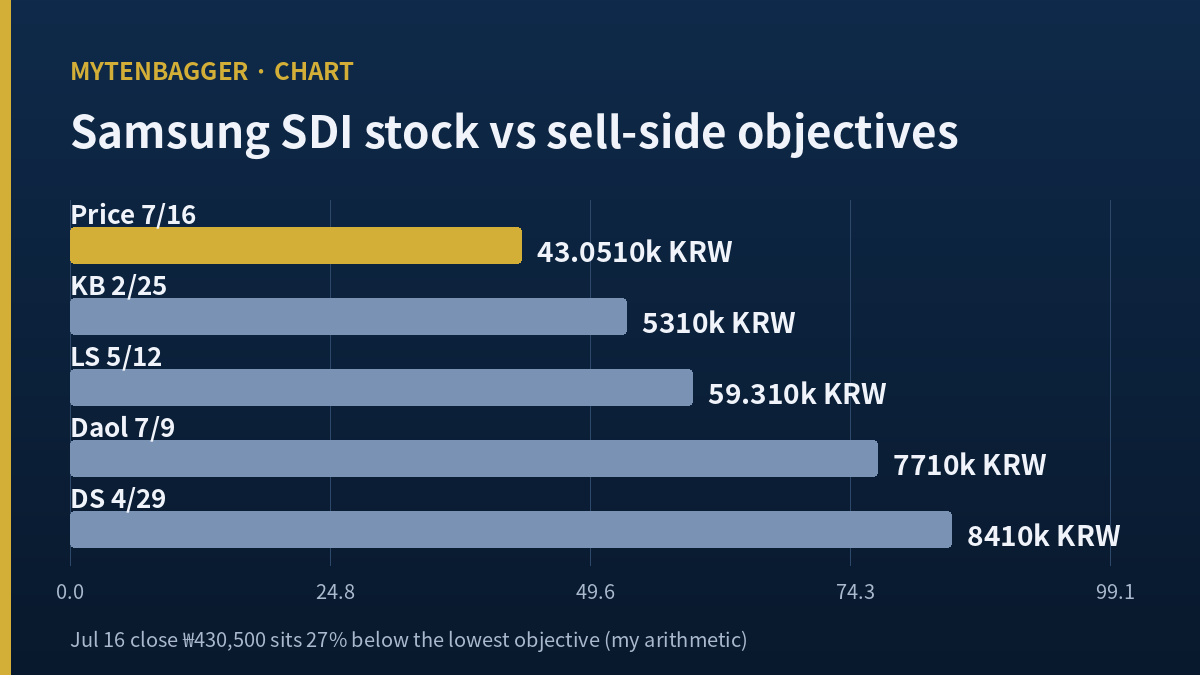
I lined up this year’s notes in time order. “Objective” here means each broker’s published 12-month price objective, cited as market information — none of them are mine.
| House (date) | Objective | Stance | One-line thesis |
|---|---|---|---|
| KB Securities (Feb 25) | ₩530,000 (~$349), +39% | Buy | ESS lifts 2026–2030 margin outlook from 4.1% to 6.0% |
| DS Investment & Securities (Apr 29) | ₩450,000 → ₩840,000 (~$553) | Raised | Q4 swing to profit gaining visibility; valuation base year rolled |
| LS Securities (May 12) | ₩618,000 → ₩593,000 (~$390) | Hold | European share slipping, ramp-up costs; price ran ahead of earnings |
| Daol Investment & Securities (Jul 9) | ₩900,000 → ₩770,000 (~$507) | Buy | Cut on the view that proof of earnings recovery is still required |
What interests me isn’t the direction of the revisions — it’s the geometry. On May 12, when LS Securities trimmed its objective to ₩593,000, the market price was ₩684,000: the skeptic’s number sat below the price. Two months later the picture has inverted. Today’s ₩430,500 sits 27% below that same most-skeptical objective — equivalently, the number sits 38% above the price (both my arithmetic). The market has sold this thing down to three-quarters of what the house that called it overvalued thinks it’s worth. I don’t treat that as a buy signal by itself; a ₩593,000-to-₩840,000 spread mostly tells me nobody’s earnings model has converged. But it does tell me where the burden of proof now lives — on the bears’ side of the price, for the first time in months. Only earnings can shrink that spread.
A confession belongs here, because this journal is supposed to contain my misses. Last summer, when this stock was in the high ₩100,000s, I crossed it off my watchlist on the logic that the market still had a rights-offering share overhang to digest. The stock then went up two and a half times. Chasing it now out of regret would be compounding the error. What I actually missed back then wasn’t the price — it was the slope of ESS demand. The instrument I’m using to avoid missing it twice is the next battery-division P&L line, not the chart.
Samsung SDI Stock and the $6.6 Billion Display-Stake Puzzle
There’s a balance-sheet event hanging over this name that has nothing to do with quarterly cells-per-line math. On February 19 the company disclosed that it is pursuing a sale of its 15.2% stake in Samsung Display, as reported by The Electronic Times and others; the company framed it as securing investment resources and improving its financial structure. Korean press estimates put the stake’s value around ₩10 trillion (about $6.6 billion), and the widely floated — but unconfirmed — buyer is Samsung Electronics. Counterparty, terms and timing all remain open. Reported company plans call for over ₩3 trillion (about $2 billion) of investment this year across ESS line conversion, solid-state batteries, high-nickel chemistry and dry-electrode process work, so nobody is confused about where the money would go. For a company that already tapped shareholders once with a rights offering last year, monetizing an asset instead of printing shares is, from where I sit as a prospective shareholder, the more respectful path. What that money looks like once it lands on the balance sheet is on the record at Hanon Systems — after two equity issues, total liabilities fell by 1,042.2 billion won and the debt-to-equity ratio went from 254.16 percent to 168.14 percent.
One more lens, borrowed from my own earlier work on a peer: when I dug into LG Energy Solution in this journal, the uncomfortable finding was how much of its quarterly profit was the U.S. Advanced Manufacturing Production Credit rather than the underlying business. Samsung SDI is the mirror image — it’s losing money, so there’s no subsidy makeup hiding the face underneath, and when it does cross into profit, that profit will arguably carry less cosmetic help. I’m not scoring one approach above the other; I’m noting that within one industry, the same income-statement line has to be read differently name by name.
But I write down the back of this card too. In Q1, the operating line lost ₩155.6 billion while net income came in positive at ₩561 billion. That gap lives outside operations, and the equity-method slice of Samsung Display is the pillar most often cited for it in the Korean coverage of the sale. If the stake sale completes, ₩10 trillion of cash walks in — and the recurring non-operating prop that has been holding up net income walks out. From that point on, the bottom line shows up without makeup. I actually think that’s healthy. It just means nobody should extrapolate today’s net income past the closing date.
Three Paths for Samsung SDI Stock After Q2
Here’s how the tree splits in my head. The probabilities are mine and worth exactly what you paid for them.
Path 1 — breakeven confirmed (my gut: 40%). The Q2 battery division lands at or near breakeven and the path to a Q3 profit becomes visible. This is the world DB Securities’ estimate describes. I also read Daol’s July move — cutting the objective while keeping its buy stance — as a hedge that flips back to conviction in exactly this branch. The upper half of the objective spread (₩770,000–840,000) returns to the conversation, and I start my first tranche.
Path 2 — narrower but still negative (my gut: 40%). Losses shrink, zero stays out of reach, and the ESS profit contribution slides toward Q4. The stock likely keeps carving out a base in the ₩400,000s while I wait for the September auction result. What I’d watch in this branch isn’t the drawdown — it’s whether ESS revenue keeps compounding quarter over quarter. As long as the direction is alive, waiting costs me nothing but patience.
Path 3 — the European undertow (my gut: 20%). The share-loss and ramp-cost problems LS Securities flagged in Europe swallow the ESS gains. In that world, “the price ran ahead of earnings” stays true even at ₩430,000. At roughly 1.6 times book value (price over book per share, my arithmetic), this is not a statistically cheap stock even for a profitable company — so in this branch I take it off the watchlist entirely and revisit next cycle.
My Staircase on Samsung SDI Stock
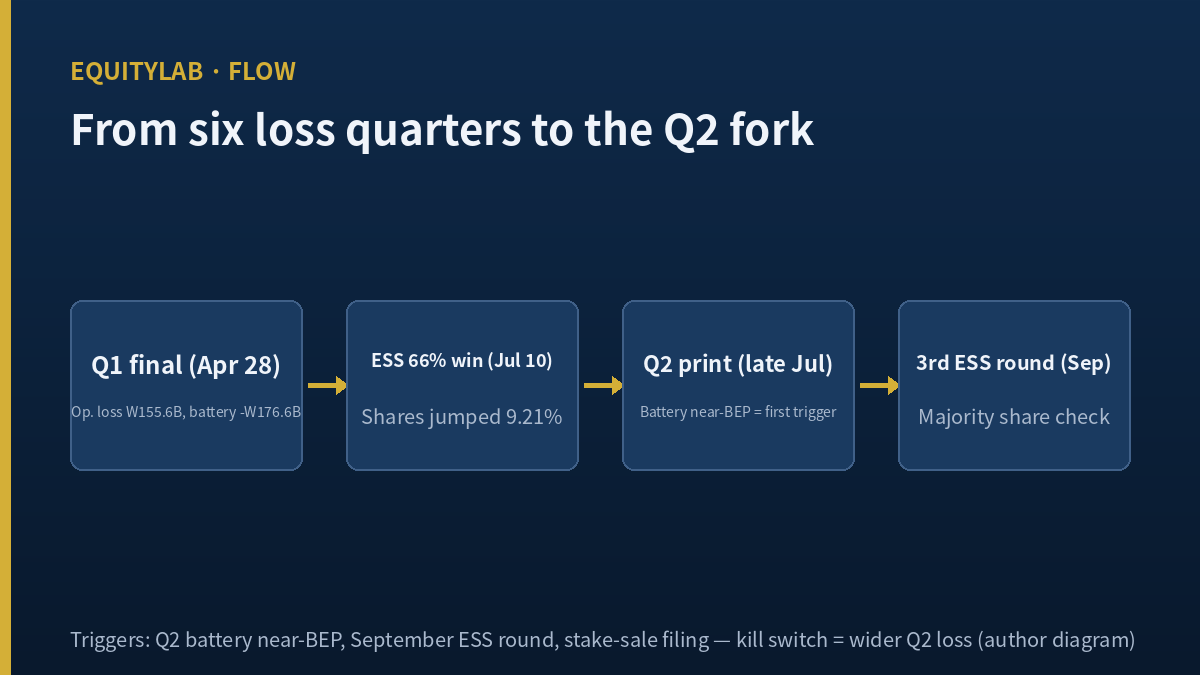
I’m structuring this one as a staircase rather than a single trigger. Step one up: the Q2 battery division narrows to near-breakeven (within a few tens of billions of won, by my own yardstick) — I take a starter position. Step two: the September third-round central-contract ESS auction shows the company holding a majority share — I add. Step three: the display-stake sale gets a disclosed counterparty and price, with the proceeds visibly wired into capacity and the solid-state roadmap — I complete the position. One step down is enough to end it: if the Q2 battery loss comes in wider than Q1’s ₩176.6 billion, my thesis is wrong regardless of how good the ESS story sounds, and the name goes back on the some-future-cycle list. An indefinitely drifting stake sale gets the same treatment. Of my three calendar checkpoints — Q2 results, the September auction, the sale disclosure — two have dates and one doesn’t. I size nothing against events that don’t have dates.
Currency matters here too: my entire staircase is denominated in won, and a dollar-based holder is stacking a currency view on top of a turnaround view whether they mean to or not. And if you only track U.S. tickers, the nearest read-across isn’t another cell maker at all — it’s the deployment side of the same AI-power trade, the storage businesses at Tesla and Fluence, which tell you how fast the racks are going in. Samsung SDI is fighting for the cells inside those racks; the demand signal and the supply scoreboard are two different instruments, and I watch both.
I started this entry excited about a 66, and finished it realizing the number I’m actually waiting for is a zero. Whether closing that order ticket on spike day was discipline or timidity is something the Q2 print will grade for me. The next line of this journal gets written that day. What anyone else does with these notes is their own call.
Sources: Seoul Economic Daily — AI grid ESS program results (Korean), Aju Business Daily — Q1 2026 results (Korean), Etoday — July 13 move and DB Securities Q2 estimate (Korean), BusinessPost — LS Securities note (Korean), News1 — DS Investment & Securities note (Korean), SBS Biz — Daol Investment & Securities note (Korean), The Electronic Times — Samsung Display stake sale disclosure (Korean), Trading Economics — USD/KRW, OTC Markets — SSDIY
Related reading