Kolon Global Debt Extension: What Changed and What Did Not
- Kolon Global stock: KRW 9,170 at the September 23, 2026 close.
- Debt due within a year, December 2025: KRW 696.39 billion.
- Same line, June 2026: KRW 461.36 billion.
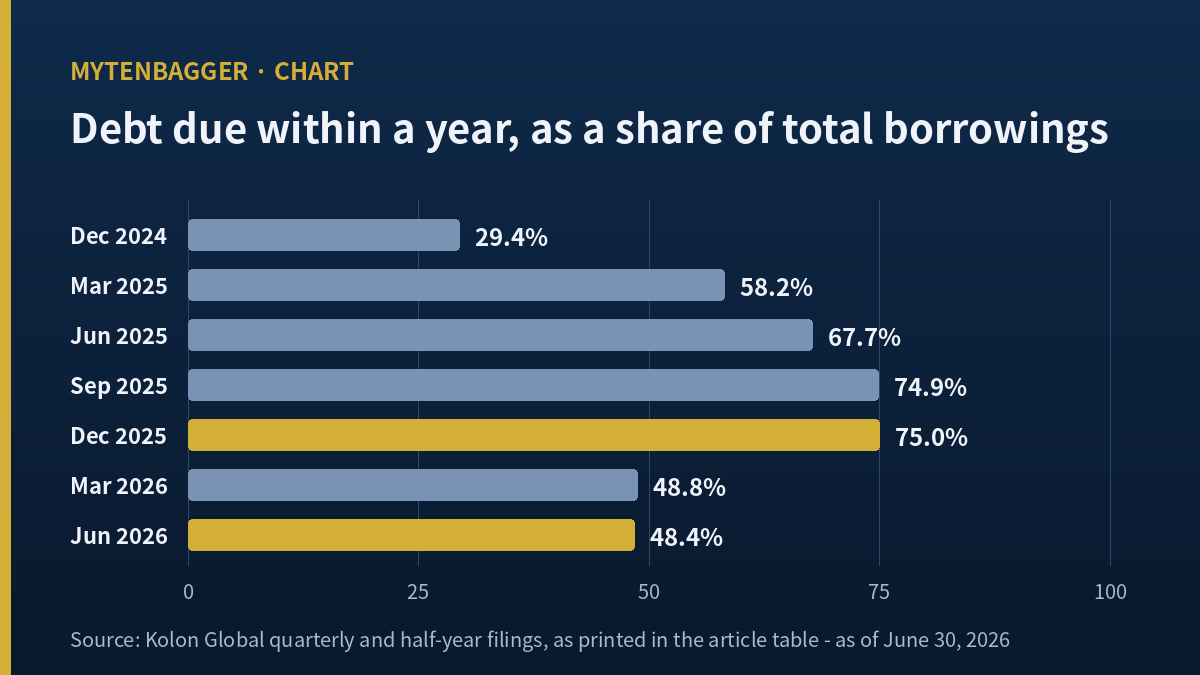
- Share of borrowings due inside a year: 75.0% to 48.4%.
- Long-term debt over the same six months: KRW 231.57 to 492.27 billion.
- Cash and equivalents: KRW 272.48 to 201.22 billion.
- Cash against debt due within a year: 0.39x to 0.44x.
- Borrowings minus cash: up KRW 96.93 billion.
- Shares outstanding after the October 2025 merger: 19.59 to 25.82 million.
- My position: none. Watching until the Q3 report, due by November 16 (Mon).
Kolon Global stock closed at KRW 9,170 (about USD 6.75) on September 23, 2026, the last trading day before Korea’s Chuseok holiday. In the six months to June 30, the builder cut the debt it owed within twelve months from KRW 696.39 billion to KRW 461.36 billion, and the share of its borrowings due inside a year fell from 75.0% to 48.4%. That looks like a repaired balance sheet until you check the cash: it fell too, to KRW 201.22 billion, which covers only 0.44 times what is still due within a year.
Kolon Global is a mid-sized Korean contractor listed on the KOSPI, Korea’s main board, with a market value of roughly KRW 233.17 billion (about USD 171.7 million) at that close. It builds apartments, civil works and environmental plants, and since October 2025 it also runs hotels, golf courses and building management after absorbing two sister companies from the Kolon group. I do not own it. This entry is about one thing I kept coming back to while going through its balance sheet: when its bills fall due, and what was actually done about them this year.
Contents
Kolon Global Stock and the Debt That Came Due at Once
I pulled seven quarter-end balance sheets from Stock Analysis, which republishes the company’s Korean filings in a standard format. I used the three borrowing lines it lists: short-term debt, the current portion of long-term debt, and long-term debt. Its total-debt line adds roughly another KRW 47 to 50 billion in the December and June columns only, which I left out so that every quarter is measured the same way.
| Quarter end (KRW bn) | Due within a year | Long-term debt | Share due in a year | Cash | Cash / due |
|---|---|---|---|---|---|
| Dec 31, 2024 | 274.45 | 658.23 | 29.4% | 278.65 | 1.02x |
| Mar 31, 2025 | 553.47 | 397.57 | 58.2% | 476.18 | 0.86x |
| Jun 30, 2025 | 639.15 | 304.88 | 67.7% | 349.71 | 0.55x |
| Sep 30, 2025 | 687.17 | 230.41 | 74.9% | 291.02 | 0.42x |
| Dec 31, 2025 | 696.39 | 231.57 | 75.0% | 272.48 | 0.39x |
| Mar 31, 2026 | 469.61 | 491.93 | 48.8% | 326.00 | 0.69x |
| Jun 30, 2026 | 461.36 | 492.27 | 48.4% | 201.22 | 0.44x |
Source: Stock Analysis quarterly balance sheet for KRX:003070, figures in KRW billion. “Due within a year” is short-term debt plus the current portion of long-term debt; the share and the cash ratio are my own arithmetic from those columns.
Read top to bottom, the table tells a story in two acts. Through 2025 the debt kept sliding toward the near end. At the close of 2024, 29.4% of borrowings were due within a year. Three months later it was 58.2%, then 67.7%, then 74.9%, and it sat at 75.0% on December 31. The total barely moved in that stretch; what moved was the clock. Loans that had been long-term simply got closer to their due dates and were reclassified as current, while long-term debt shrank from KRW 658.23 billion to KRW 231.57 billion.
The second act is the first quarter of 2026. Long-term debt more than doubled, from KRW 231.57 billion to KRW 491.93 billion, and the current portion of long-term debt fell by almost the same amount, from KRW 570.28 billion to KRW 281.41 billion. By my arithmetic, about KRW 260 billion of borrowings due inside a year were exchanged for longer ones in that single quarter. The June column shows that position held.
That is the part I credit. A contractor that enters a year owing three-quarters of its borrowings inside twelve months is exposed to whatever mood the lenders are in that spring. Kolon Global went through that spring and came out with under 50% of its borrowings due inside a year. Somebody lent it longer money in a weak Korean housing market, and that is information in itself.
What the Extension Did Not Change for Kolon Global Stock
The extension moved dates. It did not add money. Look at the cash column again. Kolon Global held KRW 278.65 billion at the end of 2024 and KRW 201.22 billion at the end of June 2026. Measured against the debt due within a year, cash went from roughly one-for-one (1.02x) to 0.44x. The ratio improved between December and June only because the debt due inside a year got smaller through the extension, while the cash itself fell by KRW 71.26 billion.
Put the three borrowing lines together and subtract cash, and the gap was KRW 655.48 billion at the end of 2025 and KRW 752.41 billion at the end of June 2026. It widened by KRW 96.93 billion in six months. Those were six months in which the company reported a profit, so the widening did not come from losses on the income side. The Korean trade paper 1conomy News reported the same direction with its own measure on August 12, 2026: cash down to about KRW 201.2 billion and net borrowings up about 13.2% from the end of 2025 (1conomy News, in Korean). Its net-borrowing figures use a different definition from mine, so I quote its direction and not its level.
Where did the cash go? I can see two candidates on the balance sheet but I have not read the cash-flow notes that would settle it. Inventory rose sharply over the six months, and the company kept paying its dividend. What I can say is that operating cash flow for January to June 2026 was negative in the company’s own filing, so those six months were not funded by the business throwing off cash. The lenders carried them.
A larger Korean builder showed me a different version of the same lesson. In an entry on GS E&C winning far more work than it bills, the gap was between orders and revenue. Kolon Global is smaller and its gap is simpler: between the dates on its loans and the money in its account. Moving the dates does nothing for the account.
The Merger That Sits Under Kolon Global Stock
There is a second event inside these seven quarters, and it changes how the equity column should be judged. On October 1, 2025, Kolon Global absorbed two unlisted Kolon group companies: MOD, which runs a seaside resort, golf courses and a Seoul hotel, and Kolon LSI, which runs hotels, highway rest stops, building maintenance and catering. Both had been wholly owned by the group holding company and its honorary chairman. The new Kolon Global shares were listed on October 22, 2025, according to the Korean outlet EBN (EBN, in Korean).
Stock Analysis shows shares outstanding moving from 19.59 million to 25.82 million between the September and December 2025 columns. That is 6.23 million new shares, an increase of about 31.8% by my arithmetic. At the September 23 close, those new shares alone are worth about KRW 57.13 billion, which is the market’s current price tag on what the group put into Kolon Global through the merger. The Korean press at the time of the deal, including Dealsite’s merger analysis, framed the merger as a way to add equity and lower the debt ratio from a weak starting point; I read those as the company’s stated intentions, and the equity line does bear them out in direction. On Stock Analysis’s figures, shareholders’ equity was KRW 606.61 billion at the end of 2024, KRW 684.40 billion a year later despite a large 2025 loss, and KRW 722.90 billion in June 2026.
So the balance sheet in June 2026 is the product of two separate repairs: more equity through a share-for-share merger in October, and longer debt through refinancing in the first quarter. Neither one produced cash. I think this distinction matters more for a builder than for most companies. A contractor pays suppliers and subcontractors before it collects from clients, and the cushion that carries it through a slow collection season is cash. Equity and maturity dates do not do that job.
I looked at a similar tension from another angle in a DL E&C entry where one percentage showed up three times, where the lesson was that the same-looking number can describe very different things. Here the parallel is only in structure: a falling share of short-term debt looks like strength, and in this case it is partly strength and partly a reshuffle of the calendar.
A US Contractor on the Same June 30 Balance Sheet
For a US reader it helps to see what a comfortable version of this ratio looks like. My peer for this entry is Tutor Perini (NYSE: TPC), a US civil and building contractor. I picked it for one reason only: it reports a June 30, 2026 quarter-end balance sheet that Stock Analysis lays out with the same three borrowing lines, so I can compute the same share with the same method. I am not comparing size, profitability or valuation, and the two companies operate in different markets under different accounting rules.
On Stock Analysis, Tutor Perini showed USD 8.11 million as the current portion of long-term debt and USD 390.79 million of long-term debt at March 31, 2026, and USD 5.00 million against USD 391.34 million at June 30, with no separate short-term debt line (Stock Analysis, TPC balance sheet). By my arithmetic that is 2.03% and then 1.26% of borrowings due within a year. Kolon Global’s figure for the same two quarter-ends was 48.8% and 48.4%.
Both moved in the same direction between March and June, and that is all I want from the comparison. The level gap says something obvious: one of these companies borrows mostly for the long haul and the other borrows mostly for the near term, even after a refinancing. I would not turn that gap into a valuation argument. It does tell me where the Korean builder still sits on the spectrum after its best quarter of repair.
The Case Against My Caution on Kolon Global Stock
I am watching this one without buying, and the other side deserves a fair hearing. Five points push against my caution.
- Lenders already voted. Refinancing about KRW 260 billion into longer loans during a weak year for Korean housing is not something a lender does for a borrower it expects to fail. The maturity fix is evidence of access to credit, and access to credit is what kills builders when it disappears.
- Profits are back. The company reported operating profit growth in the first two quarters of 2026 after a loss-heavy fourth quarter of 2025, and Hyundai Motor Securities analyst Shin Dong-hyun kept a buy rating in June, with a 2026 operating-profit estimate of about KRW 120.2 billion, according to Asia Economy’s coverage (Asia Economy, in Korean). If profit keeps arriving, cash eventually follows.
- The merged leisure businesses are steadier. Hotels, golf and building maintenance collect cash on a different cycle from apartment construction. The Korean business daily Edaily reported on August 12, 2026 that the leisure and asset-management segment roughly quadrupled its second-quarter sales from a year earlier (Edaily, in Korean). That is a source of cash the old Kolon Global did not have.
- Guarantees have come down. Daily Yeonhap, a smaller Korean outlet, reported that project-financing guarantees stood above KRW 1 trillion after the 2025 annual report, down from about KRW 1.49 trillion a year earlier (Daily Yeonhap, in Korean). I treat this as a single-source figure, but the direction supports the view that the off-balance-sheet risk is shrinking.
- My peer is unfair to it. Tutor Perini funds itself in the US debt market, which offers longer terms to contractors of its size; the Korean mid-sized builders whose filings I have gone through tend to borrow on shorter terms. A 48% share due in a year may be ordinary for a Korean mid-cap contractor, and I have not measured Korean peers the same way.
A word of background on that fourth point, because it is the part of Korean construction that US readers usually do not see. In Korea, apartment projects are often financed by the developer through project-financing loans, and the builder frequently stands behind those loans with a guarantee or a promise to finish construction. Those guarantees do not appear among the borrowings in my table, yet they can become the builder’s problem if a project stalls. That is what turned the 2023 housing slowdown into a crisis for several mid-sized builders, the best-known case being Taeyoung Engineering & Construction, which sought a creditor-led workout in December 2023. So when I say Kolon Global’s borrowings due within a year fell, I am describing only the debt it owes directly. The guarantees sit beside that number, and they are why I care so much about cash.
The fourth point is the one I weigh most. If project-financing guarantees are really falling that fast, the true near-term exposure is smaller than the balance sheet alone suggests. I just could not confirm that figure from a second source, so I leave it as a possibility.
Two Things I Could Not Pin Down
The price of the extra time
The first is the interest cost of the new money. Swapping short loans for long ones usually costs more per year, and a weaker borrower pays more for the extra time. I did not find a disclosure of the terms on the roughly KRW 260 billion that moved in the first quarter, so I cannot say whether the refinancing raised or lowered the company’s annual interest bill. That matters, because an extension that costs more each year shifts the pressure from the balance sheet to the income statement.
The calendar inside the next twelve months
The second is the calendar of what is left. KRW 461.36 billion is still due within twelve months of June 30, 2026. A table of maturities by period usually sits in the liquidity-risk notes of Korean January-to-June reports, and I have not read it for this company. It is possible that most of that amount sits in bank lines that roll over routinely, in which case the risk is lower than the headline suggests. It is also possible that a large bond comes due in early 2027. Until I read the notes, I keep both possible.
Lines I kept out on purpose
One more line deserves a mention because I nearly used it. Stock Analysis shows receivables of KRW 801.37 billion at December 31, 2025 and KRW 280.58 billion three months later. A drop of that size in one quarter is not what collections look like at a builder whose revenue did not collapse. It looks like an item moving between receivables and an adjacent line such as contract assets, which Korean contractors report separately and which a data service may fold in differently from one filing to the next. I could not confirm which, so the receivables line stays out of every calculation in this entry. If I had used it, the cash story would have looked far better in the first quarter than it was.
I also want to be clear about what I left out. I did not use equity multiples, dividend yield or earnings multiples in this entry at all. None of them answer the question I care about here, which is whether this company can meet its obligations as they fall due without asking the market for more.
What Would Reopen Kolon Global Stock for Me
The next test is the third-quarter report, which must be filed by November 16, 2026 (Mon). Before the checklist, here are the two broad pictures I expect to choose between.
If the September cash line rises
In this picture, the second-quarter profit starts to turn into collections, cash climbs back above the June level of KRW 201.22 billion, and the debt due inside a year stays near KRW 461.36 billion or falls. The extension then looks like what the company presumably meant it to be: time bought to let the recovering business catch up with its obligations. The merged hotel and golf operations would be part of that, because they collect as they go. I would read the stock very differently in that case, because the question would shift from survival arithmetic to how much the builder can earn in a normal year.
If September cash falls again
In the other picture, cash slips below KRW 201.22 billion while short-term debt rises to fill the gap. The share due within a year might even stay under 50%, which would make the headline look fine, but the cushion would be thinner than at any point in my table. At that stage the next step for a contractor is usually another round of refinancing, an asset sale, or support from the group, and each of those has a cost that lands on minority shareholders in one way or another. I have no way to handicap the group’s willingness from the outside, so I would simply stay away.
I will check nine things in the September 30 balance sheet and the notes, roughly in the order they answer my question.
- Debt due within a year stays at or below KRW 461.36 billion.
- The share due within a year stays under 50%.
- Cash does not fall below KRW 201.22 billion.
- Cash against debt due within a year rises above 0.44x.
- The three borrowing lines together do not rise above their June sum of KRW 953.63 billion.
- Operating cash flow for January to September turns positive.
- Short-term debt, KRW 190.82 billion in June, does not jump again; a rise there would mean the gap is being filled with the shortest money available.
- The notes disclose the interest terms on the new long-term loans.
- A second source confirms project-financing guarantees near or below KRW 1 trillion.
Items one to five and item seven come straight from the balance sheet on the day it is published. Item six needs the cash-flow statement. Item eight needs the notes, and item nine needs a second reporter or the filing itself; those last two decide how much weight I put on everything before them. If the cash items all improve and the notes show reasonable terms, I would move this company from the far edge of my watch list toward the center. If cash falls again while the maturity share holds, the extension was a delay and not a fix.
Where I Leave Kolon Global Stock for Now
Maturity was not the first thing I looked at on this company. I started, like most people would, with the recovering profit line, and the debt columns came later. The sequence in the table stopped me. A company does not slide from 29.4% to 75.0% of its borrowings due within a year by accident; it slides there because long money is not being renewed for a while. That changed in the first quarter of 2026, and I respect the change.
Where I remain cautious is the cash. Every repair on this balance sheet this year, the merger shares and the longer loans, came from outside the business. The business itself has not yet produced the cash to stand on its own. For a contractor that is the only repair that lasts.
When the September figures arrive, I will check the cash line first, and I will not let a lower share of short-term debt answer a question that only cash can answer.
Prices and market value reflect the September 23, 2026 close. USD figures are approximate, converted at roughly KRW 1,358 per dollar on the same date. Ratios marked as my arithmetic are computed from the Stock Analysis columns cited above.
Related reading
- Daesang Holdings Dividend Now Uses 96% of What It Receives
- SK Bioscience Operating Loss: One German Plant Did the Work