Korea Zinc Stock: Record Earnings Meet a 50% Governance Discount
The 30-second version
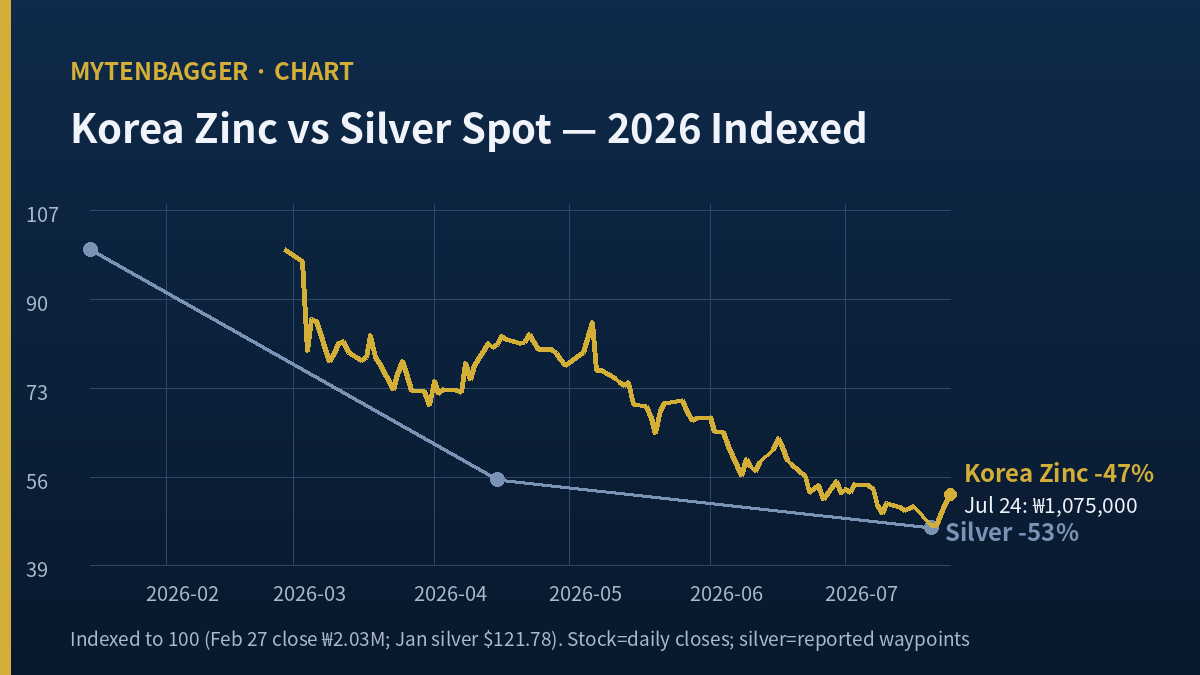
- Korea Zinc stock closed July 24 around $707 (₩1,075,000), Naver-verified — down from roughly $1,336 (₩2.03 million) in late February. Half the company’s market value evaporated in five months.
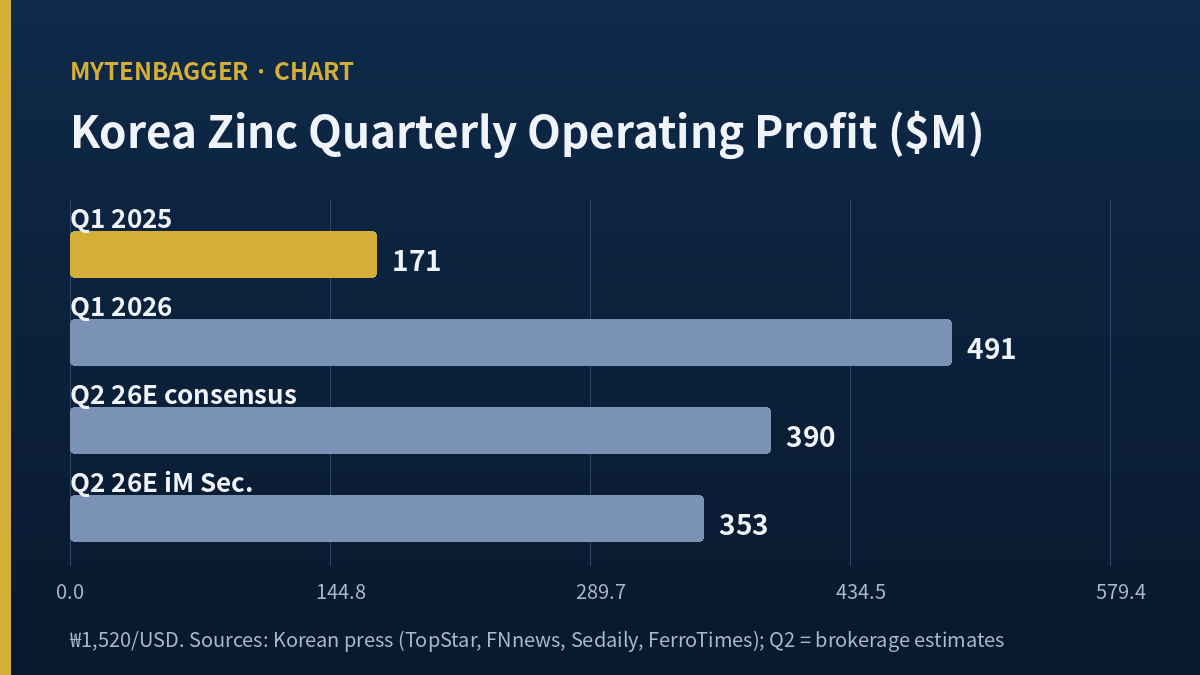
- The books went the other way: Q1 operating profit of about $491 million (₩746.1 billion) was an all-time record, up 175% year over year.
- What landed in between: silver down 53% from its January print, a special tax probe, accounting fines, and a share count up 9.4%.
- I’m watching, not buying. My four checkpoints are at the end.
I keep a mental scale for situations like this. On one pan sits what the company earns; on the other, what the market has carved off the price. Korea Zinc stock is the strangest reading that scale has given me all year: the earnings pan has never been heavier, and the price pan still won. This journal entry is me taking the scale apart to see why — and what would have to change before I touch the shares. All won-to-dollar figures below use roughly ₩1,520 per U.S. dollar, and I’ve re-checked each conversion myself.
Contents
Korea Zinc Stock Lost Half Its Value in Five Months
First, what actually happened. Korea Zinc trades on the KOSPI — Korea’s main board, loosely the country’s S&P 500 — under ticker 010130, and it is the world’s leading zinc smelter by most accounts. Korean daily Hankyung reported that the shares fell from about ₩2.03 million ($1,336) in late February to ₩1.084 million ($713) by July 2 — an almost 50% drawdown that took the market cap from roughly ₩42 trillion ($27.6 billion) to the ₩22 trillion range (about $15 billion). The slide didn’t stop there: a Korean economic outlet put the July 15 close at ₩1.02 million ($671), and the Naver-verified July 24 close is ₩1,075,000 ($707). Multiply by 20.87 million shares outstanding and you get a market cap near $14.8 billion — my own back-calculation. Against the 52-week high of ₩2,188,000 ($1,439), reported by Korean press in early May, the stock sits 51% lower.
The first trigger wasn’t the smelter, and it wasn’t the boardroom. It was silver. Hankyung’s reporting traced the silver spot price from $121.78 per troy ounce in January to $68 by April, and Fortune’s price tracker showed $56.92 on July 20 — a 53% collapse from the January level, by my math. Here’s why that matters so much: per the same Korean reporting, precious-metal byproducts — gold and silver recovered while refining zinc concentrate — account for about 30% of Korea Zinc’s revenue. When a third of your revenue base reprices down by half in six months, your stock chart starts tracking silver, not zinc. That is exactly what this one did.
Record Profits at the World’s Top Smelter — the Earnings Are Real
Let me be precise about what this selloff is not. It is not an earnings problem. In the first quarter, Korea Zinc posted revenue of about $4.0 billion (₩6.07 trillion) and operating profit of $491 million (₩746.1 billion) — up 58% and 175% year over year respectively, both records, per Korean press summaries of the filing. Seoul Economic Daily notes the company has now strung together 105 consecutive profitable quarters — twenty-six years without a single loss-making quarter. I don’t treat that streak as trivia. Smelting is a spread business: you buy concentrate, you charge treatment fees, you recover metals, and your margin lives or dies on recovery rates and currency. Nobody stays profitable through twenty-six years of commodity cycles without a structural cost advantage.
The forward numbers stay heavy on the earnings side, too. Per Seoul Economic Daily’s July 11 roundup, Hanwha Investment & Securities projects full-year 2026 revenue near $15.8 billion (₩24 trillion) with operating profit in the $1.6 billion range (₩2.5 trillion), while Samsung Securities sees revenue above $13.2 billion (₩20 trillion) and operating profit above $1.3 billion (₩2 trillion) — which would be the company’s first ₩2-trillion operating year ever. For the second quarter, due in August, Korean outlet FNnews put consensus at roughly $390 million (₩590–600 billion), up 128.6% from a year earlier, helped by precious-metal sales, defense-driven antimony demand, and a favorable won. But read the fine print with me: Meritz Securities models about $371 million (₩563.6 billion) and iM Securities about $353 million (₩537 billion) — meaning Q2 lands roughly 25% below Q1’s record on a sequential basis, by my arithmetic. iM’s stated reasons: the price-and-cost tailwind fading and lower volumes. Year over year the quarter looks explosive; quarter over quarter it’s a downshift. The August print will be judged on the second lens, not the first.
Three Layers Pressing Down on Korea Zinc Stock
If silver is the top layer of this decline, two heavier ones sit underneath. I weight them more than the metal, because metal prices mean-revert on supply and demand — trust reverts on a much slower clock.
Layer two — the trust bill: a tax probe and accounting fines
On May 7, Korean media reported that the National Tax Service’s Bureau 4 — the unit that handles non-routine, special investigations — had opened a probe into the company. The stock fell 10.76% that single day, closing at ₩1,559,000 ($1,026), even though no specific allegation has been officially confirmed. A month later the accounting regulator moved: Korea’s Securities and Futures Commission sanctioned both Korea Zinc and its rival-shareholder Youngpoong for accounting violations on June 10, per Newspim, and on July 15 the Financial Services Commission fixed the penalties — about $13.5 million (₩20.5 billion) for Youngpoong and $5.5 million (₩8.4 billion) for Korea Zinc, per FNnews. Korea Zinc’s cited violations: understating fair-value losses on financial instruments, failing to recognize impairments on overseas-subsidiary goodwill, and omitting related-party transaction disclosures. A designated-auditor regime comes with the package.
Hold the fine up against the earnings and it looks almost comical — $5.5 million is roughly one day of Q1 operating profit (my division: $491 million over 91 days is about $5.4 million a day). But markets don’t price the invoice; they price the label. When the very ledger that produced record profits carries an official finding of understated losses, every future quarter gets read with one eyebrow raised. And with the tax probe still open, there’s an unquantified liability sitting in the file. I’ve started calling this layer the trust discount, and I don’t think that’s too dramatic.
Layer three — the denominator, and a feud that isn’t over
Global research platform Simply Wall Street, cited by Korean outlet Global Economic, flagged the quieter problem: while annual net profit surged 292%, shares outstanding grew 9.4% year over year. That’s the residue of one of Korea’s most expensive corporate-control battles — Chairman Choi Yun-beom’s camp versus the Youngpoong group allied with private-equity firm MBK Partners. Both sides spent enormously; the company’s balance sheet kept score. Debt-to-equity went from 25% in 2023 to 87.59% as of Q1 2026, per Hankyung. When the numerator (profit) grows but the denominator (share count) grows too, each share’s claim grows less than the headline suggests. American readers who lived through the buyback era know this identity in reverse.
The feud itself is dormant, not dead. Per Invest Chosun’s June 21 breakdown, the Youngpoong–MBK alliance holds about 41.1% against roughly 37.9% for Chairman Choi’s side, with strategic investors — Hyundai Motor Group at 5%, LG Chem at 2%, Meritz Securities at 2.01% — layered on top. Choi controls 9 of 14 board seats. Korea’s Supreme Court effectively settled the legal front on April 2, ruling that voting restrictions on Youngpoong’s stake — triggered by a cross-shareholding structure through Korea Zinc’s Australian subsidiary — were lawful, the third court in a row to side with the company, per Korean legal-beat reporting. So management control looks secure. But a hostile 41.1% block doesn’t evaporate; it eventually finds an exit — a block sale, a re-escalation, something. Until then it hangs over the order book as permanent prospective supply.
For U.S. readers, that court ruling deserves a one-paragraph detour, because there’s no American equivalent. Korea’s Commercial Code strips a shareholder’s voting rights when the company it invests in — through a subsidiary — turns around and holds more than 10% of that shareholder’s own stock. Korea Zinc’s Australian subsidiary, Sun Metals Holdings, holds over 10% of Youngpoong, which under the statute silences Youngpoong’s votes in Korea Zinc’s general meetings. Youngpoong argued a foreign-incorporated subsidiary shouldn’t count and called the maneuver an abuse of rights; per the Financial Post (Korean), the Supreme Court on April 2 held that foreign subsidiaries do count and found no abuse — the third consecutive court to say so. Strategically, it means a chunk of that hostile 41.1% sits in the room but cannot raise its hand. It’s the kind of legal chess that simply doesn’t exist in Delaware, and it’s half the reason a minority-holding chairman still runs the board.
The $1.8 Billion Raise That Changed Korea Zinc Stock’s Math
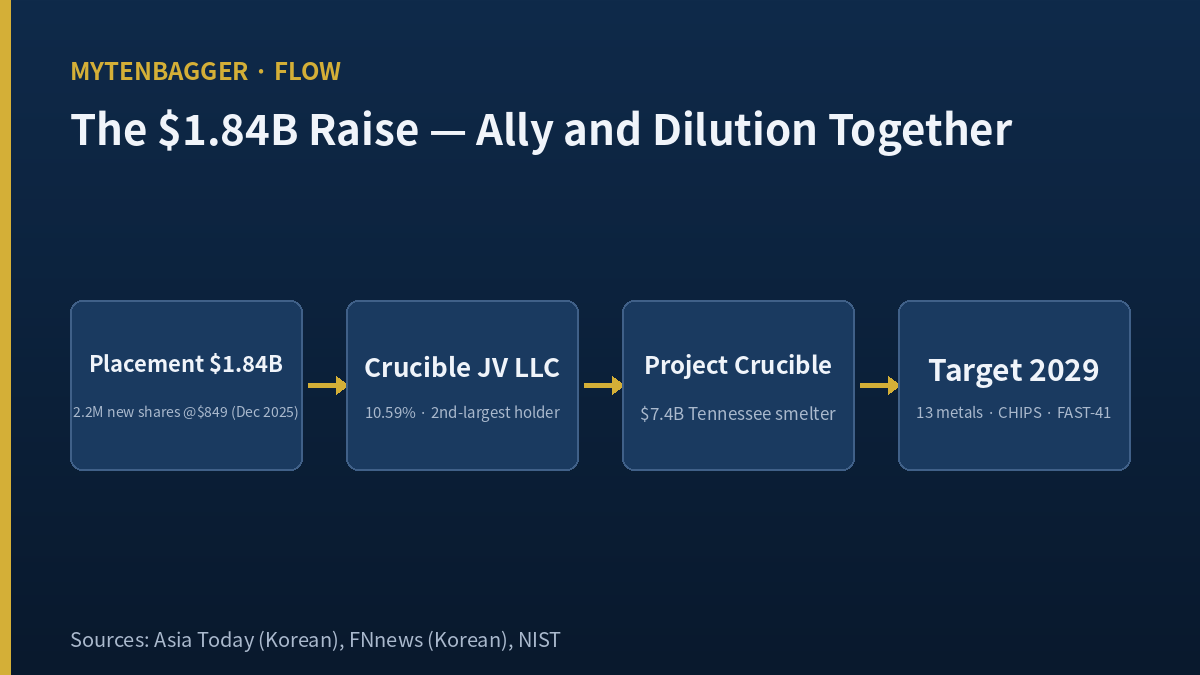
The transaction I’ve spent the most time on is the December 2025 capital raise. Per Asia Today’s May reporting: Korea Zinc issued 2.2 million new shares at ₩1.29 million ($849) apiece — about $1.84 billion (₩2.8 trillion) in total — to Crucible JV LLC, a U.S. joint venture, in a third-party placement. That single deal made the JV the company’s second-largest shareholder at 10.59%, and it is friendly to management. The money funds Project Crucible: a $7.4 billion integrated smelter in Tennessee, targeted for 2029, designed to produce thirteen critical metals plus semiconductor-grade sulfuric acid. This is not a vague memorandum — the U.S. Commerce Department awarded CHIPS incentives to Korea Zinc’s subsidiary Crucible Metals for the facility (the announcement sits on NIST’s own site), and the project has secured FAST-41 fast-track permitting coverage from the federal Permitting Council. The U.S. has spent decades letting its smelting capacity wither; Washington is now paying a Korean company to rebuild it, because that’s where the process knowledge lives.
I read this deal with both hands. Front of the card: an ally with U.S. government backing, a North American refining foothold, and balance-sheet relief, all in one stroke — Korean press called it killing three birds with one stone. Back of the card: that ally walked in through a placement that diluted every existing holder by roughly 9%, and the shares went to a friend of management rather than to the market. Some of the cost of defending the boardroom was paid out of everyone’s denominator — that’s my reading, and I hold it alongside genuine respect for the strategic logic. And here’s the footnote that anchors the whole thing for me: the JV paid $849 a share. The stock trades at $707. The U.S.-government-linked anchor investor is sitting on a 17% paper loss, by my math. I don’t treat that as proof of a floor. I treat it as a measurement of how large a discount the market is currently charging this company for trust — large enough to put even the insiders’ price underwater.
Dividends Out One Hand, New Shares In the Other
Before anyone concludes this is a company that hoards, the record says otherwise. Per Asia Today, Korea Zinc declared a quarterly dividend of ₩5,000 a share (about $3.29) in the first quarter and cancelled outright the 2.04 million treasury shares it had accumulated during the control fight. Its full-year 2025 dividend ran ₩20,000 a share (about $13.16), and the regulatory filing history I can see shows the payout rising two years in a row. Cancellations plus quarterly dividends is the textbook answer sheet for Korea’s “Value-up” program — the government-nudged campaign, loosely modeled on Tokyo’s exchange reforms, that pushes chronically discounted Korean companies to return capital and lift book-value multiples. On that scorecard, this company checks the boxes that many KOSPI names still leave blank.
And yet I stop on the arithmetic. One hand cancelled 2.04 million treasury shares, shrinking the denominator; the other hand issued 2.2 million brand-new shares to the Crucible JV, expanding it right back — and then some. Net-net, the share count still grew 9.4% year over year, which is the Simply Wall Street figure from earlier. Dividends and cancellations reach every shareholder equally; the new shares went to a chosen ally at a chosen price. I’m not framing that as bad faith — it’s the residue of a hostile-takeover defense, an emergency most U.S. companies never face because poison pills and staggered boards do the job instead. Korean corporate law gives management fewer standing defenses, so defense gets improvised with capital. But when I compute a true shareholder-return yield on this name, I have to net the issuance against the cancellation, and the netting eats most of it. Two ledgers, one company: the return ledger says generous, the denominator ledger says diluted. Both are telling the truth, which is precisely the problem.
How Americans Can (and Can’t) Trade Korea Zinc Stock
A practical detour, because this comes up every time I write about a KRX-only name. One caveat I repeat like a ritual: buying a KRX stock is a double bet — on the company and on the Korean won. At today’s roughly ₩1,520 per dollar, the won is historically weak; if it strengthens, dollar-based holders get a tailwind on top of the stock, and the reverse if it weakens further. Know which bet you’re actually making.
A Cost-and-Technology Moat, With Three Cracks
Where does this company sit against global peers? Structurally, the comparables are Boliden in Sweden (mining plus smelting), Glencore’s smelting network, and the handful of integrated non-ferrous processors in Japan — but I’m deliberately not quoting their current multiples, because I couldn’t verify fresh numbers to my standard while writing this, and I’d rather show you the gap than fill it with stale data. What I can say structurally: almost none of them recover as many payable metals per tonne of feed, and none of them built a 26-year unbroken profit streak in this industry. That’s a cost-and-technology moat in the classic sense — recovery-rate engineering compounded over decades, now valuable enough that the Pentagon and Commerce Department want it copied onto U.S. soil, with antimony — a defense-critical metal Korea Zinc produces as a byproduct — suddenly geopolitical.
But I write moats with their cracks attached, and this one has three. First, the earnings mix: about 30% of revenue rides on precious-metal prices, so the moat protects the margin structure, not the top line — silver just demonstrated that in real time. Second, the trust crack: the accounting findings came from the investment-and-subsidiary side of the ledger, not the smelting floor, and that side keeps growing as the company expands into Tennessee and, reportedly, Australia — more surface area to audit. Third, the denominator crack: Invest Chosun reports the company is studying a North Queensland integrated smelter in Australia, and that the Youngpoong–MBK camp openly worries another third-party placement would dilute them again. The American playbook could become the Australian playbook. Each new government ally, bought with new shares, is simultaneously a strategic asset and a claim against existing holders.
My Four Checkpoints for Korea Zinc Stock
The bull case deserves its say before my conclusion. Korean brokerages remain constructive: the average analyst objective stood near $1,178 (₩1.79 million) as of early July per Hankyung — 65% above the then-price — with iM Securities at $1,283 (₩1.95 million) and Hyundai Motor Securities at $1,227 (₩1,865,000). Their common thread: silver and the sanctions are transient; the $1.6 billion earnings engine and the strategic value of critical minerals are structural. FNnews quoted a financial-industry source arguing the company has shifted onto a long-term growth track under Chairman Choi. If Q2 defends consensus and the tax probe closes quietly, then today’s price will have been the bottom of the trust discount, and the bulls will have been right to lean in early. I don’t dismiss that outcome. I just won’t front-run the confirmation.
So: I hold no position in Korea Zinc stock, and I’m watching four things as one combined picture rather than a checklist with an order. One, the August Q2 print. Consensus is roughly $390 million in operating profit; what I’ll actually study is how management frames the June–July silver collapse in its second-half outlook. A sequential drop deeper than iM’s $353 million would tell me the silver sensitivity is worse than modeled. Two, the trust file. Does the tax probe resolve into a disclosed, finite assessment, or does it metastasize — restated financials, criminal referral? The first is a discount that can close; the second, for me, ends the thesis entirely. Three, silver’s level. Reclaiming the $60s would signal the bleeding in a third of the revenue base has stopped; a slide through $50 would start pulling those ₩2-trillion full-year projections down with it. Four, the denominator’s direction. An Australian placement announcement extends the dilution era; movement in the 41.1% hostile block starts resolving the overhang. Those two point in opposite directions, and either could arrive first.
If earnings and silver clear up while trust and the denominator lag, I can picture building a position in stages somewhere below the JV’s $849 entry — the insiders’ price is as honest a reference line as this situation offers. If instead one more file lands on the trust side of the scale, no earnings record will hold the other pan down. Right now Korea Zinc stock is the rare case where the scale itself is still swinging, and I’ve learned not to rest my hand on a swinging scale.
Related entries — the same governance-discount lens: Samsung C&T Stock: 29% Drop, Stakes Worth Twice the Cap · another materials-sector scale: POSCO Holdings Stock Fell 42% Just as Lithium Started Paying
Sources and renderings: price history and causes from Hankyung (Korean); silver spot from Fortune; Q2 preview and full-year projections from FNnews (Korean), Seoul Economic Daily (Korean), and FerroTimes (Korean); sanctions from Newspim (Korean) and FNnews (Korean); the tax-probe day from TopStarNews (Korean); the placement and ownership map from Asia Today (Korean), Invest Chosun (Korean), and Global Economic (Korean); Project Crucible from NIST, the Federal Permitting Council, The Korea Herald, and MINING.com. Where I quote Korean-language reporting, the renderings into English are mine.
Related reading