Hyosung Heavy Industries Stock: Buying the Rally Give-Back
- I put my first tranche into Hyosung Heavy Industries stock around ₩3.32 million (about $2,170 at ₩1,530 per dollar) — after the shares handed back roughly 14% of a policy-driven rally in two sessions.
- What rallied was a government headline: ₩1,500 trillion of planned mega-project investment announced June 29. What stayed after the give-back is the company’s own book — record 2025 earnings, ₩4 trillion of Q1 orders, more than 70% of them American.
- The test comes July 24. Roughly ₩40 billion of that quarter’s operating profit is Q1 income that slid over on accounting timing. I’m judging the print with that ₩40 billion removed — below about ₩270 billion ex-deferral, my thesis is in trouble.
The crowd spent the first week of July arguing about a number with twelve zeros. On June 29, Seoul unveiled plans for roughly ₩1,500 trillion — close to a trillion dollars — of corporate investment across three mega projects: semiconductor fabs, AI data centers, and physical AI. Seoul Economic Daily’s English coverage caught the market reaction: by July 1, Hyosung shares were up almost 10% on the day, alongside every other Korean grid name.
I couldn’t stop staring at a much smaller number. Forty billion won — about $26 million. That’s the slice of operating profit that, per Korean earnings previews, slipped out of Hyosung’s first quarter and into its second on revenue-recognition timing. It sits inside the July 24 report like a pre-paid surprise: the headline will look bigger than the quarter actually was, and everyone who reads only headlines will cheer a number the company effectively booked months ago.
A trillion-dollar policy package that won’t convert into transformer purchase orders for quarters, versus a $26 million accounting shuffle that decides whether the next earnings print is real. The market priced the first within hours. My entire entry hangs on the second. That asymmetry — everyone watching the loud number while the quiet one does the deciding — is why I finally moved on this name, and why I moved when the loud number was being refunded.
Contents
What the Market Gave Back — Hyosung Heavy Industries Stock in Five Sessions
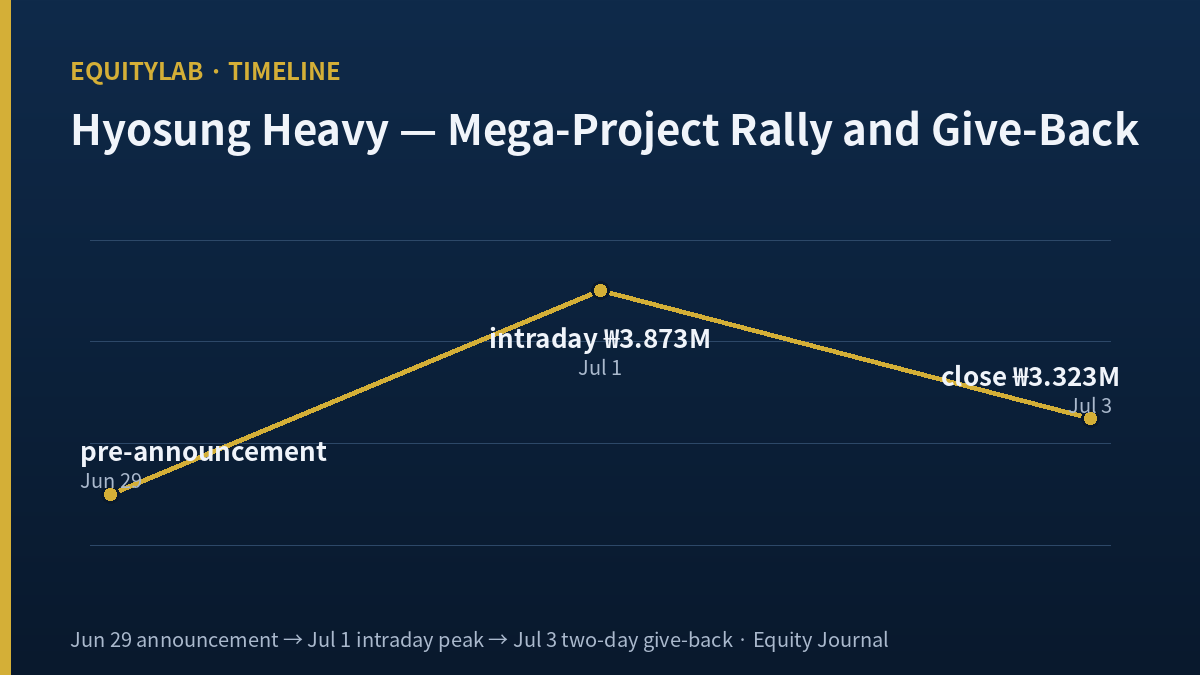
The tape, quickly, for readers who don’t follow the KOSPI — Korea’s main board, where Hyosung Heavy Industries trades under ticker 298040. Monday June 29: the government presents its mega-project investment plan. By Wednesday July 1 the stock is up 9.7% on the session, touching ₩3,873,000 (about $2,530) intraday. Then the last two sessions of the week take it all back and more — Friday July 3 closed at ₩3,323,000, roughly 14% below Wednesday’s high. Two sessions to refund what one announcement built.
Some wider framing matters here. This retreat happened inside a much larger one: the shares set their all-time high of ₩4,742,000 back on May 7, which made it, at the time, the most expensive stock on Korea’s main bourse, per share, after a six-year run from a pandemic-era low under ₩10,000. So the July give-back landed on a name already about 30% off its peak. That’s the psychology I was buying into — a crowd that chased a policy headline, got burned within a week, and was still nursing a two-month drawdown underneath.
Why did I treat the give-back as an entrance rather than a warning? Because nothing that left the price in those two sessions belonged to the company. No order was cancelled, no guidance cut, no filing corrected. What evaporated was a premium on a government presentation — gigawatt figures that need budget lines, site permits, and utility procurement before they become anyone’s revenue. I’ve now written three journals in this Korean power-equipment series, and this is the third time the volatility came from outside the company itself. My job, as I see it, isn’t to predict these episodes. It’s to check whether the price they leave behind matches the numbers the company actually carries.
Why I Started Buying Hyosung Heavy Industries Stock in the Pullback
My first reason: the rally was borrowed, but the order book is owned
I keep a crude test for policy rallies: would the business be different tomorrow if the announcement had never happened? For Hyosung, the honest answer is no — not for several quarters at minimum. The ₩1,500 trillion package routes through Samsung and SK hynix fab construction, an 8.4-gigawatt first phase of AI data centers, and a physical-AI push. Every one of those eventually needs substations, ultra-high-voltage transformers, and grid ties. None of them issued a transformer purchase order last week.
What the company owns today is different in kind. Per the same Seoul Economic Daily piece, Hyosung Heavy Industries booked ₩4 trillion (about $2.6 billion) of new orders in the first quarter alone, with the US market accounting for more than 70%. That came on top of a 2025 that closed with record results — revenue of ₩5.97 trillion ($3.9 billion) and operating profit of ₩747 billion ($488 million), up 106% year over year — and an order backlog that ended 2025 at ₩11.9 trillion ($7.8 billion), up 34%.
My read: the give-back stripped out the borrowed part of the price and left the owned part intact. If the domestic mega projects ever do convert into procurement, that’s upside I’m not paying for at ₩3.32 million. I’d rather own the option for free than pay Wednesday’s price for it.
My second reason: the US engine sits on the right side of the tariff line
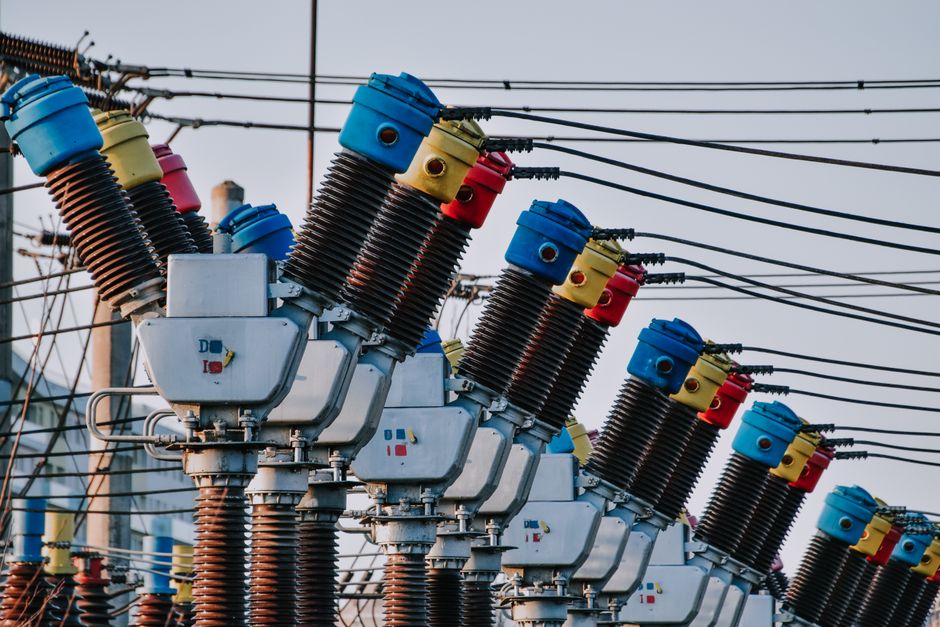
The 70%-plus American share of Q1 orders isn’t an accident of one quarter. Hyosung manufactures 765kV-class ultra-high-voltage transformers at its plant in Memphis, Tennessee — hardware physically built inside the United States, selling into a grid whose replacement cycle for aging transformers has collided with data-center load growth. In a year when Washington’s tariff policy has made imported heavy electrical equipment more expensive and less certain, domestic production capacity is not a nice-to-have; it’s the moat.
I want to be careful with what I claim here. Tariffs cut both ways even for local producers — imported components and steel still cost more while trade talks grind on, and Korean sell-side previews I’ve read note that compensation and pass-through clauses would flow into earnings only once negotiations settle. So I hold this reason as directional, not precise: Hyosung’s US footprint converts a policy risk that punishes its import-dependent competitors into, at worst, a cost-timing nuisance and, at best, pricing power. The demand side — grid replacement plus AI load — doesn’t depend on how the tariff talks land.
My third reason: margin leverage is the actual 2026 story
The number that convinced me to size a first tranche wasn’t revenue — it was the shape of profit growth against it. Operating profit doubled in 2025 on revenue that grew far more slowly, which is what happens when high-priced backlog from 2024-vintage orders starts converting while capacity stays tight. First-quarter 2026 operating profit rose another 49% year over year — and that reported figure already excludes the roughly ₩40 billion that slid into Q2 on recognition timing, per the Korean previews.
Forward estimates carry the same shape. Youanta Securities, a Korean brokerage — I’m working from its Korean-language research, so treat my numbers as translated summaries — pegs 2026 operating profit at ₩1.18 trillion, roughly $773 million, and models second-quarter operating profit around ₩318 billion including the deferral. Street consensus compiled in May sat lower, near ₩288 billion for the quarter. If anything close to the full-year figure lands, operating profit climbs nearly 60% on top of 2025’s record, and the multiple I’m paying today gets recalculated underneath me. That “if” is the whole bet, which is why the next section is a table and not a victory lap.
Hyosung Heavy Industries Stock by the Numbers
Everything below converts at ₩1,530 per dollar, the rate around the July 3 close. One housekeeping note for US readers: these are KRX-listed common shares — no ADR — so access runs through a broker with Seoul market coverage.
| Metric | Figure | Context |
|---|---|---|
| 2025 revenue | $3.9B (₩5.97T) | Record year (company results) |
| 2025 operating profit | $488M (₩747B) | +106% YoY |
| Order backlog, end-2025 | $7.8B (₩11.9T) | +34% YoY (company results) |
| Q1 2026 new orders | $2.6B (₩4T) | US share above 70% (Seoul Economic Daily) |
| Q2 2026E operating profit | $188M–$208M (₩288B–₩318B) | May consensus vs. Youanta estimate; includes ~₩40B deferral |
| Valuation, July 3 | ~60x P/E (TTM) | Market cap north of ₩30T (~$20B); multiple per Korean market-data aggregators at the close |
Sources: company disclosed results via Seoul Economic Daily, Youanta Securities estimates (Korean-language research, summarized), Investing.com quote data | As of July 3, 2026 close | USD at ₩1,530/$
Two entries in that table deserve the uncomfortable spotlight before anyone accuses me of cherry-picking. First, the bottom row: sixty times trailing earnings is not a cheap stock by any framework I respect. My entry only makes sense against the forward estimates, and forward estimates are promises, not assets. If 2026 profit stalls near the 2025 level instead of climbing toward Youanta’s ₩1.18 trillion, I overpaid, full stop.
Second, a line that never makes the bullish threads: first-quarter net income fell 14.6% year over year even as operating profit jumped 49%, and market data trackers show the quarter’s EPS missed the street estimate by roughly a third. Below-the-line items ate the operating strength. I don’t have a clean explanation I trust yet, so I’m carrying it as an open question into July 24 rather than papering over it. A margin story where operating and net income diverge for two straight quarters stops being a margin story.
And a third factor the table can’t show, specific to anyone keeping score in dollars: the won. The Korean currency has spent early July near ₩1,530–1,550 to the dollar — territory it last visited around 2009 — pressured by a stretch of record foreign selling of Korean equities. My cost basis converts to about $2,170 a share today, but the same won position is worth fewer dollars than it would have been at last year’s exchange rates. That cuts both directions from here. If the won mean-reverts while the stock treads water, my dollar return improves for free; if the currency slides toward fresh lows, a decent stock-price outcome can still land flat in dollars. I sized the position knowing I’m implicitly long the won as well as the transformers — a second bet I didn’t get to decline.
The GE Vernova Mirror — What 60x Has to Prove
My habit with Korean industrials is to hold them up against the global bellwether and see which side of the comparison squirms. The bellwether here is GE Vernova. Its first-quarter call laid out the demand backdrop better than any Korean policy deck: $18.3 billion of quarterly orders, up 71%, a record $163 billion backlog, and full-year 2026 revenue guidance of $44.5–45.5 billion. The electrification segment — transformers, switchgear, grid gear, Hyosung’s direct territory — has grown its backlog from $9 billion to $42 billion since the end of 2022.
Now the uncomfortable part of the mirror. GE Vernova, the company with the $163 billion backlog, trades in the low 30s on trailing earnings. Hyosung Heavy Industries trades near 60x. The Korean pure-play is priced at nearly double the multiple of the global leader riding the identical cycle. There are honest partial explanations — Hyosung’s profit base is doubling off a smaller denominator, its US-manufacturing position carries scarcity value in a tariff regime, and Korean grid names carry the domestic energy-superhighway option that GE Vernova participates in only through its KAPES joint venture with KEPCO. Korea’s own grid buildout is real spending, too: the West Coast HVDC “energy expressway” alone carries a budget that trade press puts at roughly ₩11.5 trillion, with the timeline pulled forward to 2030.
But partial explanations don’t close a 2x multiple gap; delivered earnings do. That’s the discipline the comparison hands me. Owning Hyosung at this price means believing its earnings growth will outrun GE Vernova’s by enough to burn off the premium — and the first audit of that belief is dated July 24. Which brings me to the number I opened with.
The deferred ₩40 billion matters precisely because of the 60x multiple. A stock priced for perfection doesn’t get graded on its headline; it gets graded on its residue. Strip the deferral out and the quarter needs to stand at roughly ₩278 billion to hit Youanta’s line — call it ₩270 billion as my floor. The market’s previews already carry the deferral inside their estimates, so a print that only clears the bar because of it would be a miss wearing a costume. I wrote this paragraph before the release on purpose. Pre-committing to the ex-deferral test is the only defense I have against my own urge to cheer a big headline I’m long.
What I bought is not the rally. It’s the order book that was still there after the rally left.
Three Paths for Hyosung Heavy Industries Stock From Here
The path I’m weighted toward (~55%)
July 24 delivers operating profit around ₩300 billion or better, and the ex-deferral residue clears ₩270 billion with room to spare. Management nudges full-year order guidance up, having reportedly filled a large share of the annual target by spring. The market’s anchor shifts from the trailing 60x to the forward earnings ramp, US backlog keeps converting at rich margins through the second half, and I complete the tranches I’ve mapped out. I put a bit more than half my confidence here because it’s the path the existing order data supports without requiring anything new to go right.
The path where I’m the problem (~30%)
Earnings arrive fine and the stock goes nowhere — or lower. Sixty times trailing profit is a sentiment structure as much as a valuation, and sentiment structures crack on things I can’t model: an AI-capex scare out of the US hyperscalers, a KOSPI-wide de-rating while foreign investors keep selling Korean equities, a tariff negotiation that stalls and leaves costs accruing with the offsets stuck in committee. The domestic mega projects add their own lag risk — a government presentation measured in gigawatts can take years to become a substation tender, and any political turbulence stretches that further. In this path the company keeps executing and my timing still loses money for a year. The flaw wouldn’t be Hyosung’s. It would be mine, for paying a premium multiple at the wrong point in the sentiment cycle.
The tails (~15%)
Upside tail, maybe 10%: US 765kV awards keep chaining through the second half, order guidance gets raised by more than anyone models, and the energy-superhighway program moves from presentation to procurement faster than the skeptics — me included — expect. Downside tail, roughly 5%: the policy program shrinks or slips on politics, construction-segment weakness resurfaces, and the domestic growth leg has to be written down to near zero, leaving the US business to justify the whole valuation alone. I’d have to re-underwrite from scratch in that world, not average down.
Where My Hyosung Heavy Industries Stock Thesis Breaks
Three breakpoints, and usefully, the calendar sorts them for me. The first one reports on a known date: July 24, second-quarter results, ex-deferral operating profit versus my ₩270 billion floor. The second answers the same day or soon after — whether full-year order guidance moves up. After a first quarter that reportedly banked half the annual target, standing pat on guidance would itself be information, and a visibly cooling second-quarter order number would tell me the backlog I bought is a high-water mark, not a base. The third has no date at all: the direction of US-Korea tariff talks, which I can monitor on the earnings call’s tone but can’t schedule. So it stays a watch item, not a trigger.
What I’ve promised myself is a sequencing rule rather than a formula. The July 24 number gets judged first and alone, before I let the order commentary or the tariff mood color it. A quarter that fails the ex-deferral floor freezes every remaining tranche and sends the holding itself back to underwriting — no averaging into a broken margin story because the conference call sounded upbeat. A quarter that passes buys the other two breakpoints another season of patience. I’m writing the rule down here so the version of me reading the July 24 headline can’t renegotiate it.
For the Record
Three journals into this Korean power-equipment series, the pattern I keep meeting is that the sector’s air pockets come from everywhere except the income statement — a corrected filing at HD Hyundai Electric, a parent company’s disclosure typo at LS Electric, and now a policy rally refunded in two sessions. Each time, the useful move was the same boring one: measure the price the episode left behind against numbers the company actually reported.
So, for the record: first tranche filled near ₩3.32 million, a planned fraction and no more. I skipped the three days the crowd paid up for a presentation, and I bought the two days they asked for their money back. Whether that gap was an opportunity or a trap is not something I can argue my way into — it’s something a specific number will settle on a specific Friday in late July. When it does, this journal gets its next entry, written against the ₩270 billion line I’ve already drawn.
Related reading
- CS Wind Stock: Accumulating the World’s #1 Into an OBBBA Cliff
- Samsung Heavy Industries Stock: $10B in Orders, Zero Dividend