Korea’s BYC Earns Two Thirds of Its Profit From Rent
BYC stock closed at KRW 34,950 on Wednesday, September 23, 2026, about $25.73, and the company behind it is one most Korean shoppers know for white cotton underwear. In 2025, though, its leasing business produced 68.4% of operating profit while bringing in under 28% of sales, according to a September 16 report in the Korean press. I am watching BYC stock without owning it, because the part of the company that pays the bills is the part the brand name hides.
Leasing: 27.6% of 2025 sales, 68.4% of 2025 operating profit.
Everything else, mostly underwear and clothing: 72.4% of sales, about 32% of operating profit.
Second quarter: the weakest profit quarter in 2024, 2025 and 2026 alike. I hold none and I am waiting for the third quarter report before I change that.
I came to this company sideways. A Korean news item from February 5, 2026 said the stock had jumped almost 18% in one session as traders focused on the company’s real estate around Yeongdeungpo in southwest Seoul (Topstar News, Korean, February 5, 2026). I had always filed BYC under underwear. My first thought was that a clothing company had stumbled into a property theme. The more I dug, the more the story ran the other way: a property business that also happens to make underwear.
For readers new to the market: BYC trades on KOSPI, the main board of the Korea Exchange, which plays the role the NYSE plays in the US. BYC is a small company there. At the September 23 close, its common shares were worth about KRW 218.29 billion, or roughly $160.7 million. It also has a preferred share class listed on its own, which I leave out of every number here.
Contents
What BYC stock is actually paid by
BYC reports two main businesses: textiles and apparel, which is the underwear and clothing people know, and leasing, which rents out commercial property the company owns. A third, tiny advertising unit ran a small loss in 2025. I could not open the segment note in the annual report myself, so the split below relies on two Korean press reports that did quote those notes.
The September 16 report put 2025 leasing revenue at KRW 45.1 billion out of total revenue of KRW 163.2 billion, and property-related operating profit at KRW 18.2 billion out of KRW 26.6 billion (Straight News, Korean, September 16, 2026). The article prints the sales share as 27.7%. My own division of the two printed figures gives 27.6%, and I use that.
| 2025, KRW billion | Revenue | Operating profit | Profit per won of sales |
|---|---|---|---|
| Leasing | 45.1 | 18.2 | 40.4% |
| Everything else (my calculation) | 118.1 | 8.4 | 7.1% |
| Company total | 163.2 | 26.6 | 16.3% |
| Leasing share of total | 27.6% | 68.4% | not applicable |
Sources: Straight News (September 16, 2026) for the leasing lines; company totals from BYC’s 2025 annual report via the DART disclosure system. The “everything else” row is total minus leasing, by my arithmetic.
Put plainly, every 100 won of leasing sales kept about 40 won as operating profit in 2025, and every 100 won of everything else kept about 7 won. The company total of 16.3% looks like a good clothing business on a screen. It is really a blend of a very good property business and a modest clothing one.
A second report gives the same picture for the first nine months of 2025: KRW 15.2 billion of operating profit, of which leasing was KRW 12.4 billion and textiles KRW 2.9 billion (C-Journal, Korean, December 8, 2025). By my arithmetic that is 81.6% from leasing for those nine months, higher than the 68.4% for the full year. The fourth quarter is when the clothing side does most of its earning, which matters for the quarterly pattern further down.
The December report also gives a rougher figure for 2024: leasing made up about three quarters of operating profit that year, with textiles at about a quarter. So the leasing share has sat between roughly 68% and 82% in every period I could check, depending on whether the strong fourth quarter falls inside the period or not. It has not dipped below two thirds in any full year I have numbers for.
This is the part a stock screen misses. The luxrix data server runs a seven-point checklist on every Korean stock, and one of the tests asks whether the operating profit ratio clears 5%. BYC passes easily at 16.3%. Taken alone, that pass says “healthy clothing maker.” Split by segment, the clothing side on its own clears the 5% bar by only a small distance, and in 2024 it cleared it by less than a tenth of a point. The pass belongs to the buildings. I do not think the checklist is wrong; it simply has no way to know that one company is two businesses glued together.
The underwear side of BYC stock over three years
The same December report lists the textile segment’s own figures for three full years. Sales slid every year and profit fell hard in the last one.
| Textile segment, KRW billion | 2022 | 2023 | 2024 |
|---|---|---|---|
| Revenue | 127.4 | 121.7 | 116.6 |
| Operating profit | 7.8 | 8.3 | 5.9 |
| Profit per won of sales (my calculation) | 6.1% | 6.8% | 5.1% |
Source: C-Journal (December 8, 2025), quoting BYC’s segment notes. The percentage row is my division of the two printed lines.
Textile revenue fell 8.5% from 2022 to 2024. The segment still earns money, and it is still the bigger share of sales by a wide distance, but it is shrinking and it is not where the profit comes from. The same article quotes a company-side source saying BYC has no plans to move into businesses beyond textiles and clothing. I read that as a statement about the operating business. It sits oddly beside a company that is now building a large mixed-use tower on its old head office site in Seoul, which the Korean press covered in September.
Other Korean apparel names face a version of the same question about what a brand can still earn. When I looked at how F&F paid for a brand whose Korean sales were shrinking, the brand was the whole bet. At BYC the brand is the smaller earner inside its own company.
Where my first read slipped
A February headline set my first frame, and the frame was wrong. When I saw the one-day jump, I assumed a clothing company with some spare buildings had become a trading theme for a week. I went looking for the underwear numbers first, expecting them to carry the story, and they did not. The clothing business earned about 5 to 7 won of operating profit on every 100 won of sales over those three years. The property business earned about 40. I had the proportions backwards for the first hour of reading, and I suspect plenty of people who buy the shares for the brand have them backwards too.
BYC stock by quarter: the second quarter keeps coming in last
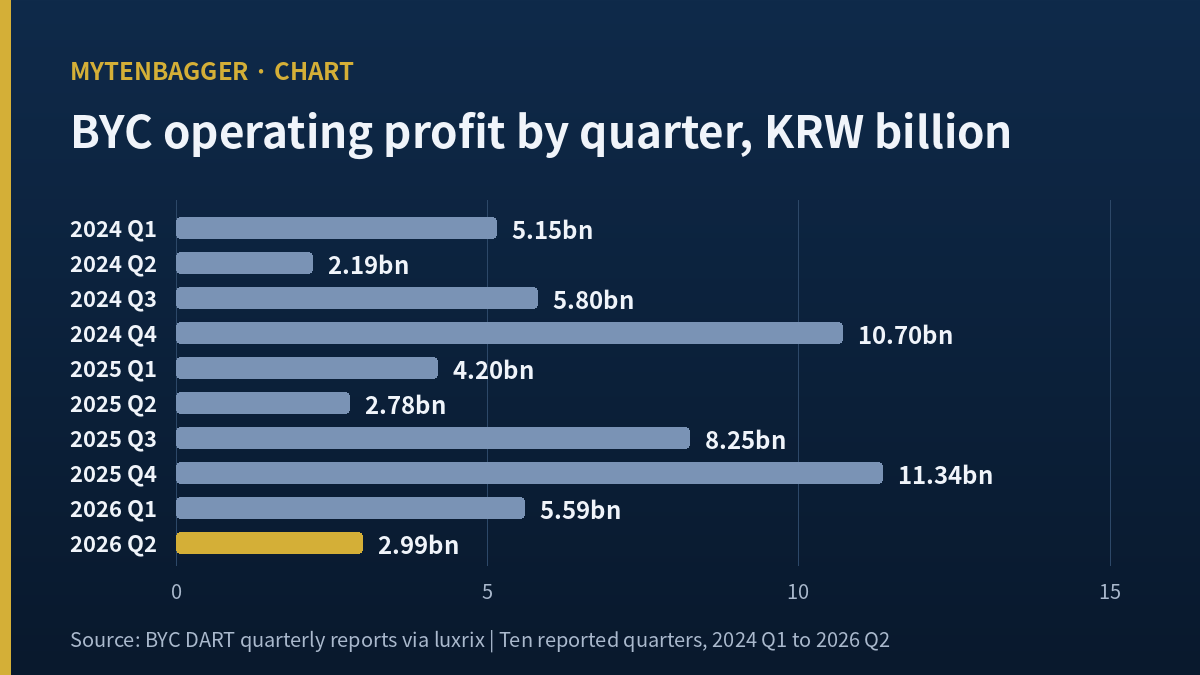
Once I knew leasing was steady and clothing was seasonal, I lined up the single-quarter operating profit figures. BYC’s regulatory reports give cumulative year-to-date numbers, so each quarter below is the cumulative figure minus the prior one, and the fourth quarter is the annual figure minus the nine-month figure. I took the series from BYC’s DART reports through the luxrix data server.
| Operating profit, KRW billion | Q1 | Q2 | Q3 | Q4 |
|---|---|---|---|---|
| 2024 | 5.15 | 2.19 | 5.80 | 10.70 |
| 2025 | 4.20 | 2.78 | 8.25 | 11.34 |
| 2026 | 5.59 | 2.99 | not yet reported | not yet reported |
Source: BYC quarterly and annual reports on DART, single-quarter figures computed from cumulative numbers (luxrix). Group-level figures, common and preferred shareholders combined.
The pattern holds in all three years. The second quarter is the weakest, and the fourth quarter is the strongest by a wide distance. In 2025 the fourth quarter alone produced 42.7% of the full-year operating profit, by my arithmetic. Sales do not follow the same pattern: second-quarter revenue was KRW 41.21 billion in 2024 and KRW 39.50 billion in 2025, neither the lowest quarter of its year. The profit dip comes from cost, and I do not know which cost. My guess is that thermal underwear and winter lines lift the fourth quarter and spring stock clearance weighs on the second, but I have no segment-by-quarter breakdown to prove it. Leasing income should be roughly even across the year, so the swings belong to the clothing side.
To see how sharp the swing is, I divided each quarter’s operating profit by that quarter’s revenue. Same sources, same single-quarter method.
| Operating profit per 100 won of revenue | Q1 | Q2 | Q3 | Q4 |
|---|---|---|---|---|
| 2024 | 13.3 | 5.3 | 15.2 | 22.7 |
| 2025 | 11.9 | 7.0 | 21.1 | 23.0 |
| 2026 | 15.4 | 6.9 | not yet reported | not yet reported |
My calculation from BYC’s DART single-quarter revenue and operating profit (luxrix). Won of operating profit per 100 won of revenue.
In every year the second quarter sits at 5 to 7 won per 100, and the fourth quarter sits above 22. The gap is too steady to be noise. If leasing income is spread evenly, which is the normal pattern for rent, then the clothing side must be close to break-even in the second quarter and doing most of its annual earning in the fourth. I have not seen the company say so, and I am treating it as my inference from the numbers.
That has a practical consequence for anyone reading the company through its first six months. January to June 2026 revenue was KRW 79.74 billion, up 6.55% on the same months of 2025, and operating profit was KRW 8.58 billion, up 22.9%. Those are respectable gains, but they cover the two quarters that carry the least profit. The second quarter of 2026 turned KRW 43.43 billion of revenue into KRW 2.99 billion of operating profit, about 6.9 won per 100. I wrote about a very different Korean property owner, one where a single tenant group pays almost all of the rent, in my note on a Korean REIT and its one big payer. BYC’s leasing income looks steadier than its clothing income, but I could not find a tenant list to check how spread out it is.
A Japanese innerwear maker with a property segment
I wanted one company outside Korea that sells underwear and also rents out commercial property, and reports the two apart. Gunze (Tokyo Stock Exchange: 3002) fits. Its Lifestyle Creations segment includes leasing of shopping complexes, housing and office buildings, along with sports clubs and gardening products (Japan IR company profile). Its Apparel segment includes innerwear.
I compare one thing only: which way each segment’s profit moved over the last two fiscal years. Gunze’s fiscal year ends in March, BYC’s in December, and the segments are not built the same way, so I put no sizes or valuations side by side. In Gunze’s results for the year to March 31, 2026, Apparel swung from a segment profit of JPY 753 million to a loss of JPY 1,334 million, while Lifestyle Creations rose from JPY 988 million to JPY 1,232 million (Gunze results for the fiscal year ended March 2026).
Sales tell the same story. Gunze’s Apparel sales fell from JPY 60,782 million to JPY 58,597 million, down 3.6%, while Lifestyle Creations sales rose 4.4% to JPY 12,530 million. The property-heavy segment is about a fifth the size of Apparel by sales, yet it out-earned Apparel in both years I checked. Scale aside, that is the BYC pattern in a much larger company.
The direction matches BYC’s: the clothing side weakening, the property-heavy side holding up. It does not prove anything about BYC. It does tell me BYC is not a one-off oddity. An old innerwear maker that owns good real estate can end up earning more from the buildings than from the garments, and the market has to decide which business it is pricing. At BYC the brand earns little, and the buildings do the earning.
Three things I left out of the argument on purpose. First, the Korean press has reported a fair value for BYC’s investment property far above the company’s market value. That number drives most of the bullish talk about the stock, but I could not see who produced the valuation or when, so I kept it out of the profit analysis. Second, I did not use earnings or price-to-equity multiples. With two businesses of such different quality inside one income line, a single multiple says little about either. Third, I did not use dividend yield, since the payout is small next to the question of what the company earns.
What cuts against my wait-and-see read on BYC stock
- The property business is real and profitable. Earning about 40 won of operating profit on every 100 won of rent sales is a strong result by any standard. If you value BYC as a property owner with a clothing sideline, today’s price may look low.
- The first six months of 2026 were up. Revenue grew 6.55% and operating profit 22.9% on the prior year. If the fourth quarter repeats its usual strength, 2026 could beat 2025. Second-quarter revenue alone rose 9.96%, the fastest single-quarter sales gain in the series I built, which may mean the clothing side found some demand.
- Minority shareholders have pushed and won some ground. The fund manager Truston pressed for better use of low-yielding property and for buybacks and dividends, and BYC split its shares ten for one in 2024 (Korea Economic Daily, Korean, March 5, 2024). The company also signed a share buyback trust in August 2026 (disclosure note, August 5, 2026).
- The textile decline may have bottomed. I only have segment numbers through 2024 and the first nine months of 2025. If textile profit recovered in 2026, my picture of a shrinking clothing side would be out of date.
- No analyst coverage cuts both ways. I found no named Korean brokerage publishing earnings forecasts for BYC. That means no one is anchoring expectations high, and any good news reaches a stock few people follow.
Point 4 is the one that worries me most. My clothing numbers stop in September 2025, and the segment split for January to June 2026 sits in a six-month report note I could not open. I have kept the argument to what the numbers I could check will carry.
Two paths for BYC stock from here
The clothing side keeps sliding (about 55%)
This is the path I think more likely. Textile sales keep drifting down a few percent a year, the fourth quarter stays strong but not stronger, and leasing keeps supplying two thirds or more of operating profit. In that world the shares trade on property sentiment, which moves with headlines about Seoul real estate, and the underwear business adds little. I would stay out, because I have no edge in timing property sentiment.
The clothing side steadies (about 45%)
Here the second quarter of 2026, which already beat the same quarter of 2025, turns out to be the first sign of a steadier clothing business. If third quarter operating profit clears the KRW 8.25 billion of 2025 and textiles hold their share, the company earns more from both sides at once. That would make me look at the shares again as a two-engine business. I give it a real chance, just not the better one.
A side path I cannot price: rent softens
Both paths above assume leasing income holds. It might not. BYC’s rental revenue depends on commercial tenants in Seoul, and shop and office rents move with the local economy. The company is also redeveloping its old head office site in the Daerim area into a large residential and office tower, a project the Korean press described in detail in September. A site under construction produces no rent while it is being built, and the money going into the project has to come from somewhere. I leave the funding question out here, because this note is about where the profit comes from today.
If rent softens while the clothing side keeps sliding, both engines weaken at once, and the 16.3% company-wide profit ratio would fall faster than either business alone suggests. I give this no probability because I have no tenant list, no vacancy figure and no lease expiry table. I only know it would hurt, and that I would not see it coming from the numbers I have.
These probabilities are my own judgment and nothing more. No forecast from a brokerage stands behind either number.
What would make me revisit BYC stock
- Third quarter 2026 operating profit above KRW 8.25 billion, the 2025 figure for the same quarter.
- January to September 2026 revenue growth holding above the 6.55% of the first six months.
- A segment note showing textile operating profit for 2025 above KRW 5.9 billion, the 2024 level.
- The leasing share of operating profit dropping below 60% because clothing rose, and not because rent fell.
- A second quarter profit in 2027 that no longer comes in as the weakest of the year.
- Any named brokerage starting coverage with published earnings forecasts.
- Rent revenue for 2026 falling below the KRW 45.1 billion of 2025, which would point the other way and keep me out for longer.
The first two answer soonest. The third quarter report is due by Monday, November 16, 2026, and it will tell me whether the second quarter improvement carried on. The segment items take longer, because they depend on the annual report notes.
The company on the label and the company in the income numbers are two different things. BYC stock prices a brand, but the profit comes from buildings, and the clothing side earns its most in the last three months of the year. I am not buying a property business on the strength of a clothing brand, and I am not buying a clothing company whose profit depends on rent. I will open the November report to the third-quarter operating profit line first, and let that one number decide whether this note needs rewriting.
Prices reflect the September 23, 2026 close. Dollar figures are approximate, at roughly KRW 1,358.4 per dollar on the same date. Korean-language sources are paraphrased and translated by me.