Shinheung SEC Debt: Interest Costs Run 3.4x Its Profit
Shinheung SEC stock closed at KRW 5,440 (about $4.00) on September 23, 2026, and the number that keeps me on the sidelines is this: in 2025 the company paid KRW 20.37 billion (about $15.0 million) in interest and earned only KRW 5.93 billion (about $4.4 million) in operating profit. The interest bill was 3.4 times the profit. I own none of it, and I am watching to see whether the factories that loan money paid for can ever cover their own financing.
Shinheung SEC makes the cap assemblies and current interrupt devices that sit on top of cylindrical and prismatic lithium-ion cells. It borrowed heavily in 2022 and 2023 to build factories in Hungary, Malaysia, China and the United States. Those loans now sit at about KRW 451.6 billion, roughly 2.15 times what the whole company is worth on the market. In the first six months of 2026 operating profit improved, yet interest still came to 1.46 times operating profit. I am waiting for one year in which operating profit covers interest, and 2026 is not that year yet.
For readers new to the name: Shinheung SEC (KOSDAQ: 243840) trades on KOSDAQ, Korea’s growth-company board, which sits alongside the larger KOSPI main market much the way Nasdaq sits alongside the NYSE. The company is a parts supplier. Its caps and interrupt devices vent built-up pressure inside a battery cell and cut the current if something goes wrong, which lowers the fire risk. Samsung SDI is the customer most often named in Korean press coverage, and the US factory in Allen County, Indiana was first built to serve the Samsung SDI and Stellantis battery joint venture, according to a July 2023 report in The Guru, a Korean trade outlet.
I came back to this name after reading a sell-side note that liked the sales story. Sales are in fact recovering. What the note spent little time on was the other side of the income line, the part below operating profit where interest lives. That is where this journal entry stays.
Contents
Shinheung SEC stock next to a debt pile twice its size
I started with the balance sheet. Stock Analysis, which draws on S&P Global Market Intelligence data, lists the company’s figures for every three-month period in millions of won (Stock Analysis quarterly balance sheet). I added up three borrowing lines myself: short-term debt, the portion of long-term debt coming due, and long-term debt.
At the end of June 2026 those three lines came to KRW 451.6 billion (about $332.5 million). At the end of December 2024 they came to KRW 446.7 billion. Eighteen months passed and the pile barely moved. Over the same period cash and short-term investments, which I again added from two separate lines, went from KRW 115.6 billion to KRW 114.5 billion. Borrowings minus that cash stood at about KRW 337.2 billion in June.
The market value of the common stock, at KRW 5,440 on roughly 38.57 million shares, is about KRW 209.8 billion ($154.4 million). So the loans on the balance sheet are 2.15 times the equity market value, by my arithmetic. For a company whose equity trades at a small fraction of its debt, every movement in operating profit gets magnified on the way down to shareholders.
The short-term side is where the pressure shows. Chickstock, a Korean market data site, flags the company’s liquidity with a caution label: at the end of 2025 its current liabilities of KRW 310.2 billion exceeded current assets of KRW 214.6 billion, a current ratio of about 69% (Chickstock company page). That does not mean a crisis. It means the company relies on its banks to keep rolling short loans, and it has done so for years.
What the interest bill did to Shinheung SEC stock earnings
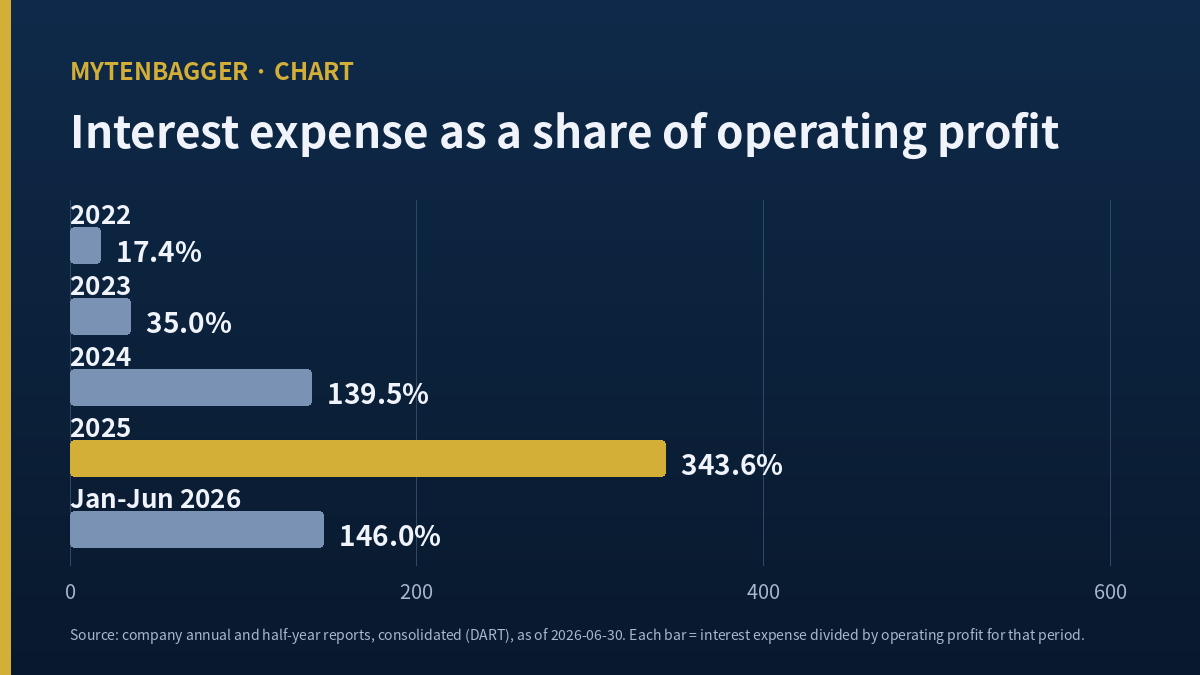
The income side is where the debt starts to bite. I pulled five periods of operating profit and interest expense from the company’s DART filings through the luxrix data tool. One caution before the table: the tool notes that for some companies the “interest expense” field falls back to total finance costs, which can include foreign-exchange and hedging losses. I could not confirm which line this company’s figure uses, so the table carries the tool’s number as printed.
| Period | Operating profit (KRW bn) | Interest expense (KRW bn) | Interest as % of operating profit |
|---|---|---|---|
| 2022 | 31.02 | 5.38 | 17.4% |
| 2023 | 43.65 | 15.26 | 35.0% |
| 2024 | 13.17 | 18.37 | 139.5% |
| 2025 | 5.93 | 20.37 | 343.6% |
| January to June 2026 | 6.79 | 9.91 | 146.0% |
Source: company DART reports, whole-company figures, via luxrix. Percentages are my own arithmetic, rounded to one decimal. The 2026 row covers six months only.
Two lines crossed in 2024. Before that, operating profit comfortably covered interest; in 2022 interest took about a sixth of it. Then operating profit fell from KRW 43.65 billion to KRW 13.17 billion in one year while interest kept climbing, and by 2025 interest was more than three times what the business earned from its operations.
The annual view hides a more hopeful detail, so I broke the last six periods into three-month pieces. For each stretch I took the cumulative interest figure from one filing and subtracted the previous one.
| Three months | Operating profit (KRW bn) | Interest expense (KRW bn) | Profit covers interest? |
|---|---|---|---|
| January to March 2025 | −4.30 | 4.88 | No |
| April to June 2025 | 2.14 | 5.03 | No |
| July to September 2025 | 2.70 | 5.64 | No |
| October to December 2025 | 5.38 | 4.81 | Yes |
| January to March 2026 | 1.59 | 5.03 | No |
| April to June 2026 | 5.20 | 4.88 | Yes |
Source: company DART filings via luxrix. Each row is my own subtraction of consecutive cumulative figures; the October to December row is the full year minus the first nine months.
Two of the last three stretches cleared the bar. In October to December 2025 operating profit beat interest by about KRW 0.57 billion, and in April to June 2026 by about KRW 0.32 billion. Those are thin cushions, and January to March 2026 fell back below the line between them. Before October 2025, the last stretch in which the business covered its financing cost was April to June 2024 (operating profit KRW 6.15 billion against interest of KRW 4.57 billion). The trend is not only down, and I would be dishonest to write this entry as if it were.
Interest itself has been remarkably steady, between KRW 4.8 billion and KRW 5.6 billion every three months. That steadiness is the real problem for a common shareholder. It means the loans are not shrinking, and any gain in operating profit has to clear a fixed charge of roughly KRW 20 billion a year (about $14.7 million) before it counts for equity holders.
Here is the test I applied to the sell-side forecast. Samsung Securities expects KRW 21.3 billion of operating profit for 2026. If interest runs at the first-six-months pace of KRW 9.91 billion times two, about KRW 19.8 billion, the forecast year would cover interest only 1.07 times. Even the optimistic case, in other words, leaves almost nothing between operating profit and the interest bill in 2026. Samsung Securities’ own 2027 forecast of KRW 30.0 billion would raise that cover to about 1.5 times, and Sangsangin’s KRW 36.1 billion to about 1.8 times, assuming borrowing stays where it is. Those are the years in which the equity story could begin, and they depend on sales growth that has not happened yet.
What happened to operating profit is mostly a sales story. Revenue fell from KRW 539.9 billion in 2023 to KRW 408.2 billion in 2025 as European electric-vehicle sales slowed, and the Hungarian subsidiary, which the brokerage Sangsangin Investment & Securities names as the largest market by far in 2025, took the hit (Newspim brief on the April 24, 2026 Sangsangin report). What happened to interest is a balance-sheet story. The factories were already built and the loans were already drawn, so interest did not fall when sales did.
If I spread the 2025 interest bill over the average of the year-start and year-end borrowing totals, KRW 454.3 billion, the implied cost is about 4.5% a year. That is a rough figure, and it inherits the uncertainty about whether the interest line includes other finance costs.
I have seen this pattern at a Korean customer too. Samsung SDI kept winning energy-storage orders through a run of loss-making results, and I wrote about why I watched Samsung SDI’s Q2 profit line before its ESS contract win. A supplier sits one step further down that chain, with less room to wait.
Where the borrowed money went: two heavy factory years
The loans paid for factories. Capital spending in 2022 and 2023 came to KRW 140.0 billion and KRW 168.3 billion, while operating cash flow in those same years was KRW 50.3 billion and KRW 56.1 billion. Over the four years from 2022 to 2025 the company spent KRW 445.4 billion on capital projects and generated KRW 225.7 billion from operations. The difference, about KRW 219.7 billion, had to come from lenders or the balance sheet, and the liabilities side grew from KRW 348.5 billion at the end of 2022 to KRW 522.0 billion at the end of 2025.
The US factory is one piece of that. The Guru reported a $62 million investment in Allen County, including an $11.8 million building purchase, with production targeted for 2025. The rest went into expansions in Hungary, Malaysia and China, which I could not split by country from the documents I checked.
Spending has since slowed sharply. Capital spending fell to KRW 87.6 billion in 2024, KRW 49.5 billion in 2025 and KRW 11.8 billion in the first six months of 2026. With operating cash flow of KRW 25.1 billion in those six months, free cash flow turned positive at about KRW 13.4 billion. That is the most encouraging number in this entry. It is also small next to KRW 451.6 billion of borrowing: at that pace it would take well over a decade to pay the loans down from cash alone. In practice that means the loans will be rolled over by banks, and repayment from cash is a distant prospect.
Fixed assets on the balance sheet stayed near KRW 650 billion from December 2024 to June 2026. The factories are all there. What is missing is enough sales running through them. A lead-acid battery maker I covered recently had the opposite setup, profitable old factories funding a new lithium venture, and Sebang Battery’s case shows how much easier the sequence is when the old business pays for the new one. Shinheung SEC built first and is still waiting for the volume.
One more line surprised me. Net income for January to June 2026 was KRW 8.30 billion, above that period’s operating profit of KRW 6.79 billion even after KRW 9.91 billion of interest. Almost all of it came in January to March, when net income was KRW 8.49 billion on operating profit of only KRW 1.59 billion. Something below the operating line added several billion won in those three months, and the report extracts I checked do not show what it was. It could be a currency effect on foreign-currency balances or a one-off gain; I cannot tell, so I leave it out of every judgment in this entry. In April to June the company posted a small net loss of about KRW 0.19 billion, which fits the interest picture far better.
Shinheung SEC stock beside a Chinese cap maker
For a global comparison I looked for a listed company that makes the same kind of structural battery parts. Peer number 218 in my journal is Shenzhen Kedali Industry (SHE: 002850), a Shenzhen-listed maker of battery caps, cases and other metal structural components. My selection standard for this entry, the 84th I have used, is a listed company that makes battery cell caps or cases for the same cell makers. My method, the 82nd, is to compare only the direction of sales and operating income across the same two fiscal years, with no sizes and no valuation multiples.
Stock Analysis lists Kedali’s revenue at CNY 12,030 million in fiscal 2024 and CNY 15,213 million in fiscal 2025, and operating income at CNY 1,823 million and CNY 2,193 million (Stock Analysis, Kedali financials). That is sales up 26.5% and operating income up 20.3%. Over the same two years Shinheung SEC’s sales fell 5.7% and operating profit fell 55.0%.
I am not drawing a valuation conclusion from this. Kedali’s sales kept growing over the same two years, while Shinheung SEC’s largest single market was Hungary, where European car sales slowed. What the comparison suggests to me is that the product category alone does not explain 2025; where the customers sit explains a good part of it. That matters for the debt question, because a supplier can change where it sells faster than it can shrink a factory it already owns.
The US factory is the piece of the debt story I watch most closely, because it is the newest building and the one with the least sales behind it. Sangsangin put the United States at a single-digit share of 2025 sales, far behind Hungary. A building bought and fitted out for about $62 million is producing a small slice of revenue while it switches from electric-vehicle caps to energy-storage products. The good news for lenders is that the switch is described as converting existing capacity, which suggests it should not need another round of construction money. The open question for me is how long the building runs below capacity while the new customers ramp up, because interest on the money that paid for it does not pause during that time.
The 2021 preferred shares still sitting in the capital structure
One more item affects every per-share number here. In September 2021 the company sold KRW 100.0 billion of convertible preferred shares to four investors, including JKL Partners and the Korea Development Bank, with a right to turn them into common stock until October 13, 2030, according to a September 2021 Edaily report. At the time the issue equaled about 17.8% of the shares then outstanding.
I could not confirm how much of that issue remains unconverted today. My data tools and Kokstock both put the common share number near 38.56 million (Kokstock quote page). If a meaningful block of preferred stock is still out there, the equity value per common share would be lower than the market value I used above. I am flagging it and leaving it open.
The case against my caution on Shinheung SEC stock
- The sell-side sees a recovery. Samsung Securities kept a buy rating on March 20, 2026 and put a valuation on the stock about 1.4 times the September 23 close, at a time when shares traded roughly 14% above where they sit now (Samsung Securities report, in Korean). Its 2026 forecast called for KRW 21.3 billion in operating profit, which would put interest at a much smaller share of profit than in 2025. Sangsangin went further for 2027, forecasting KRW 36.1 billion.
- Sales are already turning. Revenue in the first six months of 2026 was KRW 255.2 billion (about $187.9 million), up by roughly a quarter on a year earlier, and April to June grew faster than January to March. Samsung Securities points to data-center backup battery units and North American energy storage as the drivers, which are markets with growth that does not depend on European car sales.
- Cash flow has already improved. With capital spending down to KRW 11.8 billion in six months, the company produced positive free cash flow. Sangsangin also says the US factory is shifting three quarters of its capacity to energy-storage products by early 2027, which could fill the building without new construction.
These are fair points, and the second one is the strongest. I simply want to see the recovery reach the operating profit line in a size that covers interest before I treat it as real.
Two conditions that would change my mind on Shinheung SEC stock
- Operating profit for July to September 2026 exceeds the interest expense for the same three months. Under Korean disclosure rules the Q3 report is due by November 16, 2026. In the same months of 2025 operating profit was KRW 2.70 billion and interest was KRW 5.64 billion, so the bar is concrete.
- The June 2026 borrowing total of KRW 451.6 billion falls, even modestly, by the end of 2026, while cash stays near KRW 114.5 billion. A shrinking pile would tell me free cash flow is going to lenders and staying positive.
The first condition answers sooner, in November. The second needs the full-year report in March 2027. If the first one passes and the second one fails, I would still not buy; I would want to know why the borrowing grew while profit improved.
What I got wrong reading this company the first time
My first spreadsheet on this company, built a couple of years ago, had a column for revenue growth and a column for operating profit, and nothing below that. I was looking at a battery parts maker during a battery boom and I cared about volume. The interest line did not seem worth a column. This time, putting the interest bill next to operating profit changed the whole picture: the same company that looked like a cheap recovery on sales looks like a leveraged bet on sales once you add the financing cost.
I am not saying the recovery will fail. The sales numbers say it has started, and the free cash flow in the first six months is real. What I am saying is that for a company whose loans are more than twice its market value, the order of events matters. Sales come first, operating profit comes second, and only when operating profit clears interest does any of it reach the common shareholder. Right now Shinheung SEC stock is priced somewhere between the first and second steps. When the November report arrives, the first line I will check is operating profit against interest for those three months, and only then the sales line.
After November, the next document I will read is the 2026 annual report, due in March 2027. The note on borrowings should list interest costs and repayment dates by lender, and the note on finance costs should separate pure interest from currency and other items. If the pure interest figure turns out much smaller than the KRW 20.37 billion the data tool shows for 2025, a good part of this entry’s concern shrinks with it, and I will say so here.
Prices and market values reflect the September 23, 2026 close of KRW 5,440 (Kokstock and Chickstock agree; down 0.73% on the day). USD figures are approximate, at roughly KRW 1,358 per dollar, the Seoul close on the same date. Company financials are whole-company DART figures retrieved through luxrix; balance-sheet lines are from Stock Analysis. Percentages and multiples are my own rounded arithmetic.
Related reading