Aekyung Industrial Operating Profit: Eighteen Quarters Rebuilt
Aekyung Industrial stock cost 11,060 won, or USD 8.14, at the close on Wednesday, September 23, 2026, and before I looked at that number I wrote out eighteen quarters of the company’s operating profit by hand. I stopped four times. The October-to-December stretch of 2022, 2023, 2024 and 2025 was where I stopped, because no periodic filing this company submits carries those four stretches as a single line. The annual report carries twelve months. The third-quarter report carries nine. I made the fourth quarter by taking the second away from the first.
One of the four values I built that way is an operating loss of 3,351 million won, about USD 2.47 million, for October to December 2025. And in the same table the largest revenue entry is 194,165 million won, about USD 142.9 million, for April to June 2026. That one is also absent from any filing as a single line: it comes out of the half-year report’s six-month total minus the first-quarter report’s three-month total. This piece is a record of checking those subtractions against what the company and the Korean press published, and I wrote the ranking sentence only after the checks.
Contents
What Aekyung Industrial Stock Is, and What Its Filings Actually Carry
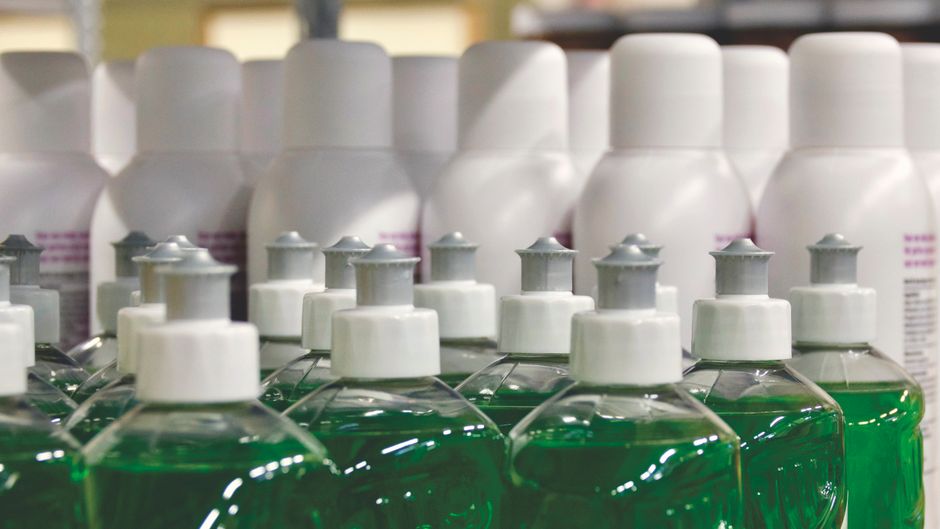
Aekyung Industrial makes and sells two things. One is household goods: toothpaste, laundry detergent, fabric softener, dishwashing liquid. The other is cosmetics, both color and skincare. The company trades on the KOSPI under code 018250. KOSPI is the senior board of the Korea Exchange, the one that carries Samsung Electronics and Hyundai Motor; the junior board, KOSDAQ, carries smaller and earlier-stage names, and a KOSPI listing means this company clears the larger board’s size and governance bar. The vendor screen I use files it under a sector label that reads “cosmetics” in Korean.
At the September 23, 2026 close of 11,060 won and 26,410,488 shares outstanding, the multiplication gives 292,099,997,280 won, about USD 215.0 million. Foreign investors held 1.58 percent. The fiscal year runs January to December, the same calendar the company’s Japanese and American peers use.
Here is the part that matters for everything below. A Korean listed company files four periodic reports a year, and in all four the income statement is cumulative. The first-quarter report carries January to March. The half-year report carries January to June. The third-quarter report carries January to September. The annual business report carries January to December. There is exactly one stretch that appears on its own, and that is the first quarter. Everything else has to be produced by taking one cumulative total away from another, and the October-to-December stretch has to be produced from the annual report minus the nine-month total.
An American reader is used to something else. A 10-Q carries the quarter and the year to date side by side, and the fourth quarter arrives in the 8-K earnings release before the 10-K. In Korea the discrete quarter is a derived object almost all of the time. Which means the sentences investors actually say out loud, “this was a record quarter,” “it swung back to a profit,” rest on values that no single document contains.
| Stretch | What a filing carries | Single quarter revenue | Operating profit | Grade |
|---|---|---|---|---|
| Jan-Mar 2026 | 158,790 (three months) | 158,790 as filed | -1,588 | 1 |
| Apr-Jun 2026 | 352,955 (six months) | 352,955 less 158,790 = 194,165 | 4,527 | 2 |
| Jan-Sep 2025 | 491,642 (nine months) | not applicable | 24,496 | filed |
| Oct-Dec 2025 | 654,527 (twelve months) | 654,527 less 491,642 = 162,885 | -3,351 | 2 |
| Oct-Dec 2023 | 668,866 (twelve months) | 668,866 less 493,109 = 175,757 | 11,597 | 3 |
| Oct-Dec 2022 | 610,410 (twelve months) | 610,410 less 443,341 = 167,069 | 11,785 | 3 |
Why did I chase only two of the eleven?
Eleven of my thirteen subtractions went unconfirmed, and skipping them was a choice about where to spend the hours. The values this piece leans on are the top two revenue entries and the bottom three margin entries, five in all. Of those five, only two needed outside confirmation: the second-largest revenue entry, October to December 2023, and one of the low margin entries, October to December 2024. I went after those two four ways. I dropped the date filter from three months out to twelve, widened past the business dailies to trade press and wire services, cut the query down to the company name alone, and went looking for the original annual results release. Neither stretch turned up stated on its own. So in this piece those two do one job, which is to be two of the eighteen entries I count, and no conclusion sits on them. The remaining nine are not in any table here.
Aekyung Industrial Stock and the Two Subtractions That Matched
Take the 2026 April-to-June figure first. My subtraction gives 194,165 million won. On August 12, 2026 the company released second-quarter revenue of 194.2 billion won and several outlets carried that number. Rounded to the tenth of a billion, they agree. The operating profit released the same day, 4.5 billion won, matches my 4,527 million won at the same rounding.
Now the 2025 October-to-December figure. My subtraction gives revenue of 162,885 million won and an operating loss of 3,351 million won. A January 26, 2026 report on the company’s full-year results carried a fourth-quarter revenue of 162.9 billion won and an operating loss of 3.4 billion won. My values are 162,885 and 3,351, so both agree at the billion-won rounding. A value I made by subtraction was confirmed from outside.
Why does the confirmation matter. Without it I could not write the sentence “an operating loss occurred between October and December 2025.” Over the last six quarters this company posted two operating losses, and that stretch is one of them. The other, the 1,588 million won loss for January to March 2026, sits in the first-quarter report as filed and needed no checking. So the phrase “two consecutive loss-making quarters” is half a filed figure and half a figure I built and then verified. Anyone who says that phrase without doing the second half is saying something they have not checked.
What do I make of two years that landed on the same number with opposite signs?
The same method gives an operating profit of 3,342 million won for October to December 2024. A year later the same stretch is a 3,351 million won loss. The absolute values differ by 9 million won and the sign flips. I am not treating that as evidence of anything. Both figures are mine, built the same way, and a gap that small reads to me as chance. I note it for a different reason. Two values that happen to be symmetric will generate a story about being “exactly reversed” whether or not anything reversed. I decided not to write that story, and I am telling you that I decided.
Aekyung Industrial Stock’s Biggest Revenue Quarter Ranks Fifteenth on Margin
Now the counting. My eighteen quarters run from January-March 2022 to April-June 2026. The largest revenue entry is April-June 2026 at 194,165 million won, and the second is October-December 2023 at 175,757 million won. Both of the top two are subtractions of mine, one grade 2 and one grade 3. The smallest is January-March 2022 at 139,868 million won, so across eighteen quarters the largest revenue is 1.3882 times the smallest. Revenue moved inside that band for four and a half years.
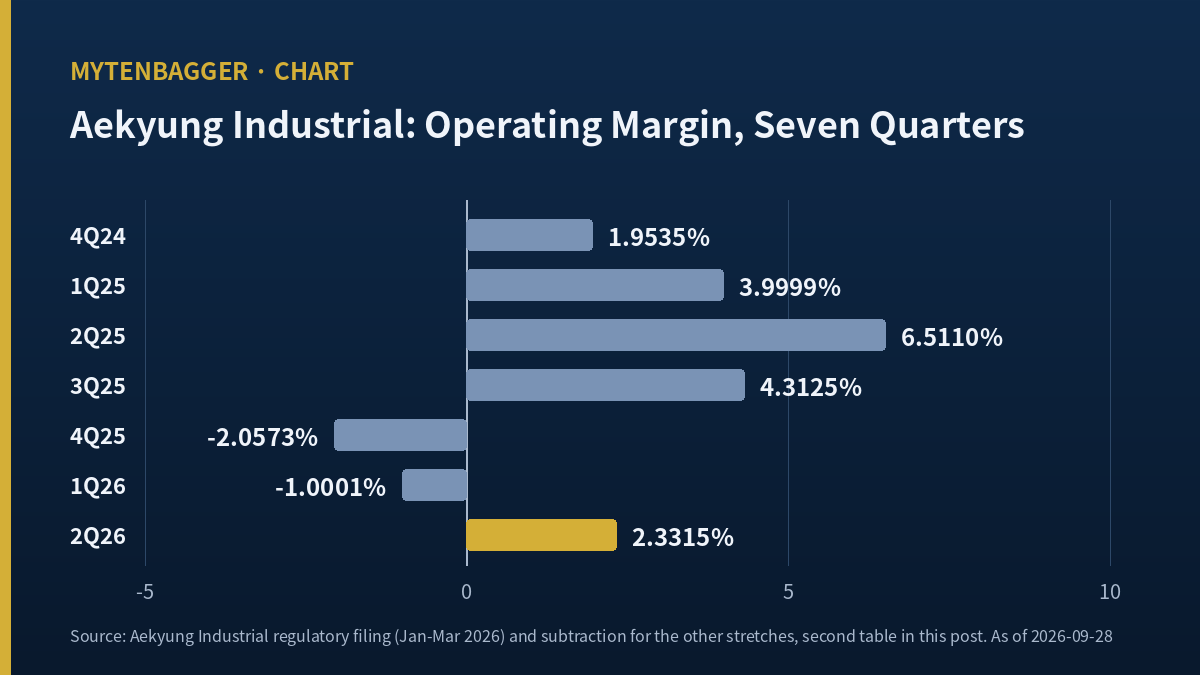
Operating margin did not. April-June 2026 came in at 2.3315 percent. Sorted from the top, that entry sits fifteenth of eighteen. Only three sit below it: October-December 2024 at 1.9535 percent, January-March 2026 at minus 1.0001 percent, and October-December 2025 at minus 2.0573 percent. The highest entry is July-September 2023 at 10.5547 percent.
Put those two stretches next to each other. April-June 2026 revenue is 1.1165 times July-September 2023 revenue. Operating profit in the same two stretches is 4,527 million won against 18,355 million won, a factor of 0.2466. Revenue grew 11.65 percent and operating profit fell 75.34 percent. The top line did not go anywhere; the margin went to under a quarter of where it had been. For a Korean company whose return came mostly from its balance sheet arrangement, I worked through Cosmax and the debt behind its 23.9 percent return separately, and for one that held its revenue while the margin left, I looked at Handsome Corp, where markdowns took the margin.
| Stretch | Revenue | Operating profit | Operating margin | Grade |
|---|---|---|---|---|
| Oct-Dec 2024 | 171,076 | 3,342 | 1.9535% | 3 |
| Jan-Mar 2025 | 151,077 | 6,043 | 3.9999% | 1 |
| Apr-Jun 2025 | 171,311 | 11,154 | 6.5110% | 2 |
| Jul-Sep 2025 | 169,254 | 7,299 | 4.3125% | 2 |
| Oct-Dec 2025 | 162,885 | -3,351 | -2.0573% | 2 |
| Jan-Mar 2026 | 158,790 | -1,588 | -1.0001% | 1 |
| Apr-Jun 2026 | 194,165 | 4,527 | 2.3315% | 2 |
Why did I not write “all time”?
The Korean coverage called the second quarter of 2026 a record on a quarterly basis. I did not use that word. My series begins in January-March 2022, and this company listed in 2017, so quarters exist before my window opens. The company can see its whole history and the claim is probably right. But a claim wider than what I checked is not a claim I can make. “An all-time record” and “the largest of the eighteen I counted” may point at the same quarter; the difference is who verified it.
Where Aekyung Industrial Stock’s 4.5 Billion Won of Operating Profit Came From
Why is the margin where it is in the biggest revenue quarter. Two answers, and they do not conflict. The first is mix. The cosmetics division brought in 75.3 billion won, about USD 55.4 million, in April-June 2026, up 20.5 percent from the same stretch a year earlier, and that division’s operating profit was 4.1 billion won. Company-wide operating profit was 4,527 million won. That leaves 427 million won, about USD 314,000, for household goods and everything else. Revenue on that side was 118,865 million won, 61.2186 percent of the company. So 61 percent of the revenue produced 9.4323 percent of the operating profit, and the 38.7814 percent that is cosmetics produced the other 90.5677 percent.
The second answer is selling and administrative expense. It came to 81.4 billion won in April-June 2026 against 66.7 billion a year earlier, up 22 percent, with advertising up 33 percent inside that. Measured against revenue, the expense line went from 38.9350 percent to 41.9231 percent, up 2.9881 percentage points. Operating margin over the same two stretches went from 6.5110 percent to 2.3315 percent, down 4.1794 percentage points. The rise in the expense ratio accounts for 71.5 percent of the fall in margin. The remaining 1.1914 percentage points come from what cost of sales takes out of revenue, and this company does not publish that line on a quarterly basis.
The direction management has stated is more cosmetics. It wants the cosmetics share of revenue at half by 2028; on a full-year 2025 basis that share was 32.8481 percent. The overseas share of revenue reached 42 percent in April-June 2026, seven percentage points wider than a year before. For a Korean company selling several divisions in one wrapper, I took Kolmar Korea’s five segments apart one at a time, and for one whose overseas pricing power was the whole question I looked at Amorepacific against a beauty peer group with a 23-point return spread.
How did I settle two sources that stated the same segment margin differently?
One outlet put the cosmetics division’s operating profit at 4.1 billion won. Another put the cosmetics division’s operating margin at 2 percent and household goods at 0.3 percent. I tested which set closes against the company total. Dividing 4.1 billion by 75.3 billion gives 5.4449 percent; subtracting 4.1 billion from the company’s 4,527 million won leaves 427 million won, which is 0.3592 percent of that side’s revenue. That combination agrees with the 0.3 percent figure. Run it the other way and cosmetics at 2 percent implies 1,506 million won, leaving 3,021 million won on the other side, which is 2.5415 percent and contradicts the same article’s own 0.3 percent. So I used 4.1 billion and 427 million, and I did not use the 2 percent figure. This is the second time in one piece that a printed page failed to close against itself, and the third is at the bottom of this article.
| Division | Revenue (bn won) | Share of revenue | Operating profit (bn won) | Operating margin |
|---|---|---|---|---|
| Cosmetics | 75.3 | 38.7814% | 4.10 | 5.4449% |
| Household goods and other | 118.865 | 61.2186% | 0.427 | 0.3592% |
| Company | 194.165 | 100% | 4.527 | 2.3315% |
| Reference, full year 2025 divisions summed | 643.5 | 98.32% of the 654.5 consolidated | 21.1 | 3.2789% |
The last row is worth a paragraph. Full-year 2025 divisional revenue was 215.0 billion won of cosmetics and 428.5 billion of household goods, summing to 643.5 billion, while consolidated revenue was 654.5 billion. Eleven billion won sits outside the divisional sum. Yet divisional operating profit was 7.5 billion and 13.6 billion, summing to 21.1 billion, and consolidated operating profit was 21,145 million won, the same at that rounding. Revenue does not close between the divisions and the company; operating profit does. The likely reason is that intercompany elimination lands on one line and not the other, but the company does not explain the gap and I will not invent an explanation for it.
A Peer Whose December Quarter Is Printed
I picked the global comparison for one property and nothing else. Church & Dwight Company, listed in New York as CHD, sells household goods and personal care out of one corporate wrapper, and its fiscal year runs January to December exactly as Aekyung Industrial’s does. On the quarterly statements a data provider publishes for it, the stretch ending December 31, 2025 appears as its own column, with revenue of USD 1,644 million and operating income of USD 305.1 million printed in that column. The page carried a last-updated date of July 31, 2026.
That is the entire comparison. I am not putting the two companies’ revenues, margins or multiples side by side, because the sizes are not comparable and a ratio between them would carry no information. What is comparable is the presence of a column. Church & Dwight’s December quarter is printed. Aekyung Industrial’s December quarter appears in no periodic filing of the company, and I built it myself. Same calendar, same kind of business, two different disclosure conventions, and the difference lands on the reader as work.
What follows for anyone reading Korean quarterly numbers?
Two things. First, when a Korean company or the Korean press gives you a single quarter, someone did a subtraction, and it is worth knowing whether that someone was the company or the writer. Second, the fourth quarter is the stretch where this is most likely to bite, because it is the only one with no interim report of its own at all. In this company’s case the two subtractions I checked both held, which counts in the convention’s favor. The risk is not that the arithmetic fails. The risk is that nobody says out loud that arithmetic happened.

A Control Change, a Price Cut and a Recall at Aekyung Industrial Stock
The biggest event at this company in 2026 was not an earnings print. The controlling shareholder changed. AK Holdings agreed on February 19, 2026 to sell its 63 percent stake to a group made up of Taekwang Industrial, T2 Private Equity and Yuanta Investment, and the transaction closed on March 26, 2026. Taekwang Industrial became the largest shareholder with 63.13 percent. The company name stays as it is.
The price moved once before closing. It began at about 470.0 billion won and ended at 447.5 billion won, about USD 329.4 million. The cut was 22.5 billion won, 4.7872 percent. The reason for the cut is the other thing that defines this company’s year. Triclosan, a preservative and antibacterial agent not permitted in the product category, was found in 2080 toothpaste, a voluntary recall followed, and the damage to that brand plus the legal exposure behind it went into the purchase price.
The recall itself: roughly 29.75 million units were in scope and about 2.6 million units came back. Divide those and you get 8.7395 percent; the coverage stated a recovery rate of 8 percent. The recall closed on January 5, 2026. The company said it had no separate compensation plan for product already used. Regulations allowed the recovery window to be extended, the company filed no request to extend it, and the regulator accepted the closure. The affected product had been on shelves for roughly two and a half years, from April 2023.
Divide 447.5 billion won by the 16,672,941 shares that 63.13 percent represents and you get 26,839.9 won a share, about USD 19.76. That division assumes the whole consideration attaches to that stake alone, the deal structure changed midway, and I could not read the per-share figure the company filed. With that caveat attached, the September 23, 2026 close of 11,060 won is 41.2073 percent of my number.
What would have to happen for me to be wrong, and which document would settle it?
Five objections, each paired with the filing that closes it.
- Cosmetics already carries all the profit, so the household drag is a timing problem. The document is the divisional note in the November 16, 2026 third-quarter report. Whether cosmetics clears 4.1 billion won and the other side clears 427 million won is settled in one place.
- Raising advertising to grow revenue is investment, so the margin fall was planned. The document is the selling and administrative expense schedule in the same report. Advertising down with revenue held makes the objection right; both rising together makes it wrong.
- Taekwang bought 63.13 percent near 26,839 won a share, so the current price is cheap. The document is the per-share consideration as stated in the change-of-control filing. My division is not enough, and I could not read that original.
- The toothpaste recall closed in January 2026, so it is behind the company. The documents are any litigation or penalty disclosure after the closure and the provisions line in the audited statements. An 8 percent recovery with no compensation plan is not by itself an ending.
- The overseas share at 42 percent is the real story and the domestic margin is noise. The document is the geographic breakdown in the third-quarter report. If the overseas share widens again while company operating margin stays under 2.3315 percent, the objection is describing growth that has not reached profit.
Where I Stand on Aekyung Industrial Stock, and Three Checks for November 16, 2026
No position, watching. On the seven-indicator checklist I use, this company clears four; the three it misses are operating margin at 3.22 percent, return on equity at 3.8 percent, and the earnings multiple. A market value of about USD 215.0 million puts it well outside the hundred largest listings in Korea, and this piece takes no trading stance on names in that range.
Three checks. The first one asks about method, not about an outcome. One, the single-quarter operating profit for July to September 2026. The third-quarter report will carry nine months, so I will be subtracting again; first-half cumulative operating profit is 2,939 million won, so whatever the nine-month figure exceeds that by is the quarter. Two, whether selling and administrative expense falls below 41.9231 percent of revenue. Three, whether cosmetics divisional operating profit clears 4.1 billion won while the other side clears 427 million won.
Which figures did I gather and leave out?
Book value per share came out three ways. One screen states 15,111 won, which is the December 31, 2025 equity of 399,068 million won divided by the current share count, so it is nine months old. Another states 15,841 won, and the equity that produces it is 418,369 million won, which does not match any equity figure I hold, so I left it alone. Using June 30, 2026 equity of 412,914 million won, about USD 304.0 million, my own figure is 15,634.47 won, or USD 11.51, and the price to book on the close is 0.7074. The other two give 0.7319 and 0.6982.
The earnings multiple of 19.21 I could trace all the way up. Owners’ net income for 2025 of 15,205 million won divided by the current share count gives 575.72 won, and the close divided by that gives 19.2108, which agrees with the screen. The dividend for 2025 was 200 won a share, down 65.5 percent from 580 the year before; total dividend was 5,282 million won and the payout against that same net income is 34.7392 percent. The payout a year earlier was similar. Cutting the dividend looks less like a change of policy and more like the result of a smaller profit, and in 2025 total equity actually fell by 1,543 million won, partly because the 15,318 million won paid out on the prior year’s declaration exceeded what the company earned.
The close itself came out two ways, and this is the third page in this piece that fails to close against itself. One screen stated the September 23, 2026 close as 11,070 won, down 10 won on the day. The confirmed price series has 11,060 that day against 11,120 on the previous session, so down 60. The screen settles its own question: the market value it prints, 292.1 billion won, requires 11,060 times the share count, while 11,070 would give 292,364 million won. The market value line on that page did not use the price line on the same page. So I took 11,060. A different screen carried a 27,000 won valuation and a buy rating with no house name and no analyst name attached, and on the same screen an earnings multiple of 21.75 and earnings per share of 604 do not close against the price that screen displays, so I used neither. Named 2026-vintage sell-side estimates did not turn up across four search approaches. There is a coverage gap on the forward view for this name, and I am leaving it open on the page.
One more set of figures, gathered and unused. The 250-session high is 19,100 won and the low is 10,120, so the close sits at 57.91 percent of the high and 9.29 percent above the low. Operating cash flow and inventory both moved in ways worth a separate piece and neither belongs to this axis. All dollar figures here use 1,358.4 won to the dollar, the Seoul foreign exchange market daytime close on September 23, 2026, which was 0.2 won higher than the previous session.
Which sentence here breaks first, and what falls with it?
The sturdiest sentence in this piece is that first-half 2026 cumulative operating profit was 2,939 million won. It is filed as such, and for it to be wrong the filing would have to be wrong. Next come the April-June 2026 revenue of 194,165 million won and the October-December 2025 operating loss of 3,351 million won: both are mine, and both were matched against a company release and a press report. The weakest sentence is that the October-December stretches of 2022 and 2023 were 167,069 and 175,757 million won. Nothing outside my own arithmetic supports those two.
If the weakest two fall, the second-largest revenue entry changes and the sentence “both of the top two are subtractions of mine” wobbles. The largest revenue entry and the fifteenth-of-eighteen margin do not move, because they come out of April-June 2026, October-December 2025 and January-March 2026, and those three are either grade 1 or confirmed grade 2. That is why I keep the watching stance while knowing exactly where the soft ground is. On November 16 I will take one cumulative figure away from another again, and the first thing I will do with the result is check it against what the company says, because that check is the only reason the last two of these numbers are worth anything.
Sources
- Financial time series derived from DART periodic filings: half-year report filed 2026-08-14, first-quarter report 2026-05-15, 2025 annual business report 2026-03-18, 2025 third-quarter report 2025-11-13, 2023 annual report 2024-03-13, 2022 annual report 2023-03-15
- Price and indicator screen: luxrix vendor screen (Kiwoom data, price refreshed 2026-09-25) and the confirmed daily series, on the September 23, 2026 close
- Money Today, August 12, 2026, Aekyung Industrial second-quarter revenue of 194.2 billion won
- Bloter, August 13, 2026, a third straight year of falling operating profit at Aekyung Industrial
- Cosmorning, August 12, 2026, cosmetics division revenue of 75.3 billion won in the second quarter
- Dailian, January 26, 2026, full-year operating profit of 21.1 billion won and a fourth-quarter operating loss
- Money Today, February 20, 2026, agreement to sell control to the Taekwang group consortium
- Dealsite, 2026, the 22.5 billion won reduction in the purchase price
- MTN, February 27, 2026, Taekwang to complete the acquisition and keep the Aekyung name
- Alphabiz, March 4, 2026, the toothpaste recovery closed at 8 percent
- Hankyung Markets consensus screen for 018250
- Chickstock screen for 018250
- Church and Dwight quarterly financial statements
- Money Today, September 23, 2026, the won closed 0.2 higher at 1,358.4 to the dollar