Korea’s L&F Convertible Bond Plan Meets a 373% Debt Ratio
The L&F convertible bond that the company confirmed it is studying on September 8, 2026 would be issued by a cathode maker whose liabilities are 3.7 times its equity. That is the number I started with. L&F (KOSPI: 066970) closed at KRW 112,000 on September 30 (about $82.79), giving it a market value near KRW 4.56tn, roughly $3.37bn. I am not buying before the board sets the bond’s terms, because the share total and the rating both move with those terms.
- [ ] Terms of the L&F convertible bond are public: size, exercise price, any reset clause.
- [ ] Remaining 2025 warrants are small enough that total new shares stay under a tenth of today’s share total.
- [ ] Debt-to-equity is below 300% in the report for the period ending September 30, or the rating outlook moves off Negative.
None of the three is ticked today. That is my whole position in one box.
Here is how this entry started. I was reading a Korean battery trade story about the September investor day, and the paragraph I remembered afterward was not about lithium iron phosphate plants. It was a short line from the chief financial officer, Ryu Seung-heon, saying that a company growing sales this fast has to fund more operating cash, and that the new LFP subsidiary, L&F Plus, would need support from the parent at first (Digital Daily, September 8, my paraphrase of a Korean report). My first thought was about the plant. My second thought, a few minutes later, was about who pays for it.
I read a convertible bond review the way a US reader might read a shelf registration: a signal that paper is coming, with the terms still open. The KOSPI is Korea’s main board, and L&F moved into it from the growth-oriented KOSDAQ in January 2024. The stock matters to US investors mainly through its customers: it supplies high-nickel cathode material to Korean cell makers that sell into North American electric vehicles and energy storage.
Contents
What the L&F convertible bond review actually says
The facts are few and I will keep them few. On September 8, 2026, L&F confirmed it was reviewing a convertible bond, and possibly a perpetual convertible, to fund high-nickel and 46-series cylindrical cathode sales, the LFP business, raw material purchases and new North American orders (Digital Daily, September 8). The next day the company said a KRW 300bn issue was under consideration and that nothing was decided (JobPost, September 9). KRW 300bn is about $222m at the September 30 rate.
Three details are missing: the exercise price, whether the price can be reset downward if the shares fall, and the maturity. Each one changes how many shares could appear. I will not guess them. What I can do is put the known pieces on the table and see how much room is left for new paper before the dilution becomes the story.
For readers used to US disclosure: in Korea a listed company that is asked about a press report must answer through the exchange’s disclosure system, and a reply saying a plan is “under review” does not commit it to anything. The binding step is a board resolution, which is filed promptly with the size, coupon, exercise price, reset terms and exercise window. Until that filing appears on DART, Korea’s equivalent of EDGAR, any number in the press is the company’s intention and not a contract. I am treating the KRW 300bn figure that way.
The L&F convertible bond and the share total
The share total on September 30 was 40,686,184, according to AlphaSquare’s quote page. That is my starting point. Two pieces of equity-linked paper matter: the 2025 bonds with warrants, and the new L&F convertible bond now under study.
The 2025 warrants have mostly been used
In June 2025, L&F decided to sell KRW 300bn of bonds with warrants to the public. The initial exercise price was set at KRW 50,002, with room to reset it down to KRW 35,002 if the stock fell; warrants became exercisable from September 14, 2025 to July 14, 2030 (Seoul Economic Daily, June 16, 2025). At KRW 50,002, the full issue buys about 6.0 million shares, by my calculation.
Holders moved quickly once the stock ran. Hankyung reported on October 21, 2025 that about 2.8 million new shares had been issued from the warrants by the previous day, and that full exercise would lift the share total by about 21.7% (Hankyung via Daum, October 21, 2025). By the end of 2025, the fourth-period call notes put the exercise rate near 65%, and noted that the related derivative liability fell by KRW 159.8bn during the period as warrants turned into shares (Finance Scope, February 20, 2026).
If 65% of about 6.0 million shares were issued, roughly 3.9 million came out and about 2.1 million could still come, or about 5.2% of today’s total (my estimates, assuming the exercise price stayed at KRW 50,002). I could not find a 2026 figure for the unexercised remainder, so this is the weakest number in the post. With the shares at more than twice the exercise price, I assume most of the remaining warrants will be used.
One detail in the 2025 terms is worth carrying forward. The reset floor of KRW 35,002 was exactly 70% of the initial KRW 50,002. In other words, the issue was built so that a falling share price would hand bondholders more shares, down to a fixed limit. That clause did not matter in the end because the stock rose. It will matter for the next bond if the shares fall between launch and exercise, and the stock has already swung more widely over the past year than I would like. A reset clause on a stock that moves that much is a live option, and existing holders are the ones who write it.
A new bond on top
Now add the new paper. If KRW 300bn were convertible at the September 30 close of KRW 112,000, it would become about 2.68 million shares, or 6.6% of today’s total. That is an illustration and nothing more. The 2025 warrants carried a downward reset clause, and I expect the same question to come up with any new paper. If the price resets lower, the share figure goes up.
Put the two together and a holder today could face roughly 11.8% more shares if both the remaining warrants and the new bond are exercised at my assumed prices. My second check in the box above asks for less than a tenth. On today’s information the answer is no.
To see how far a reset could push the share figure, I reused the only reset rule I have on record for this company. If a new bond carried the same 70% floor as the 2025 warrants and the price were reset all the way down from KRW 112,000, KRW 300bn would buy about 3.83 million shares, or 9.4% of today’s total (my calculation). Add the roughly 2.1 million shares still possible from the warrants and the worst case under these assumptions is close to 5.9 million new shares, about 14.6% of the current total. I do not think the worst case is the likely one. I do think it is the case the market has not written down anywhere I could find.
I have seen this pattern in the same sector before. EcoPro BM showed how much of a cathode maker’s reported profit can belong to someone other than the listed parent; here the question is similar in spirit, about how many owners the same profit will be split among.
The balance sheet the L&F convertible bond would join
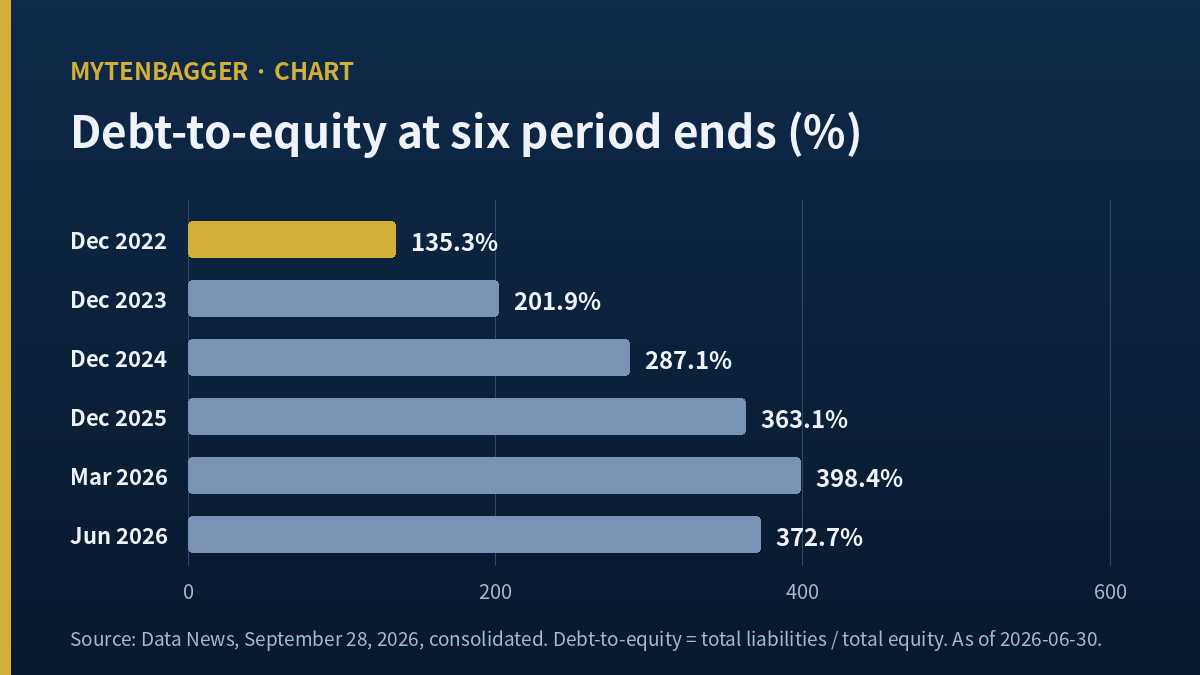
A convertible bond sits as debt until it converts into equity. So the question is what debt load it joins. Data News pulled the June 30 figures on September 28, and the debt-to-equity ratio tells most of it (Data News, September 28).
| Period end | Debt-to-equity |
|---|---|
| December 2022 | 135.3% |
| December 2023 | 201.9% |
| December 2024 | 287.1% |
| December 2025 | 363.1% |
| March 2026 | 398.4% |
| June 2026 | 372.7% |
Source: Data News, September 28, 2026, consolidated figures. Debt-to-equity = total liabilities ÷ total equity.
At June 30, total liabilities were KRW 2.91tn (about $2.15bn) against equity of KRW 779.4bn (about $576m). The current ratio was 74.7%, meaning short-term obligations exceed short-term assets. Borrowings were 47.7% of total assets; applied to total assets of KRW 3.68tn, that is roughly KRW 1.76tn of borrowings, or about $1.30bn (my calculation from the reported ratio). NICE Investors Service rates the company BB+ with a Negative outlook, which in Korean terms sits just below investment grade.
The warrants helped. The ratio fell from 691.8% at September 2025 to 363.1% at December 2025, according to the company’s consolidated data as compiled by the luxrix data service, and the derivative liability cut I cited above was part of that. New shares did the repair work that profits had not yet done. That is fine once. Doing it a second time with a convertible bond is what I want to see priced before I commit.
The longer record shows why. I took total equity at each year end and the net result for each year from the company’s consolidated DART reports (queried through luxrix).
| Year end | Total equity (KRW bn) | Net result for the year (KRW bn) | Interest line (KRW bn) |
|---|---|---|---|
| 2022 | 1,285.3 | 271.0 | 26.0 |
| 2023 | 1,110.0 | -194.9 | 105.8 |
| 2024 | 723.3 | -380.7 | 244.4 |
| 2025 | 676.8 | -534.7 | 430.5 |
Source: DART consolidated annual reports via luxrix. The interest line is the vendor’s field, which may include all finance costs. Figures rounded to KRW 0.1bn.
Across 2023 to 2025 the company lost about KRW 1.11tn in net terms (my sum). Equity fell by far less than that, from KRW 1,285.3bn to KRW 676.8bn, because new shares from the warrants filled part of the hole in late 2025. Meanwhile the interest line grew about 16.5 times from 2022 to 2025. That last figure is the one I would put in front of anyone who calls the new bond simple growth funding. Borrowing costs already took more than the operating profit of the first six months of 2026, and the bond adds a coupon on top, however small.
The other Korean name I keep beside this one is Cosmo AM&T, where I wrote about a KRW 1.6tn supply contract that its main cathode customer placed with a competitor. The figure matches the LFP contract L&F signed with Samsung SDI in March, as Korean press reported it. The contract is the reason the new money is needed, and it is also the best argument for why the money will come back.
At the market level, the September 30 price is about 5.9 times equity per share, using equity attributable to the parent of KRW 776.0bn at June 30 and the current share total (my calculation). Buyers at KRW 112,000 are paying for the LFP ramp years ahead of its profit. That is a reasonable bet for some people. It also means the price is sensitive to anything that makes the ramp need more money than planned, and a convertible with a reset clause is one of those risks.
Cash tells the same story from another angle. For January to June 2026, a data vendor’s interest line was KRW 187.0bn against operating profit of KRW 138.1bn, a cover of about 0.74 times; the vendor notes this line may include all finance costs and not only interest, so I treat it as an upper estimate of the burden. Operating cash for the six months was KRW 22.2bn and capital spending was KRW 108.9bn (luxrix, consolidated, year to date). The gap had to be funded from outside. The new plant in Daegu, the LFP subsidiary and a larger raw material stock all need money before they return any.
The size of that need is not small against the cash the business produced. Data News put the investment in the new Daegu LFP cathode plant at KRW 338.0bn, aimed at 30,000 tonnes a year from the end of the third period and 60,000 tonnes by the first six months of 2027. That single plant is about 15 times the operating cash of January to June 2026. Even if operating cash improves as the high-nickel line runs fuller, the plant, the subsidiary and the North American orders the CFO mentioned all draw on the same pool in the same year. A bond is the obvious way to bridge that. My objection is not to bridging; it is to bridging without knowing the price of the bridge.
One European peer and one ratio
I wanted one outside reference for leverage at a cathode maker, and I picked Umicore (Euronext Brussels: UMI) because its battery materials unit makes the same class of product and it reported the same six months with an explicit leverage figure. I compare that one ratio and nothing else. On July 31, 2026, Umicore reported adjusted EBITDA of €577m for the first six months and net financial debt of €1.5bn, a net debt to trailing adjusted EBITDA of 1.52 times, and raised its full-year adjusted EBITDA outlook to slightly above €1bn (Umicore via GlobeNewswire, July 31).
I cannot build the same ratio for L&F, because Korean filings do not give depreciation in the tables I use, and without it there is no EBITDA to divide by. That gap is itself useful. Umicore can state its leverage as a multiple of earnings; L&F’s leverage today is easier to express as a multiple of equity, and equity has been rebuilt twice by share issuance. Two companies making similar material are funding growth in visibly different ways. I do not claim one is cheaper.
Three paths for the L&F convertible bond
I put rough probabilities on these. They are guesses of mine and should be treated that way.
Issued near the market price with a modest reset floor (my estimate: 45%). The board approves something close to KRW 300bn, priced near the prevailing close, with a floor that limits how far the exercise price can drop. Dilution stays near my 6.6% illustration. The rating outlook probably stays Negative until the LFP plant shows income. I would keep watching and look for the report for the period ending September 30 to show the debt-to-equity ratio moving back toward 300%.
Issued with a deep reset and a perpetual feature (my estimate: 30%). Under IFRS, a perpetual instrument with no obligation to repay may be classified as equity, which would improve the reported ratio on day one while adding a claim that ranks ahead of common holders. If the reset allows the price to fall far, the share figure could grow well beyond 2.68 million. This is the path that would make me step further back.
No issue, funding from operating cash and bank lines (my estimate: 25%). If the LFP ramp and high-nickel sales lift operating cash fast enough, the company might shelve the bond. That would tick my second check at once. I do not think it is the most likely path because the CFO’s own wording pointed to parent support for the subsidiary.
The case against my L&F convertible bond worry
- The market has already voted. Shares jumped the day after the review was confirmed, which says investors read the bond as fuel for LFP growth and did not treat it as a dilution warning.
- The Samsung SDI contract is real and long-dated. If the LFP line runs on time from the end of September, the equity side of the ratio can grow from profit and not from paper.
- At least one Korean broker, DS Investment & Securities, published a positive note right after the investor day, going by the headline of a Korean report brief; IBK published a note without a rating. I have not read either report in full, so I cannot weigh them properly.
- The warrant dilution that worried me in October 2025 turned out to be the event that repaired the balance sheet. I may be repeating that mistake.
Three developments would break my cautious stance:
- The board sets terms with an exercise price at or above the prevailing close and no downward reset.
- The report for the period ending September 30, due by November 16 (Mon), shows debt-to-equity under 300% without new share issuance in the period.
- NICE moves the outlook from Negative to Stable.
The first of these could arrive any day; the second has a fixed date; the third follows the other two. I am watching them in that order, and if the first and second both go my way I will redo the share math from scratch.
Where I was wrong last time
A warrant issue is where I made my last mistake with this company. In October 2025, when the Hankyung story about new shares came out, I filed L&F under dilution and moved on. Over the next months the share total rose, and so did the stock, and the balance sheet got stronger because of those very shares. I was right about the direction of the share total and wrong about what it meant. I remember writing a note to myself that week that just said “too many shares,” which reads badly now. It was on the back of a receipt from a coffee shop near my office, which is probably why I never looked at it again until I cleared my desk drawer in the spring.
So this time I am being more specific. I am not against a convertible bond as such. I want to know the exercise price and the reset floor, because those two numbers decide whether the new paper repairs the balance sheet again or simply moves value from existing holders to bondholders. Until they are public, I will hold no position and check the board’s disclosure list each week.
Prices and multiples reflect the September 30, 2026 close (KRW 112,000; AlphaSquare and a regular-session daily quote agree). Dollar figures are approximate, at roughly ₩1,352.8 per dollar, the Seoul foreign exchange market close on the same date. Balance sheet figures are consolidated, as of June 30, 2026.